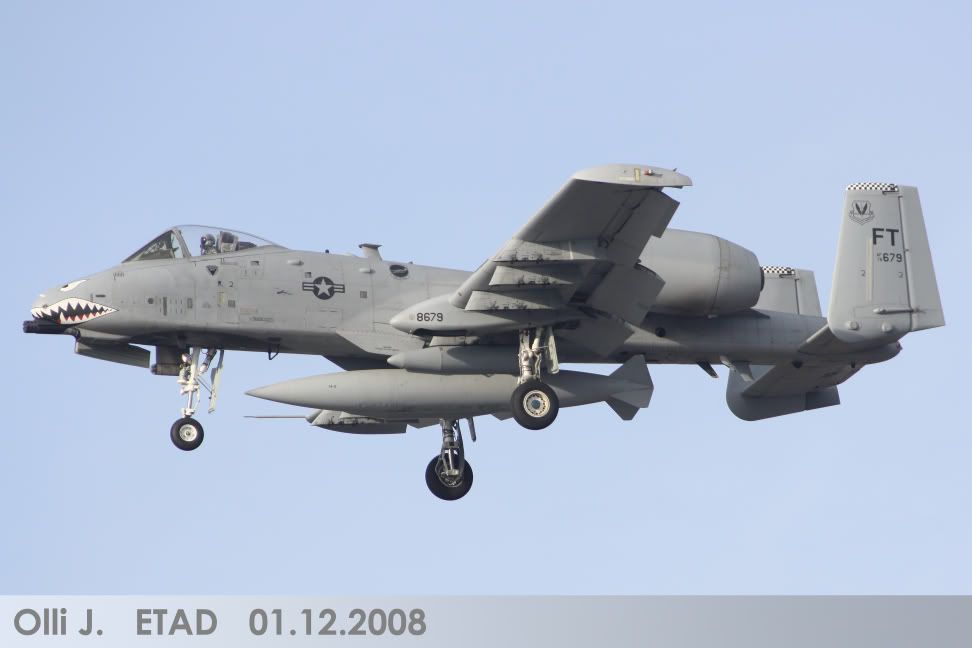
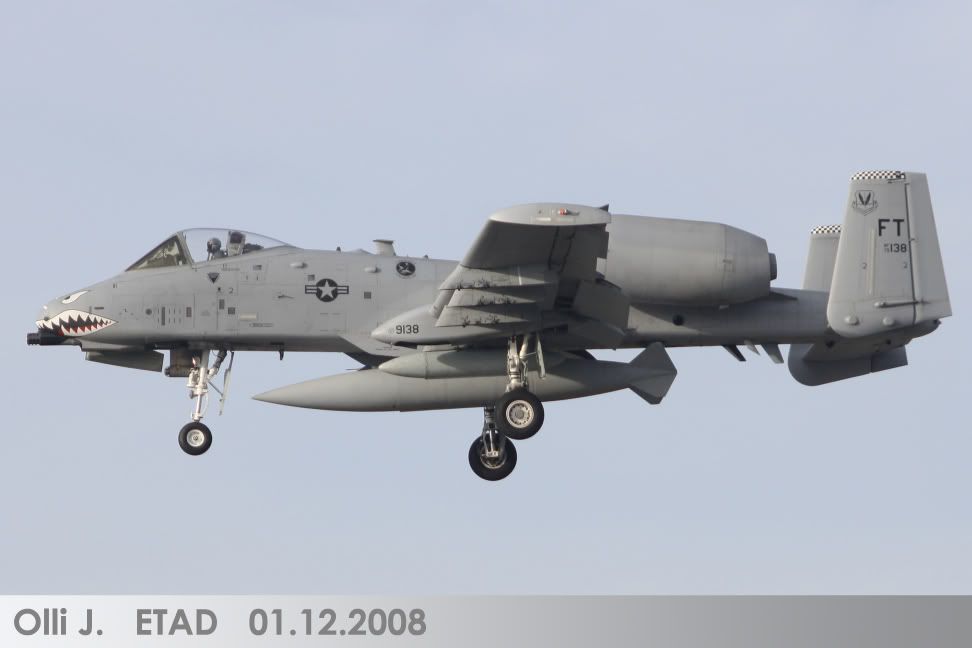
In his Daily Report for June 11, 2009, airforce-magazine.com wrote:
Home Stretch: About 60 of the Air Force's A-10s ground-attack platforms are still not flying due to concern over wings cracks, but are expected to be cleared for return to flight status by the end of the month, two Air Force generals told lawmakers Tuesday. In a joint written statement presented to the Senate Armed Services' airland subcommittee June 9 (see above), Lt. Gen. Mark Shackelford, military assistant in the service's acquisition shop, and Maj. Gen. Marke Gibson, director of operations on the Air Staff, said the inspect and repair program that the Air Force put in place last fall after the issue came to light has whittled the number of grounded A-10s from about 240 down to the 60 or so. "We anticipate these will all return to flying by the end of the June," they wrote. While the Air Force has an initiative in place to install new wings on 242 A-10s which have the comparatively thinner skinned wings that are more susceptible to cracking, the wing installations are not scheduled to begin until Fiscal 2011.
Note: The following excerpt is from the combined statements of Lieutenant General Mark D. Shackelford, Military Deputy, Office of the Assistant Secretary of the Air Force for Acquisition (SAF/AQ), and Major General Marke Gibson, Air Force Director of Operations for Air, Space And Information Operations, Plans And Requirements (AF/A3O), presented to the Senate Armed Services Commitee, Airland Subcommitte, United States Senate, on June 9, 2009:
SUBJECT: AIR FORCE TACAIR PROGRAMS
[...] IV. Status of Combat Aircraft Acquisition
The following information provides updates on Air Force combat aircraft modernization:
A-10
The A-10 provides the Joint Force Commander lethal, precise, persistent, and responsive firepower for CAS and combat search and rescue (CSAR). It has performed superbly in OPERATIONS DESERT STORM, ALLIED FORCE (OAF), OEF and OIF. However, the age of the A-10 and high operations tempo have taken a toll on the fleet. In the Fall of 2006, the Air Force Fleet Viability Board (FVB) recommended that the Air Force upgrade 242 thin-skin center wing A-10 aircraft with thick-skinned wing replacements; this program is currently designing the new wing and installs will begin in FY11. Last fall, approximately 240 A-10s were grounded due to wing cracks. An inspect and repair program was implemented that has reduced the number still grounded to approximately 60; we anticipate these will all return to flying by the end of June 2009. Additionally, A-10 landing gear failures have resulted in a program for replacing failure-prone parts. The Air Force is currently upgrading 347 A-10s to the "C" configuration through the Precision Engagement (PE) modification and anticipates completion by the end of FY11. This modification enables J-Series weapons, such as Joint Direct Attack Munitions (JDAM) and Wind Corrected Munitions Dispenser (WCMD); integrates a digital data link and advanced targeting pods with video downlink; replaces monochrome cockpit displays with color multi-function displays; installs new pilot throttle and stick controls; adds a moving map capability and a mass-memory upgrade; and doubles current DC power. Additionally, we have integrated beyond line of sight radios into the A-10 for faster communication with ground units, forward controllers, and C2 centers. [...]
Source
Showing posts with label A-10 Groundings. Show all posts
Showing posts with label A-10 Groundings. Show all posts
Friday, June 12, 2009


Saturday, March 28, 2009
442nd Fighter Wing maintainer earns AF-level award
by Senior Master Sgt. Mark Mock
442nd Maintenance Squadron
3/27/2009 - WHITEMAN AIR FORCE BASE, Mo. -- Air Force reservist, Master Sgt. Brian Bass, a structural maintenance supervisor in the 442nd Fighter Wing's 442nd Maintenance Squadron, was recognized by the Air Force as he was awarded the "Hog Star" award, Jan. 27, at the annual World Wide Review conference held at Hill Air Force Base, Utah.
The award was for a single individual of outstanding contribution to the overall improvement for the combined Air Force.
Sergeant Bass was requested by the A-10 Systems Program Office Engineering and the Chief of Air Combat Command to participate on three different validation/verifications for the center wing crack repair designs.
"I believe the reason I was selected is that the 442nd has continually been observed as the lead participant providing changes and improvement inputs to the SPO Engineering at Hill AFB," Sergeant Bass said. "Our involvement at A-10 product improvement working group conferences and for the new Boeing wing designs."
According to Sergeant Bass he was able to provide 30 years of field level experience and capability to the engineers that would normally not be visible to them.
"The 442nd never has been a unit to brag on themselves," Sergeant Bass said. "Our expertise and aircraft speak for themselves and always has.
Sergeant Bass, an Air Reserve Technician, was selected from nominees throughout the Guard, Reserve and active duty forces.

Master Sgt. Brian Bass, 442nd Maintenance Squadron, earned the Air Force's "Hog Star" award for outstanding contribution to the overall improvement for the combined Air Force. (Courtesy photo) Full size
Source
442nd Maintenance Squadron
3/27/2009 - WHITEMAN AIR FORCE BASE, Mo. -- Air Force reservist, Master Sgt. Brian Bass, a structural maintenance supervisor in the 442nd Fighter Wing's 442nd Maintenance Squadron, was recognized by the Air Force as he was awarded the "Hog Star" award, Jan. 27, at the annual World Wide Review conference held at Hill Air Force Base, Utah.
The award was for a single individual of outstanding contribution to the overall improvement for the combined Air Force.
Sergeant Bass was requested by the A-10 Systems Program Office Engineering and the Chief of Air Combat Command to participate on three different validation/verifications for the center wing crack repair designs.
"I believe the reason I was selected is that the 442nd has continually been observed as the lead participant providing changes and improvement inputs to the SPO Engineering at Hill AFB," Sergeant Bass said. "Our involvement at A-10 product improvement working group conferences and for the new Boeing wing designs."
According to Sergeant Bass he was able to provide 30 years of field level experience and capability to the engineers that would normally not be visible to them.
"The 442nd never has been a unit to brag on themselves," Sergeant Bass said. "Our expertise and aircraft speak for themselves and always has.
Sergeant Bass, an Air Reserve Technician, was selected from nominees throughout the Guard, Reserve and active duty forces.

Master Sgt. Brian Bass, 442nd Maintenance Squadron, earned the Air Force's "Hog Star" award for outstanding contribution to the overall improvement for the combined Air Force. (Courtesy photo) Full size
Source
Friday, March 20, 2009
75th EFS got more than four replacements, probably eight
By Joachim Jacob
As Warthog News reported, in September 2008 twelve Moody A-10Cs deployed with the 75th Expeditionary Fighter Squadron to Bagram AB, Afghanistan, for Operation Enduring Freedom (OEF) as part of USAF's AEF 5/6 (Cycle 7) rotation (September - December 2008).
Originally, the 75th EFS deployed with twelve A-10Cs. All of these aircraft are verified by private shots taken during their stopover at Lajes Field, Azores, and partially also by USAF photos.
78-0674, 74th FS (marked 74 FS)
78-0679, 75th FS
78-0697, 74th FS
79-0138, 75th FS
79-0172, 74th FS
79-0179, 74th FS
79-0186, 75th FS
79-0192, 74th FS
80-0140, 74th FS
80-0149, 75th FS
80-0178, 74th FS
80-0226, 74th FS
After the A-10 groundings due to wing cracks, Moody AFB officially deployed four additional aircraft as replacements to allow relocate jets of the original aircraft package to Spangdahlem AB, Germany, for inspections and repairs.
In a commentary, published on Moody’s public website on November 21th, 2008, Col. Kenneth Todorov, 23rd Wing Commander, said:
"I want to extend my personal thanks to each of you for your participation in Exercise Flying Tiger 08-11. During the Phase I portion we deployed over 300 personnel, 300+ tons of cargo, four real-world A-10C Thunderbolt II aircrafts for Operation Enduring Freedom, and one real-world HH-60G Pave Hawk helicopter to support the Space Shuttle launch. […]"
Source
According to the Scramble Message Board, these four aircraft (probably all from the 74th Fighter Squadron) arrived for stopover at Lajes Field, Azores, on October 22nd, 2008, one day later as expected. They should have landed at Naval Air Station Sigonella, Sicily, as Trend 41 on October 29th, 2008.
Part of this flight were at least:
79-0135, 74th FS [USAF photo 7 November 2008]
80-0272, 74th FS [USAF photo 7 November 2008]
On November 22nd, 2008, on the Scramble Message Board was posted that four more A-10s routed Lajes, Sigonella and Middle East (that means Al Udeid AB, Qatar) as more replacements for the 75th EFS.
After that, three more replacements were identified:
80-0144, 74th FS [USAF photo 2 December 2008]
80-0228, 74th FS [USAF photo 24 February 2009] (aircraft identified only by numbers on ejection seat and left canopy rail)
80-0252, 75th FS [USAF photo 24 February 2009]
Meanwhile, a sixth and a seventh replacement are identified by private shots, posted on airliners.net:
82-0657, 74th FS [Chris Hagstrom photo 12 December 2008]
81-0944, without unit markings (ex 190th FS, 124th Wg, Idaho ANG) [Chris Hagstrom photo 14 December 2008] Scramble Aircraft Database notes: Ogden ALC sep07 nm, rep AMARG nov08
On March 11th, 2009, on the Scramble Message Board was posted that 4 A-10s are at Sigonella and will depart early next day to Lajes and then to CONUS on March 13th.
The re-deployment of four A-10s suggest that Bagram AB was simply overloaded with 20 A-10Cs, 18 F-15E Strike Eagles, probably four to six EA-6B Prowlers and some other aircraft.
I still want to verify the eighth replacement A-10C by serial number. Anybody who can/will help me?

A-10C 79-0179, callsign Hawg 63, from the 74th Fighter Squadron moves into precontact to a tanker over Afghanistan on December 21th, 2008. This aircraft deployed with the original 75th Expeditionary Fighter Squadron aircraft package. (Photo by Chris Hagstrom) Hi-res

Replacement A-10C 82-0657, callsign Hawg 61, from the 74th Fighter Squadron departs from a tanker after taking gas over Afghanistan on December 12th, 2008. (Photo by Chris Hagstrom) Hi-res

Replacement A-10C 81-0944 departs from a tanker after taking gas over eastern Afghanistan on December 14th, 2008. The aircraft, formerly assigned to the 190th Fighter Squadron, 124th Wing, Idaho ANG, still wears no new unit markings and also no shark mouth nose painting. (Photo by Chris Hagstrom) Hi-res
Special thanks to Chris Hagstrom for permission to post his pictures on my blog!
As Warthog News reported, in September 2008 twelve Moody A-10Cs deployed with the 75th Expeditionary Fighter Squadron to Bagram AB, Afghanistan, for Operation Enduring Freedom (OEF) as part of USAF's AEF 5/6 (Cycle 7) rotation (September - December 2008).
Originally, the 75th EFS deployed with twelve A-10Cs. All of these aircraft are verified by private shots taken during their stopover at Lajes Field, Azores, and partially also by USAF photos.
78-0674, 74th FS (marked 74 FS)
78-0679, 75th FS
78-0697, 74th FS
79-0138, 75th FS
79-0172, 74th FS
79-0179, 74th FS
79-0186, 75th FS
79-0192, 74th FS
80-0140, 74th FS
80-0149, 75th FS
80-0178, 74th FS
80-0226, 74th FS
After the A-10 groundings due to wing cracks, Moody AFB officially deployed four additional aircraft as replacements to allow relocate jets of the original aircraft package to Spangdahlem AB, Germany, for inspections and repairs.
In a commentary, published on Moody’s public website on November 21th, 2008, Col. Kenneth Todorov, 23rd Wing Commander, said:
"I want to extend my personal thanks to each of you for your participation in Exercise Flying Tiger 08-11. During the Phase I portion we deployed over 300 personnel, 300+ tons of cargo, four real-world A-10C Thunderbolt II aircrafts for Operation Enduring Freedom, and one real-world HH-60G Pave Hawk helicopter to support the Space Shuttle launch. […]"
Source
According to the Scramble Message Board, these four aircraft (probably all from the 74th Fighter Squadron) arrived for stopover at Lajes Field, Azores, on October 22nd, 2008, one day later as expected. They should have landed at Naval Air Station Sigonella, Sicily, as Trend 41 on October 29th, 2008.
Part of this flight were at least:
79-0135, 74th FS [USAF photo 7 November 2008]
80-0272, 74th FS [USAF photo 7 November 2008]
On November 22nd, 2008, on the Scramble Message Board was posted that four more A-10s routed Lajes, Sigonella and Middle East (that means Al Udeid AB, Qatar) as more replacements for the 75th EFS.
After that, three more replacements were identified:
80-0144, 74th FS [USAF photo 2 December 2008]
80-0228, 74th FS [USAF photo 24 February 2009] (aircraft identified only by numbers on ejection seat and left canopy rail)
80-0252, 75th FS [USAF photo 24 February 2009]
Meanwhile, a sixth and a seventh replacement are identified by private shots, posted on airliners.net:
82-0657, 74th FS [Chris Hagstrom photo 12 December 2008]
81-0944, without unit markings (ex 190th FS, 124th Wg, Idaho ANG) [Chris Hagstrom photo 14 December 2008] Scramble Aircraft Database notes: Ogden ALC sep07 nm, rep AMARG nov08
On March 11th, 2009, on the Scramble Message Board was posted that 4 A-10s are at Sigonella and will depart early next day to Lajes and then to CONUS on March 13th.
The re-deployment of four A-10s suggest that Bagram AB was simply overloaded with 20 A-10Cs, 18 F-15E Strike Eagles, probably four to six EA-6B Prowlers and some other aircraft.
I still want to verify the eighth replacement A-10C by serial number. Anybody who can/will help me?
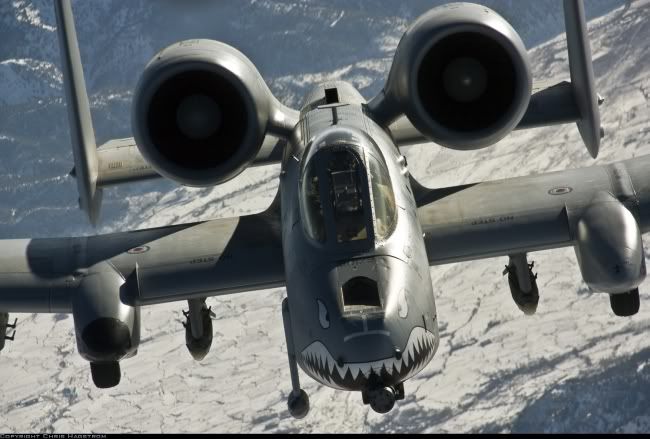
A-10C 79-0179, callsign Hawg 63, from the 74th Fighter Squadron moves into precontact to a tanker over Afghanistan on December 21th, 2008. This aircraft deployed with the original 75th Expeditionary Fighter Squadron aircraft package. (Photo by Chris Hagstrom) Hi-res
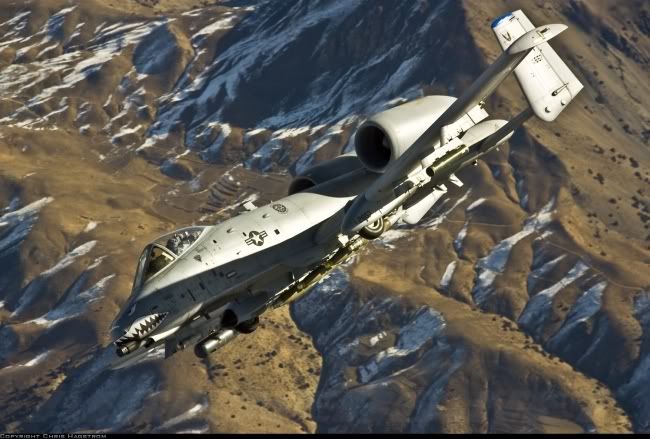
Replacement A-10C 82-0657, callsign Hawg 61, from the 74th Fighter Squadron departs from a tanker after taking gas over Afghanistan on December 12th, 2008. (Photo by Chris Hagstrom) Hi-res
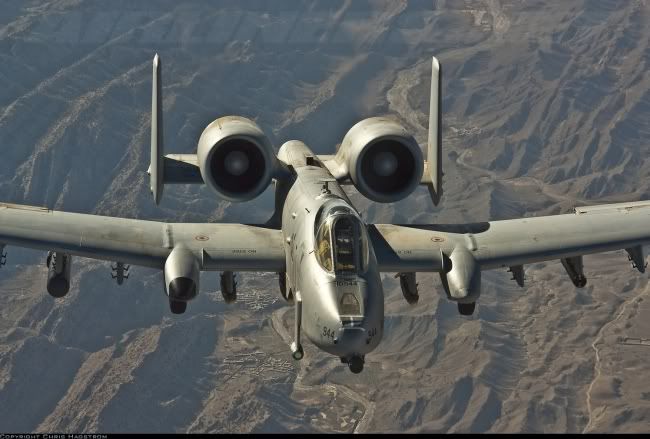
Replacement A-10C 81-0944 departs from a tanker after taking gas over eastern Afghanistan on December 14th, 2008. The aircraft, formerly assigned to the 190th Fighter Squadron, 124th Wing, Idaho ANG, still wears no new unit markings and also no shark mouth nose painting. (Photo by Chris Hagstrom) Hi-res
Special thanks to Chris Hagstrom for permission to post his pictures on my blog!
Reworking The A-10 Wing
By Jerome Greer Chandler
Overhaul & Maintenance
March 19th, 2009

If you have any questions as to the worth of the A-10 Thunderbolt II (a.k.a. Warthog), just ask the soldiers in Wanat, an impossibly mountainous region of Afghanistan. They were fighting for their lives this past July. U.S. Air Force A-10s and other craft flew into a river valley near the place and laid down withering fire, helping hold back the opposition until U.S. troops could evacuate their wounded.
Absent the rugged, "low 'n slow" Hog, what was a very bad day for these men could have turned out far, far worse.
The Hog has been integral to close-air-support missions in Iraq and Afghanistan, but the venerable aircraft (first operationally deployed in March 1976) has begun to show its age.
The problem areas were located on the underside of the wings, in the landing gear area just outboard of where the gear attaches to the wing. "[They're] in the skin," said Lt. Col. Jim Marx, deputy commander of the 538th Aircraft Sustainment Group at Hill Air Force Base, Utah. "It's in what we would describe as the 'aft lower skin' of the wing," said Marx, specifically near the center panels of the landing gear trunnions.
Taking no chances with the welfare of its warfighters, the Air Force originally grounded a full 145 of the 356 A-10s in its active inventory. When this interview was conducted in late January--four to five months into repairs--the number of aircraft whose duty-time was limited had plummeted. "We're down to 55 [aircraft] that are on flight hour limitation," said Lt. Col. Dave Ruth, the A-10's weapon system team chief at Air Combat Command headquarters in Langley, Va.
The A-10s still are flying, and the nature of their missions hasn't changed. They can still get in low 'n slow, still sling armor-piercing shells via their potent 30-mm GAU-8/A Avenger Gatling gun. The Air Force says it didn't want to impose g-loading restrictions on the Hog, didn't want its pilots to second-guess the capabilities of the airplane when things get hot.
What the Air Force did want to do was get as many of the airplanes repaired as quickly as possible and back in the fight. That's imperative, because the 356 aircraft currently in the inventory represent just about half of the 715 Warthogs that have been built. Consider further that as of this writing some 240 of those 356 are actually flying (the rest are in various stages of repair), and the urgency of the challenge is apparent. Despite the advent of newer, sleeker aircraft, none of them possess the close-air-support capabilities of the ineffably ugly A-10.
The Longevity Equation
The cumulative current rigors of Operations Iraqi Freedom and Enduring Freedom today, and Desert Storm two decades ago, have put lots of wear on Warthog airframes. "The high-time airframe is right around 12,000 hrs.," said Master Sgt. Steve Grimes, headquarters Air Combat Command maintenance liaison with the Systems Program Office. "The low-time life is just under 3,000 hrs." On average, Warthogs have racked up around 8,800 flight hrs,, about half the current life expectancy of 16,000 hrs.
Pushing these airplanes through the repair process is imperative. Marx declined to say how much the work will cost, but he does offer an idea of when it will be finished. "We started repairs in the August 2008 timeframe," he said. "We expect that by the summer of 2009 we'll have everything completed."
The Fix
Marx said the repair process--start to finish--takes "several hundred [man]hours to complete." That's because of where the cracks are located. "As you can imagine," he said, "to get to the wing skin in [that] area we have to take a considerable number of panels away, and we have to remove the landing gear and some other structure to get to the wing skin we need to look at."
Getting there is half the fun, but you've got to be small to really enjoy it. In this instance, "it" is the "Hell Hole," a claustrophobically compressed area that offers access to the cracks in question. "It's not a very nice place to be," said Capt. Kristen Shadden, operations officer for the 571st Aircraft Maintenance Squadron at Hill AFB.
But it is the best way to get at the problem.
Through the classic process of continuous improvement, the U.S. Air Force doesn't sequester its successes, doesn't silo maintenance techniques that work best. At Hill, Shadden said maintainers actually were removing the outer wings to get at the work area. Down at the Aircraft Maintenance and Regeneration Group (AMARG) at Davis-Monthan AFB, Ariz., they were going at it via the Hell Hole. It's "just above the landing gear," said Shadden. "You can open up a couple of panels in the wing and just fit in a small human being."
Davis-Monthan is one of four prime sites where the Air Force is executing the fixes. The others are Hill, a location in Europe, and Korean Airlines in the Republic of South Korea.
After talking with their counterparts at Davis-Monthan, Hill maintainers decided to switch approaches. The Hell Hole was in, and wing removal out. In making the change, "We went from 29 workdays to 14," said Shadden.
Access achieved, it's time to make the repair. Preceding all of this, of course, is non-destructive testing, non-destructive inspection. Marx said, "That's going to tell you whether you have a crack, and how significant the cracks are." At that point, the roster of options ranges from reaming the skin to implanting repair plates.
"We NDI with a surface probe," said Hill sheet metal mechanic Dan Wright. "If there's a crack indicated, we continue to grind [it] out until it's totally gone." In this case, the flaw is just skin-deep. "We're not getting into the spar or any other stiffeners or structure," said Wright.
If the crack is a large one, a 6-in. by 14-in. doubler does the deed. "It's meant to relieve stress where the cracking is happening," said Marx, "and better distribute the load as the aircraft continues its mission."
This portion of the process takes 50-60 man-hours, said Wright. That encompasses performing the cutout, drilling the plate, and working with the machine shop to shim up the trunnion, the area at which the main landing gear mount attaches to the belly of the aircraft. "We're running into some trunnion issues," said the sheet metal mechanic. "With the doubler, you're changing the height of the trunnion where you're going to re-attach [the landing gear]. We have to re-shim to get proper height for the landing gear to be aligned properly."
Clearly, this is no cut and paste job. As Marx said, the whole process consumes hundreds of man-hours.
To get it to consume less, the Air Force is milking continuous improvement for all it's worth. Going in through the Hell Hole rather than removing outer wings was the biggest process improvement.
But there are others. Shadden said one of the most effective things was to issue pagers to both supervisory and critical members of the Hill A-10 wing crack team. That did away with a lot of the endemic "hurry-up and wait" nature of running an MRO operation.
"We give them a 30-minute page [as] to when they're going to be needed on the aircraft," said Shadden. The page identifies the tail number "so that they can be [here] as soon as the previous skill is finished working on that aircraft."
Another relatively mundane, but eminently sensible measure was to requisition a dedicated government vehicle to move maintainers between tasks. "We had a lot of mechanics who were basically just beating the pavement, and walking back and forth between different areas to get parts," said Shadden.
"Looking for opportunities to take waste out of the process" can be exactingly site-specific, she indicates. At Hill, "we have people who are in different buildings. There can be movement issues. Other places, like Tinker [Air Force Base] has some co-located efforts. They may not have that problem."
One problem the Air Force sought to short-circuit from the get-go was moving aircraft back and forth between operational areas and rear-echelon depots for maintenance. The idea is to perfuse as much of the fix as possible out into the field, to train--and equip--front-line maintainers to do the job as far forward as feasible. None of these moves is rocket science. But they are anchored in the rock-solid realization that the A-10 is at this precise point-in-time perhaps the indispensable warfighting aircraft out there.
Operational readiness matters for all military flying machines. But if you take a poll among infantrymen on the ground, those who pray for the A-10's ugly silhouette to save the day, you'd be hard-pressed to find a machine that matters more than the Hog.
Photo credit: Billy Arrowood/U.S. Air Force
This article appeared in Overhaul & Maintenance's March 2009 issue.
Source
Overhaul & Maintenance
March 19th, 2009

If you have any questions as to the worth of the A-10 Thunderbolt II (a.k.a. Warthog), just ask the soldiers in Wanat, an impossibly mountainous region of Afghanistan. They were fighting for their lives this past July. U.S. Air Force A-10s and other craft flew into a river valley near the place and laid down withering fire, helping hold back the opposition until U.S. troops could evacuate their wounded.
Absent the rugged, "low 'n slow" Hog, what was a very bad day for these men could have turned out far, far worse.
The Hog has been integral to close-air-support missions in Iraq and Afghanistan, but the venerable aircraft (first operationally deployed in March 1976) has begun to show its age.
The problem areas were located on the underside of the wings, in the landing gear area just outboard of where the gear attaches to the wing. "[They're] in the skin," said Lt. Col. Jim Marx, deputy commander of the 538th Aircraft Sustainment Group at Hill Air Force Base, Utah. "It's in what we would describe as the 'aft lower skin' of the wing," said Marx, specifically near the center panels of the landing gear trunnions.
Taking no chances with the welfare of its warfighters, the Air Force originally grounded a full 145 of the 356 A-10s in its active inventory. When this interview was conducted in late January--four to five months into repairs--the number of aircraft whose duty-time was limited had plummeted. "We're down to 55 [aircraft] that are on flight hour limitation," said Lt. Col. Dave Ruth, the A-10's weapon system team chief at Air Combat Command headquarters in Langley, Va.
The A-10s still are flying, and the nature of their missions hasn't changed. They can still get in low 'n slow, still sling armor-piercing shells via their potent 30-mm GAU-8/A Avenger Gatling gun. The Air Force says it didn't want to impose g-loading restrictions on the Hog, didn't want its pilots to second-guess the capabilities of the airplane when things get hot.
What the Air Force did want to do was get as many of the airplanes repaired as quickly as possible and back in the fight. That's imperative, because the 356 aircraft currently in the inventory represent just about half of the 715 Warthogs that have been built. Consider further that as of this writing some 240 of those 356 are actually flying (the rest are in various stages of repair), and the urgency of the challenge is apparent. Despite the advent of newer, sleeker aircraft, none of them possess the close-air-support capabilities of the ineffably ugly A-10.
The Longevity Equation
The cumulative current rigors of Operations Iraqi Freedom and Enduring Freedom today, and Desert Storm two decades ago, have put lots of wear on Warthog airframes. "The high-time airframe is right around 12,000 hrs.," said Master Sgt. Steve Grimes, headquarters Air Combat Command maintenance liaison with the Systems Program Office. "The low-time life is just under 3,000 hrs." On average, Warthogs have racked up around 8,800 flight hrs,, about half the current life expectancy of 16,000 hrs.
Pushing these airplanes through the repair process is imperative. Marx declined to say how much the work will cost, but he does offer an idea of when it will be finished. "We started repairs in the August 2008 timeframe," he said. "We expect that by the summer of 2009 we'll have everything completed."
The Fix
Marx said the repair process--start to finish--takes "several hundred [man]hours to complete." That's because of where the cracks are located. "As you can imagine," he said, "to get to the wing skin in [that] area we have to take a considerable number of panels away, and we have to remove the landing gear and some other structure to get to the wing skin we need to look at."
Getting there is half the fun, but you've got to be small to really enjoy it. In this instance, "it" is the "Hell Hole," a claustrophobically compressed area that offers access to the cracks in question. "It's not a very nice place to be," said Capt. Kristen Shadden, operations officer for the 571st Aircraft Maintenance Squadron at Hill AFB.
But it is the best way to get at the problem.
Through the classic process of continuous improvement, the U.S. Air Force doesn't sequester its successes, doesn't silo maintenance techniques that work best. At Hill, Shadden said maintainers actually were removing the outer wings to get at the work area. Down at the Aircraft Maintenance and Regeneration Group (AMARG) at Davis-Monthan AFB, Ariz., they were going at it via the Hell Hole. It's "just above the landing gear," said Shadden. "You can open up a couple of panels in the wing and just fit in a small human being."
Davis-Monthan is one of four prime sites where the Air Force is executing the fixes. The others are Hill, a location in Europe, and Korean Airlines in the Republic of South Korea.
After talking with their counterparts at Davis-Monthan, Hill maintainers decided to switch approaches. The Hell Hole was in, and wing removal out. In making the change, "We went from 29 workdays to 14," said Shadden.
Access achieved, it's time to make the repair. Preceding all of this, of course, is non-destructive testing, non-destructive inspection. Marx said, "That's going to tell you whether you have a crack, and how significant the cracks are." At that point, the roster of options ranges from reaming the skin to implanting repair plates.
"We NDI with a surface probe," said Hill sheet metal mechanic Dan Wright. "If there's a crack indicated, we continue to grind [it] out until it's totally gone." In this case, the flaw is just skin-deep. "We're not getting into the spar or any other stiffeners or structure," said Wright.
If the crack is a large one, a 6-in. by 14-in. doubler does the deed. "It's meant to relieve stress where the cracking is happening," said Marx, "and better distribute the load as the aircraft continues its mission."
This portion of the process takes 50-60 man-hours, said Wright. That encompasses performing the cutout, drilling the plate, and working with the machine shop to shim up the trunnion, the area at which the main landing gear mount attaches to the belly of the aircraft. "We're running into some trunnion issues," said the sheet metal mechanic. "With the doubler, you're changing the height of the trunnion where you're going to re-attach [the landing gear]. We have to re-shim to get proper height for the landing gear to be aligned properly."
Clearly, this is no cut and paste job. As Marx said, the whole process consumes hundreds of man-hours.
To get it to consume less, the Air Force is milking continuous improvement for all it's worth. Going in through the Hell Hole rather than removing outer wings was the biggest process improvement.
But there are others. Shadden said one of the most effective things was to issue pagers to both supervisory and critical members of the Hill A-10 wing crack team. That did away with a lot of the endemic "hurry-up and wait" nature of running an MRO operation.
"We give them a 30-minute page [as] to when they're going to be needed on the aircraft," said Shadden. The page identifies the tail number "so that they can be [here] as soon as the previous skill is finished working on that aircraft."
Another relatively mundane, but eminently sensible measure was to requisition a dedicated government vehicle to move maintainers between tasks. "We had a lot of mechanics who were basically just beating the pavement, and walking back and forth between different areas to get parts," said Shadden.
"Looking for opportunities to take waste out of the process" can be exactingly site-specific, she indicates. At Hill, "we have people who are in different buildings. There can be movement issues. Other places, like Tinker [Air Force Base] has some co-located efforts. They may not have that problem."
One problem the Air Force sought to short-circuit from the get-go was moving aircraft back and forth between operational areas and rear-echelon depots for maintenance. The idea is to perfuse as much of the fix as possible out into the field, to train--and equip--front-line maintainers to do the job as far forward as feasible. None of these moves is rocket science. But they are anchored in the rock-solid realization that the A-10 is at this precise point-in-time perhaps the indispensable warfighting aircraft out there.
Operational readiness matters for all military flying machines. But if you take a poll among infantrymen on the ground, those who pray for the A-10's ugly silhouette to save the day, you'd be hard-pressed to find a machine that matters more than the Hog.
Photo credit: Billy Arrowood/U.S. Air Force
This article appeared in Overhaul & Maintenance's March 2009 issue.
Source
Saturday, March 7, 2009
Inspections of A-10 Thunderbolts continue
Air Force Times
By Bruce Rolfsen - Staff writer
Posted : Friday Mar 6, 2009 16:11:57 EST
The Air Force continues to inspect and repair the wings of A-10 Thunderbolts.
As of the end of February, 322 of the service’s 356 Warthogs had been inspected for wing cracks, according to the service. Of the checked jets, 214 returned to flying while 108 await or are undergoing repairs.
Another 34 jets had not been inspected but were allowed to continue flying because they were considered the least likely to have cracks.
“We remain on schedule to complete the fleet-wide inspections and initial repairs by June,” Lt. Col. Jim Marx, deputy commander of the 538th Aircraft Sustainment Group, Hill Air Force Base, Utah, told Air Force Times. Marx added that all A-10s deployed to Afghanistan have been repaired.
The groundings and inspections began Oct. 3 after inspections at Ogden Air Logistics Center, where A-10s go through depot-level repairs, uncovered unexpected cracks. The cracks were in wheel trunnions, sections not frequently checked. While A-10s were designed to last for 8,000 flying hours, many have passed the 10,000 hour mark.
Starting in late 2010, the Air Force hopes to replace the aging A-10 wings with new wings.
Source
By Bruce Rolfsen - Staff writer
Posted : Friday Mar 6, 2009 16:11:57 EST
The Air Force continues to inspect and repair the wings of A-10 Thunderbolts.
As of the end of February, 322 of the service’s 356 Warthogs had been inspected for wing cracks, according to the service. Of the checked jets, 214 returned to flying while 108 await or are undergoing repairs.
Another 34 jets had not been inspected but were allowed to continue flying because they were considered the least likely to have cracks.
“We remain on schedule to complete the fleet-wide inspections and initial repairs by June,” Lt. Col. Jim Marx, deputy commander of the 538th Aircraft Sustainment Group, Hill Air Force Base, Utah, told Air Force Times. Marx added that all A-10s deployed to Afghanistan have been repaired.
The groundings and inspections began Oct. 3 after inspections at Ogden Air Logistics Center, where A-10s go through depot-level repairs, uncovered unexpected cracks. The cracks were in wheel trunnions, sections not frequently checked. While A-10s were designed to last for 8,000 flying hours, many have passed the 10,000 hour mark.
Starting in late 2010, the Air Force hopes to replace the aging A-10 wings with new wings.
Source
Saturday, February 28, 2009
442nd MXG earns Maintenance Effectiveness Award
by Maj. David Kurle
442nd Fighter Wing
2/27/2009 - WHITEMAN AIR FORCE BASE, Mo. -- The 442nd Maintenance Group can add another award to the hallway leading to the wing's 5-Bay Hangar - the Air Force Reserve Command Maintenance Effectiveness Award as the best medium-sized aircraft maintenance unit in the command for Fiscal Year 2008.
"It's kind of nice to be known as the best," said Lt. Col. Michael Wood, the group's commander since Dec. 6, 2008. "This unit has always been known as one of the best A-10 maintenance units in the entire Air Force."
Among the group's accomplishments in 2008 was a 45-day deployment of A-10s and maintenance specialists to Bagram Air Base, Afghanistan, to produce combat sorties in support of Operation Enduring Freedom.
"What I think put us over the top for the award, was the deployment (to Afghanistan)," Colonel Wood said. "I always say, 'quality maintenance equals combat effectiveness.'"
While deployed, Citizen Airmen in the 442nd MXG produced more than 600 A-10 combat sorties, which put more than 2,500 hours on the wing's aircraft. The amount of sorties represented a 17-percent increase over previous A-10 units at Bagram.
A deployment halfway around the world wasn't the only accomplishment of the 442nd MXG - at its home base the men and women in the unit provided combat capability every day to the tune of almost 3,500 sorties.
During training missions from Whiteman Air Force Base, the wing's pilots dropped more than 240 bombs and fired more than 94,000 rounds of 30-millimeter ammunition - all of which had to be stored, maintained, prepared for flight and loaded on aircraft by 442nd MXG maintainers.
In November 2007, the group finished installing smart-multi-function color displays in all 27 of the wing's A-10s, representing a major electronics and combat-capability upgrade for the wing's pilots. From February through May, 442nd maintainers completed another electronics upgrade to the wing's aircraft to enable pilots to talk "beyond-line-of-sight" using satellites for communication.
After its Bagram deployment, the 442nd MXG began work on three time-compliance technical orders to identify and repair wing cracks in certain A-10s.
And, in October, the group provided the majority of the maintenance effort for 14 A-10 teams competing in Hawgsmoke 2008 in Salina, Kan.
"We accomplished everything that was asked of us and still maintained the highest standards of quality in all of our maintenance shops," said Chief Master Sgt. Steve Brazeal, 442nd Maintenance Squadron superintendent. "We do as much as any maintenance group in the Air Force and our planes still look the best of any in the A-10 community as far as appearance."
"The Airmen in the 442nd MXG should be proud of the fact that they have been recognized as the best of the best out of all the maintenance organizations in Air Force Reserve Command," Colonel Wood said. "This is all due to their tremendous efforts."
Far from resting on the group's laurels, Colonel Wood is focused on 2009 and the challenges in store for the 442nd MXG.
"Our main focus this year is nothing but our upcoming operational readiness inspection," he said. "My focus other than the ORI is making sure everyone is getting back to the basics - maintenance-101.''
Source
442nd Fighter Wing
2/27/2009 - WHITEMAN AIR FORCE BASE, Mo. -- The 442nd Maintenance Group can add another award to the hallway leading to the wing's 5-Bay Hangar - the Air Force Reserve Command Maintenance Effectiveness Award as the best medium-sized aircraft maintenance unit in the command for Fiscal Year 2008.
"It's kind of nice to be known as the best," said Lt. Col. Michael Wood, the group's commander since Dec. 6, 2008. "This unit has always been known as one of the best A-10 maintenance units in the entire Air Force."
Among the group's accomplishments in 2008 was a 45-day deployment of A-10s and maintenance specialists to Bagram Air Base, Afghanistan, to produce combat sorties in support of Operation Enduring Freedom.
"What I think put us over the top for the award, was the deployment (to Afghanistan)," Colonel Wood said. "I always say, 'quality maintenance equals combat effectiveness.'"
While deployed, Citizen Airmen in the 442nd MXG produced more than 600 A-10 combat sorties, which put more than 2,500 hours on the wing's aircraft. The amount of sorties represented a 17-percent increase over previous A-10 units at Bagram.
A deployment halfway around the world wasn't the only accomplishment of the 442nd MXG - at its home base the men and women in the unit provided combat capability every day to the tune of almost 3,500 sorties.
During training missions from Whiteman Air Force Base, the wing's pilots dropped more than 240 bombs and fired more than 94,000 rounds of 30-millimeter ammunition - all of which had to be stored, maintained, prepared for flight and loaded on aircraft by 442nd MXG maintainers.
In November 2007, the group finished installing smart-multi-function color displays in all 27 of the wing's A-10s, representing a major electronics and combat-capability upgrade for the wing's pilots. From February through May, 442nd maintainers completed another electronics upgrade to the wing's aircraft to enable pilots to talk "beyond-line-of-sight" using satellites for communication.
After its Bagram deployment, the 442nd MXG began work on three time-compliance technical orders to identify and repair wing cracks in certain A-10s.
And, in October, the group provided the majority of the maintenance effort for 14 A-10 teams competing in Hawgsmoke 2008 in Salina, Kan.
"We accomplished everything that was asked of us and still maintained the highest standards of quality in all of our maintenance shops," said Chief Master Sgt. Steve Brazeal, 442nd Maintenance Squadron superintendent. "We do as much as any maintenance group in the Air Force and our planes still look the best of any in the A-10 community as far as appearance."
"The Airmen in the 442nd MXG should be proud of the fact that they have been recognized as the best of the best out of all the maintenance organizations in Air Force Reserve Command," Colonel Wood said. "This is all due to their tremendous efforts."
Far from resting on the group's laurels, Colonel Wood is focused on 2009 and the challenges in store for the 442nd MXG.
"Our main focus this year is nothing but our upcoming operational readiness inspection," he said. "My focus other than the ORI is making sure everyone is getting back to the basics - maintenance-101.''
Source
Monday, December 29, 2008
Two more 75th EFS A-10Cs arrives at Spang for wing inspections and repairs
By Joachim Jacob
Updated 30 December 2008
Today, two more A-10Cs, originally deployed with the 75th Expeditionary Fighter Squadron for Operation Enduring Freedom to the 455th Air Expeditionary Wing at Bagram AB, Afghanistan, arrived at Spangdahlem AB, Germany, for wing inspections and repairs due to partial A-10 groundings.
A-10C 79-0172 arrived at Runway 23 as Trend 91 14:30 local time, followed by 80-0178 as Trend 93 14:31 local time. First known public photo proofs are shared with me by German aviation photographer Dalibor Ankovic / Photaviaworks. Special thanks for your great support, Dalibor!
According to the Dutch Scramble Message Board and the German FlugzeugForum, originally a flight of three A-10Cs was announced as Trend 91-93 with 79-0172, 80-0178 and "80-0228" (in fact probably 80-0226 and also from the 74th FS). But the flight of the third jet was cancelled at NAS Sigonella, Cicily.
Including the two latest arrivals, relocated to Spangdahlem AB for wing inspections and repairs are the following ten A-10Cs:
78-0674 (74th Fighter Squadron, marked 74 FS), arrival 5 December 2008 (after diverting to Ramstein AB)
78-0679 (75th Fighter Squadron), arrival 1 December 2008 (after diverting to Ramstein AB)
78-0697 (74th Fighter Squadron), arrival 2 December 2008 (after diverting to Ramstein AB)
79-0138 (75th Fighter Squadron), arrival 1 December 2008 (after diverting to Ramstein AB)
79-0172 (74th Fighter Squadron), arrival 29 December 2008
79-0186 (75th Fighter Squadron), arrival 2 December 2008 (after diverting to Ramstein AB)
79-0192 (74th Fighter Squadron), arrival 2 December 2008 (after diverting to Ramstein AB)
80-0140 (74th Fighter Squadron), arrival 8 November 2008
80-0149 (75th Fighter Squadron), arrival 8 November 2008
80-0178 (74th Fighter Squadron), arrival 29 December 2008

A-10C 79-0172 from the 74th Fighter Squadron arrives. (Photo by Dalibor Ankovic / Photaviaworks)

A-10C 79-0172 from the 74th Fighter Squadron arrives. (Photo by Dalibor Ankovic / Photaviaworks)

A-10C 80-0178 from the 74th Fighter Squadron arrives. (Photo by Dalibor Ankovic / Photaviaworks)

A-10C 80-0178 from the 74th Fighter Squadron arrives. (Photo by Dalibor Ankovic / Photaviaworks)
For relocations to Spang see also:
Spangdahlem helps get deployed aircraft back into the air, and into the fight
Diverted 81st FS A-10s relocated from Ramstein to Spang
USAF released first photos of diverted 75th EFS A-10s at Ramstein
Two diverted 75th EFS A-10s left Ramstein for Spang
Intel: Enroute to Spang, Bagram A-10s diverted to Ramstein
Intel: Two more 75th EFS A-10s enroute to Spang?
Two combat-deployed 75th EFS A-10s relocate from Bagram to Spang
Updated 30 December 2008
Today, two more A-10Cs, originally deployed with the 75th Expeditionary Fighter Squadron for Operation Enduring Freedom to the 455th Air Expeditionary Wing at Bagram AB, Afghanistan, arrived at Spangdahlem AB, Germany, for wing inspections and repairs due to partial A-10 groundings.
A-10C 79-0172 arrived at Runway 23 as Trend 91 14:30 local time, followed by 80-0178 as Trend 93 14:31 local time. First known public photo proofs are shared with me by German aviation photographer Dalibor Ankovic / Photaviaworks. Special thanks for your great support, Dalibor!
According to the Dutch Scramble Message Board and the German FlugzeugForum, originally a flight of three A-10Cs was announced as Trend 91-93 with 79-0172, 80-0178 and "80-0228" (in fact probably 80-0226 and also from the 74th FS). But the flight of the third jet was cancelled at NAS Sigonella, Cicily.
Including the two latest arrivals, relocated to Spangdahlem AB for wing inspections and repairs are the following ten A-10Cs:
78-0674 (74th Fighter Squadron, marked 74 FS), arrival 5 December 2008 (after diverting to Ramstein AB)
78-0679 (75th Fighter Squadron), arrival 1 December 2008 (after diverting to Ramstein AB)
78-0697 (74th Fighter Squadron), arrival 2 December 2008 (after diverting to Ramstein AB)
79-0138 (75th Fighter Squadron), arrival 1 December 2008 (after diverting to Ramstein AB)
79-0172 (74th Fighter Squadron), arrival 29 December 2008
79-0186 (75th Fighter Squadron), arrival 2 December 2008 (after diverting to Ramstein AB)
79-0192 (74th Fighter Squadron), arrival 2 December 2008 (after diverting to Ramstein AB)
80-0140 (74th Fighter Squadron), arrival 8 November 2008
80-0149 (75th Fighter Squadron), arrival 8 November 2008
80-0178 (74th Fighter Squadron), arrival 29 December 2008
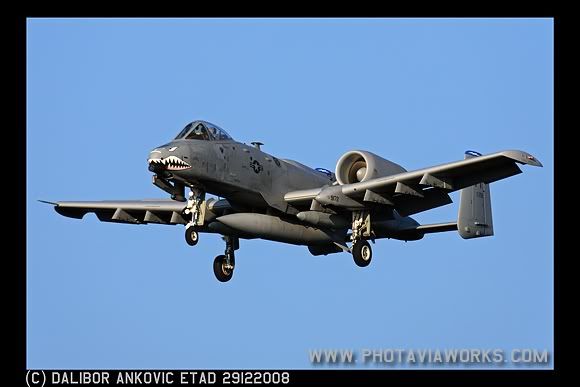
A-10C 79-0172 from the 74th Fighter Squadron arrives. (Photo by Dalibor Ankovic / Photaviaworks)
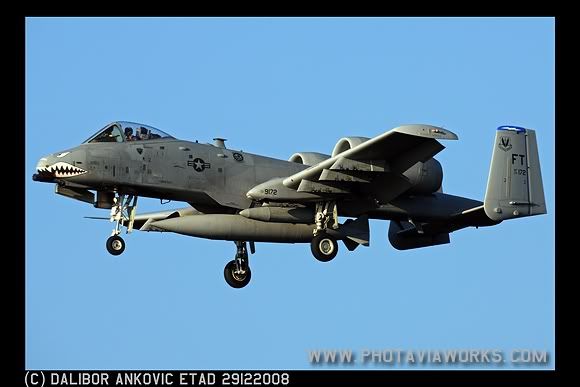
A-10C 79-0172 from the 74th Fighter Squadron arrives. (Photo by Dalibor Ankovic / Photaviaworks)
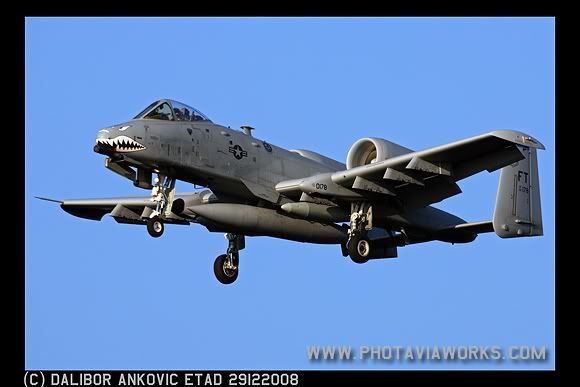
A-10C 80-0178 from the 74th Fighter Squadron arrives. (Photo by Dalibor Ankovic / Photaviaworks)
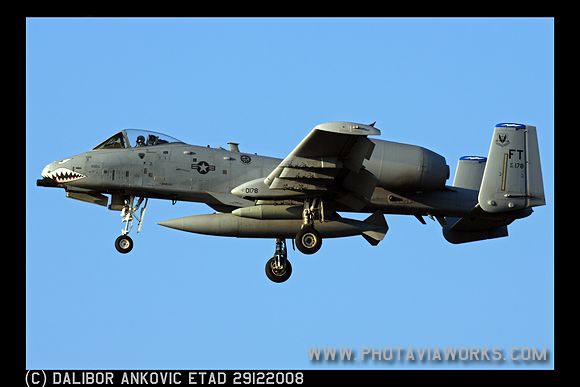
A-10C 80-0178 from the 74th Fighter Squadron arrives. (Photo by Dalibor Ankovic / Photaviaworks)
For relocations to Spang see also:
Spangdahlem helps get deployed aircraft back into the air, and into the fight
Diverted 81st FS A-10s relocated from Ramstein to Spang
USAF released first photos of diverted 75th EFS A-10s at Ramstein
Two diverted 75th EFS A-10s left Ramstein for Spang
Intel: Enroute to Spang, Bagram A-10s diverted to Ramstein
Intel: Two more 75th EFS A-10s enroute to Spang?
Two combat-deployed 75th EFS A-10s relocate from Bagram to Spang
Wednesday, December 24, 2008
Cracks still idle some A-10s
Problem has delayed training at D-M; about a third of affected jets unrepaired
By Carol Ann Alaimo
Arizona Daily Star
Tucson, Arizona | Published: 12.23.2008
The largest fleet of warplanes at Davis-Monthan Air Force Base remains partially grounded, nearly three months after wing cracks banned them from Tucson's skies.
In a process taking longer than expected, about a third of D-M's affected A-10 attack jets still aren't fit to fly, and some may not be airborne until the middle of next year.
Dozens of student pilots are behind schedule in their training as a result, and even seasoned aviators are feeling the pinch.
"We're still not flying at normal levels," said Staff Sgt. Jacob Richmond, a base spokesman.
"In some fashion or another, all of D-M's A-10 pilots have felt the effects over the last few months."
D-M is the main Air Force training base for A-10 pilots and has 82 of the warplanes, the world's largest fleet. Of those, 52 eventually were grounded with microscopic wing cracks first discovered in early October, and 35 have since been repaired.
The other 17 local jets still are out of commission, and officials can only "guesstimate" when they'll all be back in service.
"We hope to have all remaining aircraft repaired and returned to service by early to mid-2009," Richmond said.
The delay is due to the complexity of the fixes, he said. Engineers have been tailoring repair plans for each aircraft because there isn't a one-size-fits-all solution.
The problem has affected A-10s Air Force-wide, but because the jet is so central to D-M's daily operations, the impact of the groundings is keenly felt at the Tucson base.
About 20 student pilots who were supposed to graduate by year's end weren't able to because they couldn't get enough flight hours, Richmond said. Another class of 15 new student pilots was supposed to report to D-M in January but was told not to come until the situation is sorted out.
Student training has suffered because preference had to be given to veteran D-M fliers.
Depending on experience, each A-10 pilot must log between five and nine flights per month to maintain proficiency on the aircraft. That became a struggle when there weren't enough planes to go around.
The A-10, nicknamed the Warthog, has been a workhorse in Iraq and Afghanistan, renowned for its effectiveness in providing close air support to U.S. ground troops. When the wing-crack problem was discovered, the Air Force gave priority to fixing A-10s deployed to war zones.
Introduced in 1975, the jets have surpassed their normal lifespan and have been refurbished to keep them in service for another decade or more.
The Air Force last year ordered more than 200 sets of new A-10 wings from the Boeing Co. of St. Louis. Delivery is scheduled to start in 2011.
The new wings will be installed on A-10s with thin-skin wings. All the recently grounded A-10s have thin-skin wings installed during original manufacture, the service has said.
Source
Note: Up to the moment, this news story already got 40 azstarnet reader comments!
Associated pictures:

Senior Airman Bennie Gatlin removes a part on an A-10 in order to repair microscopic wing cracks. Many of the attack jets at Davis-Monthan Air Force Base have been repaired, but even so, other airplanes remain grounded, which has slowed pilot training. (Photo by Greg Bryan / Arizona Daily Star)

Senior Airman Bennie Gatlin, left, and Airman Adam Fisher work amid a collection of A-10 parts removed in the process of fixing wings with microscopic cracks. It could be mid-2009 before the Davis-Monthan fleet of A-10s is fully operational. (Photo by Greg Bryan / Arizona Daily Star)
By Carol Ann Alaimo
Arizona Daily Star
Tucson, Arizona | Published: 12.23.2008
The largest fleet of warplanes at Davis-Monthan Air Force Base remains partially grounded, nearly three months after wing cracks banned them from Tucson's skies.
In a process taking longer than expected, about a third of D-M's affected A-10 attack jets still aren't fit to fly, and some may not be airborne until the middle of next year.
Dozens of student pilots are behind schedule in their training as a result, and even seasoned aviators are feeling the pinch.
"We're still not flying at normal levels," said Staff Sgt. Jacob Richmond, a base spokesman.
"In some fashion or another, all of D-M's A-10 pilots have felt the effects over the last few months."
D-M is the main Air Force training base for A-10 pilots and has 82 of the warplanes, the world's largest fleet. Of those, 52 eventually were grounded with microscopic wing cracks first discovered in early October, and 35 have since been repaired.
The other 17 local jets still are out of commission, and officials can only "guesstimate" when they'll all be back in service.
"We hope to have all remaining aircraft repaired and returned to service by early to mid-2009," Richmond said.
The delay is due to the complexity of the fixes, he said. Engineers have been tailoring repair plans for each aircraft because there isn't a one-size-fits-all solution.
The problem has affected A-10s Air Force-wide, but because the jet is so central to D-M's daily operations, the impact of the groundings is keenly felt at the Tucson base.
About 20 student pilots who were supposed to graduate by year's end weren't able to because they couldn't get enough flight hours, Richmond said. Another class of 15 new student pilots was supposed to report to D-M in January but was told not to come until the situation is sorted out.
Student training has suffered because preference had to be given to veteran D-M fliers.
Depending on experience, each A-10 pilot must log between five and nine flights per month to maintain proficiency on the aircraft. That became a struggle when there weren't enough planes to go around.
The A-10, nicknamed the Warthog, has been a workhorse in Iraq and Afghanistan, renowned for its effectiveness in providing close air support to U.S. ground troops. When the wing-crack problem was discovered, the Air Force gave priority to fixing A-10s deployed to war zones.
Introduced in 1975, the jets have surpassed their normal lifespan and have been refurbished to keep them in service for another decade or more.
The Air Force last year ordered more than 200 sets of new A-10 wings from the Boeing Co. of St. Louis. Delivery is scheduled to start in 2011.
The new wings will be installed on A-10s with thin-skin wings. All the recently grounded A-10s have thin-skin wings installed during original manufacture, the service has said.
Source
Note: Up to the moment, this news story already got 40 azstarnet reader comments!
Associated pictures:
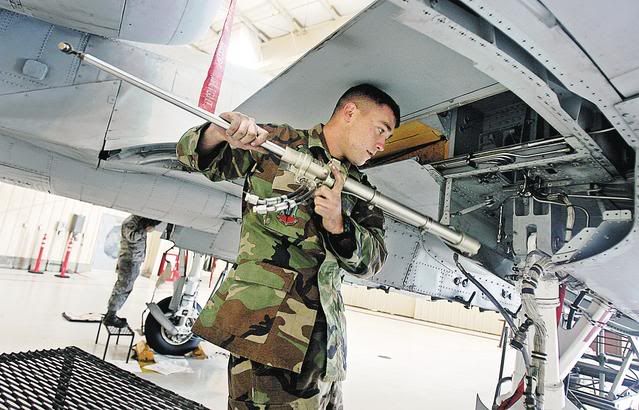
Senior Airman Bennie Gatlin removes a part on an A-10 in order to repair microscopic wing cracks. Many of the attack jets at Davis-Monthan Air Force Base have been repaired, but even so, other airplanes remain grounded, which has slowed pilot training. (Photo by Greg Bryan / Arizona Daily Star)
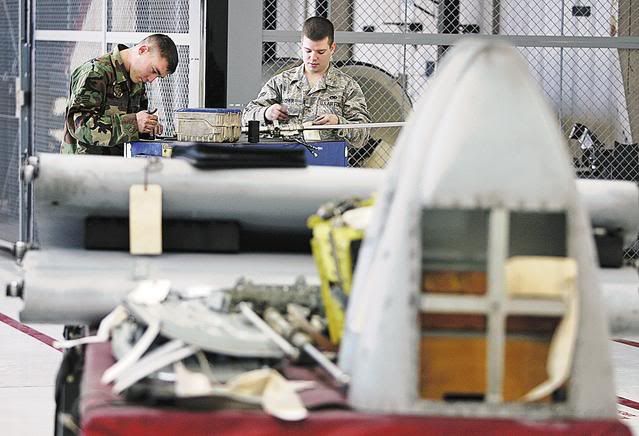
Senior Airman Bennie Gatlin, left, and Airman Adam Fisher work amid a collection of A-10 parts removed in the process of fixing wings with microscopic cracks. It could be mid-2009 before the Davis-Monthan fleet of A-10s is fully operational. (Photo by Greg Bryan / Arizona Daily Star)
Friday, December 19, 2008
A-10 crews keep up the fight during the holidays
Today, 455th Air Expeditionary Wing Public Affairs released a photo essay A-10 crews keep up the fight during the holidays with seven pictures. Only the four best shots:

An A-10C Thunderbolt II from the 75th Expeditionary Fighter Squadron takes off from Bagram AB, Afghanistan, on December 2, 2008. Even after more than 30 years of service, the A-10 remains the king of close-air support, protecting coalition forces in sticky situations. (U.S. Air Force photo by Staff Sgt. Samuel Morse) Hi-res

A-10C 80-0144 from the 74th Fighter Squadron, piloted by Capt. Eric Fleming, prepares for takeoff at Bagram AB, Afghanistan, on December 2, 2008. Visible in the background at left is A-10C 80-0272, also from the 74th Fighter Squadron and additionally deployed from Moody AFB due to A-10 groundings. Parked between revetments are F-15E Strike Eagles from the 391st EFS. (U.S. Air Force photo by Staff Sgt. Samuel Morse) Hi-res

A-10 crewchief Airman 1st Class Michael Ward climbs the crew ladder to assist pilot Capt. Eric Fleming at Bagram AB, Afghanistan, on December 2, 2008. (U.S. Air Force photo by Staff Sgt. Samuel Morse) Hi-res

Capt. Eric Fleming, Assistant Wing Weapons and Tactics and A-10 pilot, performs a preflight walk-around at Bagram AB, Afghanistan, on December 2, 2008. These preflight checks help to minimize the number of in-flight emergencies by catching small problems before they become big problems. GBU-38 JDAMs on stations 4 and 8, Mk 82 LDGPs on stations 5 and 7, AN-AAQ-28 LITENING AT pod on station 10. Not visible is the SUU-25 Flare Dispenser on station 3 (see picture two above). (U.S. Air Force photo by Staff Sgt. Samuel Morse) Hi-res
Note: 80-0144 is one more identified replacement, additionally deployed from Moody AFB due to A-10 groundings.
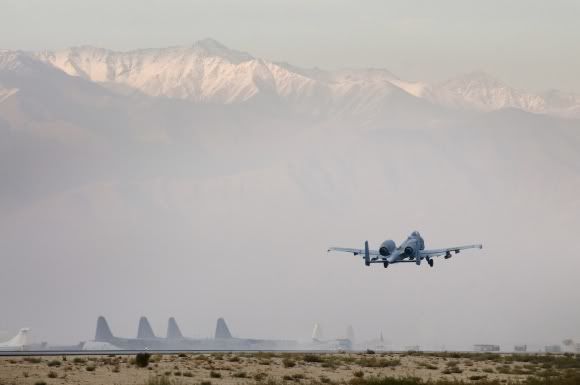
An A-10C Thunderbolt II from the 75th Expeditionary Fighter Squadron takes off from Bagram AB, Afghanistan, on December 2, 2008. Even after more than 30 years of service, the A-10 remains the king of close-air support, protecting coalition forces in sticky situations. (U.S. Air Force photo by Staff Sgt. Samuel Morse) Hi-res
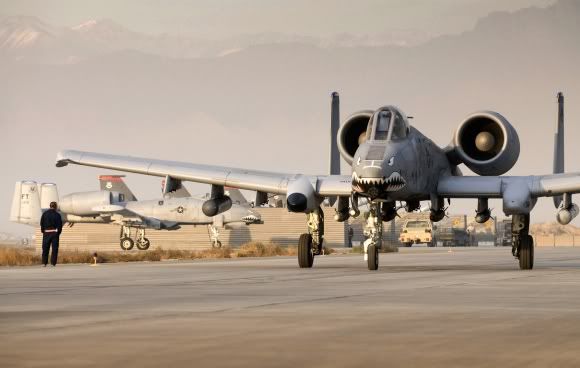
A-10C 80-0144 from the 74th Fighter Squadron, piloted by Capt. Eric Fleming, prepares for takeoff at Bagram AB, Afghanistan, on December 2, 2008. Visible in the background at left is A-10C 80-0272, also from the 74th Fighter Squadron and additionally deployed from Moody AFB due to A-10 groundings. Parked between revetments are F-15E Strike Eagles from the 391st EFS. (U.S. Air Force photo by Staff Sgt. Samuel Morse) Hi-res
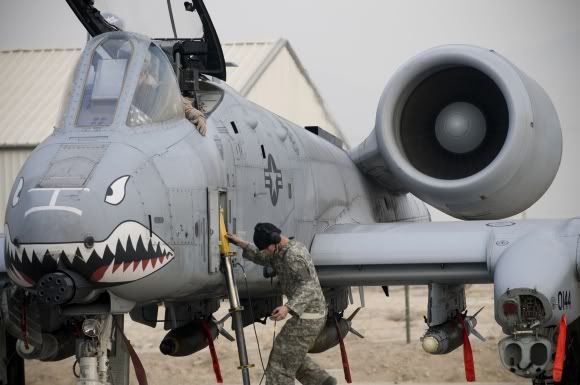
A-10 crewchief Airman 1st Class Michael Ward climbs the crew ladder to assist pilot Capt. Eric Fleming at Bagram AB, Afghanistan, on December 2, 2008. (U.S. Air Force photo by Staff Sgt. Samuel Morse) Hi-res
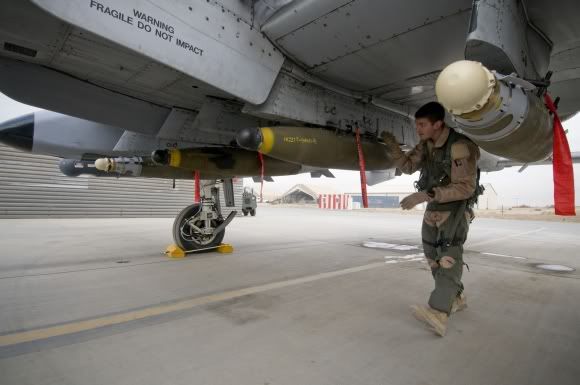
Capt. Eric Fleming, Assistant Wing Weapons and Tactics and A-10 pilot, performs a preflight walk-around at Bagram AB, Afghanistan, on December 2, 2008. These preflight checks help to minimize the number of in-flight emergencies by catching small problems before they become big problems. GBU-38 JDAMs on stations 4 and 8, Mk 82 LDGPs on stations 5 and 7, AN-AAQ-28 LITENING AT pod on station 10. Not visible is the SUU-25 Flare Dispenser on station 3 (see picture two above). (U.S. Air Force photo by Staff Sgt. Samuel Morse) Hi-res
Note: 80-0144 is one more identified replacement, additionally deployed from Moody AFB due to A-10 groundings.
Thursday, December 18, 2008
Spangdahlem helps get deployed aircraft back into the air, and into the fight
by Staff Sgt. Logan Tuttle
52nd Fighter Wing Public Affairs
12/16/2008 - SPANGDAHLEM AIR BASE, Germany -- The 52nd Fighter Wing is playing a unique role in getting aircraft back into the fight downrange by helping perform repairs on A-10 Thunderbolt II aircraft sent from a deployed location, originally from Moody Air Force Base, Ga.
Spangdahlem was able to provide not only a location close to the aircraft but, also working knowledge of the A-10 Thunderbolt II after 28 years of employing it actively.
The A-10's requiring repair were Thin Wing A-10's manufactured in the late 1970's and early 1980's. During the inspections, cracks were found in some critical areas of the wings.
"If they were allowed to continue to grow, it could possibly have caused major problems down the road for the A-10," said Master Sgt. David Hilton, Production Superintendant, 81st Aircraft Maintenance Unit, who acted as the 52nd Maintenance Group Liaison for this project.
A seven-person depot team was sent from Hill Air Force Base, Utah, to help repair the jets and Sergeant Hilton said the depot team and Spangdahlem's maintainers had an outstanding relationship with each other.
Spangdahlem first recovered the aircraft, and conducted post flight inspections. The Spangdahlem maintainers then dismantled the jets so the depot team could gain access to areas that needed to be inspected and worked on. Maintainers also assisted the depot team with repairs and rebuilt the jets when they were done, as well as accomplished overdue operational checks and scheduled maintenance.
When all the repairs and inspections are complete, Spangdahlem will send the aircraft back to their deployed locations.
"Parts were a problem in the beginning," said Sergeant Hilton. "This area of the jet isn't usually torn apart. The success was after they sent us the parts. Everyone jumped in and made it happen in quick fashion."
A wing doesn't typically get tasked to set up and man a depot facility for another major command, in addition to maintaining their own flying schedule Sergeant Hilton added.
"Fear the hog, al-Qaida does," Sergeant Hilton said.
Source
52nd Fighter Wing Public Affairs
12/16/2008 - SPANGDAHLEM AIR BASE, Germany -- The 52nd Fighter Wing is playing a unique role in getting aircraft back into the fight downrange by helping perform repairs on A-10 Thunderbolt II aircraft sent from a deployed location, originally from Moody Air Force Base, Ga.
Spangdahlem was able to provide not only a location close to the aircraft but, also working knowledge of the A-10 Thunderbolt II after 28 years of employing it actively.
The A-10's requiring repair were Thin Wing A-10's manufactured in the late 1970's and early 1980's. During the inspections, cracks were found in some critical areas of the wings.
"If they were allowed to continue to grow, it could possibly have caused major problems down the road for the A-10," said Master Sgt. David Hilton, Production Superintendant, 81st Aircraft Maintenance Unit, who acted as the 52nd Maintenance Group Liaison for this project.
A seven-person depot team was sent from Hill Air Force Base, Utah, to help repair the jets and Sergeant Hilton said the depot team and Spangdahlem's maintainers had an outstanding relationship with each other.
Spangdahlem first recovered the aircraft, and conducted post flight inspections. The Spangdahlem maintainers then dismantled the jets so the depot team could gain access to areas that needed to be inspected and worked on. Maintainers also assisted the depot team with repairs and rebuilt the jets when they were done, as well as accomplished overdue operational checks and scheduled maintenance.
When all the repairs and inspections are complete, Spangdahlem will send the aircraft back to their deployed locations.
"Parts were a problem in the beginning," said Sergeant Hilton. "This area of the jet isn't usually torn apart. The success was after they sent us the parts. Everyone jumped in and made it happen in quick fashion."
A wing doesn't typically get tasked to set up and man a depot facility for another major command, in addition to maintaining their own flying schedule Sergeant Hilton added.
"Fear the hog, al-Qaida does," Sergeant Hilton said.
Source
Sunday, December 7, 2008
Wing cracks take out half of A-10 fleet
Air Force Times
By Bruce Rolfsen - Staff writer
Posted : Sunday Dec 7, 2008 9:58:02 EST
It will likely take six months before the entire A-10 Thunderbolt fleet is back in the sky, Air Force officials said.
As of early December, 168 attack jets — nearly half the service’s 356 Warthogs — remain grounded because of wing cracks. Those planes should be repaired by June, said Maj. David Ruth, A-10 weapons system team chief at Air Combat Command headquarters, Langley Air Force Base, Va.
The grounding began Oct. 3 after inspectors at Ogden Air Logistics Center in Utah, where A-10s are sent for major overhauls and upgrades, raised concerns about wing cracks.
Inspectors found breaks in both wings near the center panels of the landing gear trunnions. The cracks were inside a portion of the wing where base-level maintainers rarely check.
Those concerns resulted in the Oct. 3 grounding order for 129 jets and a mandate to inspect other A-10s. Additional inspections and concerns about planes not covered by the Oct. 3 order pushed the total higher, reaching 191 jets in mid-November. Repairs and completed checks reduced the number of grounded jets to 168.
While inspection teams open wings and patch cracks, A-10 pilots have seen their flying hours fall.
The bottom line for the Air Force is A-10 pilots keeping their basic qualifications up to date, said Lt. Col. David Trucksa, ACC's A-10 subject matter expert.
To ensure pilots are getting at least minimum flying hours and to balance the A-10 shortage among squadrons, about 40 pilots have traveled to fly out of other A-10 bases, Trucksa said. Also, 15 jets were temporarily shifted among units.
Meanwhile, training is on hold for student pilots slated to attend the A-10 class set to start in January at Davis-Monthan Air Force Base, Ariz., Trucksa said. Students will not get orders to report to the school until instructors are certain there will be enough planes.
In mid-November, a training team from Ogden traveled to Moody Air Force Base, Ga., home of the largest Thunderbolt unit on the East Coast, to teach maintainers from across the service how to look for the cracks and repair them, Ruth said.
Because the minute cracks cannot be visually spotted, the inspection includes running an electrical current through metal parts to determine crack locations. Air Force officials estimate inspections and repairs will take about seven to 10 days per A-10 plane.
Source
By Bruce Rolfsen - Staff writer
Posted : Sunday Dec 7, 2008 9:58:02 EST
It will likely take six months before the entire A-10 Thunderbolt fleet is back in the sky, Air Force officials said.
As of early December, 168 attack jets — nearly half the service’s 356 Warthogs — remain grounded because of wing cracks. Those planes should be repaired by June, said Maj. David Ruth, A-10 weapons system team chief at Air Combat Command headquarters, Langley Air Force Base, Va.
The grounding began Oct. 3 after inspectors at Ogden Air Logistics Center in Utah, where A-10s are sent for major overhauls and upgrades, raised concerns about wing cracks.
Inspectors found breaks in both wings near the center panels of the landing gear trunnions. The cracks were inside a portion of the wing where base-level maintainers rarely check.
Those concerns resulted in the Oct. 3 grounding order for 129 jets and a mandate to inspect other A-10s. Additional inspections and concerns about planes not covered by the Oct. 3 order pushed the total higher, reaching 191 jets in mid-November. Repairs and completed checks reduced the number of grounded jets to 168.
While inspection teams open wings and patch cracks, A-10 pilots have seen their flying hours fall.
The bottom line for the Air Force is A-10 pilots keeping their basic qualifications up to date, said Lt. Col. David Trucksa, ACC's A-10 subject matter expert.
To ensure pilots are getting at least minimum flying hours and to balance the A-10 shortage among squadrons, about 40 pilots have traveled to fly out of other A-10 bases, Trucksa said. Also, 15 jets were temporarily shifted among units.
Meanwhile, training is on hold for student pilots slated to attend the A-10 class set to start in January at Davis-Monthan Air Force Base, Ariz., Trucksa said. Students will not get orders to report to the school until instructors are certain there will be enough planes.
In mid-November, a training team from Ogden traveled to Moody Air Force Base, Ga., home of the largest Thunderbolt unit on the East Coast, to teach maintainers from across the service how to look for the cracks and repair them, Ruth said.
Because the minute cracks cannot be visually spotted, the inspection includes running an electrical current through metal parts to determine crack locations. Air Force officials estimate inspections and repairs will take about seven to 10 days per A-10 plane.
Source
Monday, December 1, 2008
Two diverted 75th EFS A-10s left Ramstein for Spang
By Joachim Jacob
Updated December 6, 2008
Today, the first two of six 75th Expeditionary Fighter Squadron A-10s which diverted last week to Ramstein AB, Germany, due to fog over Spangdahlem AB, Germany, left this airbase. Callsign was Iron 01/02, a local Spang callsign, because they were flown by 81st Fighter Squadron pilots. At Spang, the aircraft will get wing inspections and repairs. Alongside were two 81st Fighter Squadron A-10s which had also diverted to Ramstein.

A-10C 78-0679 from the 75th Fighter Squadron departs Ramstein AB, Germany. (Photo by Dalibor Ankovic / Photaviaworks) Hi-res

A-10C 79-0138 from the 75th Fighter Squadron departs Ramstein AB, Germany. (Photo by Dalibor Ankovic / Photaviaworks) Hi-res

A-10C 78-0679 arrives at Spangdahlem AB, Germany. (Photo by Oliver Jonischkeit) Hi-res

A-10C 79-0138 arrives at Spangdahlem AB, Germany. (Photo by Oliver Jonischkeit) Hi-res
According to the Scramble Messageboard, three more 75th Expeditionary Fighter Squadron A-10s left Ramstein AB on December 2, 2008 (single ship departed 15:40, two ship departed 16:02 local time). The fourth aircraft taxied back to ramp 4.
UPDATE: The last A-10C, serial 78-0674, departed Ramstein AB as "Maniac 01" on December 5, 2008.
Special thanks to my German contributors who spent a lot of time and also money (for gasoline) to take these rare shots.
See also: Intel: Enroute to Spang, Bagram A-10s diverted to Ramstein
Updated December 6, 2008
Today, the first two of six 75th Expeditionary Fighter Squadron A-10s which diverted last week to Ramstein AB, Germany, due to fog over Spangdahlem AB, Germany, left this airbase. Callsign was Iron 01/02, a local Spang callsign, because they were flown by 81st Fighter Squadron pilots. At Spang, the aircraft will get wing inspections and repairs. Alongside were two 81st Fighter Squadron A-10s which had also diverted to Ramstein.
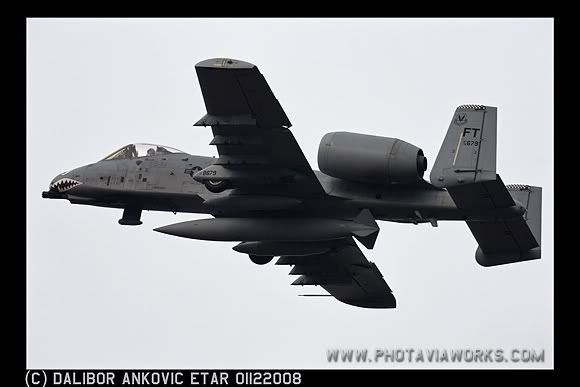
A-10C 78-0679 from the 75th Fighter Squadron departs Ramstein AB, Germany. (Photo by Dalibor Ankovic / Photaviaworks) Hi-res
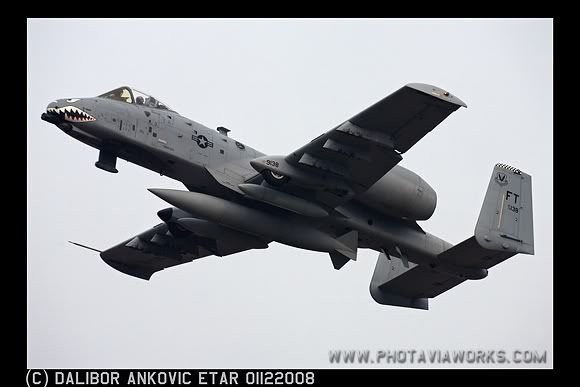
A-10C 79-0138 from the 75th Fighter Squadron departs Ramstein AB, Germany. (Photo by Dalibor Ankovic / Photaviaworks) Hi-res
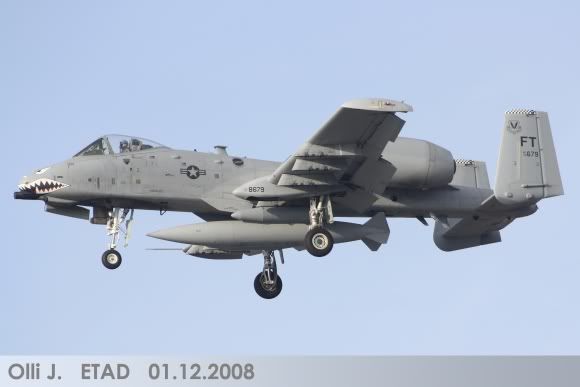
A-10C 78-0679 arrives at Spangdahlem AB, Germany. (Photo by Oliver Jonischkeit) Hi-res
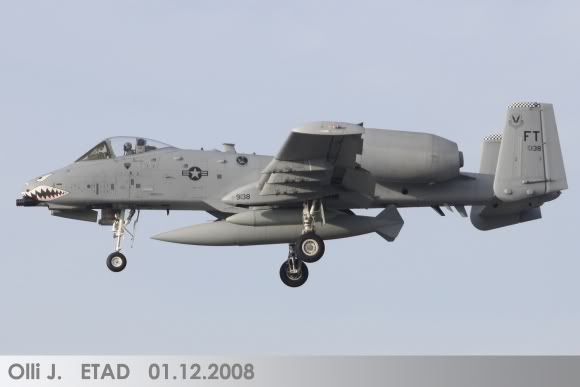
A-10C 79-0138 arrives at Spangdahlem AB, Germany. (Photo by Oliver Jonischkeit) Hi-res
According to the Scramble Messageboard, three more 75th Expeditionary Fighter Squadron A-10s left Ramstein AB on December 2, 2008 (single ship departed 15:40, two ship departed 16:02 local time). The fourth aircraft taxied back to ramp 4.
UPDATE: The last A-10C, serial 78-0674, departed Ramstein AB as "Maniac 01" on December 5, 2008.
Special thanks to my German contributors who spent a lot of time and also money (for gasoline) to take these rare shots.
See also: Intel: Enroute to Spang, Bagram A-10s diverted to Ramstein
Monday, November 24, 2008
Intel: Four more A-10 replacements enroute to Bagram?
By Joachim Jacob
According to the Scramble Messageboard, probably over the last weekend four more A-10s passed through Lajes Field, Azores, and Sigonella, Sicily, for stopovers enroute to Bagram AB, Afghanistan, as additional replacements due to partial A-10 groundings. At the moment, I'm very busy to get some more related first-hand info like serial numbers and pictures.
Please note: That's a breaking news. I will make updates if further info is available.
According to the Scramble Messageboard, probably over the last weekend four more A-10s passed through Lajes Field, Azores, and Sigonella, Sicily, for stopovers enroute to Bagram AB, Afghanistan, as additional replacements due to partial A-10 groundings. At the moment, I'm very busy to get some more related first-hand info like serial numbers and pictures.
Please note: That's a breaking news. I will make updates if further info is available.
Saturday, November 22, 2008
Juggling act: Maintenance and operations groups cooperate to complete A-10 inspections
by Tech. Sgt. Leo Brown
442nd Fighter Wing Public Affairs
11/20/2008 - WHITEMAN AIR FORCE BASE, Mo. -- Citizen Airmen in the maintenance and operations groups are becoming professional jugglers these days.
Complying with an Air Force-issued time-compliance technical order from early October, the 442nd Maintenance Group is inspecting and repairing fatigue-related wing cracks in 11 of the unit's 27 A-10s. Most of the affected aircraft have "thin-skin" wings, installed during original manufacture.
Throughout the Air Force, roughly 130 A-10s are affected by the order. While there is no firm date for when the inspections will be completed, immediate demands are never-ending.
With pilots' mandatory combat currencies and aircraft phase inspections - done every 500 flying hours - needing to be met, the demand for cooperation between the maintenance and operations communities has never been higher. Reservists in the 442nd, however, are meeting that challenge.
"Operations and maintenance work together so well in the 442nd Fighter Wing," said Col. John Hoff, 442nd Operations Group commander. "There's no issue we can't work out. I've been here over 15 years and I think it's the best relationship in the combat Air Force. There's give and take on both sides and everyone wins in the end."
"Operations gives us their requirements - their types of missions - and we tell them how many aircraft we have available," said Tech. Sgt. Melissa Alexander, aircraft maintenance scheduler with the 442nd Maintenance Operations Flight. "You never fly more than half your fleet and ops has been working with us to cut back what they can.
"We've lost a couple sorties here and there," she said. "Things happen. They're old aircraft, but we're juggling everything and still maintaining what we need to. We don't want all the aircraft coming in for phase (inspections) at once. The biggest thing is the crew chiefs and the sheet-metal guys and the R and R (repair and reclamation) guys - they're making the mission happen. Everyone's taking pride in what we're doing."
Simply creating the opportunity to assess the severity of a crack can be quite a process, according to Senior Master Sgt. Cary Brown, inspection flight chief for the 442nd Maintenance Squadron.
"You have to remove the aft landing pod assembly," he said. "Just to inspect it is a day's work and that includes work from several shops. Once we have everything removed, it's pretty simple. (The) structures (shop) removes some fasteners and NDI (non-destructive inspection) puts in their probe to look for cracks. We'll then put in an engineering assistance request and give the information we find to the A-10 depot at Hill (Air Force Base, Utah). They'll send us back information on what we need to do next."
The coordination between various shops - fabrication, repair and reclamation, metals, structural maintenance, and the crew chief's community, among others - and the dedication of the Airmen involved have brought praise from several wing leaders.
"Our maintainers are the best in the world," said Col. Mark Clemons, 442nd Fighter Wing commander. "They've taken the initiative on something that looked like dire straits for us and turned it to where we're in the best position of any A-10 organization right now. Everybody knows what's going on and they have a game plan for the rest of our wing's fleet. We're doing things smart and it's a testament to what Gen. (John) Bradley and Gen. (Charles) Stenner have said - we have the best maintainers in the world here."
General Bradley, who recently retired as chief of the Air Force Reserve, led the 442nd Fighter Wing from 1989-1993. General Stenner assumed command of AFRC in June. He commanded the 442nd Fighter Wing from 1997-1998.
"Our wing has Airmen who have so much talent," said Lt. Col. Anne Yelderman, 442nd Maintenance Squadron commander. "They are truly master craftsmen. It's absolutely incredible to watch them as they gather and feed-back information as they're teaching and learning. They're at the heart-beat of how to solve this problem, which has far-reaching implications across the entire fleet."
Regardless of what happens at other A-10 units, confidence is sky-high that 442nd Fighter Wing Airmen will keep doing what they've been doing, according to Colonel Vander Linden.
"We're here to produce safe, flyable airplanes to get the mission done and we'll keep on doing that," he said.
Only one of the three associated pictures:

Staff Sgt. Micah Gaches inspects the wing of an A-10 Thunderbolt II for cracks on November 9, 2008, in the 442nd Maintenance Group's 5-Bay Hangar. The inspections are mandatory throughout certain A-10s in the entire fleet due to a time-compliance technical order, which was issued in October. Organization, planning and skill in the maintenance group has minimized the impact on the wing's flying operations. Sergeant Gaches is an aircraft structural technician in the 442nd Maintenance Squadron, part of the 442nd Fighter Wing, an Air Force Reserve unit based at Whiteman AFB, Missouri. (U.S. Air Force photo by Master Sgt. Bill Huntington) Hi-res
Source (Released today)
442nd Fighter Wing Public Affairs
11/20/2008 - WHITEMAN AIR FORCE BASE, Mo. -- Citizen Airmen in the maintenance and operations groups are becoming professional jugglers these days.
Complying with an Air Force-issued time-compliance technical order from early October, the 442nd Maintenance Group is inspecting and repairing fatigue-related wing cracks in 11 of the unit's 27 A-10s. Most of the affected aircraft have "thin-skin" wings, installed during original manufacture.
Throughout the Air Force, roughly 130 A-10s are affected by the order. While there is no firm date for when the inspections will be completed, immediate demands are never-ending.
With pilots' mandatory combat currencies and aircraft phase inspections - done every 500 flying hours - needing to be met, the demand for cooperation between the maintenance and operations communities has never been higher. Reservists in the 442nd, however, are meeting that challenge.
"Operations and maintenance work together so well in the 442nd Fighter Wing," said Col. John Hoff, 442nd Operations Group commander. "There's no issue we can't work out. I've been here over 15 years and I think it's the best relationship in the combat Air Force. There's give and take on both sides and everyone wins in the end."
"Operations gives us their requirements - their types of missions - and we tell them how many aircraft we have available," said Tech. Sgt. Melissa Alexander, aircraft maintenance scheduler with the 442nd Maintenance Operations Flight. "You never fly more than half your fleet and ops has been working with us to cut back what they can.
"We've lost a couple sorties here and there," she said. "Things happen. They're old aircraft, but we're juggling everything and still maintaining what we need to. We don't want all the aircraft coming in for phase (inspections) at once. The biggest thing is the crew chiefs and the sheet-metal guys and the R and R (repair and reclamation) guys - they're making the mission happen. Everyone's taking pride in what we're doing."
Simply creating the opportunity to assess the severity of a crack can be quite a process, according to Senior Master Sgt. Cary Brown, inspection flight chief for the 442nd Maintenance Squadron.
"You have to remove the aft landing pod assembly," he said. "Just to inspect it is a day's work and that includes work from several shops. Once we have everything removed, it's pretty simple. (The) structures (shop) removes some fasteners and NDI (non-destructive inspection) puts in their probe to look for cracks. We'll then put in an engineering assistance request and give the information we find to the A-10 depot at Hill (Air Force Base, Utah). They'll send us back information on what we need to do next."
The coordination between various shops - fabrication, repair and reclamation, metals, structural maintenance, and the crew chief's community, among others - and the dedication of the Airmen involved have brought praise from several wing leaders.
"Our maintainers are the best in the world," said Col. Mark Clemons, 442nd Fighter Wing commander. "They've taken the initiative on something that looked like dire straits for us and turned it to where we're in the best position of any A-10 organization right now. Everybody knows what's going on and they have a game plan for the rest of our wing's fleet. We're doing things smart and it's a testament to what Gen. (John) Bradley and Gen. (Charles) Stenner have said - we have the best maintainers in the world here."
General Bradley, who recently retired as chief of the Air Force Reserve, led the 442nd Fighter Wing from 1989-1993. General Stenner assumed command of AFRC in June. He commanded the 442nd Fighter Wing from 1997-1998.
"Our wing has Airmen who have so much talent," said Lt. Col. Anne Yelderman, 442nd Maintenance Squadron commander. "They are truly master craftsmen. It's absolutely incredible to watch them as they gather and feed-back information as they're teaching and learning. They're at the heart-beat of how to solve this problem, which has far-reaching implications across the entire fleet."
Regardless of what happens at other A-10 units, confidence is sky-high that 442nd Fighter Wing Airmen will keep doing what they've been doing, according to Colonel Vander Linden.
"We're here to produce safe, flyable airplanes to get the mission done and we'll keep on doing that," he said.
Only one of the three associated pictures:

Staff Sgt. Micah Gaches inspects the wing of an A-10 Thunderbolt II for cracks on November 9, 2008, in the 442nd Maintenance Group's 5-Bay Hangar. The inspections are mandatory throughout certain A-10s in the entire fleet due to a time-compliance technical order, which was issued in October. Organization, planning and skill in the maintenance group has minimized the impact on the wing's flying operations. Sergeant Gaches is an aircraft structural technician in the 442nd Maintenance Squadron, part of the 442nd Fighter Wing, an Air Force Reserve unit based at Whiteman AFB, Missouri. (U.S. Air Force photo by Master Sgt. Bill Huntington) Hi-res
Source (Released today)
Tuesday, November 18, 2008
Intel: Two more 75th EFS A-10s enroute to Spang?
By Joachim Jacob
According to latest European aircraft spotter info, two more 75th Expeditionary Fighter Squadron A-10s are enroute from Bagram AB, Afghanistan, to Spangdahlem AB, Germany, for inspections and repairs - related to the current partial A-10 groundings. Their arrival is expected for today, Tuesday, November 18, 2008.
This is a breaking news. I will make updates if further info is available.
According to latest European aircraft spotter info, two more 75th Expeditionary Fighter Squadron A-10s are enroute from Bagram AB, Afghanistan, to Spangdahlem AB, Germany, for inspections and repairs - related to the current partial A-10 groundings. Their arrival is expected for today, Tuesday, November 18, 2008.
This is a breaking news. I will make updates if further info is available.
Tuesday, November 11, 2008
Depot team provides A-10C maintainers hands-on training
by Airman 1st Class Frances Locquiao
23rd Wing Public Affairs
11/10/2008 - MOODY AIR FORCE BASE, Ga. -- Approximately five members of a depot maintenance team arrived at Moody Nov. 12 and provided A-10C Thunderbolt II maintainers hands-on training to perform major crack repairs on the aircraft.
The team came from Ogden Air Logistics Center at Hill Air Force Base, Utah, where all C-130 Hercules aircraft, A-10s and F-16 Fighting Falcons go for maintenance. The depot team performs extensive and heavy maintenance that cannot be done at the unit level.
"The goal of the depot team was to teach maintainers how to repair major cracks so that grounded A-10s can be returned to flying status," said Master Sgt. Jeffrey Andrews, 23rd Equipment Maintenance Squadron repair and reclamation section chief. "Each depot team member had an A-10 to repair so they could show how major repairs are done and allow Airmen to apply what they learned."
Moody has more than 10 A-10s that have to be repaired and returned to flying status, said Sergeant Andrews.
In addition to Moody maintainers, there were 40 active duty, Reserve and Guard maintainers from several bases including Davis-Monthan Air Force Base, Ariz., Nellis AFB, Nev., Whiteman AFB, Mo., and Willow Grove Air Reserve Station, Pa., who received training to bring back to their bases.
All the A-10 maintainers comprised of five different Air Force specialties to include repair and reclamation, metals technology, sheet metal technology, nondestructive inspection and crew chiefs.
"It would cost too much to fly all the aircraft to Hill," said Master Sgt. Steve Grimes, Air Combat Command Headquarters A-10 maintenance liaison. "It would also take longer to repair all since three could only be sent at a time. This method is more cost-effective and it would be a faster way to repair the A-10s."
The Ogden Air Logistics Center has responsibilities for Air Force-wide item management, depot-level overhaul and repair for all types of landing gear, wheels, brakes and tires and is the logistics manager for all conventional air munitions, solid propellants and explosive devices used throughout the Air Force. The center is the Air Force technical repair center for composites.
The team concentrated on teaching trunnion removal and sheet metal repair. The trunnion is the attachment point of the main landing gear and wing, which receives stress that causes cracks.
"The whole process has been surprisingly effective and swift," said Sergeant Andrews. "Although, there is no definite time of when all grounded A-10s will be fixed, the newly-trained maintainers have the proper training to immediately start teaching and repairing their own A-10s.
"We want the A-10s to be properly repaired as soon as possible so that they are mission-capable in support of the Global War on Terrorism," he added.

Forty Airmen from eight bases begin the task of simultaneously preparing five A-10C models for wing section repair at Moody AFB on November 7, 2008. Visible in the foreground is A-10 79-0159 from the 75th Fighter Squadron. Airmen not assigned to Moody will learn how to repair the A-10C wing section and return home station to share this knowledge within their units. In order to accomplish these repairs, Airmen must climb into tiny compartments within the wing to reach certain areas. (U.S. Air Force photo by Senior Airman Javier Cruz) Hi-res
Source
23rd Wing Public Affairs
11/10/2008 - MOODY AIR FORCE BASE, Ga. -- Approximately five members of a depot maintenance team arrived at Moody Nov. 12 and provided A-10C Thunderbolt II maintainers hands-on training to perform major crack repairs on the aircraft.
The team came from Ogden Air Logistics Center at Hill Air Force Base, Utah, where all C-130 Hercules aircraft, A-10s and F-16 Fighting Falcons go for maintenance. The depot team performs extensive and heavy maintenance that cannot be done at the unit level.
"The goal of the depot team was to teach maintainers how to repair major cracks so that grounded A-10s can be returned to flying status," said Master Sgt. Jeffrey Andrews, 23rd Equipment Maintenance Squadron repair and reclamation section chief. "Each depot team member had an A-10 to repair so they could show how major repairs are done and allow Airmen to apply what they learned."
Moody has more than 10 A-10s that have to be repaired and returned to flying status, said Sergeant Andrews.
In addition to Moody maintainers, there were 40 active duty, Reserve and Guard maintainers from several bases including Davis-Monthan Air Force Base, Ariz., Nellis AFB, Nev., Whiteman AFB, Mo., and Willow Grove Air Reserve Station, Pa., who received training to bring back to their bases.
All the A-10 maintainers comprised of five different Air Force specialties to include repair and reclamation, metals technology, sheet metal technology, nondestructive inspection and crew chiefs.
"It would cost too much to fly all the aircraft to Hill," said Master Sgt. Steve Grimes, Air Combat Command Headquarters A-10 maintenance liaison. "It would also take longer to repair all since three could only be sent at a time. This method is more cost-effective and it would be a faster way to repair the A-10s."
The Ogden Air Logistics Center has responsibilities for Air Force-wide item management, depot-level overhaul and repair for all types of landing gear, wheels, brakes and tires and is the logistics manager for all conventional air munitions, solid propellants and explosive devices used throughout the Air Force. The center is the Air Force technical repair center for composites.
The team concentrated on teaching trunnion removal and sheet metal repair. The trunnion is the attachment point of the main landing gear and wing, which receives stress that causes cracks.
"The whole process has been surprisingly effective and swift," said Sergeant Andrews. "Although, there is no definite time of when all grounded A-10s will be fixed, the newly-trained maintainers have the proper training to immediately start teaching and repairing their own A-10s.
"We want the A-10s to be properly repaired as soon as possible so that they are mission-capable in support of the Global War on Terrorism," he added.

Forty Airmen from eight bases begin the task of simultaneously preparing five A-10C models for wing section repair at Moody AFB on November 7, 2008. Visible in the foreground is A-10 79-0159 from the 75th Fighter Squadron. Airmen not assigned to Moody will learn how to repair the A-10C wing section and return home station to share this knowledge within their units. In order to accomplish these repairs, Airmen must climb into tiny compartments within the wing to reach certain areas. (U.S. Air Force photo by Senior Airman Javier Cruz) Hi-res
Source
Saturday, November 8, 2008
Two combat-deployed 75th EFS A-10s relocate from Bagram to Spang
By Joachim Jacob
Updated on November 11, 2008
On November 8, 2008, A-10s 80-0140 and 80-0149 from the 75th Expeditionary Fighter Squadron, currently deployed for Operation Enduring Freedom to the 455th Air Expeditionary Wing at Bagram AB, Afghanistan, arrived at Spangdahlem AB, Germany, probably for inspections or repairs due to the partial A-10 grounding. The following screenshot shows first pictures of their arrival, already published on Photaviaworks.com (c) D. Ankovic / Photoaviaworks.com).


A-10 80-0140 from the 74th Fighter Squadron arrives at Spangdahlem AB. (Photo by Dalibor Ankovic / Photaviaworks.com)

A-10 80-0149 from the 75th Fighter Squadron arrives at Spangdahlem AB. (Photo by Dalibor Ankovic / Photaviaworks.com)
Special thanks to Dalibor for his permission to post his pictures!

A-10 80-0140 from the 74th Fighter Squadron arrives at Spangdahlem AB. (Photo by Johnny Chocholaty / jc-images.de)

A-10 80-0149 from the 75th Fighter Squadron arrives at Spangdahlem AB. (Photo by Johnny Chocholaty / jc-images.de)
Special thanks also to Johnny for his kind permission to post his shots!
For some more specific background info please check: Thunderbolts, grounded by Hill, on the mend
This source states:
According to that, it could be possible two more Moody Hogs will relocate from Bagram to Spang in the next couple of days...
Updated on November 11, 2008
On November 8, 2008, A-10s 80-0140 and 80-0149 from the 75th Expeditionary Fighter Squadron, currently deployed for Operation Enduring Freedom to the 455th Air Expeditionary Wing at Bagram AB, Afghanistan, arrived at Spangdahlem AB, Germany, probably for inspections or repairs due to the partial A-10 grounding. The following screenshot shows first pictures of their arrival, already published on Photaviaworks.com (c) D. Ankovic / Photoaviaworks.com).
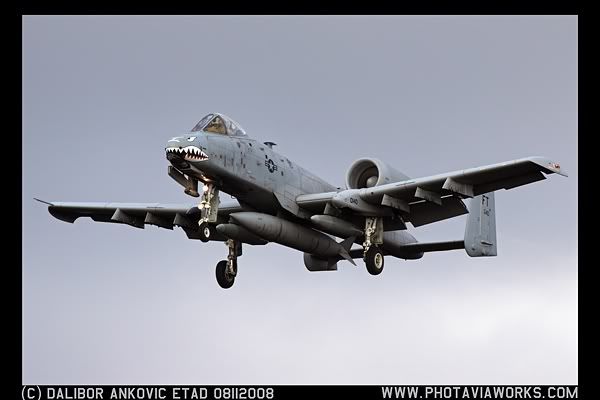
A-10 80-0140 from the 74th Fighter Squadron arrives at Spangdahlem AB. (Photo by Dalibor Ankovic / Photaviaworks.com)
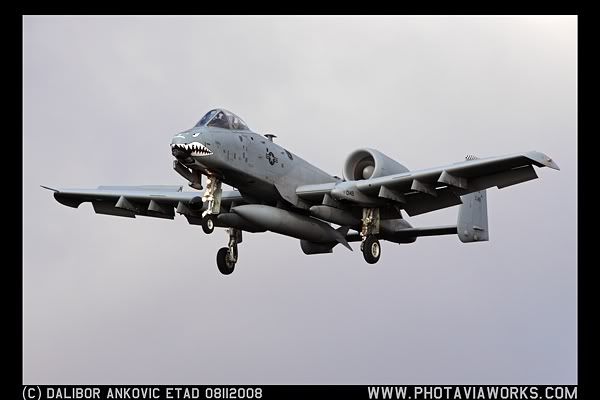
A-10 80-0149 from the 75th Fighter Squadron arrives at Spangdahlem AB. (Photo by Dalibor Ankovic / Photaviaworks.com)
Special thanks to Dalibor for his permission to post his pictures!

A-10 80-0140 from the 74th Fighter Squadron arrives at Spangdahlem AB. (Photo by Johnny Chocholaty / jc-images.de)

A-10 80-0149 from the 75th Fighter Squadron arrives at Spangdahlem AB. (Photo by Johnny Chocholaty / jc-images.de)
Special thanks also to Johnny for his kind permission to post his shots!
For some more specific background info please check: Thunderbolts, grounded by Hill, on the mend
This source states:
[...] A small number, including the four which received a one-time flight authorization from Afghanistan to Spangdahlem Air Base, Germany, will need more extensive repairs.
Those fixes may take as long as two months. [...]
According to that, it could be possible two more Moody Hogs will relocate from Bagram to Spang in the next couple of days...
Latest A-10 OEF Combat Imagery
As a big surprise, on November 7, 2008, the following four brand-new pictures (all taken during CAS mission air refuelings over Afghanistan on November 7, 2008) were released on USAF's public main website as photo essay Flying high in the sky.

A-10 80-0272 Hi-res

A-10 80-0272 Hi-res

A-10 79-0135 Hi-res

A-10 79-0135 Hi-res
(U.S. Air Force photos by Staff Sgt. Aaron Allmon)
Source
Note: Originally, both aircraft were not deployed with the 75th Expeditionary Fighter Squadron to Bagram AB. They are two of four replacements to fulfill some gaps because of current A-10 groundings. According to the Scramble Messageboard, they arrived at Lajes Field on October 22, and at Sigonella as Trend 41 flight on October 29.

A-10 80-0272 Hi-res

A-10 80-0272 Hi-res

A-10 79-0135 Hi-res

A-10 79-0135 Hi-res
(U.S. Air Force photos by Staff Sgt. Aaron Allmon)
Source
Note: Originally, both aircraft were not deployed with the 75th Expeditionary Fighter Squadron to Bagram AB. They are two of four replacements to fulfill some gaps because of current A-10 groundings. According to the Scramble Messageboard, they arrived at Lajes Field on October 22, and at Sigonella as Trend 41 flight on October 29.
Sunday, November 2, 2008
Thunderbolts, grounded by Hill, on the mend
Temporary fix keeps jets flying over Iraq, Afghanistan; long-term solution in the works
By Matthew D. LaPlante
The Salt Lake Tribune
Article Launched: 10/27/2008 10:54:59 AM MDT
Nearly one month after the Air Force grounded scores of jets favored by the military for protecting U.S. ground forces in Iraq and Afghanistan, engineers at Hill Air Force Base say they have "a way ahead" for getting the A-10 Thunderbolt back into service.
For now, the temporary inspection and maintenance regimen ordered by Hill's A-10 System Program Office will keep all but three jets in combat zone service. A permanent fix to the problem - fractures in the wings of many aircraft discovered during routine maintenance at Hill - is in the works, according to base officials.
Engineers at Hill "have been working diligently to develop and validate more comprehensive repairs," said base spokesman Charles Freeman.
Nearly 150 A-10 Thunderbolts were immediately grounded as a result of the Hill alert. Almost all showed signs of cracking, but the temporary fix, which takes about 45 man-hours per jet, has returned about one-third of the grounded jets to service.
At least 200 of the jets, popularly known as the "Warthog," await inspection.
A small number, including the four which received a one-time flight authorization from Afghanistan to Spangdahlem Air Base, Germany, will need more extensive repairs.
Those fixes may take as long as two months.
Lt. Gen. Gary North, Combined Forces Air Component commander for U.S. Central Command, said NATO forces would use "other assets in theater to meet mission requirements" while waiting for four replacement aircraft.
Air Force officials said that military members on the ground would not notice a difference, however. Weekly airpower summaries issued by the Air Force since Oct. 11 show A-10s have been used in several close-air missions recently.
There have been no crashes involving the aircraft, but the presence of cracks in the wings, similar to a maintenance problem discovered on many of the Air Force's F-15 fighter jets last year, concerned Air Force officials enough to order the grounding of a large portion of the fleet for inspection. If the problem had gone undetected, military aviation experts said, it had the potential to cause wings to fall off.
Source
Note: This news article was first-published with the headline HAFB gets 'Warthogs' back in battle on October 25, 2008.
By Matthew D. LaPlante
The Salt Lake Tribune
Article Launched: 10/27/2008 10:54:59 AM MDT
Nearly one month after the Air Force grounded scores of jets favored by the military for protecting U.S. ground forces in Iraq and Afghanistan, engineers at Hill Air Force Base say they have "a way ahead" for getting the A-10 Thunderbolt back into service.
For now, the temporary inspection and maintenance regimen ordered by Hill's A-10 System Program Office will keep all but three jets in combat zone service. A permanent fix to the problem - fractures in the wings of many aircraft discovered during routine maintenance at Hill - is in the works, according to base officials.
Engineers at Hill "have been working diligently to develop and validate more comprehensive repairs," said base spokesman Charles Freeman.
Nearly 150 A-10 Thunderbolts were immediately grounded as a result of the Hill alert. Almost all showed signs of cracking, but the temporary fix, which takes about 45 man-hours per jet, has returned about one-third of the grounded jets to service.
At least 200 of the jets, popularly known as the "Warthog," await inspection.
A small number, including the four which received a one-time flight authorization from Afghanistan to Spangdahlem Air Base, Germany, will need more extensive repairs.
Those fixes may take as long as two months.
Lt. Gen. Gary North, Combined Forces Air Component commander for U.S. Central Command, said NATO forces would use "other assets in theater to meet mission requirements" while waiting for four replacement aircraft.
Air Force officials said that military members on the ground would not notice a difference, however. Weekly airpower summaries issued by the Air Force since Oct. 11 show A-10s have been used in several close-air missions recently.
There have been no crashes involving the aircraft, but the presence of cracks in the wings, similar to a maintenance problem discovered on many of the Air Force's F-15 fighter jets last year, concerned Air Force officials enough to order the grounding of a large portion of the fleet for inspection. If the problem had gone undetected, military aviation experts said, it had the potential to cause wings to fall off.
Source
Note: This news article was first-published with the headline HAFB gets 'Warthogs' back in battle on October 25, 2008.
Tuesday, October 28, 2008
A-10s may be moved in case of groundings
Wing cracks limit jets' availability
Air Force Times
By Bruce Rolfsen - Staff writer
Posted: Monday Oct 27, 2008 12:42:34 EDT
With more than one-third of Air Force A-10 Thunderbolts grounded because of wing cracks, the service is considering temporarily reassigning aircraft and even reassigning airmen.
The groundings began Oct. 3, when orders went out not to fly 127 jets that were built with "thin wings" until the wings had been checked and repaired, if needed. The number of grounded A-10s is likely to grow as more aircraft are inspected for cracks near the main landing gear.
Lt. Col. David Trucksa, a Warthog subject matter expert with Air Combat Command headquarters, said the full extent of the wing problems won't be known until end of October, when inspections are completed.
But Trucksa said he doesn't expect the problem to end soon.
"It will be a long time — a year," he said. "It's not short-term like the F-15 Eagle."
In November 2007, the service grounded all F-15s after an F-15C broke apart in flight while on a training mission over Missouri. Inspectors traced the problem to cracked beams inside fuselages that were thinner than what specifications called for, and it took three months to get all but a few of the fighters back in the air.
While F-15s sat on flight lines, the only experience pilots got was in simulators. As the jets returned to flight, it took squadrons another month to requalify all their pilots.
Trucksa said the situation for A-10 pilots is not as severe because A-10 pilots can still fly. Grounding the entire fleet is not anticipated.
According to the Ogden Air Logistics Center in Utah, which oversees the health of all 356 Thunderbolts, 65 jets were grounded as of Wednesday, awaiting inspections and 96 were grounded awaiting repairs. The initial grounding had the greatest impact on active-duty units in the U.S., where about 50 percent of the A-10s could not be flown, according to information from the units and Ogden.
Of the remaining Warthogs, 48 were inspected and returned to flight, and an additional 147 A-10s with a differently designed "thick wing" were deemed flyable but faced later inspections once all the "thin wing" A-10s are checked.
Depending on the severity of the cracks, the grounded aircraft will be repaired at their home base or delivered to a depot for more extensive work.
When the inspections are completed, the command will assess the impact on each A-10 unit and look at what steps should be taken, Trucksa said.
Those include temporarily reassigning aircraft so that flyable A-10s are more evenly spread across the service and temporarily sending A-10 pilots who need flying time to units less severely impacted, Trucksa said. Pilots preparing for combat deployments would get first dibs on those temporary reassignments.
The command is also keeping watch on how the grounding could impact combat operations in Afghanistan. Since 2002, A-10s have been a near continuous presence at Bagram Air Base. So far, there has not been a need to send replacement A-10s or change deployment schedules to make up for the jets grounded at Afghanistan, Trucksa said.
Air Forces Central filled the gap with F-15E Strike Eagles stationed at Bagram and carrier-based Navy jets already in the region flying Afghanistan missions.
One option not on the table is delaying flyable A-10s from going through the fleetwide cockpit and avionics upgrade, Trucksa said.
All A-10s are getting digital cockpits and new avionics. The upgrades enable the jets to release satellite-guided bombs, and cuts the time a pilot needs to find and attack a target.
Trucksa said the advantages of having all A-10s configured as "C models" outweighs delaying the conversion, expected to finish in 2010.
The A-10 grounding was prompted by inspections at Ogden, where A-10s go through depot-level repairs. The Ogden inspections involve removing panels and checking parts that aren't touched during base-level phase inspections.
When Ogden inspectors looked at the wheel trunnions in the "thin wing" jets, they found cracks that had not been anticipated. While A-10s were designed to last for 8,000 flying hours, many have passed the 10,000 hour mark.
The initial 244 A-10 jets were built with wings that used thinner sheet metal than the wings used in later editions of the jet.
The Air Force knew the thin wings wouldn't last for 16,000 hours and had signed a $2 billion contract with Boeing to build 247 new sets of wings to replace the thin wings. Boeing is in the engineering phase of designing the wings, and delivery of the first wings is expected in December 2010.
Source
Air Force Times
By Bruce Rolfsen - Staff writer
Posted: Monday Oct 27, 2008 12:42:34 EDT
With more than one-third of Air Force A-10 Thunderbolts grounded because of wing cracks, the service is considering temporarily reassigning aircraft and even reassigning airmen.
The groundings began Oct. 3, when orders went out not to fly 127 jets that were built with "thin wings" until the wings had been checked and repaired, if needed. The number of grounded A-10s is likely to grow as more aircraft are inspected for cracks near the main landing gear.
Lt. Col. David Trucksa, a Warthog subject matter expert with Air Combat Command headquarters, said the full extent of the wing problems won't be known until end of October, when inspections are completed.
But Trucksa said he doesn't expect the problem to end soon.
"It will be a long time — a year," he said. "It's not short-term like the F-15 Eagle."
In November 2007, the service grounded all F-15s after an F-15C broke apart in flight while on a training mission over Missouri. Inspectors traced the problem to cracked beams inside fuselages that were thinner than what specifications called for, and it took three months to get all but a few of the fighters back in the air.
While F-15s sat on flight lines, the only experience pilots got was in simulators. As the jets returned to flight, it took squadrons another month to requalify all their pilots.
Trucksa said the situation for A-10 pilots is not as severe because A-10 pilots can still fly. Grounding the entire fleet is not anticipated.
According to the Ogden Air Logistics Center in Utah, which oversees the health of all 356 Thunderbolts, 65 jets were grounded as of Wednesday, awaiting inspections and 96 were grounded awaiting repairs. The initial grounding had the greatest impact on active-duty units in the U.S., where about 50 percent of the A-10s could not be flown, according to information from the units and Ogden.
Of the remaining Warthogs, 48 were inspected and returned to flight, and an additional 147 A-10s with a differently designed "thick wing" were deemed flyable but faced later inspections once all the "thin wing" A-10s are checked.
Depending on the severity of the cracks, the grounded aircraft will be repaired at their home base or delivered to a depot for more extensive work.
When the inspections are completed, the command will assess the impact on each A-10 unit and look at what steps should be taken, Trucksa said.
Those include temporarily reassigning aircraft so that flyable A-10s are more evenly spread across the service and temporarily sending A-10 pilots who need flying time to units less severely impacted, Trucksa said. Pilots preparing for combat deployments would get first dibs on those temporary reassignments.
The command is also keeping watch on how the grounding could impact combat operations in Afghanistan. Since 2002, A-10s have been a near continuous presence at Bagram Air Base. So far, there has not been a need to send replacement A-10s or change deployment schedules to make up for the jets grounded at Afghanistan, Trucksa said.
Air Forces Central filled the gap with F-15E Strike Eagles stationed at Bagram and carrier-based Navy jets already in the region flying Afghanistan missions.
One option not on the table is delaying flyable A-10s from going through the fleetwide cockpit and avionics upgrade, Trucksa said.
All A-10s are getting digital cockpits and new avionics. The upgrades enable the jets to release satellite-guided bombs, and cuts the time a pilot needs to find and attack a target.
Trucksa said the advantages of having all A-10s configured as "C models" outweighs delaying the conversion, expected to finish in 2010.
The A-10 grounding was prompted by inspections at Ogden, where A-10s go through depot-level repairs. The Ogden inspections involve removing panels and checking parts that aren't touched during base-level phase inspections.
When Ogden inspectors looked at the wheel trunnions in the "thin wing" jets, they found cracks that had not been anticipated. While A-10s were designed to last for 8,000 flying hours, many have passed the 10,000 hour mark.
The initial 244 A-10 jets were built with wings that used thinner sheet metal than the wings used in later editions of the jet.
The Air Force knew the thin wings wouldn't last for 16,000 hours and had signed a $2 billion contract with Boeing to build 247 new sets of wings to replace the thin wings. Boeing is in the engineering phase of designing the wings, and delivery of the first wings is expected in December 2010.
Source
Subscribe to:
Posts (Atom)


 Posts
Posts