By Jeff Ferrell
12 KSAL-TV
Posted: July 14, 2012 1:46 AM / Updated: July 14, 2012 1:48 AM
It's official: Barksdale's allotment of A-10 Warthogs will stay at the air force base at least one more year. Word came late this week that the attack jet will 'not' be phased out at Barksdale for now. And the reaction has been one of relief.
Not far from the gates of Barksdale Air Force Base you could hear strong reactions to word that the 21 A-10 Warthogs assigned to the base will stay at least one more year. Local resident Ray Chaney told us, "The A-10 to me is one of the greatest warplanes that we ever had. I love it."
Even the cashier inside Beam's Restaurant, right across the street from the base, had an opinion. Lee Henning said, "Well, they need 'em right now, they do for everything that's going on in the world."
A recently disclosed letter sent by U.S. Defense Secretary Leon Panetta to lawmakers announced that those A-10s, assigned to the 47th Fighter Squadron of the 917th Fighter group at Barksdale would survive the budget ax through the 2013 fiscal year.
"If you ever ask an, whether he's a marine, a special operator, or a regular army guy, you ask him, 'if they're in a pinch what aircraft would they like to have overhead helping them out,' beyond a doubt ninety-plus percent of the time they'll say the A-10, that's the airplane to have supporting you," said Lt. Col. Rod Glass.
He's the deputy commander of the 917th and says the A-10's mission of close air support for ground troops has made it ideal for the fighting conditions in Afghanistan, where he's served several tours himself. "We can get low, we can get slow. We can get close-up and personal."
The next big step in the A-10's future will come in the spring of 2013. That's about six months before funding would run out for Fiscal '13. Lt. Col. Glass says the U.S. Senate made a provision for the creation of a committee that will evaluate the long-term future of the A-10 jet and then present it to a panel by March 2013 for final recommendations.
And with the A-10's Gatlin Gun able to fire 4-thousand, 30-millimeter rounds a minute some predict this famous 'tank killer' will survive long after next year as well. It's little wonder when you consider that by some estimates, the A-10's presence at Barksdale brings in 45-million dollars to the local economy every year.
Source
Please note: Related video will be embedded soon.
Showing posts with label A-10 Cuts. Show all posts
Showing posts with label A-10 Cuts. Show all posts
Monday, July 16, 2012


A-10s at Barksdale get reprieve
By John Andrew Prime
The Shreveport Times
July 11, 2012, 5:19 PM
The Air Force Reserve A-10s at Barksdale Air Force Base have gotten a new lease on life, according to a letter Secretary of Defense Leon Panetta sent to lawmakers concerned with cuts and reassignments in the recently proposed defense budget.
"I have directed the Air Force to suspend aircraft transfers and retirements previously scheduled for implementation in (Fiscal Year 2012)" Panetta wrote in a June 22 letter to Sen. Daniel K. Inouye, D-Hawaii, a combat-wounded World War II veteran who heads the Senate Committee on Appropriations' Defense Subcommittee. The letter was released by lawmakers this week.
Panetta's decision follows concerns and actions by lawmakers from both parties in the wake of the defense budget submitted earlier this year. In Louisiana, that would have dispersed to other squadrons or retired the A-10s from Barksdale's historic 47th Fighter Squadron. It also would shut down Carrier Airborne Early Warning Squadron 77 based at Naval Air Station Joint Reserve Base New Orleans, the U.S. Navy's only fully dedicated counter-narcotics squadron.
Inouye and full committee chairman Sen. Carl Levin, D-Mich., wrote Panetta in early June expressing concerns with the budget, as did Louisiana lawmakers and most of the nation's governors, including Bobby Jindal.
"We're still awaiting a final determination," said Col. John Breazeale, commander of the 917th Fighter Group, under which the 47th Fighter Squadron operates. Senior leadership, seven unit aircraft and their pilots and more than 100 other unit personnel are in Hawaii through early August taking part in RIMPAC 2012, a major exercise involving people and platforms from almost two dozen nations. "The language from the House and the Senate, and the latest directive that we're getting, is that the decision will be delayed and it's not going to happen in FY '13. It's under review."
Both House and Senate versions of the 2013 National Defense Authorization Act would reject or defer Air Force force structure adjustments and also would authorize an additional $1.4 billion offset.
The Senate Armed Services Committee report urged the Air Force to suspend all force structure adjustments until October 2013 and the bill it endorsed also would prohibit any funding to enact force structure changes. That would prevent the transfer of around 150 aircraft and the retirement of almost 100 others.
Panetta cautioned about the effects uncertainty over funding and casing could have on troops and that delaying action will make future budget deliberations more difficult. Local military observers applauded the decision.
"I think its great they've put a stay on that premature retirement of the A-10s out at Barksdale," said retired Brig. Gen. Peyton Cole, 2nd Bomb Wing commander from 1992 to 1994. A former Pentagon legislative liaison, he recalled a previous move to retire the hardy airplanes just before the first Gulf War, in which they proved to be a remarkably useful and versatile weapon. "I think the A-10 is a viable airplane and will remain viable. We need to retain it."
Source
The Shreveport Times
July 11, 2012, 5:19 PM
The Air Force Reserve A-10s at Barksdale Air Force Base have gotten a new lease on life, according to a letter Secretary of Defense Leon Panetta sent to lawmakers concerned with cuts and reassignments in the recently proposed defense budget.
"I have directed the Air Force to suspend aircraft transfers and retirements previously scheduled for implementation in (Fiscal Year 2012)" Panetta wrote in a June 22 letter to Sen. Daniel K. Inouye, D-Hawaii, a combat-wounded World War II veteran who heads the Senate Committee on Appropriations' Defense Subcommittee. The letter was released by lawmakers this week.
Panetta's decision follows concerns and actions by lawmakers from both parties in the wake of the defense budget submitted earlier this year. In Louisiana, that would have dispersed to other squadrons or retired the A-10s from Barksdale's historic 47th Fighter Squadron. It also would shut down Carrier Airborne Early Warning Squadron 77 based at Naval Air Station Joint Reserve Base New Orleans, the U.S. Navy's only fully dedicated counter-narcotics squadron.
Inouye and full committee chairman Sen. Carl Levin, D-Mich., wrote Panetta in early June expressing concerns with the budget, as did Louisiana lawmakers and most of the nation's governors, including Bobby Jindal.
"We're still awaiting a final determination," said Col. John Breazeale, commander of the 917th Fighter Group, under which the 47th Fighter Squadron operates. Senior leadership, seven unit aircraft and their pilots and more than 100 other unit personnel are in Hawaii through early August taking part in RIMPAC 2012, a major exercise involving people and platforms from almost two dozen nations. "The language from the House and the Senate, and the latest directive that we're getting, is that the decision will be delayed and it's not going to happen in FY '13. It's under review."
Both House and Senate versions of the 2013 National Defense Authorization Act would reject or defer Air Force force structure adjustments and also would authorize an additional $1.4 billion offset.
The Senate Armed Services Committee report urged the Air Force to suspend all force structure adjustments until October 2013 and the bill it endorsed also would prohibit any funding to enact force structure changes. That would prevent the transfer of around 150 aircraft and the retirement of almost 100 others.
Panetta cautioned about the effects uncertainty over funding and casing could have on troops and that delaying action will make future budget deliberations more difficult. Local military observers applauded the decision.
"I think its great they've put a stay on that premature retirement of the A-10s out at Barksdale," said retired Brig. Gen. Peyton Cole, 2nd Bomb Wing commander from 1992 to 1994. A former Pentagon legislative liaison, he recalled a previous move to retire the hardy airplanes just before the first Gulf War, in which they proved to be a remarkably useful and versatile weapon. "I think the A-10 is a viable airplane and will remain viable. We need to retain it."
Source
Friday, March 2, 2012
Arkansas Delegation Questions Plan For 188th Drones
By Peter Urban
Stephens Washington Bureau
Times Record
5:55 pm - February 29, 2012
WASHINGTON — U.S. Sen. Mark Pryor, D-Ark., said Wednesday that the Air Force should expand Fort Smith's 188th Fighter Wing mission to keep the "Flying Razorbacks" and add unmanned drones.
In its 2013 budget request, the Air Force has proposed replacing the A-10 mission with one that would operate Predator/Reaper drones.
While the entire Arkansas delegation is focused on saving the A-10, Pryor suggested Wednesday that the choice doesn't have to be between the two missions.
"I don't want to sound greedy, but we want both," Pryor said on a conference call with Arkansas reporters. "We can totally justify why both should be there."
Fort Smith provides an ideal setting for both missions given its proximity to the Fort Chaffee training facility and dedicated military air space over the Ozarks, Pryor said.
"We could and should do both for all the same reasons that the A-10 makes sense," Pryor said.
Kevin Wear, chairman of the 188th Steering Committee, agreed that the Air Force should be adding missions to Fort Smith given its unique assets.
"If decisions were being made based on objective and transparent criteria, I believe the Air Force would be looking at expanding the missions there as well as having a definite eye on the 188th as a future home to the Joint Strike Fighter," Wear said.
As to the battle for the A-10, Wear said the Steering Committee is cautiously optimistic that the Arkansas delegation will succeed in sending Air Force planners "back to the drawing board."
The Arkansas congressional delegation on Wednesday sent a letter to Defense Secretary Leon Panetta seeking more details into the decision making process behind removing the A-10 "Flying Razorbacks" from Fort Smith.
In the letter, the delegation stressed that members have "serious concerns" regarding the criteria the Air Force used to reach its decision.
Pryor, Sen. John Boozman, R-Ark., and Reps. Mike Ross, D-Prescott, Steve Womack, R-Rogers, Tim Griffin, R-Little Rock, and Rick Crawford, R-Jonesboro, signed the letter. The letter requests a response by March 12.
Womack, whose district includes Fort Smith, also wrote a separate letter to Panetta, noting the 188th "outperforms in all major objective categories, and it is one of the most-cost-effective flying units in the Air Force."
Womack stated that the Air National Guard represents 21 percent of the total Air Force, but 59 percent of the aircraft cuts in the 2013 plan.
"The excessive nature of these cuts to the Air National Guard — not just the 188th Fighter Wing — doesn't make sense," Womack's letter states.
Aside from voicing their concerns with the Pentagon, Pryor said, the delegation is reaching out to their colleagues to impress on them the value of keeping the A-10 mission in Fort Smith, where the 188th Fighter Wing has proven to be the most cost-effective and best trained.
"I think we have some very good arguments on why the 188th should stay right were it is. Truth is on our side," he said.
But Pryor cautioned that saving the mission remains a difficult task given the short time period for rallying support. Congressional leaders are hoping to complete 2013 appropriations bills before the end of September.
"We have a fairly short time frame here because this is a budget matter. We need to deal with this in the next two or three months, so the pressure is on," Pryor said.
The 188th is currently authorized about 1,000 airmen, with a full-time staff of about 350 and 21 assigned A-10 aircraft.
On Tuesday, the Arkansas state Senate passed Senate Resolution 1 by Sen. Jake Files, R-Fort Smith, which asks the U.S. Department of the Air Force, the U.S. Department of Defense and the National Guard Bureau to keep the 188th in Fort Smith. Also Tuesday, the Fort Smith Airport Commission adopted a resolution supporting the 188th.
Source
Stephens Washington Bureau
Times Record
5:55 pm - February 29, 2012
WASHINGTON — U.S. Sen. Mark Pryor, D-Ark., said Wednesday that the Air Force should expand Fort Smith's 188th Fighter Wing mission to keep the "Flying Razorbacks" and add unmanned drones.
In its 2013 budget request, the Air Force has proposed replacing the A-10 mission with one that would operate Predator/Reaper drones.
While the entire Arkansas delegation is focused on saving the A-10, Pryor suggested Wednesday that the choice doesn't have to be between the two missions.
"I don't want to sound greedy, but we want both," Pryor said on a conference call with Arkansas reporters. "We can totally justify why both should be there."
Fort Smith provides an ideal setting for both missions given its proximity to the Fort Chaffee training facility and dedicated military air space over the Ozarks, Pryor said.
"We could and should do both for all the same reasons that the A-10 makes sense," Pryor said.
Kevin Wear, chairman of the 188th Steering Committee, agreed that the Air Force should be adding missions to Fort Smith given its unique assets.
"If decisions were being made based on objective and transparent criteria, I believe the Air Force would be looking at expanding the missions there as well as having a definite eye on the 188th as a future home to the Joint Strike Fighter," Wear said.
As to the battle for the A-10, Wear said the Steering Committee is cautiously optimistic that the Arkansas delegation will succeed in sending Air Force planners "back to the drawing board."
The Arkansas congressional delegation on Wednesday sent a letter to Defense Secretary Leon Panetta seeking more details into the decision making process behind removing the A-10 "Flying Razorbacks" from Fort Smith.
In the letter, the delegation stressed that members have "serious concerns" regarding the criteria the Air Force used to reach its decision.
Pryor, Sen. John Boozman, R-Ark., and Reps. Mike Ross, D-Prescott, Steve Womack, R-Rogers, Tim Griffin, R-Little Rock, and Rick Crawford, R-Jonesboro, signed the letter. The letter requests a response by March 12.
Womack, whose district includes Fort Smith, also wrote a separate letter to Panetta, noting the 188th "outperforms in all major objective categories, and it is one of the most-cost-effective flying units in the Air Force."
Womack stated that the Air National Guard represents 21 percent of the total Air Force, but 59 percent of the aircraft cuts in the 2013 plan.
"The excessive nature of these cuts to the Air National Guard — not just the 188th Fighter Wing — doesn't make sense," Womack's letter states.
Aside from voicing their concerns with the Pentagon, Pryor said, the delegation is reaching out to their colleagues to impress on them the value of keeping the A-10 mission in Fort Smith, where the 188th Fighter Wing has proven to be the most cost-effective and best trained.
"I think we have some very good arguments on why the 188th should stay right were it is. Truth is on our side," he said.
But Pryor cautioned that saving the mission remains a difficult task given the short time period for rallying support. Congressional leaders are hoping to complete 2013 appropriations bills before the end of September.
"We have a fairly short time frame here because this is a budget matter. We need to deal with this in the next two or three months, so the pressure is on," Pryor said.
The 188th is currently authorized about 1,000 airmen, with a full-time staff of about 350 and 21 assigned A-10 aircraft.
On Tuesday, the Arkansas state Senate passed Senate Resolution 1 by Sen. Jake Files, R-Fort Smith, which asks the U.S. Department of the Air Force, the U.S. Department of Defense and the National Guard Bureau to keep the 188th in Fort Smith. Also Tuesday, the Fort Smith Airport Commission adopted a resolution supporting the 188th.
Source
Saturday, February 18, 2012
Vadnais: Strong Guard Strengthens America
by TSgt. Dan Heaton
127th Wing Public Affairs

Major Gen. Gregory J. Vadnais, adjutant general of Michigan, makes a point during a Feb. 17, 2012, news conference at Selfridge Air National Guard Base, Mich. Vadnais spoke about the value the National Guard provides to the nation and the key role the Guard plays in national defense. (U.S. Air Force photo by John S. Swanson) Hi-res
2/17/2012 - SELFRIDGE AIR NATIONAL GUARD BASE, Mich. -- A strong militia makes for a strong America, Michigan's top soldier said today.
And Major Gen. Gregory J. Vadnais aims to keep it that way.
Vadnais, the adjutant general of Michigan's Army and Air National Guard, is seeking to maintain the current levels of personnel, aircraft and mission assignments in Michigan - possibly seeking to grow those numbers - even in the face of overall declines in the nation's military spending.
"Put simply, it makes the most economic sense for our nation to put more of its resources into the National Guard, rather than the active duty force," the general said during a Feb. 17, 2012, news conference at Selfridge Air National Guard Base.
During the news conference, the general pointed out that the total cost of operating a squadron of 24 A-10 Thunderbolt II attack aircraft in an Air National Guard unit is about $26 million per year. The same squadron in an active duty Air Force unit costs about $52 million per year - almost exactly twice as much.
The Air Guard's 127th Wing flies A-10s at Selfridge, but that unit, the 107th Fighter Squadron and its various supporting elements, is scheduled to be eliminated as part of an Air Force plan to reduce the number of A-10s in the overall inventory. That plan, along with a plan to eliminate a squadron of cargo aircraft slated to locate at a base in Battle Creek, Mich., will eliminate about 630 jobs in the Michigan Air National Guard - about a quarter of the total positions in the organization.
"The loss of the A-10 squadron at Selfridge air National Guard Base would be detrimental to the entire area," said Macomb County Executive Mark Hackel, one of several local elected and community leaders who attended Vadnais' news conference in a show of support for local Airmen. "Hundreds of jobs would be eliminated as a result of the plan, causing economic hardship to local families."
As the general spoke at Selfridge, a pair of A-10s were preparing to fly on a training mission. The pilots, engine mechanics, weapons loaders, crew chiefs and related A-10 personnel from Selfridge recently returned home after a 4-month deployment in Afghanistan. The 325 or so personnel who participated in that deployment have resumed a regular training schedule at the base, even in light of proposed cuts to their organization, to be ready to answer the next call.
Elsewhere on the base, Airmen from the Michigan Air National Guard's KC-135 Stratotanker unit, the 171st Air Refueling Squadron, are packing up to leave later in the month for a deployment to the Pacific Ocean region. Under the current Air Force proposals, an additional four KC-135s are to be stationed at Selfridge, in addition to the eight currently at the base.
"Our fighter squadron, our tanker squadron, civil engineers, security police - you name the squadron, they have been deployed time and time again and have served this nation well," said Col. Michael Thomas, the 127th Wing commander at Selfridge. "We sent our fighters into the sky on Sept. 11, 2001, and it has not stopped since. Our people are highly-trained, highly-motivated, and to say we are highly-experienced is an understatement."
Vadnais said he is also making a case to the nation's elected leaders in Washington D.C. that Michigan has borne too much of the brunt of past military reductions and that, with the Great Lakes State still recovering from a recession and the restructuring of the auto industry, making cuts to the military spending is simply unfair to the residents of the state.
Three major Air Force bases have closed in the state since 1977 and an Army garrison closed in 2005. Meanwhile, Vadnais said, Michigan ranks last among the 50 states in the number of Dept. of Defense employees and the per capita DoD payroll in the state.
"We all understand that the nation has to reduce spending. We get that. We are taxpayers, too," Vadnais said. "But what I am asking for is two things - fairness in who is sharing in the pain of any cuts and doing what makes the most economic sense for the nation as a whole. And that means keeping and strengthening our low-cost, well-trained forces in the National Guard."
Source
127th Wing Public Affairs
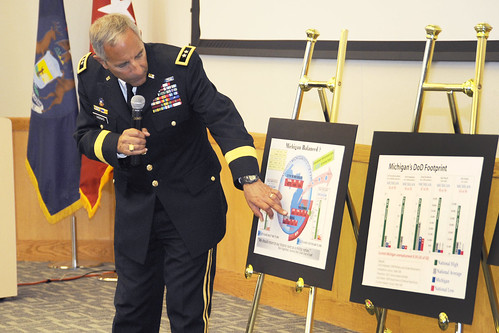
Major Gen. Gregory J. Vadnais, adjutant general of Michigan, makes a point during a Feb. 17, 2012, news conference at Selfridge Air National Guard Base, Mich. Vadnais spoke about the value the National Guard provides to the nation and the key role the Guard plays in national defense. (U.S. Air Force photo by John S. Swanson) Hi-res
2/17/2012 - SELFRIDGE AIR NATIONAL GUARD BASE, Mich. -- A strong militia makes for a strong America, Michigan's top soldier said today.
And Major Gen. Gregory J. Vadnais aims to keep it that way.
Vadnais, the adjutant general of Michigan's Army and Air National Guard, is seeking to maintain the current levels of personnel, aircraft and mission assignments in Michigan - possibly seeking to grow those numbers - even in the face of overall declines in the nation's military spending.
"Put simply, it makes the most economic sense for our nation to put more of its resources into the National Guard, rather than the active duty force," the general said during a Feb. 17, 2012, news conference at Selfridge Air National Guard Base.
During the news conference, the general pointed out that the total cost of operating a squadron of 24 A-10 Thunderbolt II attack aircraft in an Air National Guard unit is about $26 million per year. The same squadron in an active duty Air Force unit costs about $52 million per year - almost exactly twice as much.
The Air Guard's 127th Wing flies A-10s at Selfridge, but that unit, the 107th Fighter Squadron and its various supporting elements, is scheduled to be eliminated as part of an Air Force plan to reduce the number of A-10s in the overall inventory. That plan, along with a plan to eliminate a squadron of cargo aircraft slated to locate at a base in Battle Creek, Mich., will eliminate about 630 jobs in the Michigan Air National Guard - about a quarter of the total positions in the organization.
"The loss of the A-10 squadron at Selfridge air National Guard Base would be detrimental to the entire area," said Macomb County Executive Mark Hackel, one of several local elected and community leaders who attended Vadnais' news conference in a show of support for local Airmen. "Hundreds of jobs would be eliminated as a result of the plan, causing economic hardship to local families."
As the general spoke at Selfridge, a pair of A-10s were preparing to fly on a training mission. The pilots, engine mechanics, weapons loaders, crew chiefs and related A-10 personnel from Selfridge recently returned home after a 4-month deployment in Afghanistan. The 325 or so personnel who participated in that deployment have resumed a regular training schedule at the base, even in light of proposed cuts to their organization, to be ready to answer the next call.
Elsewhere on the base, Airmen from the Michigan Air National Guard's KC-135 Stratotanker unit, the 171st Air Refueling Squadron, are packing up to leave later in the month for a deployment to the Pacific Ocean region. Under the current Air Force proposals, an additional four KC-135s are to be stationed at Selfridge, in addition to the eight currently at the base.
"Our fighter squadron, our tanker squadron, civil engineers, security police - you name the squadron, they have been deployed time and time again and have served this nation well," said Col. Michael Thomas, the 127th Wing commander at Selfridge. "We sent our fighters into the sky on Sept. 11, 2001, and it has not stopped since. Our people are highly-trained, highly-motivated, and to say we are highly-experienced is an understatement."
Vadnais said he is also making a case to the nation's elected leaders in Washington D.C. that Michigan has borne too much of the brunt of past military reductions and that, with the Great Lakes State still recovering from a recession and the restructuring of the auto industry, making cuts to the military spending is simply unfair to the residents of the state.
Three major Air Force bases have closed in the state since 1977 and an Army garrison closed in 2005. Meanwhile, Vadnais said, Michigan ranks last among the 50 states in the number of Dept. of Defense employees and the per capita DoD payroll in the state.
"We all understand that the nation has to reduce spending. We get that. We are taxpayers, too," Vadnais said. "But what I am asking for is two things - fairness in who is sharing in the pain of any cuts and doing what makes the most economic sense for the nation as a whole. And that means keeping and strengthening our low-cost, well-trained forces in the National Guard."
Source
Friday, February 17, 2012
81st Fighter Squadron have been identified as the overseas A-10C squadron to be retired
By Joachim Jacob, Warthog News Editor
I'ts official now: The 81st Fighter Squadron, 52nd Fighter Wing (USAFE), Spangdahlem AB, Germany, have been identified for inactivation in fiscal year 2013.
On Thursday, the Pentagon released additional details about planned reductions in the U.S. military presence in Europe as part of a budget-cutting drive.
One of the changes: Deactivate the 81st Fighter Squadron of A-10 aircraft at Spangdahlem Air Base, Germany, during 2013. The change will affect about 525 U.S. airmen, who will be reassigned based on the needs of the Air Force.
Related news coverage:
By Jill Laster - Staff writer
Air Force Times
Posted: Thursday Feb 16, 2012 16:03:48 EST
The Air Force will lose an A-10 squadron in Germany as well as an air control squadron in Italy as part of proposed budget cuts in fiscal 2013, a senior defense official said Thursday.
The 81st Fighter Squadron at Spangdahlem Air Base, Germany, would be inactivated under the Air Force's plan, eliminating 20 A-10s and 525 airmen's positions. The 603rd Air Control Squadron at Aviano Air Base, Italy, would also be cut along with 336 positions.
The defense official, speaking to reporters on background during a press briefing, said the U.S. plans to reduce its force numbers in Europe from 80,000 to 70,000 over the next five years. Those cuts include the loss of two Army brigades and 2,500 soldiers in Germany.
Source
by Staff Reports
52nd Fighter Wing Public Affairs
2/17/2012 - SPANGDHALEM AIR BASE, Germany -- Air Force Secretary Michael B. Donley and Air Force Chief of Staff Gen. Norton A. Schwartz announced detailed force structure changes to take effect in Fiscal Year 2013 at a press conference at the Pentagon Feb. 3.
The Air Force will cut 286 aircraft to include 123 fighters, 133 mobility aircraft and 30 intelligence, surveillance and reconnaissance platforms. Among the fighter aircraft that will be retired are 102 A-10 Thunderbolt IIs, and this reduction includes the A-10s of the 81st Fighter Squadron.
According to the USAF Force Structure Changes: Sustaining Readiness and Modernizing the Total Force white paper, [Air Force leadership] has accepted the risk in our Combat Air Forces by retiring or reclassifying aircraft from seven squadrons: five A-10 squadrons, one F-16 squadron and one training/support coded F-15 Aggressor squadron.
"There are still going to be 246 A-10s left in the inventory," Schwartz said. "We are doing close-air support with B-52s, with B-1s, certainly with F-16s and F-15s and AC-130 gunships."
The bottom line, he said, is there are plenty of assets that can deliver pinpoint close-air support.
"The United States Army and the United States Marine Corps and our own battlefield Airmen can rely on having plenty of close-air support provided by the United States Air Force from above," the general said.
These force structure changes mean a reduction of 9,000 Airmen - 3,900 active duty, 5,100 Air Guardsmen and 900 Air Force Reservists. Officials expect all these reductions can be made voluntarily.
Even though the Panthers have been identified as the overseas A-10 squadron to be retired, Col. Chris Weggeman, 52nd Fighter Wing commander, says the future of Spangdahlem AB still remains bright.
"As a service, we've been opening and closing squadrons for more than 60 years in response to the demands of time, and our base has weathered these storms along the way," he said.
The colonel also stressed that regardless of the type and number of aircraft assigned to the wing, "we have a massive capacity to provide ready and responsive combat power around the globe as recently demonstrated during Operation Odyssey Dawn."
The colonel equated the change to a smart tablet or phone with a robust capacity to support people during their daily lives by adding and subtracting a multitude of "apps" to meet individual needs.
"Spangdahlem will continue to be that smart tablet or phone," he said. "What the Air Force will continue to do is change the 'apps' we're running to ensure the greatest capability and capacity exists for us to achieve enduring mission success.
"The mighty Saber nation remains a strong and vital part of our U.S. Air Forces in Europe arsenal in the Eifel thanks to the dedication, strength and flexibility of our German-American friendship ... dare I say no one comes close!"
For more information on service changes or the Fiscal Year 2013 budget announced Feb. 13, visit http://www.af.mil or http://www.spangdahlem.af.mil.
(Editor's Note: Information used in this article came from Jim Garamone, American Forces Press Service.)
Source
from U.S. Air Forces in Europe Public Affairs
2/17/2012 - WASHINGTON (AFNS) -- The Air Force released its fiscal 2013 budget Feb. 13 and stressed the need for difficult budgetary cuts to meet the new defense strategy while maintaining the service's agility, flexibility and readiness. These cuts include several impacts to force structure in Europe.
The Air Force is requesting $154.3 billion in the president's 2013 budget, a reduction of five percent from the $162.5 billion the service received in fiscal 2012. The impact of this reduction to U.S. Air Forces in Europe will include the inactivation of the 81st Fighter Squadron at Spangdahlem Air Base and the retirement of its 20 A-10 fighter aircraft. The Air Control Squadron at Aviano Air Base in Italy will also inactivate. More details on Air Force wide force structure changes and the impact to personnel will be announced in March. Both units will inactivate by the end of Fiscal Year 2013.
According to officials at U.S. European Command, the United States has an enduring interest in supporting peace, prosperity, unity and freedom in Europe, as well as bolstering the strength and vitality of NATO. Despite the announced force structure changes, the U.S. will maintain a robust military presence in Europe.
Budget reductions affect the entire Department of Defense and according to Maj. Gen. Edward L. Bolton Jr., the deputy assistant secretary for budget, "The Air Force made some very difficult choices. But it was our priority to tightly align with the new strategy and also stay within the fiscal environment as a result of the realities we are facing economically."
The Air Force Strategic Choices and Budget Priorities paper, released by Secretary of the Air Force Michael Donley and Air Force Chief of Staff Gen. Norton Schwartz on Jan. 27, calls for streamlining of the force, making it smaller and more efficient with care to not create a hollow force.
While the Air Force is working to adjust to a new strategic environment, the Commander of U.S. Air Forces in Europe emphasized the continuing importance of USAFE's forward presence.
"Despite the changes to our force structure and budget, close cooperation with Europe remains key to our national security strategy, and USAFE is a major part of that," said Gen. Mark A. Welsh III. "We are strategically located and provide critical capabilities to NATO, EUCOM, AFRICOM and CENTCOM. From mobility, to communications, to logistics, to command and control, to contingency response ... USAFE remains vital."
Under the Budget Control Act, the Department of Defense is required to reduce expenditures by $487 billion over the next 10 years with a reduction of $259 billion over the next five.
"It is worth noting that our budget has reduced by 12 percent in real terms since FY09," Bolton said. "So we have seen a consistent trend of reductions in the budget.
"The Air Force budget portion of the Budget Control Act reductions over the next five years is $54 billion," Bolton said.
The Air Force's portion is not a result of simply dividing responsibility between the services. Instead, the budget amount is strategy driven, while maintaining a properly equipped force with the ability to deter, deny and defeat an opportunistic aggressor in a combined campaign anytime, anywhere, he added.
"The strategy requires a different force structure and different tools; the Air Force is realigning the total force to address the future," Bolton said.
The service has drawn down many times in the past, but never as a nation still at war. Previous size reductions focused more on maintaining force structure, which left the Air Force with a hollow force, he said.
"It is really about balancing risk among the themes of force structure, readiness, modernization and taking care of our people," Bolton said. "We have sized the force to the strategy within the fiscal constraints we are facing."
The Air Force is looking at a nearly $3 billion reduction in procurement cost because the service divested and is purchasing less hardware. Also, there is a reduction of about $500 million in research, development, testing and evaluation, but the Air Force continued its focus on modernizing key components that will maintain the service's technological edge, Bolton said.
"Funding for intelligence, surveillance and reconnaissance and space remain a priority," he added. "We will continue to develop programs in ISR ensuring we are supplying this skill set to the joint warfighter and coalition partners."
According to Bolton, funding also remains in place for the F-35 Lightning II joint strike fighter -- the centerpiece for future modernization to be able to prevail in contested environments.
"Ensuring fiscal goals are met and fleet modernization continues are only half of the goal in the new strategy," said Bolton. "Taking care of Airmen and their families is a key component and cannot get lost in talking of mere numbers.
"We are reducing the force by 9,900 Airmen, which will reduce the end strength of active duty, Guard and Reserve to around a 501,000 total force," he said. "This allows us to appropriately size the force structure to the strategy and hardware we are going to have in the inventory."
The Air Force is proposing a 1.7 percent military pay raise in fiscal 2013 and a 4.2 percent raise in basic allowance for housing and 3.4 percent raise in the basic allowance for subsistence as a continuing growth of compensation for service.
"We are budgeting more than $700 million for family programs including child and youth programs and child development centers," Bolton said. "We will continue to take care of our folks; we just need to ensure it is being done efficiently under tighter fiscal constraints."
Housing is a key ingredient to taking care of Airmen and the Air Force is close to reaching its goal of 53,000 privatized housing units force-wide with over 40,000 units in place and the remaining units to be ready in fiscal 2013.
"We've increased our family housing budget by $93 million and this will allow us to meet our goal," Bolton said. "Completing this transition is important because we have found through privatization we are able to increase the quality of housing for our Airmen and their families."
Looking back to the 2011 requirements -- military action and support in Iraq and Afghanistan, supporting NATO missions in Libya, along with humanitarian support to Japan following a major earthquake -- Bolton reinforced the reach and responsibility placed on today's Airmen and emphasized the importance of providing them the tools required for a versatile force.
"We will continue to do everything we can to provide them with the tools they need to continue to be the best Air Force in the world for decades to come," Bolton said.
Editor's note: The U.S. Air Force Public Affairs Agency, USAFE Public Affairs and EUCOM Public Affairs contributed to this story
Source
Commentary by Gen. Mark A. Welsh III
U.S. Air Forces in Europe commander
2/17/2012 - RAMSTEIN AIR BASE, Germany -- Since the first Gulf War, the U.S. has been engaged continuously in combat operations and U.S. Air Forces in Europe have played a critical role. Not only have we deployed thousands of our Airmen and assets, we have also served as an essential support platform enabling the long-term projection and sustainment of combat power throughout the U.S. Euprean Command, Central Command and Africa Command areas of responsibility. At the same time, NATO has increased both in size and scope of operations. Through all this, USAFE has steadily increased engagement and strengthened relations with our partners and Allies. We demonstrate the value of forward-based forces every day.
However, our challenges today are many and changing: a global economic slowdown, shrinking defense budgets, continuing operations in Afghanistan and the rise of missile threats to the U.S. and our allies. We're also witnessing a significant transition in the command's mission as we inactivate 17th Air Force and assume the role of air component to U.S. Africa Command in addition to our traditional role as the air component to U.S. European Command. We must meet these challenges head on to maintain our effectiveness and capabilities within a much larger area of responsibility.
Dealing with the same challenges on a global scale, the Department of Defense recently concluded a thorough review of our defense strategy and has begun a transition to a new approach that emphasizes future challenges, supports federal deficit reduction, and accounts for the declining costs of operations in Iraq and Afghanistan. Operating within constrained budgets is simply a reality. On February 13, the President presented a proposed budget to Congress that reflects these strategic changes and reductions, and includes a reduction of about $8 billion, or about 5%, in FY13 for the Air Force. Over the next 10 years, the DoD will need to cut more than $487 billion; $54 billion will come from Air Force accounts. Further, within the next year, the Air Force will bring the Total Force end strength down by around 9,900 Airmen.
What do these reductions and strategy changes mean for USAFE?
For the DoD and the entire Air Force, all of this means a shift in focus and a change in how we do business. Our senior leaders, including the President, have determined that our national focus needs to emphasize Asia and the Middle East. However, the new strategy also calls for continued engagement in Europe and Africa. As recent operations in Libya proved, USAFE's forward presence and close relationships within NATO and throughout our entire area of responsibility are of critical importance.
We must also target investments to ensure we have the resources to execute the missions of the future. We will be smaller, but we will be effective and well-trained. Let me be clear, even with these budget cuts, our military and our Air Force are by far the best resourced, best trained and best equipped in the world. We can and will adapt to the new paradigm. And as we always have in the past, we will meet these challenges head on.
Of course, changes to our strategic focus and reductions in Defense spending will change how USAFE looks in the future. The 81st Fighter Squadron at Spangdahlem will be inactivated as part of an overall reduction of five A-10 squadrons. In addition, the 603rd Air Control Squadron at Aviano will be inactivated. While personnel reductions Air Force wide will often hit close to home, what that means for USAFE is still unclear.
However, this is not just about downsizing. It's about adapting to a changing environment. As Ballistic Missile Defense becomes more critical, our investment and participation in Integrated Air and Missile Defense in theater is increasing. We are also taking a hard look at all of our installations to ensure we are operating efficiently at every location and that we are postured to support future operations. There are certainly more changes to come, but we will work through them all carefully and we will ensure our people are taken care of.
The bottom line: USAFE has been and will remain critical to our national defense strategy. We have an expanding mission in terms of geography and operations, and the new strategy will continue to draw heavily on our forces and our enduring capabilities -- mobility access and throughput; communications throughput; logistical support and throughput; contingency response; and command and control in Intelligence, Surveillance and Reconnaissance, Air Operations, ballistic missile defense, and humanitarian response. We will also continue to rely on and partner with our close friends and Allies, especially those who host our bases, personnel and families.
I know change is never fun, but it is necessary ... it is an opportunity to get better at what we do and there is no doubt in my mind that we will. As we move into the future together, let me thank you for all you do to ensure freedom's future.
Additional Info
The FY13 budget overview available on-line at http://www.saffm.hq.af.mil/budget/ provides a great look at many of the efforts we will continue to pursue from training, to building partnerships, to supporting our Allies, and more.
Source
See also:
Panetta Outlines U.S. Troop Changes in Europe
Pentagon lays out significant cuts to U.S. forces in Europe
USEUCOM Releases Command Statement on Force Posture
Please note: This breaking news will be further updated soon.
I'ts official now: The 81st Fighter Squadron, 52nd Fighter Wing (USAFE), Spangdahlem AB, Germany, have been identified for inactivation in fiscal year 2013.
On Thursday, the Pentagon released additional details about planned reductions in the U.S. military presence in Europe as part of a budget-cutting drive.
One of the changes: Deactivate the 81st Fighter Squadron of A-10 aircraft at Spangdahlem Air Base, Germany, during 2013. The change will affect about 525 U.S. airmen, who will be reassigned based on the needs of the Air Force.
Related news coverage:
Spangdahlem A-10 squadron to shut down
By Jill Laster - Staff writer
Air Force Times
Posted: Thursday Feb 16, 2012 16:03:48 EST
The Air Force will lose an A-10 squadron in Germany as well as an air control squadron in Italy as part of proposed budget cuts in fiscal 2013, a senior defense official said Thursday.
The 81st Fighter Squadron at Spangdahlem Air Base, Germany, would be inactivated under the Air Force's plan, eliminating 20 A-10s and 525 airmen's positions. The 603rd Air Control Squadron at Aviano Air Base, Italy, would also be cut along with 336 positions.
The defense official, speaking to reporters on background during a press briefing, said the U.S. plans to reduce its force numbers in Europe from 80,000 to 70,000 over the next five years. Those cuts include the loss of two Army brigades and 2,500 soldiers in Germany.
Source
Force structure changes hit 52nd Fighter Wing
by Staff Reports
52nd Fighter Wing Public Affairs
2/17/2012 - SPANGDHALEM AIR BASE, Germany -- Air Force Secretary Michael B. Donley and Air Force Chief of Staff Gen. Norton A. Schwartz announced detailed force structure changes to take effect in Fiscal Year 2013 at a press conference at the Pentagon Feb. 3.
The Air Force will cut 286 aircraft to include 123 fighters, 133 mobility aircraft and 30 intelligence, surveillance and reconnaissance platforms. Among the fighter aircraft that will be retired are 102 A-10 Thunderbolt IIs, and this reduction includes the A-10s of the 81st Fighter Squadron.
According to the USAF Force Structure Changes: Sustaining Readiness and Modernizing the Total Force white paper, [Air Force leadership] has accepted the risk in our Combat Air Forces by retiring or reclassifying aircraft from seven squadrons: five A-10 squadrons, one F-16 squadron and one training/support coded F-15 Aggressor squadron.
"There are still going to be 246 A-10s left in the inventory," Schwartz said. "We are doing close-air support with B-52s, with B-1s, certainly with F-16s and F-15s and AC-130 gunships."
The bottom line, he said, is there are plenty of assets that can deliver pinpoint close-air support.
"The United States Army and the United States Marine Corps and our own battlefield Airmen can rely on having plenty of close-air support provided by the United States Air Force from above," the general said.
These force structure changes mean a reduction of 9,000 Airmen - 3,900 active duty, 5,100 Air Guardsmen and 900 Air Force Reservists. Officials expect all these reductions can be made voluntarily.
Even though the Panthers have been identified as the overseas A-10 squadron to be retired, Col. Chris Weggeman, 52nd Fighter Wing commander, says the future of Spangdahlem AB still remains bright.
"As a service, we've been opening and closing squadrons for more than 60 years in response to the demands of time, and our base has weathered these storms along the way," he said.
The colonel also stressed that regardless of the type and number of aircraft assigned to the wing, "we have a massive capacity to provide ready and responsive combat power around the globe as recently demonstrated during Operation Odyssey Dawn."
The colonel equated the change to a smart tablet or phone with a robust capacity to support people during their daily lives by adding and subtracting a multitude of "apps" to meet individual needs.
"Spangdahlem will continue to be that smart tablet or phone," he said. "What the Air Force will continue to do is change the 'apps' we're running to ensure the greatest capability and capacity exists for us to achieve enduring mission success.
"The mighty Saber nation remains a strong and vital part of our U.S. Air Forces in Europe arsenal in the Eifel thanks to the dedication, strength and flexibility of our German-American friendship ... dare I say no one comes close!"
For more information on service changes or the Fiscal Year 2013 budget announced Feb. 13, visit http://www.af.mil or http://www.spangdahlem.af.mil.
(Editor's Note: Information used in this article came from Jim Garamone, American Forces Press Service.)
Source
FY2013 budget cuts to impact U.S. Air Forces in Europe
from U.S. Air Forces in Europe Public Affairs
2/17/2012 - WASHINGTON (AFNS) -- The Air Force released its fiscal 2013 budget Feb. 13 and stressed the need for difficult budgetary cuts to meet the new defense strategy while maintaining the service's agility, flexibility and readiness. These cuts include several impacts to force structure in Europe.
The Air Force is requesting $154.3 billion in the president's 2013 budget, a reduction of five percent from the $162.5 billion the service received in fiscal 2012. The impact of this reduction to U.S. Air Forces in Europe will include the inactivation of the 81st Fighter Squadron at Spangdahlem Air Base and the retirement of its 20 A-10 fighter aircraft. The Air Control Squadron at Aviano Air Base in Italy will also inactivate. More details on Air Force wide force structure changes and the impact to personnel will be announced in March. Both units will inactivate by the end of Fiscal Year 2013.
According to officials at U.S. European Command, the United States has an enduring interest in supporting peace, prosperity, unity and freedom in Europe, as well as bolstering the strength and vitality of NATO. Despite the announced force structure changes, the U.S. will maintain a robust military presence in Europe.
Budget reductions affect the entire Department of Defense and according to Maj. Gen. Edward L. Bolton Jr., the deputy assistant secretary for budget, "The Air Force made some very difficult choices. But it was our priority to tightly align with the new strategy and also stay within the fiscal environment as a result of the realities we are facing economically."
The Air Force Strategic Choices and Budget Priorities paper, released by Secretary of the Air Force Michael Donley and Air Force Chief of Staff Gen. Norton Schwartz on Jan. 27, calls for streamlining of the force, making it smaller and more efficient with care to not create a hollow force.
While the Air Force is working to adjust to a new strategic environment, the Commander of U.S. Air Forces in Europe emphasized the continuing importance of USAFE's forward presence.
"Despite the changes to our force structure and budget, close cooperation with Europe remains key to our national security strategy, and USAFE is a major part of that," said Gen. Mark A. Welsh III. "We are strategically located and provide critical capabilities to NATO, EUCOM, AFRICOM and CENTCOM. From mobility, to communications, to logistics, to command and control, to contingency response ... USAFE remains vital."
Under the Budget Control Act, the Department of Defense is required to reduce expenditures by $487 billion over the next 10 years with a reduction of $259 billion over the next five.
"It is worth noting that our budget has reduced by 12 percent in real terms since FY09," Bolton said. "So we have seen a consistent trend of reductions in the budget.
"The Air Force budget portion of the Budget Control Act reductions over the next five years is $54 billion," Bolton said.
The Air Force's portion is not a result of simply dividing responsibility between the services. Instead, the budget amount is strategy driven, while maintaining a properly equipped force with the ability to deter, deny and defeat an opportunistic aggressor in a combined campaign anytime, anywhere, he added.
"The strategy requires a different force structure and different tools; the Air Force is realigning the total force to address the future," Bolton said.
The service has drawn down many times in the past, but never as a nation still at war. Previous size reductions focused more on maintaining force structure, which left the Air Force with a hollow force, he said.
"It is really about balancing risk among the themes of force structure, readiness, modernization and taking care of our people," Bolton said. "We have sized the force to the strategy within the fiscal constraints we are facing."
The Air Force is looking at a nearly $3 billion reduction in procurement cost because the service divested and is purchasing less hardware. Also, there is a reduction of about $500 million in research, development, testing and evaluation, but the Air Force continued its focus on modernizing key components that will maintain the service's technological edge, Bolton said.
"Funding for intelligence, surveillance and reconnaissance and space remain a priority," he added. "We will continue to develop programs in ISR ensuring we are supplying this skill set to the joint warfighter and coalition partners."
According to Bolton, funding also remains in place for the F-35 Lightning II joint strike fighter -- the centerpiece for future modernization to be able to prevail in contested environments.
"Ensuring fiscal goals are met and fleet modernization continues are only half of the goal in the new strategy," said Bolton. "Taking care of Airmen and their families is a key component and cannot get lost in talking of mere numbers.
"We are reducing the force by 9,900 Airmen, which will reduce the end strength of active duty, Guard and Reserve to around a 501,000 total force," he said. "This allows us to appropriately size the force structure to the strategy and hardware we are going to have in the inventory."
The Air Force is proposing a 1.7 percent military pay raise in fiscal 2013 and a 4.2 percent raise in basic allowance for housing and 3.4 percent raise in the basic allowance for subsistence as a continuing growth of compensation for service.
"We are budgeting more than $700 million for family programs including child and youth programs and child development centers," Bolton said. "We will continue to take care of our folks; we just need to ensure it is being done efficiently under tighter fiscal constraints."
Housing is a key ingredient to taking care of Airmen and the Air Force is close to reaching its goal of 53,000 privatized housing units force-wide with over 40,000 units in place and the remaining units to be ready in fiscal 2013.
"We've increased our family housing budget by $93 million and this will allow us to meet our goal," Bolton said. "Completing this transition is important because we have found through privatization we are able to increase the quality of housing for our Airmen and their families."
Looking back to the 2011 requirements -- military action and support in Iraq and Afghanistan, supporting NATO missions in Libya, along with humanitarian support to Japan following a major earthquake -- Bolton reinforced the reach and responsibility placed on today's Airmen and emphasized the importance of providing them the tools required for a versatile force.
"We will continue to do everything we can to provide them with the tools they need to continue to be the best Air Force in the world for decades to come," Bolton said.
Editor's note: The U.S. Air Force Public Affairs Agency, USAFE Public Affairs and EUCOM Public Affairs contributed to this story
Source
What the FY13 Budget means to USAFE
Commentary by Gen. Mark A. Welsh III
U.S. Air Forces in Europe commander
2/17/2012 - RAMSTEIN AIR BASE, Germany -- Since the first Gulf War, the U.S. has been engaged continuously in combat operations and U.S. Air Forces in Europe have played a critical role. Not only have we deployed thousands of our Airmen and assets, we have also served as an essential support platform enabling the long-term projection and sustainment of combat power throughout the U.S. Euprean Command, Central Command and Africa Command areas of responsibility. At the same time, NATO has increased both in size and scope of operations. Through all this, USAFE has steadily increased engagement and strengthened relations with our partners and Allies. We demonstrate the value of forward-based forces every day.
However, our challenges today are many and changing: a global economic slowdown, shrinking defense budgets, continuing operations in Afghanistan and the rise of missile threats to the U.S. and our allies. We're also witnessing a significant transition in the command's mission as we inactivate 17th Air Force and assume the role of air component to U.S. Africa Command in addition to our traditional role as the air component to U.S. European Command. We must meet these challenges head on to maintain our effectiveness and capabilities within a much larger area of responsibility.
Dealing with the same challenges on a global scale, the Department of Defense recently concluded a thorough review of our defense strategy and has begun a transition to a new approach that emphasizes future challenges, supports federal deficit reduction, and accounts for the declining costs of operations in Iraq and Afghanistan. Operating within constrained budgets is simply a reality. On February 13, the President presented a proposed budget to Congress that reflects these strategic changes and reductions, and includes a reduction of about $8 billion, or about 5%, in FY13 for the Air Force. Over the next 10 years, the DoD will need to cut more than $487 billion; $54 billion will come from Air Force accounts. Further, within the next year, the Air Force will bring the Total Force end strength down by around 9,900 Airmen.
What do these reductions and strategy changes mean for USAFE?
For the DoD and the entire Air Force, all of this means a shift in focus and a change in how we do business. Our senior leaders, including the President, have determined that our national focus needs to emphasize Asia and the Middle East. However, the new strategy also calls for continued engagement in Europe and Africa. As recent operations in Libya proved, USAFE's forward presence and close relationships within NATO and throughout our entire area of responsibility are of critical importance.
We must also target investments to ensure we have the resources to execute the missions of the future. We will be smaller, but we will be effective and well-trained. Let me be clear, even with these budget cuts, our military and our Air Force are by far the best resourced, best trained and best equipped in the world. We can and will adapt to the new paradigm. And as we always have in the past, we will meet these challenges head on.
Of course, changes to our strategic focus and reductions in Defense spending will change how USAFE looks in the future. The 81st Fighter Squadron at Spangdahlem will be inactivated as part of an overall reduction of five A-10 squadrons. In addition, the 603rd Air Control Squadron at Aviano will be inactivated. While personnel reductions Air Force wide will often hit close to home, what that means for USAFE is still unclear.
However, this is not just about downsizing. It's about adapting to a changing environment. As Ballistic Missile Defense becomes more critical, our investment and participation in Integrated Air and Missile Defense in theater is increasing. We are also taking a hard look at all of our installations to ensure we are operating efficiently at every location and that we are postured to support future operations. There are certainly more changes to come, but we will work through them all carefully and we will ensure our people are taken care of.
The bottom line: USAFE has been and will remain critical to our national defense strategy. We have an expanding mission in terms of geography and operations, and the new strategy will continue to draw heavily on our forces and our enduring capabilities -- mobility access and throughput; communications throughput; logistical support and throughput; contingency response; and command and control in Intelligence, Surveillance and Reconnaissance, Air Operations, ballistic missile defense, and humanitarian response. We will also continue to rely on and partner with our close friends and Allies, especially those who host our bases, personnel and families.
I know change is never fun, but it is necessary ... it is an opportunity to get better at what we do and there is no doubt in my mind that we will. As we move into the future together, let me thank you for all you do to ensure freedom's future.
Additional Info
The FY13 budget overview available on-line at http://www.saffm.hq.af.mil/budget/ provides a great look at many of the efforts we will continue to pursue from training, to building partnerships, to supporting our Allies, and more.
Source
See also:
Panetta Outlines U.S. Troop Changes in Europe
Pentagon lays out significant cuts to U.S. forces in Europe
USEUCOM Releases Command Statement on Force Posture
Please note: This breaking news will be further updated soon.
Wednesday, February 15, 2012
The Fort Report: Col. David Augustine, commander of the 122nd Fighter Wing
The News-Sentinel
Sunday, February 12, 2012 - 12:35 pm
In this week's Fort Report, Kevin Leininger of The News-Sentinel speaks with Col. David Augustine, commander of the 122nd Fighter Wing at Fort Wayne International Airport's Air National Guard base, about the base's proposed transition from A-10s to a new type of aircraft.
Source
Watch the video in a very better resolution on YouTube:
Source
Sunday, February 12, 2012 - 12:35 pm
In this week's Fort Report, Kevin Leininger of The News-Sentinel speaks with Col. David Augustine, commander of the 122nd Fighter Wing at Fort Wayne International Airport's Air National Guard base, about the base's proposed transition from A-10s to a new type of aircraft.
Source
Watch the video in a very better resolution on YouTube:
Source
Plans to cut Guard drawing flak from lawmakers
By Jill Laster, Staff writer
Air Force Times
Posted: Tuesday Feb 14, 2012 12:12:51 EST
The Air Force's proposal to cut more than 5,000 personnel and scores of aircraft from its Guard component is hitting turbulence from lawmakers and state-level Guard officials, who say the service should reconsider where it cuts.
About 5,100 guardsmen would be cut in fiscal 2013 if the service's proposal is approved on Capitol Hill, and a number of aircraft would be sold or scrapped over the next few years — including about 60 of the Guard's A-10s, a service workhorse used for close-air support.
Several state-level National Guard leaders say they don't see the logic behind the Air Force's proposal, and that all but top Guard leadership was left out of the decision-making process.
"This, to me, is totally out of character with the operating environment between the Air Force Reserve, the Air Guard and the active Air Force," said Maj. Gen. William Wofford, adjutant general of the Arkansas National Guard. "Before, [the Guard] was always a full partner in the process, and this time it doesn't feel like a partnership."
Arkansas stands to lose about 20 A-10s belonging to the 188th Fighter Wing in Fort Smith, Ark. Local government officials also started a website, which asks supporters to write Defense Secretary Leon Panetta and ask him to spare the fighter wing.
One argument used by opponents of the Air Force's proposal is that it echoes Cold War-era thinking — that the U.S. needs a large standing military meant to fight a looming threat — and that doesn't make sense during a drawdown.
Another is that the Air Force would spend less money by keeping a greater proportion of its aircraft and troops in the Guard. Maj. Gen. Gregory Vadnais, Michigan's adjutant general, said it doesn't make sense to cut the Guard versus the active-duty component when the Guard and guardsmen cost less.
"All I can tell you is, I'm sure not feeling the love," Vadnais said. "After 10 years of war together, honestly, it's just disappointing that that's the perspective. If I could get there logically and it made sense, I could say, 'OK, I don't like it.' I can't get there."
The Air Force announced Feb. 3 which units and aircraft would be trimmed from the service in coming years. But whether the changes will stick as the Defense Department budget makes its way through Congress remains to be seen. Within hours of Air Force leaders unveiling their proposed cuts, multiple members of Congress posted scathing rebuttals of the Air Force's plan on their websites.
The co-chairs of the Senate National Guard Caucus — Sens. Patrick Leahy, D-Vt., and Lindsey Graham, R-S.C. — also took to the Senate floor Feb. 9 to criticize cuts that Graham called "Draconian."
"We have the best of both worlds now: a very efficient, quite frankly cheaper force to maintain with very similar, if not like, capabilities," Graham said in comparing the Air National Guard with the active-duty force, "and we don't want to let that concept be eroded here by a plan that I think doesn't appreciate the role of the militia and doesn't appreciate the cost-benefit analysis from a robust reserve component."
But Air Force Chief of Staff Gen. Norton Schwartz said during a Feb. 9 speech that the active and reserve components have worked closely together, and will continue to work together, on cuts the service must make over the next few years. He added that the service has taken risks it "deems acceptable and manageable.
"We have no illusions that the road ahead is going to be easy, as I discovered this morning on the Hill," Schwartz said at a forum hosted by the Center for Strategic and International Studies, a Washington, D.C. think tank. "But I do think it's manageable if — if — we all deal with this in an unemotional fashion."
Source
Please note: This news article has been already shared on 188th Fighter Wing's official Facebook page with the following statement:
Major Gen. William Wofford, adjutant general of the Arkansas National Guard, expresses his sentiments concerning potential Air Force budget cuts in this Air Force Times story: "This, to me, is totally out of character with the operating environment between the Air Force Reserve, the Air Guard and the active Air Force," General Wofford said. "Before, [the Guard] was always a full partner in the process, and this time it doesn't feel like a partnership."
Air Force Times
Posted: Tuesday Feb 14, 2012 12:12:51 EST
The Air Force's proposal to cut more than 5,000 personnel and scores of aircraft from its Guard component is hitting turbulence from lawmakers and state-level Guard officials, who say the service should reconsider where it cuts.
About 5,100 guardsmen would be cut in fiscal 2013 if the service's proposal is approved on Capitol Hill, and a number of aircraft would be sold or scrapped over the next few years — including about 60 of the Guard's A-10s, a service workhorse used for close-air support.
Several state-level National Guard leaders say they don't see the logic behind the Air Force's proposal, and that all but top Guard leadership was left out of the decision-making process.
"This, to me, is totally out of character with the operating environment between the Air Force Reserve, the Air Guard and the active Air Force," said Maj. Gen. William Wofford, adjutant general of the Arkansas National Guard. "Before, [the Guard] was always a full partner in the process, and this time it doesn't feel like a partnership."
Arkansas stands to lose about 20 A-10s belonging to the 188th Fighter Wing in Fort Smith, Ark. Local government officials also started a website, which asks supporters to write Defense Secretary Leon Panetta and ask him to spare the fighter wing.
One argument used by opponents of the Air Force's proposal is that it echoes Cold War-era thinking — that the U.S. needs a large standing military meant to fight a looming threat — and that doesn't make sense during a drawdown.
Another is that the Air Force would spend less money by keeping a greater proportion of its aircraft and troops in the Guard. Maj. Gen. Gregory Vadnais, Michigan's adjutant general, said it doesn't make sense to cut the Guard versus the active-duty component when the Guard and guardsmen cost less.
"All I can tell you is, I'm sure not feeling the love," Vadnais said. "After 10 years of war together, honestly, it's just disappointing that that's the perspective. If I could get there logically and it made sense, I could say, 'OK, I don't like it.' I can't get there."
The Air Force announced Feb. 3 which units and aircraft would be trimmed from the service in coming years. But whether the changes will stick as the Defense Department budget makes its way through Congress remains to be seen. Within hours of Air Force leaders unveiling their proposed cuts, multiple members of Congress posted scathing rebuttals of the Air Force's plan on their websites.
The co-chairs of the Senate National Guard Caucus — Sens. Patrick Leahy, D-Vt., and Lindsey Graham, R-S.C. — also took to the Senate floor Feb. 9 to criticize cuts that Graham called "Draconian."
"We have the best of both worlds now: a very efficient, quite frankly cheaper force to maintain with very similar, if not like, capabilities," Graham said in comparing the Air National Guard with the active-duty force, "and we don't want to let that concept be eroded here by a plan that I think doesn't appreciate the role of the militia and doesn't appreciate the cost-benefit analysis from a robust reserve component."
But Air Force Chief of Staff Gen. Norton Schwartz said during a Feb. 9 speech that the active and reserve components have worked closely together, and will continue to work together, on cuts the service must make over the next few years. He added that the service has taken risks it "deems acceptable and manageable.
"We have no illusions that the road ahead is going to be easy, as I discovered this morning on the Hill," Schwartz said at a forum hosted by the Center for Strategic and International Studies, a Washington, D.C. think tank. "But I do think it's manageable if — if — we all deal with this in an unemotional fashion."
Source
Please note: This news article has been already shared on 188th Fighter Wing's official Facebook page with the following statement:
Major Gen. William Wofford, adjutant general of the Arkansas National Guard, expresses his sentiments concerning potential Air Force budget cuts in this Air Force Times story: "This, to me, is totally out of character with the operating environment between the Air Force Reserve, the Air Guard and the active Air Force," General Wofford said. "Before, [the Guard] was always a full partner in the process, and this time it doesn't feel like a partnership."
Thursday, February 9, 2012
Guard chief will fight to keep 122nd's fighter jets
By Brian Francisco, Washington editor
The Journal Gazette
Last updated: February 9, 2012 9:47 a.m.

Maj. Gen. R. Martin Umbarger says the A-10s are "the best for us here." (Photo by Cathie Rowand, The Journal Gazette)
The head of the Indiana National Guard endorses the Pentagon's plan to reduce spending and retire aircraft. He just doesn't think Fort Wayne's Air National Guard base is a good place to do it.
Maj. Gen. R. Martin Umbarger vowed Wednesday to try to keep A-10 jet fighters stationed at the 122nd Fighter Wing on Ferguson Road rather than trade them in for intelligence aircraft.
The Department of Defense seeks to mothball 102 of its 348 A-10s as part of $487 billion in military spending cuts required by the Budget Control Act.
"We are in support of that. We're not taking on the Air Force on that," Umbarger said Wednesday during a news conference at the local base.
"We just say, why would you reduce those A-10s at an Air National Guard base when it is so cost-effective? We can be there when you need us," he said.
As an aircraft that blasts tanks and provides close-air support to ground troops, "it's the last plane you'd want to cut. That's on the tactical side," said Umbarger, a self-described "infantry guy."
And with the 122nd Fighter Wing costing only 28 cents for every tax dollar spent at an active-duty Air Force base – largely because the base uses civilian airmen and flies out of neighboring Fort Wayne International Airport – "that ought to carry the day," Umbarger said.
"I believe this is a dialogue that needs to go on with the Air Force to keep the A-10 fighter wing here in Fort Wayne," Indiana's adjutant general said.
Under a proposal unveiled last week, the Air Force would trim $50 billion in spending by sidelining 286 aircraft of various types and reducing its ranks by nearly 10,000 people, including 5,100 in the Air National Guard.
The 122nd Fighter Wing and Guard bases in Selfridge, Mich., and Fort Smith, Ark., would lose their A-10 squadrons – at least 20 planes at each base – and replace them with other craft.
Fort Wayne would receive nine to 11 MC-12W Liberty planes starting in October 2013. The twin-engine turboprop, which carries a crew of four, is used for intelligence, surveillance and reconnaissance.
"We are very thankful that we do have a mission of that type that will be here, and it's a very relevant mission," Umbarger said. "It's one that the Air Force is wanting to grow. We still feel like the A-10 mission is the best for us here."
He said the conversion likely would mean staffing cuts – "I do not think it will be large" – at the 122nd. About 1,200 people work there, 364 of them full time. Without the A-10s, the complex would no longer need to maintain the missiles, bombs and machine-gun rounds carried by the planes.
Col. David Augustine, the base commander, told reporters: "We've got an amazing infrastructure here for fighter airplanes. But should that (mission) turn, we could use that infrastructure for different airplanes."
The 189-acre base switched from the F-16 Fighting Falcon to the A-10 Thunderbolt II, nicknamed the Warthog, in the past three years.
"I thought that would give us a long and extended future to ultimately be able to compete for the F-35 Joint Strike Fighter," Umbarger said about the next generation of jet fighters.
The Greater Fort Wayne Chamber of Commerce and the Fort Wayne Base Community Council announced a letter-writing campaign Wednesday to keep the A-10 squadron. The letters are being sent to Secretary of Defense Leon Panetta and Air Force Secretary Michael Donley.
"The business community recognizes the economic importance of the 122nd Fighter Wing in our community," Chamber CEO Mike Landram said in a statement. "We are asking for their immediate help."
Augustine said last week the federal government spent more than $58 million on the fighter wing in fiscal year 2011, including $43.7 million in pay and benefits. The White House is expected to release its fiscal year 2013 budget proposal Monday. Republicans as well as Democrats in Congress have said they will fight military cuts.
Umbarger noted the 122nd recently received an Outstanding Unit Award from the National Guard Bureau, the fifth time it has won the honor.
"It's kind of ironic," Umbarger said, considering the base might face another conversion.
Source
More related info:
By Brian Francisco, The Journal Gazette
The Journal Gazette
Last updated: February 8, 2012 4:13 p.m.
FORT WAYNE -- The head of the Indiana National Guard vowed Wednesday to try to keep an attack jet squadron based in Fort Wayne.
Maj. Gen. R. Martin Umbarger told a group of media, local government officials and economic development leaders that the A-10 planes flown by the Air National Guard's 122nd Fighter Wing are both cost-efficient and valuable weapons.
"It's not just about Fort Wayne. It makes total sense for our Air Force; it makes total sense for our nation" to retain the A-10s in Fort Wayne and at Air National Guard bases in Michigan and Arkansas, Umbarger said at the local base.
The Air Force announced Friday it will retire more than 100 A-10s, including those at the 122nd Fighter Wing, which would convert to a base that flies intelligence aircraft.
As an aircraft used to support ground troops, "it's the last plane you'd want to cut," Umbarger said about the A-10 jet. "That's on the tactical side."
And because the 122nd Fighter Wing costs only 28 cents for every dollar spent at an active-duty Air Force base -- largely because the local fighter wing flies out of the neighboring Fort Wayne International Airport – "that ought to carry the day," Umbarger said.
The Fort Wayne base has been named the recipient of an outstanding-unit award given by the National Guard, the fifth such honor for the 122nd Fighter Wing, he added.
"I believe this is a dialogue that needs to go on with the Air Force to keep the A-10 fighter wing here in Fort Wayne," Umbarger said.
Last week's Air Force announcement about realignment of bases and personnel was part of the Pentagon's plan to cut $487 billion in spending during the next 10 years. The amount was mandated by the Budget Control Act approved last summer by Congress.
Under the plan, the Air Force would trim $50 billion in spending and would reduce personnel by 10,000 people, including 5,100 who are in the Air National Guard.
As part of the cuts, more than 100 of the A-10 planes would be retired, including 20 at each of three Air National Guard bases – Fort Wayne; Selfridge, Mich., and Fort Smith, Ark.
The 122nd Fighter Wing is among four Guard bases – the others are in Connecticut, Mississippi and Texas – that would begin flying the MC-12.
The MC-12 is a twin-engine propeller craft designed for intelligence, surveillance and reconnaissance missions. The A-10, which dates to the 1970s, is best known as a "tank buster" that supports combat troops on the ground with missiles, bombs and an armor-piercing machine-gun cannon.
In response to last week's announcement, the Greater Fort Wayne Chamber of Commerce and the Fort Wayne Base Community Council announced a letter-writing campaign Wednesday for Chamber members to show their support for keeping the A-10 squadron in town.
The letters will be sent to Secretary of Defense Leon Panetta and Air Force Secretary Michael Donley.
"The business community recognizes the economic importance of the 122nd Fighter Wing in our community," Chamber CEO Mike Landram said in a statement. "We are asking for their immediate help."
Col. David Augustine, local base commander, said last week the federal government spent more than $58 million on the fighter wing in fiscal year 2011, including $43.7 million in pay and benefits.
The White House is expected to release its fiscal year 2013 budget proposal Monday. Many members of Congress have said they will resist military cuts recommended by Panetta.
For more on this story, see Thursday's print edition of The Journal Gazette or visit www.journalgazette.net after 3 a.m. Thursday.
Source
See also:
The Associated Press
Posted : Wednesday Feb 8, 2012 18:33:07 EST
FORT WAYNE, Ind. — The head of the Indiana National Guard thinks the Air Force is making a mistake in removing A-10 fighter jets from the Fort Wayne base and replacing them with reconnaissance aircraft.
The Journal Gazette reports that Maj. Gen. R. Martin Umbarger told a news conference Wednesday he believes the Air Force should keep the A-10 Warthogs not only in Fort Wayne, but elsewhere. He says the A-10s are cost-efficient and valuable and make sense for the nation.
The 122nd Fighter Wing is among four Guard bases that would begin flying the MC-12 reconnaissance aircraft under a plan announced Friday.
The Greater Fort Wayne Chamber of Commerce and the Fort Wayne Base Community Council announced a letter-writing campaign Wednesday to support keeping the A-10s.
Source
By Brian Francisco, Washington editor
The Journal Gazette
Last updated: February 8, 2012 4:09 p.m.
FORT WAYNE – Locally based airmen would shoot video instead of machine guns and missiles if a U.S. Air Force realignment plan materializes.
A proposal announced last week would retire about 20 A-10 Thunderbolt II jet fighters at Fort Wayne's Air National Guard base and replace them with half as many CW-12W Liberty twin-engine propeller planes used for surveillance, intelligence and reconnaissance.
"I believe the typical fighter pilot would consider it a step down to have to become the pilot of an MC-12W," aircraft historian Robert F. Dorr said.
That's what the base commander, Col. David Augustine, hinted at last week when breaking the news of the proposed switch in aircraft. Augustine said he would rather the 122nd Fighter Wing keep the A-10, nicknamed the Warthog for its appearance, and extend its 65-year history as a fighter squadron.
Maj. Gen. R. Martin Umbarger, the adjutant general of the Indiana National Guard, is scheduled to have a news conference this afternoon at the Ferguson Road base to discuss the conversion.
"I don't think you're going to see anybody quit because he's asked to change airplanes," Dorr said in phone interview from his home in Oakton, Va.
The MC-12 is a four-person craft equipped with a real-time video system, laser illuminator and other intelligence sensors. It has won praise for its work in the wars in Iraq and Afghanistan, including spotting improvised explosive devices and intercepting enemy communications.
The first military planes, introduced in 2009, were retrofitted from a commercial version.
"It does perform an important counterinsurgency mission. It does perform the mission well," said Dorr, an Air Force veteran and Air Force Times columnist who has authored 70 books about such aircraft as the B-17 and Air Force One.
But the MC-12 might not fit with the Air Force's long-range plans, he said. While it has thrived on tracking insurgencies on the ground, Dorr said the Pentagon sees future conflicts as probably "a peer war" against "a near-equal, a modern nation-state" that has air power.
Under that scenario, a versatile jet fighter like the F-35 will be in more demand than low-flying surveillance planes or the A-10, which provides support for ground troops.
National security analyst John Pike isn't so sure.
"Hard to say what the next war will look like," Pike, director of Globalsecurity.org in Alexandria, Va., wrote in an email. "Can't guarantee the next enemy will be Red China or Iran. Hard to see us fighting any other modern nation state. So we are left fighting insurgencies, I guess."
After flying the F-16 fighter for two decades, the 122nd Fighter Wing switched to the A-10 in the past three years.
Base conversions can be disruptive for personnel who must adapt to changes in aircraft, training and deployments, Dorr said. About 1,200 people work at the base, 364 of them full time.
Pike said the MC-12 is smaller and simpler than the A-10, "but it does have a civilian counterpart so there is a bit more career development opportunity than with combat aircraft."
The conversion will be part of an Air Force budget that will go before Congress. A dozen Air National Guard bases would switch out their squadrons, and five more bases would lose at least four planes, according to the Air Force blueprint.
"You're going to run into a lot of trouble on Capitol Hill in Washington when you try to do that," Dorr said. "The National Guard has enormous political clout on Capitol Hill."
Source
Please note: Some more related older news articles will be added soon.
The Journal Gazette
Last updated: February 9, 2012 9:47 a.m.
Maj. Gen. R. Martin Umbarger says the A-10s are "the best for us here." (Photo by Cathie Rowand, The Journal Gazette)
The head of the Indiana National Guard endorses the Pentagon's plan to reduce spending and retire aircraft. He just doesn't think Fort Wayne's Air National Guard base is a good place to do it.
Maj. Gen. R. Martin Umbarger vowed Wednesday to try to keep A-10 jet fighters stationed at the 122nd Fighter Wing on Ferguson Road rather than trade them in for intelligence aircraft.
The Department of Defense seeks to mothball 102 of its 348 A-10s as part of $487 billion in military spending cuts required by the Budget Control Act.
"We are in support of that. We're not taking on the Air Force on that," Umbarger said Wednesday during a news conference at the local base.
"We just say, why would you reduce those A-10s at an Air National Guard base when it is so cost-effective? We can be there when you need us," he said.
As an aircraft that blasts tanks and provides close-air support to ground troops, "it's the last plane you'd want to cut. That's on the tactical side," said Umbarger, a self-described "infantry guy."
And with the 122nd Fighter Wing costing only 28 cents for every tax dollar spent at an active-duty Air Force base – largely because the base uses civilian airmen and flies out of neighboring Fort Wayne International Airport – "that ought to carry the day," Umbarger said.
"I believe this is a dialogue that needs to go on with the Air Force to keep the A-10 fighter wing here in Fort Wayne," Indiana's adjutant general said.
Under a proposal unveiled last week, the Air Force would trim $50 billion in spending by sidelining 286 aircraft of various types and reducing its ranks by nearly 10,000 people, including 5,100 in the Air National Guard.
The 122nd Fighter Wing and Guard bases in Selfridge, Mich., and Fort Smith, Ark., would lose their A-10 squadrons – at least 20 planes at each base – and replace them with other craft.
Fort Wayne would receive nine to 11 MC-12W Liberty planes starting in October 2013. The twin-engine turboprop, which carries a crew of four, is used for intelligence, surveillance and reconnaissance.
"We are very thankful that we do have a mission of that type that will be here, and it's a very relevant mission," Umbarger said. "It's one that the Air Force is wanting to grow. We still feel like the A-10 mission is the best for us here."
He said the conversion likely would mean staffing cuts – "I do not think it will be large" – at the 122nd. About 1,200 people work there, 364 of them full time. Without the A-10s, the complex would no longer need to maintain the missiles, bombs and machine-gun rounds carried by the planes.
Col. David Augustine, the base commander, told reporters: "We've got an amazing infrastructure here for fighter airplanes. But should that (mission) turn, we could use that infrastructure for different airplanes."
The 189-acre base switched from the F-16 Fighting Falcon to the A-10 Thunderbolt II, nicknamed the Warthog, in the past three years.
"I thought that would give us a long and extended future to ultimately be able to compete for the F-35 Joint Strike Fighter," Umbarger said about the next generation of jet fighters.
The Greater Fort Wayne Chamber of Commerce and the Fort Wayne Base Community Council announced a letter-writing campaign Wednesday to keep the A-10 squadron. The letters are being sent to Secretary of Defense Leon Panetta and Air Force Secretary Michael Donley.
"The business community recognizes the economic importance of the 122nd Fighter Wing in our community," Chamber CEO Mike Landram said in a statement. "We are asking for their immediate help."
Augustine said last week the federal government spent more than $58 million on the fighter wing in fiscal year 2011, including $43.7 million in pay and benefits. The White House is expected to release its fiscal year 2013 budget proposal Monday. Republicans as well as Democrats in Congress have said they will fight military cuts.
Umbarger noted the 122nd recently received an Outstanding Unit Award from the National Guard Bureau, the fifth time it has won the honor.
"It's kind of ironic," Umbarger said, considering the base might face another conversion.
Source
More related info:
Indiana Guard leader seeks to keep jet fighters in Fort Wayne
By Brian Francisco, The Journal Gazette
The Journal Gazette
Last updated: February 8, 2012 4:13 p.m.
FORT WAYNE -- The head of the Indiana National Guard vowed Wednesday to try to keep an attack jet squadron based in Fort Wayne.
Maj. Gen. R. Martin Umbarger told a group of media, local government officials and economic development leaders that the A-10 planes flown by the Air National Guard's 122nd Fighter Wing are both cost-efficient and valuable weapons.
"It's not just about Fort Wayne. It makes total sense for our Air Force; it makes total sense for our nation" to retain the A-10s in Fort Wayne and at Air National Guard bases in Michigan and Arkansas, Umbarger said at the local base.
The Air Force announced Friday it will retire more than 100 A-10s, including those at the 122nd Fighter Wing, which would convert to a base that flies intelligence aircraft.
As an aircraft used to support ground troops, "it's the last plane you'd want to cut," Umbarger said about the A-10 jet. "That's on the tactical side."
And because the 122nd Fighter Wing costs only 28 cents for every dollar spent at an active-duty Air Force base -- largely because the local fighter wing flies out of the neighboring Fort Wayne International Airport – "that ought to carry the day," Umbarger said.
The Fort Wayne base has been named the recipient of an outstanding-unit award given by the National Guard, the fifth such honor for the 122nd Fighter Wing, he added.
"I believe this is a dialogue that needs to go on with the Air Force to keep the A-10 fighter wing here in Fort Wayne," Umbarger said.
Last week's Air Force announcement about realignment of bases and personnel was part of the Pentagon's plan to cut $487 billion in spending during the next 10 years. The amount was mandated by the Budget Control Act approved last summer by Congress.
Under the plan, the Air Force would trim $50 billion in spending and would reduce personnel by 10,000 people, including 5,100 who are in the Air National Guard.
As part of the cuts, more than 100 of the A-10 planes would be retired, including 20 at each of three Air National Guard bases – Fort Wayne; Selfridge, Mich., and Fort Smith, Ark.
The 122nd Fighter Wing is among four Guard bases – the others are in Connecticut, Mississippi and Texas – that would begin flying the MC-12.
The MC-12 is a twin-engine propeller craft designed for intelligence, surveillance and reconnaissance missions. The A-10, which dates to the 1970s, is best known as a "tank buster" that supports combat troops on the ground with missiles, bombs and an armor-piercing machine-gun cannon.
In response to last week's announcement, the Greater Fort Wayne Chamber of Commerce and the Fort Wayne Base Community Council announced a letter-writing campaign Wednesday for Chamber members to show their support for keeping the A-10 squadron in town.
The letters will be sent to Secretary of Defense Leon Panetta and Air Force Secretary Michael Donley.
"The business community recognizes the economic importance of the 122nd Fighter Wing in our community," Chamber CEO Mike Landram said in a statement. "We are asking for their immediate help."
Col. David Augustine, local base commander, said last week the federal government spent more than $58 million on the fighter wing in fiscal year 2011, including $43.7 million in pay and benefits.
The White House is expected to release its fiscal year 2013 budget proposal Monday. Many members of Congress have said they will resist military cuts recommended by Panetta.
For more on this story, see Thursday's print edition of The Journal Gazette or visit www.journalgazette.net after 3 a.m. Thursday.
Source
See also:
Guard general opposes A-10 removal at Ind. base
The Associated Press
Posted : Wednesday Feb 8, 2012 18:33:07 EST
FORT WAYNE, Ind. — The head of the Indiana National Guard thinks the Air Force is making a mistake in removing A-10 fighter jets from the Fort Wayne base and replacing them with reconnaissance aircraft.
The Journal Gazette reports that Maj. Gen. R. Martin Umbarger told a news conference Wednesday he believes the Air Force should keep the A-10 Warthogs not only in Fort Wayne, but elsewhere. He says the A-10s are cost-efficient and valuable and make sense for the nation.
The 122nd Fighter Wing is among four Guard bases that would begin flying the MC-12 reconnaissance aircraft under a plan announced Friday.
The Greater Fort Wayne Chamber of Commerce and the Fort Wayne Base Community Council announced a letter-writing campaign Wednesday to support keeping the A-10s.
Source
122nd's role to shift with new planes
By Brian Francisco, Washington editor
The Journal Gazette
Last updated: February 8, 2012 4:09 p.m.
FORT WAYNE – Locally based airmen would shoot video instead of machine guns and missiles if a U.S. Air Force realignment plan materializes.
A proposal announced last week would retire about 20 A-10 Thunderbolt II jet fighters at Fort Wayne's Air National Guard base and replace them with half as many CW-12W Liberty twin-engine propeller planes used for surveillance, intelligence and reconnaissance.
"I believe the typical fighter pilot would consider it a step down to have to become the pilot of an MC-12W," aircraft historian Robert F. Dorr said.
That's what the base commander, Col. David Augustine, hinted at last week when breaking the news of the proposed switch in aircraft. Augustine said he would rather the 122nd Fighter Wing keep the A-10, nicknamed the Warthog for its appearance, and extend its 65-year history as a fighter squadron.
Maj. Gen. R. Martin Umbarger, the adjutant general of the Indiana National Guard, is scheduled to have a news conference this afternoon at the Ferguson Road base to discuss the conversion.
"I don't think you're going to see anybody quit because he's asked to change airplanes," Dorr said in phone interview from his home in Oakton, Va.
The MC-12 is a four-person craft equipped with a real-time video system, laser illuminator and other intelligence sensors. It has won praise for its work in the wars in Iraq and Afghanistan, including spotting improvised explosive devices and intercepting enemy communications.
The first military planes, introduced in 2009, were retrofitted from a commercial version.
"It does perform an important counterinsurgency mission. It does perform the mission well," said Dorr, an Air Force veteran and Air Force Times columnist who has authored 70 books about such aircraft as the B-17 and Air Force One.
But the MC-12 might not fit with the Air Force's long-range plans, he said. While it has thrived on tracking insurgencies on the ground, Dorr said the Pentagon sees future conflicts as probably "a peer war" against "a near-equal, a modern nation-state" that has air power.
Under that scenario, a versatile jet fighter like the F-35 will be in more demand than low-flying surveillance planes or the A-10, which provides support for ground troops.
National security analyst John Pike isn't so sure.
"Hard to say what the next war will look like," Pike, director of Globalsecurity.org in Alexandria, Va., wrote in an email. "Can't guarantee the next enemy will be Red China or Iran. Hard to see us fighting any other modern nation state. So we are left fighting insurgencies, I guess."
After flying the F-16 fighter for two decades, the 122nd Fighter Wing switched to the A-10 in the past three years.
Base conversions can be disruptive for personnel who must adapt to changes in aircraft, training and deployments, Dorr said. About 1,200 people work at the base, 364 of them full time.
Pike said the MC-12 is smaller and simpler than the A-10, "but it does have a civilian counterpart so there is a bit more career development opportunity than with combat aircraft."
The conversion will be part of an Air Force budget that will go before Congress. A dozen Air National Guard bases would switch out their squadrons, and five more bases would lose at least four planes, according to the Air Force blueprint.
"You're going to run into a lot of trouble on Capitol Hill in Washington when you try to do that," Dorr said. "The National Guard has enormous political clout on Capitol Hill."
Source
Please note: Some more related older news articles will be added soon.
Tuesday, February 7, 2012
Website and Facebook fan page established to save the 188th Fighter Wing
By Joachim Jacob, Warthog News Editor
Meanwhile, there's a campaign online to save the 188th Fighter Wing after USAF's proposal to cut some more A-10 units, including the Flying Razorbacks at Fort Smith, Arkansas:

Website
Facebook fan page
Please note: This post will be updated soon.
Meanwhile, there's a campaign online to save the 188th Fighter Wing after USAF's proposal to cut some more A-10 units, including the Flying Razorbacks at Fort Smith, Arkansas:

Website
Facebook fan page
Please note: This post will be updated soon.
Sunday, February 5, 2012
Command chief: Airmen must be 'more flexible than ever'
by TSgt. Dan Heaton
127th Wing Public Affairs
2/5/2012 - SELFRIDGE AIR NATIONAL GUARD BASE, Mich. -- Air National Guard Airmen will need to be more flexible in their careers than ever before as the nation's military restructures for the future.
"You might have to side step, a back step, a lateral move all with the focus on moving forward. That's likely to be the career path for new Airmen today," said Chief Master Sgt. Denise Jelinski-Hall, the senior enlisted leader for the National Guard Bureau. "We have to be more flexible than we have ever been before."
Jelinski-Hall made her comments during a Feb. 4 town hall meeting attended by most of the roughly 1,400 enlisted Airmen who make up the 127th Wing at Selfridge Air National Guard Base, Mich. Her visit was part of a whirlwind tour of major National Guard facilities in Michigan and included stops at the Combat Readiness and Training Center in Alpena, Camp Graying, Joint Forces Headquarters in Lansing and Fort Custer and 110th Airlift Wing, both in Battle Creek.
Jelinski-Hall's visit with the Selfridge Airmen came a day after Air Force officials announced a plan that my bring big changes to the assigned missions at the base, including a proposed elimination of the mission to operate A-10 Thunderbolt II aircraft at the base and an increase in the number of KC-135 Stratotanker aircraft assigned to Selfridge. The proposal is now before Congress for consideration.
"You might have to re-train, you might have to change your plans. That is part of being the most dependable and reliable Airmen you can be," Jelinski-Hall told a ground of recent enlistees during her visit to Selfridge.
Among those who heard the chief speak was Justin Forton, who enlisted in the Michigan Air National Guard about five months ago. Forton is waiting for his report date to attend Basic Military Training and officially earn the title of "Airman" in the Air Force.
Forton, who plans to become a member of the 127th Security Forces Squadron at Selfridge after his initial training is complete, said the chief's message was a simple one.
"Keep your head held high, focus on your career and focus on what you are doing," Forton said.
Jelinski-Hall spent most of her career as a member of the Hawaii Air National Guard after serving both on active duty and as a member of the California Air National Guard.
A key part of her job as a senior enlisted advisor is to seek out the concerns of and the issues facing the enlisted force of the National Guard and sharing those concerns with the senior leadership of the Guard. She reports directly to Gen. Craig R. McKinley, chief of the National Guard Bureau. Jelinski-Hall urged Airmen to rely on each other and to use their enlisted leaders as resources during times of stress and uncertainty, such as what is now facing in the Air National Guard as the nation's military is re-aligned.
"I need you to stay focused and to be the very best Airman you can be and let leadership do what needs to be done at their level to determine the way forward," she said.
Source
127th Wing Public Affairs
2/5/2012 - SELFRIDGE AIR NATIONAL GUARD BASE, Mich. -- Air National Guard Airmen will need to be more flexible in their careers than ever before as the nation's military restructures for the future.
"You might have to side step, a back step, a lateral move all with the focus on moving forward. That's likely to be the career path for new Airmen today," said Chief Master Sgt. Denise Jelinski-Hall, the senior enlisted leader for the National Guard Bureau. "We have to be more flexible than we have ever been before."
Jelinski-Hall made her comments during a Feb. 4 town hall meeting attended by most of the roughly 1,400 enlisted Airmen who make up the 127th Wing at Selfridge Air National Guard Base, Mich. Her visit was part of a whirlwind tour of major National Guard facilities in Michigan and included stops at the Combat Readiness and Training Center in Alpena, Camp Graying, Joint Forces Headquarters in Lansing and Fort Custer and 110th Airlift Wing, both in Battle Creek.
Jelinski-Hall's visit with the Selfridge Airmen came a day after Air Force officials announced a plan that my bring big changes to the assigned missions at the base, including a proposed elimination of the mission to operate A-10 Thunderbolt II aircraft at the base and an increase in the number of KC-135 Stratotanker aircraft assigned to Selfridge. The proposal is now before Congress for consideration.
"You might have to re-train, you might have to change your plans. That is part of being the most dependable and reliable Airmen you can be," Jelinski-Hall told a ground of recent enlistees during her visit to Selfridge.
Among those who heard the chief speak was Justin Forton, who enlisted in the Michigan Air National Guard about five months ago. Forton is waiting for his report date to attend Basic Military Training and officially earn the title of "Airman" in the Air Force.
Forton, who plans to become a member of the 127th Security Forces Squadron at Selfridge after his initial training is complete, said the chief's message was a simple one.
"Keep your head held high, focus on your career and focus on what you are doing," Forton said.
Jelinski-Hall spent most of her career as a member of the Hawaii Air National Guard after serving both on active duty and as a member of the California Air National Guard.
A key part of her job as a senior enlisted advisor is to seek out the concerns of and the issues facing the enlisted force of the National Guard and sharing those concerns with the senior leadership of the Guard. She reports directly to Gen. Craig R. McKinley, chief of the National Guard Bureau. Jelinski-Hall urged Airmen to rely on each other and to use their enlisted leaders as resources during times of stress and uncertainty, such as what is now facing in the Air National Guard as the nation's military is re-aligned.
"I need you to stay focused and to be the very best Airman you can be and let leadership do what needs to be done at their level to determine the way forward," she said.
Source
Saturday, February 4, 2012
PRESS RELEASE: Force restructuring slated to strip 188th of A-10s, shift unit's new mission to remotely piloted aircraft
Arkansas National Guard Public Affairs
2/3/2012 - FORT SMITH, Ark. -- The Arkansas National Guard was informed today that the Air Force proposal to restructure the force includes the 188th Fighter Wing's transition from the A-10 Thunderbolt II to a remotely piloted aircraft mission in Fiscal Year 2013.
Remotely piloted aircraft are the newest intelligence, surveillance and reconnaissance aerial platforms in the Air Force inventory, used extensively the past ten years to support the war efforts in Iraq and Afghanistan.
The 189th Airlift Wing is also included in the proposal with the retirement of one of its nine C-130H aircraft in fiscal year 2017. The Air Force proposal is a part of the President's budget, which is scheduled to be presented to Congress Feb. 13.
Potential changes in the affected units' manpower have not been announced by the Department of Defense at this time.
"Undoubtedly some of our Airmen may be disappointed by the announcement, but what is important now is that we remain focused and maintain force structure, readiness and professionalism of the Guard to meet the future needs of the state and nation," said Maj. Gen. William D. Wofford, the adjutant general of Arkansas.
Army budget and force structure changes are not projected to impact Arkansas Army National Guard units in the near future.
The announcement comes on the heels of the January 12 release of the Defense Strategic Guidance that outlined the Department of Defense's plan to find $487 billion in savings over the next 10 years.
The 188th Fighter Wing is scheduled to deploy to Afghanistan this spring to provide close-air support in support of Operation Enduring Freedom. The 188th recently returned from the first combat deployment in the A-10 in 2010.
The wing is currently authorized approximately 1,000 Airmen, with a full-time staff of approximately 350 with 21 assigned A-10 aircraft.
The Arkansas Air National Guard has had a presence in Fort Smith since the 1950s, and have flown several fighter aircraft, including the F-16 Fighting Falcon, until the Base Realignment and Closure Commission mandated the switch to the A-10 airframe in 2007.
"Fort Smith remains important to the future of the Arkansas National Guard, and we plan to make full use of the demographics and existing infrastructure there," said Wofford. "We will continue to pursue missions and opportunities with the 188th, and at the Fort Smith facilities."
The 188th also supported winter weather operations in northwest Arkansas as well as deploying its Disaster Relief Beddown System (DRBS) to southeast Arkansas after severe flooding hit the region. The DRBS allowed the Arkansas Guard to house, feed and take care of troops sent in to communities hit with record flooding in eastern Arkansas.
"Even with these proposed changes, the Arkansas Army and Air National Guard will remain a strong and ready force," said Wofford. "We are dedicated to our Airmen, families and employers, and committed to addressing the concerns of the affected service members and their families."
Source
2/3/2012 - FORT SMITH, Ark. -- The Arkansas National Guard was informed today that the Air Force proposal to restructure the force includes the 188th Fighter Wing's transition from the A-10 Thunderbolt II to a remotely piloted aircraft mission in Fiscal Year 2013.
Remotely piloted aircraft are the newest intelligence, surveillance and reconnaissance aerial platforms in the Air Force inventory, used extensively the past ten years to support the war efforts in Iraq and Afghanistan.
The 189th Airlift Wing is also included in the proposal with the retirement of one of its nine C-130H aircraft in fiscal year 2017. The Air Force proposal is a part of the President's budget, which is scheduled to be presented to Congress Feb. 13.
Potential changes in the affected units' manpower have not been announced by the Department of Defense at this time.
"Undoubtedly some of our Airmen may be disappointed by the announcement, but what is important now is that we remain focused and maintain force structure, readiness and professionalism of the Guard to meet the future needs of the state and nation," said Maj. Gen. William D. Wofford, the adjutant general of Arkansas.
Army budget and force structure changes are not projected to impact Arkansas Army National Guard units in the near future.
The announcement comes on the heels of the January 12 release of the Defense Strategic Guidance that outlined the Department of Defense's plan to find $487 billion in savings over the next 10 years.
The 188th Fighter Wing is scheduled to deploy to Afghanistan this spring to provide close-air support in support of Operation Enduring Freedom. The 188th recently returned from the first combat deployment in the A-10 in 2010.
The wing is currently authorized approximately 1,000 Airmen, with a full-time staff of approximately 350 with 21 assigned A-10 aircraft.
The Arkansas Air National Guard has had a presence in Fort Smith since the 1950s, and have flown several fighter aircraft, including the F-16 Fighting Falcon, until the Base Realignment and Closure Commission mandated the switch to the A-10 airframe in 2007.
"Fort Smith remains important to the future of the Arkansas National Guard, and we plan to make full use of the demographics and existing infrastructure there," said Wofford. "We will continue to pursue missions and opportunities with the 188th, and at the Fort Smith facilities."
The 188th also supported winter weather operations in northwest Arkansas as well as deploying its Disaster Relief Beddown System (DRBS) to southeast Arkansas after severe flooding hit the region. The DRBS allowed the Arkansas Guard to house, feed and take care of troops sent in to communities hit with record flooding in eastern Arkansas.
"Even with these proposed changes, the Arkansas Army and Air National Guard will remain a strong and ready force," said Wofford. "We are dedicated to our Airmen, families and employers, and committed to addressing the concerns of the affected service members and their families."
Source
Air Force Leaders Chart Service Changes
By Jim Garamone
American Forces Press Service

Secretary of the Air Force Michael Donley and Air Force Chief of Staff Gen. Norton Schwartz explain the Air Force's Force Structure overview during a Pentagon press briefing on Feb. 3, 2012. (U.S. Air Force photo by Scott M. Ash). Hi-res (Picture from the USAF website)
WASHINGTON, Feb. 3, 2012 – Making changes to the Air Force is "hard, but manageable," Air Force Secretary Michael B. Donley said here today.
Donley and Air Force Chief of Staff Gen. Norton A. Schwartz detailed force structure changes that will be made in the service over the next year. The men spoke during a Pentagon news conference.
The Air Force will cut 286 aircraft over the future year's defense plan including 123 fighters, 133 mobility aircraft and 30 intelligence, surveillance and reconnaissance platforms, the secretary said. Among the fighter aircraft that will be retired are 102 A-10 close-air support aircraft. This has led to questions about whether there will be enough close-air assets left to support ground forces.
"There's still going to be 246 A-10s left in the inventory," Schwartz said. "We are doing close-air support with B-52s, with B-1s, certainly with F-16s and F-15Es and AC-130 gunships."
The bottom line, he said, is there are plenty of assets that can deliver pinpoint close-air support. "The United States Army and the United States Marine Corps and our own battlefield airmen can rely on having plenty of close-air support provided by the United States Air Force from above," the general said.
These force structure changes mean a reduction of 9,900 airmen -- 3,900 active duty, 5,100 Air Guardsmen and 900 Air Force Reservists. Officials expect all these reductions can be made voluntarily.
All this is being done in accordance with new doctrine derived from the strategy review President Barack Obama announced last month. "Our decision for the Air Force was that the best course of action for us is to become smaller in order to protect a high quality and ready force that will continue to modernize and grow more capable in the future," Donley said.
Service leaders balanced the needs of force structure, readiness, modernization and support for airmen as they searched for the correct mix.
The service will protect crucial Air Force capabilities including air and space control, global intelligence, surveillance and reconnaissance, global mobility and global strike enabled by effective global command and control, Donley said.
Leaders also protected the bomber force, cyber capabilities and the nuclear force.
The service resized mobility forces to meet the needs of a smaller Army and Marine Corps, and kept enough remotely piloted aircraft to field 65 combat air patrols with the ability to surge to 85.
The service also has worked to lessen risk in case the strategy is wrong and more capabilities are needed. "We're going to get smaller across all three components," Donley said. "We need to get more closely integrated and to be more ready for the contingencies out in front of us."
The secretary pointed to operations over Libya as an example of the readiness he would like to see throughout the service.
"We did not have months to prepare for that," he said. "We really didn't have weeks to prepare for that; it was more like days and hours.
"We were able to bring the total force together quickly to produce combat capability over Libya within hours and then to generate that capability with our NATO partners, as well, and sustain that for nine months," Donley added. "You can't do that if you're not ready."
American Forces Press Service
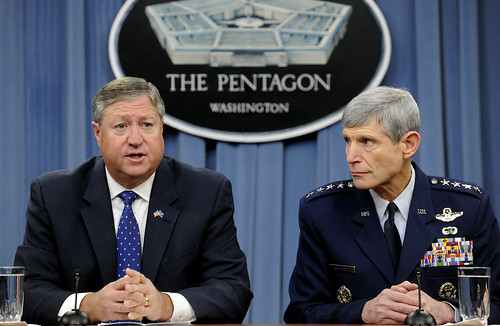
Secretary of the Air Force Michael Donley and Air Force Chief of Staff Gen. Norton Schwartz explain the Air Force's Force Structure overview during a Pentagon press briefing on Feb. 3, 2012. (U.S. Air Force photo by Scott M. Ash). Hi-res (Picture from the USAF website)
WASHINGTON, Feb. 3, 2012 – Making changes to the Air Force is "hard, but manageable," Air Force Secretary Michael B. Donley said here today.
Donley and Air Force Chief of Staff Gen. Norton A. Schwartz detailed force structure changes that will be made in the service over the next year. The men spoke during a Pentagon news conference.
The Air Force will cut 286 aircraft over the future year's defense plan including 123 fighters, 133 mobility aircraft and 30 intelligence, surveillance and reconnaissance platforms, the secretary said. Among the fighter aircraft that will be retired are 102 A-10 close-air support aircraft. This has led to questions about whether there will be enough close-air assets left to support ground forces.
"There's still going to be 246 A-10s left in the inventory," Schwartz said. "We are doing close-air support with B-52s, with B-1s, certainly with F-16s and F-15Es and AC-130 gunships."
The bottom line, he said, is there are plenty of assets that can deliver pinpoint close-air support. "The United States Army and the United States Marine Corps and our own battlefield airmen can rely on having plenty of close-air support provided by the United States Air Force from above," the general said.
These force structure changes mean a reduction of 9,900 airmen -- 3,900 active duty, 5,100 Air Guardsmen and 900 Air Force Reservists. Officials expect all these reductions can be made voluntarily.
All this is being done in accordance with new doctrine derived from the strategy review President Barack Obama announced last month. "Our decision for the Air Force was that the best course of action for us is to become smaller in order to protect a high quality and ready force that will continue to modernize and grow more capable in the future," Donley said.
Service leaders balanced the needs of force structure, readiness, modernization and support for airmen as they searched for the correct mix.
The service will protect crucial Air Force capabilities including air and space control, global intelligence, surveillance and reconnaissance, global mobility and global strike enabled by effective global command and control, Donley said.
Leaders also protected the bomber force, cyber capabilities and the nuclear force.
The service resized mobility forces to meet the needs of a smaller Army and Marine Corps, and kept enough remotely piloted aircraft to field 65 combat air patrols with the ability to surge to 85.
The service also has worked to lessen risk in case the strategy is wrong and more capabilities are needed. "We're going to get smaller across all three components," Donley said. "We need to get more closely integrated and to be more ready for the contingencies out in front of us."
The secretary pointed to operations over Libya as an example of the readiness he would like to see throughout the service.
"We did not have months to prepare for that," he said. "We really didn't have weeks to prepare for that; it was more like days and hours.
"We were able to bring the total force together quickly to produce combat capability over Libya within hours and then to generate that capability with our NATO partners, as well, and sustain that for nine months," Donley added. "You can't do that if you're not ready."
Friday, February 3, 2012
SecAF: AF will continue to be ready, agile and flexible
by Tech. Sgt. Richard Williams
Air Force Public Affairs Agency
2/3/2012 - WASHINGTON (AFNS) -- In the face of a changing strategic environment and constrained budgets, the Air Force will maintain its agility, flexibility and readiness to engage a full range of contingencies and threats, according to Secretary of the Air Force Michael Donley.
Donley spoke to approximately 160 Airmen, industry officials and Air Force Association members Feb. 2 here to provide an overview of the Air Force's way forward and the strategic rationale behind the service's budget choices and priorities.
"We have made some hard choices to closely align ourselves with the new (Defense of Defense) Strategic Guidance in our FY13 submission by trading size for quality," said Donley.
He explained that Air Force capabilities are clearly fundamental to the priorities outlined in DoD's new guidance, to include "deterring and defeating aggression, power projection--especially in the context of anti-access or area-denial environments--preventing the spread of WMD, the importance of space and cyber operations, (and) the continuing importance of strategic deterrence."
The secretary said the Air Force will be a smaller but superb force.
"In assessing how to adjust our programs and budgets going forward, we have taken care to protect the distinctive capabilities on which our joint, our interagency and coalition teammates depend," he said.
The secretary also emphasized the importance of ensuring readiness levels within the Air Force and said preventing a hollow force is a an important priority for the service's leaders.
"If we're going to be smaller, we have to make sure we are prepared," said Donley. "This is a dynamic and demanding security environment. This is part of the factoring in terms of the active-reserve component mix.
"It reinforces the need for these closer associations between the active and reserve components," he added.
He told the audience that one only has to think about operations in Libya last summer to be reminded about how quickly requirements for Air Force capabilities can materialize.
"We did not have six months to plan for that operation," said Donley. "The potential for the operation arose in weeks, and the execute order was measured in really not days but hours. So this requires a ready and agile force capable of responding quickly to these new contingencies as they arise."
In addition, modernization during a resource-constrained period is essential for the U.S. to maintain the advantages in contested air, space, and cyber domains, and the Air Force must be prepared for joint and coalition operations at any point on the spectrum of conflict, he said.
"(Air Force Chief of Staff Gen. Norton Schwartz) and I feel deeply that our leadership team...has inherited the finest Air Force in the world, one that was built over decades and passed on from generation to generation," Donley said. "It is our obligation to keep it that way going forward, so that our joint (and) our coalition partners know that they can count on the Air Force to deliver the capabilities they need."
Source
Air Force Public Affairs Agency
2/3/2012 - WASHINGTON (AFNS) -- In the face of a changing strategic environment and constrained budgets, the Air Force will maintain its agility, flexibility and readiness to engage a full range of contingencies and threats, according to Secretary of the Air Force Michael Donley.
Donley spoke to approximately 160 Airmen, industry officials and Air Force Association members Feb. 2 here to provide an overview of the Air Force's way forward and the strategic rationale behind the service's budget choices and priorities.
"We have made some hard choices to closely align ourselves with the new (Defense of Defense) Strategic Guidance in our FY13 submission by trading size for quality," said Donley.
He explained that Air Force capabilities are clearly fundamental to the priorities outlined in DoD's new guidance, to include "deterring and defeating aggression, power projection--especially in the context of anti-access or area-denial environments--preventing the spread of WMD, the importance of space and cyber operations, (and) the continuing importance of strategic deterrence."
The secretary said the Air Force will be a smaller but superb force.
"In assessing how to adjust our programs and budgets going forward, we have taken care to protect the distinctive capabilities on which our joint, our interagency and coalition teammates depend," he said.
The secretary also emphasized the importance of ensuring readiness levels within the Air Force and said preventing a hollow force is a an important priority for the service's leaders.
"If we're going to be smaller, we have to make sure we are prepared," said Donley. "This is a dynamic and demanding security environment. This is part of the factoring in terms of the active-reserve component mix.
"It reinforces the need for these closer associations between the active and reserve components," he added.
He told the audience that one only has to think about operations in Libya last summer to be reminded about how quickly requirements for Air Force capabilities can materialize.
"We did not have six months to plan for that operation," said Donley. "The potential for the operation arose in weeks, and the execute order was measured in really not days but hours. So this requires a ready and agile force capable of responding quickly to these new contingencies as they arise."
In addition, modernization during a resource-constrained period is essential for the U.S. to maintain the advantages in contested air, space, and cyber domains, and the Air Force must be prepared for joint and coalition operations at any point on the spectrum of conflict, he said.
"(Air Force Chief of Staff Gen. Norton Schwartz) and I feel deeply that our leadership team...has inherited the finest Air Force in the world, one that was built over decades and passed on from generation to generation," Donley said. "It is our obligation to keep it that way going forward, so that our joint (and) our coalition partners know that they can count on the Air Force to deliver the capabilities they need."
Source
Official details about A-10 cuts proposed by USAF
By Joachim Jacob, Warthog News Editor

The A-10C cuts, proposed by USAF, are official now!
That are A-10C-related details from the official USAF document USAF Force Structure Changes: Sustaining Readiness and Modernizing the Total Force:
Combat Air Forces
[...] As directed by the new strategic guidance, we accepted risk in our Combat Air Forces by retiring or reclassifying aircraft from seven squadrons: five A‐10 squadrons, one F‐16 squadron, and one training/support coded F‐15 Aggressor squadron. Because of the Department's evolving posture, one of the retiring squadrons is an overseas squadron. We chose to retire more A‐10s as a result of guidance to size our forces for one large scale combined arms campaign with sufficient combat power to also deny a second adversary, without conducting a large scale, prolonged stability operation. The A‐10 remains essential for combined arms and stability operations and we retain enough A‐10s to meet the requirements of the new strategic guidance, but multi‐role platforms provide more utility across the range of the potential missions for which we are directed to prepare. [...]
Total Force Aircraft Reductions by Fiscal Year
FY 13 Actions:
[...] Removes A‐10s from Barksdale AFB, LA (retires 21 and transfers three), Selfridge ANGB, MI (21), Ft Smith, AR (20), Ft Wayne, IN (20), and an Active Component overseas location (20). [...]
Total Force Re‐Missioning by Fiscal Year
FY 13 Actions:
[...] creates four additional MQ‐1/9 RSO elements at Ft Smith, AR (replacing A‐10s) [...] Adds A‐10s at Whiteman AFB, MO (3). [...]
Proposed FY 14 Actions
[...] Transfers 42 Active Component MC‐12s to the Air National Guard
by assigning between nine and eleven aircraft to each of four Air National Guard locations ‐‐ Ft Wayne, IN (replacing A‐10s), Bradley, CT (replacing C‐27s), Key Field AGS (Meridian), MS (replacing C‐27s), and NAS Ft Worth JRB (Carswell), TX (replacing C‐130s). [...]
Source
Please note: This post will be updated soon.

The A-10C cuts, proposed by USAF, are official now!
That are A-10C-related details from the official USAF document USAF Force Structure Changes: Sustaining Readiness and Modernizing the Total Force:
Combat Air Forces
[...] As directed by the new strategic guidance, we accepted risk in our Combat Air Forces by retiring or reclassifying aircraft from seven squadrons: five A‐10 squadrons, one F‐16 squadron, and one training/support coded F‐15 Aggressor squadron. Because of the Department's evolving posture, one of the retiring squadrons is an overseas squadron. We chose to retire more A‐10s as a result of guidance to size our forces for one large scale combined arms campaign with sufficient combat power to also deny a second adversary, without conducting a large scale, prolonged stability operation. The A‐10 remains essential for combined arms and stability operations and we retain enough A‐10s to meet the requirements of the new strategic guidance, but multi‐role platforms provide more utility across the range of the potential missions for which we are directed to prepare. [...]
Total Force Aircraft Reductions by Fiscal Year
FY 13 Actions:
[...] Removes A‐10s from Barksdale AFB, LA (retires 21 and transfers three), Selfridge ANGB, MI (21), Ft Smith, AR (20), Ft Wayne, IN (20), and an Active Component overseas location (20). [...]
Total Force Re‐Missioning by Fiscal Year
FY 13 Actions:
[...] creates four additional MQ‐1/9 RSO elements at Ft Smith, AR (replacing A‐10s) [...] Adds A‐10s at Whiteman AFB, MO (3). [...]
Proposed FY 14 Actions
[...] Transfers 42 Active Component MC‐12s to the Air National Guard
by assigning between nine and eleven aircraft to each of four Air National Guard locations ‐‐ Ft Wayne, IN (replacing A‐10s), Bradley, CT (replacing C‐27s), Key Field AGS (Meridian), MS (replacing C‐27s), and NAS Ft Worth JRB (Carswell), TX (replacing C‐130s). [...]
Source
Please note: This post will be updated soon.
Air Force announces force structure overview for FY 13 and beyond
by Ann Stefanek
Secretary of the Air Force Public Affairs
2/3/2012 - WASHINGTON (AFNS) -- Air Force officials announced proposed force structure changes which support the new DoD strategic guidance retiring 286 aircraft over the next five years, including 227 in fiscal year 13.
According to Secretary of the Air Force, Michael Donley, the Air Force is shaping itself for future challenges by realigning Air Force assets with the Defense Department's new strategic guidance.
"We've had to adjust our force structure based on our strategic objectives and to balance capability and capacity with constrained budgets," Donley said. "We must have the right tools and enough of them to credibly deter potential adversaries and to deliver on our objectives."
The new strategic guidance requires the joint force to be capable of fighting one large scale, combined arms campaign with sufficient combat power to also deny a second adversary, and de-emphasized large-scale, prolonged stability operations. The Air Force's approach to this new strategy is to retire fighter, mobility, and ISR that are beyond those needed to meet the capacity requirements of the new defense strategic guidance.
"Where possible, we attempted to retire all aircraft of a specific type, allowing us to also divest the unique training and logistic support structure for that aircraft," Air Force Chief of Staff Gen. Norton Schwartz explained. "When that was not possible, we worked to retire the oldest aircraft first, and redistributed aircraft into effective and economical units, eliminating other units when that was most efficient. Where we retained older aircraft, we are taking steps to ensure they will remain viable into the future."
Although the U.S. has removed all combat forces from Iraq and the new strategic guidance reduces the steady state requirement for ground forces, the Air Force expects steady state rotational requirements to remain constant, or perhaps increase.
According to Schwartz this continuing combatant commander requirement for Air Force aircraft and Airmen to deploy forward was a key factor in determining the required mix between Active and Reserve component forces due to differences in sustainable deployment rates and operations tempo.
Schwartz also explained the need for reductions in the Reserve Component.
"Two decades of military end strength and force structure reductions in our active duty component has changed the mix of active duty to Reserve Component forces," Schwartz said. "We've carefully considered the mix and what the appropriate balance should be between the active and reserve components. The Reserve Component is a critical and essential part of our Total Force, but must be balanced and matched appropriately within a constrained fiscal environment."
"We're going to do this intelligently in a way that balances tempo, that keeps the right mix of assets, modern and less modern, in each of the components, and we're doing this in an inclusive fashion with Air National Guard and Air Force Reserve leadership," said Schwartz.
The Air Force is going to get smaller, and all of the components--active, guard and reserve-- are going to get smaller together, he said.
Schwartz also emphasized that we will avoid a hollow force by protecting readiness at any force level, and strengthen our integration of the Total Force team of Active Duty, Guard, and Reserve Airmen.
"To ensure an agile and ready force, we made a conscious choice not to maintain more force structure than we could afford to properly train and equip," Schwartz said. "We've taken this approach to preserve the capabilities the Nation requires of its Air Force."
The announcement specifies the force structure changes experienced by the Total Force: Air Force Active Duty, Air National Guard, and Air Force Reserve and will save the Air Force $8.7 Billion over the next five years.
For fiscal years 2014-2017 the Air Force plans to reduce 50-plus aircraft from its inventory, continue to reshape the missions between the Total Force, and increase Reserve Component participation in the Intelligence, Surveillance and Reconnaissance as well as cyber missions.
Implementation of these actions will occur only after completion of appropriate environmental analyses. The Air Force is scheduled to announce related force structure manpower changes in March.
For more details about the Fiscal 2013 Force Structure changes click here.
(Mitch Gettle, Air Force Public Affairs Agency contributed to this article)
Source
Please note: Detailed A-10C info will be posted later this evening.
Secretary of the Air Force Public Affairs
2/3/2012 - WASHINGTON (AFNS) -- Air Force officials announced proposed force structure changes which support the new DoD strategic guidance retiring 286 aircraft over the next five years, including 227 in fiscal year 13.
According to Secretary of the Air Force, Michael Donley, the Air Force is shaping itself for future challenges by realigning Air Force assets with the Defense Department's new strategic guidance.
"We've had to adjust our force structure based on our strategic objectives and to balance capability and capacity with constrained budgets," Donley said. "We must have the right tools and enough of them to credibly deter potential adversaries and to deliver on our objectives."
The new strategic guidance requires the joint force to be capable of fighting one large scale, combined arms campaign with sufficient combat power to also deny a second adversary, and de-emphasized large-scale, prolonged stability operations. The Air Force's approach to this new strategy is to retire fighter, mobility, and ISR that are beyond those needed to meet the capacity requirements of the new defense strategic guidance.
"Where possible, we attempted to retire all aircraft of a specific type, allowing us to also divest the unique training and logistic support structure for that aircraft," Air Force Chief of Staff Gen. Norton Schwartz explained. "When that was not possible, we worked to retire the oldest aircraft first, and redistributed aircraft into effective and economical units, eliminating other units when that was most efficient. Where we retained older aircraft, we are taking steps to ensure they will remain viable into the future."
Although the U.S. has removed all combat forces from Iraq and the new strategic guidance reduces the steady state requirement for ground forces, the Air Force expects steady state rotational requirements to remain constant, or perhaps increase.
According to Schwartz this continuing combatant commander requirement for Air Force aircraft and Airmen to deploy forward was a key factor in determining the required mix between Active and Reserve component forces due to differences in sustainable deployment rates and operations tempo.
Schwartz also explained the need for reductions in the Reserve Component.
"Two decades of military end strength and force structure reductions in our active duty component has changed the mix of active duty to Reserve Component forces," Schwartz said. "We've carefully considered the mix and what the appropriate balance should be between the active and reserve components. The Reserve Component is a critical and essential part of our Total Force, but must be balanced and matched appropriately within a constrained fiscal environment."
"We're going to do this intelligently in a way that balances tempo, that keeps the right mix of assets, modern and less modern, in each of the components, and we're doing this in an inclusive fashion with Air National Guard and Air Force Reserve leadership," said Schwartz.
The Air Force is going to get smaller, and all of the components--active, guard and reserve-- are going to get smaller together, he said.
Schwartz also emphasized that we will avoid a hollow force by protecting readiness at any force level, and strengthen our integration of the Total Force team of Active Duty, Guard, and Reserve Airmen.
"To ensure an agile and ready force, we made a conscious choice not to maintain more force structure than we could afford to properly train and equip," Schwartz said. "We've taken this approach to preserve the capabilities the Nation requires of its Air Force."
The announcement specifies the force structure changes experienced by the Total Force: Air Force Active Duty, Air National Guard, and Air Force Reserve and will save the Air Force $8.7 Billion over the next five years.
For fiscal years 2014-2017 the Air Force plans to reduce 50-plus aircraft from its inventory, continue to reshape the missions between the Total Force, and increase Reserve Component participation in the Intelligence, Surveillance and Reconnaissance as well as cyber missions.
Implementation of these actions will occur only after completion of appropriate environmental analyses. The Air Force is scheduled to announce related force structure manpower changes in March.
For more details about the Fiscal 2013 Force Structure changes click here.
(Mitch Gettle, Air Force Public Affairs Agency contributed to this article)
Source
Please note: Detailed A-10C info will be posted later this evening.
Wednesday, February 1, 2012
Proposed A-10 cuts total 29% of current inventory
By Jeff Schogol - Staff writer
Air Force Times
Posted: Wednesday Feb 1, 2012 15:45:13 EST
The Air Force move in the proposed fiscal 2013 budget to stand down five A-10 squadrons over time will still leave it with a large number of Thunderbolts at its disposal.
The Air Force plans to stand down three Guard, one Reserve and one active A-10 squadrons. An F-16 tactical squadron and an F-15 training squadron would also be cut as part of a wider Defense Department effort to trim nearly $500 billion in spending over the next decade.
The Air Force currently has 348 A-10s across the active component, Guard and Reserve, said Air Force spokeswoman Ann Stefanek. The proposed budget cuts would retire 102 aircraft, or about 29 percent of the current A-10 inventory, according to an Air Force white paper.
The proposed budget cuts also call for retiring 21 older F-16s, the white paper says.
The Air Force decided which aircraft it could cut after an analysis revealed the service had too many fighters, Chief of Staff Gen. Norton Schwartz said at a Jan. 27 news conference.
"The mix of this was – again, had to do with emphasizing multirole over those kinds of aircraft with more niche or less versatility, because in a smaller force I think you can appreciate the mandate, the necessity for maximum versatility," Schwartz told reporters.
The Air Force and the other services want to gravitate toward the F-35 Joint Strike Fighter, which will be able to conduct a number of missions including close air support and air-to-air combat, but the expensive aircraft has already been plagued by a litany of problems and will remain in development for a number of more years, according to program officials.
Still, the Air Force needs aircraft that can do more than one mission, said Adm. James Winnefeld, vice chairman of the Joint Chiefs of Staff, who spoke with Military Times reporters and editors on Jan. 26.
"Is the F-35 going to be as good a close-air support platform as an A-10? I don't think anybody believes that," Winnefeld said, "But is the A-10 going to be the air-to-air platform that the F-35 is going to be? So again, the Air Force is trying to get as much multimission capability into the limited number of platforms it's going to have."
Source
Air Force Times
Posted: Wednesday Feb 1, 2012 15:45:13 EST
The Air Force move in the proposed fiscal 2013 budget to stand down five A-10 squadrons over time will still leave it with a large number of Thunderbolts at its disposal.
The Air Force plans to stand down three Guard, one Reserve and one active A-10 squadrons. An F-16 tactical squadron and an F-15 training squadron would also be cut as part of a wider Defense Department effort to trim nearly $500 billion in spending over the next decade.
The Air Force currently has 348 A-10s across the active component, Guard and Reserve, said Air Force spokeswoman Ann Stefanek. The proposed budget cuts would retire 102 aircraft, or about 29 percent of the current A-10 inventory, according to an Air Force white paper.
The proposed budget cuts also call for retiring 21 older F-16s, the white paper says.
The Air Force decided which aircraft it could cut after an analysis revealed the service had too many fighters, Chief of Staff Gen. Norton Schwartz said at a Jan. 27 news conference.
"The mix of this was – again, had to do with emphasizing multirole over those kinds of aircraft with more niche or less versatility, because in a smaller force I think you can appreciate the mandate, the necessity for maximum versatility," Schwartz told reporters.
The Air Force and the other services want to gravitate toward the F-35 Joint Strike Fighter, which will be able to conduct a number of missions including close air support and air-to-air combat, but the expensive aircraft has already been plagued by a litany of problems and will remain in development for a number of more years, according to program officials.
Still, the Air Force needs aircraft that can do more than one mission, said Adm. James Winnefeld, vice chairman of the Joint Chiefs of Staff, who spoke with Military Times reporters and editors on Jan. 26.
"Is the F-35 going to be as good a close-air support platform as an A-10? I don't think anybody believes that," Winnefeld said, "But is the A-10 going to be the air-to-air platform that the F-35 is going to be? So again, the Air Force is trying to get as much multimission capability into the limited number of platforms it's going to have."
Source
It's official now: USAF plans to retire 102 A-10Cs
By Joachim Jacob, Warthog News Editor
Today, USAF released their Air Force Priorities for a New Strategy with Constrained Budgets.
The chapter Force Structure states: [...] More than 280 aircraft have been identified in the current budget submission for elimination across all Air Force components over the next five years. This includes 123 fighters (102 A‐10s and 21 older F‐16s), 133 mobility aircraft (27 C‐5As, 65 C‐130s, 20 KC‐135s, and 21 C‐27s), and 30 select ISR systems (18 RQ‐4 Block 30s, 11 RC‐26s, and one E‐8 damaged beyond repair). [...]
Related USAF news article:
2/1/2012 - WASHINGTON (AFNS) -- Secretary of the Air Force Michael Donley and Air Force Chief of Staff Gen. Norton Schwartz released the 'Air Force Priorities for a New Strategy with Constrained Budgets' white paper Feb 1.
"The Air Force has made the hard choices to closely align with the new strategic guidance in our FY13 budget submission by trading size for quality," the leaders stated. "We will be a smaller but superb force that maintains the agility, flexibility, and readiness to engage a full range of contingencies and threats."
The Air Force strategy document provides an overview of the way forward for the present and future Air Force. The Following areas are outlined in the document: The Air Force new strategy; force structure; readiness; modernization; more disciplined use of Defense dollars; and taking care of people.
"It is our intent, indeed our obligation, to the American people and our Airmen to remain the world's finest Air Force in the years and decades to come," Donley and Schwartz penned. "Innovative and adaptable, America's Air Force will continue to meet emerging challenges and ensure the security of the Nation and its bright future."
To read the 'Air Force Priorities for a New Strategy with Constrained Budgets' click here.
(Courtesy of Secretary of the Air Force Public Affairs)
Source
Today, USAF released their Air Force Priorities for a New Strategy with Constrained Budgets.
The chapter Force Structure states: [...] More than 280 aircraft have been identified in the current budget submission for elimination across all Air Force components over the next five years. This includes 123 fighters (102 A‐10s and 21 older F‐16s), 133 mobility aircraft (27 C‐5As, 65 C‐130s, 20 KC‐135s, and 21 C‐27s), and 30 select ISR systems (18 RQ‐4 Block 30s, 11 RC‐26s, and one E‐8 damaged beyond repair). [...]
Related USAF news article:
Air Force leaders publish new strategy document
2/1/2012 - WASHINGTON (AFNS) -- Secretary of the Air Force Michael Donley and Air Force Chief of Staff Gen. Norton Schwartz released the 'Air Force Priorities for a New Strategy with Constrained Budgets' white paper Feb 1.
"The Air Force has made the hard choices to closely align with the new strategic guidance in our FY13 budget submission by trading size for quality," the leaders stated. "We will be a smaller but superb force that maintains the agility, flexibility, and readiness to engage a full range of contingencies and threats."
The Air Force strategy document provides an overview of the way forward for the present and future Air Force. The Following areas are outlined in the document: The Air Force new strategy; force structure; readiness; modernization; more disciplined use of Defense dollars; and taking care of people.
"It is our intent, indeed our obligation, to the American people and our Airmen to remain the world's finest Air Force in the years and decades to come," Donley and Schwartz penned. "Innovative and adaptable, America's Air Force will continue to meet emerging challenges and ensure the security of the Nation and its bright future."
To read the 'Air Force Priorities for a New Strategy with Constrained Budgets' click here.
(Courtesy of Secretary of the Air Force Public Affairs)
Source
122nd Fighter Wing in Jeopardy Because of $500 Billion in Defense Cuts?
By Scott Sarvay and Ryan Elijah
Indiana's NewsCenter
February 1, 2012 Updated Feb 1, 2012 at 12:31 PM EST
FORT WAYNE, Ind. (Indiana's NewsCenter) – Announced at the beginning of the month, the U.S. Air Force was asked to reduce its budget at the request of President Barack Obama in his new military strategy plan.
While there has been no official word given to the base, an Air Force source told The Military Times that Fort Wayne's National Guard Airbase is one of three bases that will be cut.
The Fort Wayne National Guard Airbase which is home to the 122nd Fighter Wing retired their wing of F-16s in 2010 for a wing of A-10s.
The base employs nearly one thousand workers and is estimated to bring in nearly $60-million to the local economy.
A-10 "Warthogs" are considered the workhorses in the war on terror and work closely in support of ground forces. The military source says the military will shift focus to F-35's, which can fly more missions.
The 122nd Fighter Wing released this statement to Indiana's NewsCenter Wednesday morning:
"The Governor, Adjutant General, Congressional Delegation, Base Community Council and myself are ready to engage to ensure the 122nd Fighter Wing is positioned for the future. The Air National Guard is an extremely efficient fighting force costing our nation only 28 cents on the dollar when compared to our active duty counterparts. In this challenging time when budgets are driving national security decisions, it is only right that efficient solutions are prioritized in this debate. In the case of the 122nd Fighter Wing, as we await the final USAF recommendation for us, we will continue to protect our ground forces in combat via the world's premiere Close Air Support platform, the A-10 Warthog."
- Col David L Augustine, 122nd Fighter Wing Commander
Indiana's NewsCenter is investigating the story and will have updates as information becomes available.
Associated video:
Source
Indiana's NewsCenter
February 1, 2012 Updated Feb 1, 2012 at 12:31 PM EST
FORT WAYNE, Ind. (Indiana's NewsCenter) – Announced at the beginning of the month, the U.S. Air Force was asked to reduce its budget at the request of President Barack Obama in his new military strategy plan.
While there has been no official word given to the base, an Air Force source told The Military Times that Fort Wayne's National Guard Airbase is one of three bases that will be cut.
The Fort Wayne National Guard Airbase which is home to the 122nd Fighter Wing retired their wing of F-16s in 2010 for a wing of A-10s.
The base employs nearly one thousand workers and is estimated to bring in nearly $60-million to the local economy.
A-10 "Warthogs" are considered the workhorses in the war on terror and work closely in support of ground forces. The military source says the military will shift focus to F-35's, which can fly more missions.
The 122nd Fighter Wing released this statement to Indiana's NewsCenter Wednesday morning:
"The Governor, Adjutant General, Congressional Delegation, Base Community Council and myself are ready to engage to ensure the 122nd Fighter Wing is positioned for the future. The Air National Guard is an extremely efficient fighting force costing our nation only 28 cents on the dollar when compared to our active duty counterparts. In this challenging time when budgets are driving national security decisions, it is only right that efficient solutions are prioritized in this debate. In the case of the 122nd Fighter Wing, as we await the final USAF recommendation for us, we will continue to protect our ground forces in combat via the world's premiere Close Air Support platform, the A-10 Warthog."
- Col David L Augustine, 122nd Fighter Wing Commander
Indiana's NewsCenter is investigating the story and will have updates as information becomes available.
Associated video:
Source
Units of further A-10 cuts identified now off the record
By Joachim Jacob, Warthog News Editor
According to an anonymous comment to my blog post 5 A-10 squadrons to be cut, slated are:
81st FS (USAFE)
47th FS (AFRC)
107th FS (ANG)
163rd FS (ANG)
184st FS (ANG)
Please note: That's NOT official. Please also watch the topic WTF? on Warthog Territory Forums. At first, I fully expected a cut of the 81st FS as part of the withdrawal from Germany after the Cold War. This "hot" post will be updated later today.
See also:
Air Guard Boss Pushes Back on Cuts
Venerable A-10 Warthog Faces Extinction
5 A-10 squadrons to be cut
According to an anonymous comment to my blog post 5 A-10 squadrons to be cut, slated are:
81st FS (USAFE)
47th FS (AFRC)
107th FS (ANG)
163rd FS (ANG)
184st FS (ANG)
Please note: That's NOT official. Please also watch the topic WTF? on Warthog Territory Forums. At first, I fully expected a cut of the 81st FS as part of the withdrawal from Germany after the Cold War. This "hot" post will be updated later today.
See also:
Air Guard Boss Pushes Back on Cuts
Venerable A-10 Warthog Faces Extinction
5 A-10 squadrons to be cut
Air Guard Boss Pushes Back on Cuts
By Michael Hoffman
Military.com
January 31, 2012
The Air National Guard's top officer took aim at Air Force Chief of Staff Gen. Norton Schwartz Tuesday, questioning why the service chief protected active duty resources and targeted Guard units in the service's latest round of budget cuts.
Lt. Gen. Harry Wyatt, the Air National Guard director, expressed his frustration with Air Force leadership during a panel discussion with the military's Guard and Reserve chiefs at the Reserve Officers Association National Security Symposium in Washington.
"Chief said we are going to do this in a 'balanced' fashion. It will be interesting to see on the 13th of this month the practical implications of what 'balanced' means," Wyatt said, followed by cheers from the crowd.
Defense Secretary Leon Panetta announced on Jan. 26 the Air Force would "divest" its C-27J cargo planes, many of which had been bound for Guard units, and close seven squadrons. Joint Chiefs Vice Chairman Adm. James Winnefeld confirmed that four of the seven cut would be Air National Guard squadrons.
The Defense Department will send its defense budget to Congress Feb. 13. It is expected to include the entire layout of what the military will cut to account for the $259 billion reduction in planned defense spending growth over the next five years.
Schwartz has said he remains committed to the Air Force's Guard and Reserve as part of the service's "total force" concept, despite the budget reductions.
"Given the reality of fiscal austerity ahead, the need for maximum efficiency in the Air Force is clear. To this end, the Air Force remains committed to a 'total force' approach, because any solution will be, by necessity, a total force solution. Air Force restructuring will occur across the total force, consistent with future trends and potential threats, our collective priorities, our national security strategy, and our collective capabilities," Schwartz said in December.
Anticipating that the Guard would bear the brunt of the Air Force's budget cut, Wyatt parsed his words, but made sure to drive home his point that the Guard was upset with which units and aircraft the Air Force plans to retire.
"I think there are different interpretations of what 'balanced' really means and I think we are going to get the opportunity to see what 'balanced' means in shaping the Air Force of the future," Wyatt said Tuesday.
The Guard expects the Air Force to order the decommissioning of three of its A-10 Warthog squadrons in Indiana, Arkansas and Michigan, as well as an F-16 squadron in Iowa, according to Guard sources who asked not to be named because the Air Force had not yet made the official force structure announcement.
The three A-10 Guard squadrons set to close -- the 107th, 163rd and 184th Fighter Squadrons -- recently transitioned from F-16 squadrons as part of the congressionally mandated Base Realignment and Closure process.
Some airmen from those Warthog squadrons, as well as the 124th Fighter Squadron, which Guard officials said also appears vulnerable, will transition to other missions, such as flying MQ-9 Reapers, Schwartz said Jan. 27.
Retiring three Guard A-10 squadrons will cut the Guard's A-10 fleet in half from 108 aircraft to 54. Wyatt questioned whether retiring Guard squadrons lined up with the new defense strategy that emphasizes "reversibility" -- or the ability to easily undo changes made amid the budget growth reductions.
Meanwhile, Wyatt's counterpart on the Army side praised Army leadership for its continued commitment to the Army Guard and Reserve. Army Reserve Chief Lt. Gen. Jack Stultz hinted during the panel that he doesn't expect the Reserve to absorb major cuts when the defense budget is released Feb. 13.
Air Guard leaders saw these cuts coming. Adjutants general in Colorado and Texas both commended the Army for how it handled its reserve component, while predicting the Air Force would target the Guard and protect its active component in retiring aircraft and units.
When approached after the panel and asked if he'd like to further explain his pointed critique over Schwartz's definition of "balance," Wyatt said he couldn't say more until Feb. 13.
"Just wait until the [president's budget] comes out and then you'll know exactly what I am talking about," Wyatt said.
Source
See also:
Venerable A-10 Warthog Faces Extinction
5 A-10 squadrons to be cut
Military.com
January 31, 2012
The Air National Guard's top officer took aim at Air Force Chief of Staff Gen. Norton Schwartz Tuesday, questioning why the service chief protected active duty resources and targeted Guard units in the service's latest round of budget cuts.
Lt. Gen. Harry Wyatt, the Air National Guard director, expressed his frustration with Air Force leadership during a panel discussion with the military's Guard and Reserve chiefs at the Reserve Officers Association National Security Symposium in Washington.
"Chief said we are going to do this in a 'balanced' fashion. It will be interesting to see on the 13th of this month the practical implications of what 'balanced' means," Wyatt said, followed by cheers from the crowd.
Defense Secretary Leon Panetta announced on Jan. 26 the Air Force would "divest" its C-27J cargo planes, many of which had been bound for Guard units, and close seven squadrons. Joint Chiefs Vice Chairman Adm. James Winnefeld confirmed that four of the seven cut would be Air National Guard squadrons.
The Defense Department will send its defense budget to Congress Feb. 13. It is expected to include the entire layout of what the military will cut to account for the $259 billion reduction in planned defense spending growth over the next five years.
Schwartz has said he remains committed to the Air Force's Guard and Reserve as part of the service's "total force" concept, despite the budget reductions.
"Given the reality of fiscal austerity ahead, the need for maximum efficiency in the Air Force is clear. To this end, the Air Force remains committed to a 'total force' approach, because any solution will be, by necessity, a total force solution. Air Force restructuring will occur across the total force, consistent with future trends and potential threats, our collective priorities, our national security strategy, and our collective capabilities," Schwartz said in December.
Anticipating that the Guard would bear the brunt of the Air Force's budget cut, Wyatt parsed his words, but made sure to drive home his point that the Guard was upset with which units and aircraft the Air Force plans to retire.
"I think there are different interpretations of what 'balanced' really means and I think we are going to get the opportunity to see what 'balanced' means in shaping the Air Force of the future," Wyatt said Tuesday.
The Guard expects the Air Force to order the decommissioning of three of its A-10 Warthog squadrons in Indiana, Arkansas and Michigan, as well as an F-16 squadron in Iowa, according to Guard sources who asked not to be named because the Air Force had not yet made the official force structure announcement.
The three A-10 Guard squadrons set to close -- the 107th, 163rd and 184th Fighter Squadrons -- recently transitioned from F-16 squadrons as part of the congressionally mandated Base Realignment and Closure process.
Some airmen from those Warthog squadrons, as well as the 124th Fighter Squadron, which Guard officials said also appears vulnerable, will transition to other missions, such as flying MQ-9 Reapers, Schwartz said Jan. 27.
Retiring three Guard A-10 squadrons will cut the Guard's A-10 fleet in half from 108 aircraft to 54. Wyatt questioned whether retiring Guard squadrons lined up with the new defense strategy that emphasizes "reversibility" -- or the ability to easily undo changes made amid the budget growth reductions.
Meanwhile, Wyatt's counterpart on the Army side praised Army leadership for its continued commitment to the Army Guard and Reserve. Army Reserve Chief Lt. Gen. Jack Stultz hinted during the panel that he doesn't expect the Reserve to absorb major cuts when the defense budget is released Feb. 13.
Air Guard leaders saw these cuts coming. Adjutants general in Colorado and Texas both commended the Army for how it handled its reserve component, while predicting the Air Force would target the Guard and protect its active component in retiring aircraft and units.
When approached after the panel and asked if he'd like to further explain his pointed critique over Schwartz's definition of "balance," Wyatt said he couldn't say more until Feb. 13.
"Just wait until the [president's budget] comes out and then you'll know exactly what I am talking about," Wyatt said.
Source
See also:
Venerable A-10 Warthog Faces Extinction
5 A-10 squadrons to be cut
Subscribe to:
Posts (Atom)


 Posts
Posts


