Showing posts with label Spangdahlem. Show all posts

Monday, July 2, 2012

52nd EMS ensure safe aircraft

Released by 52nd Fighter Wing Public Affairs

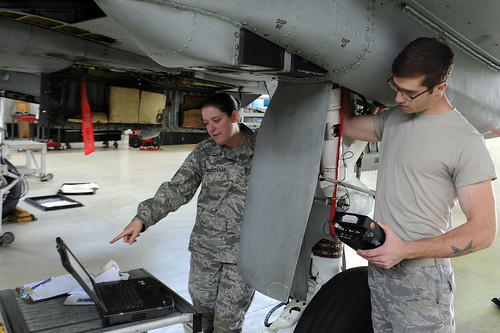
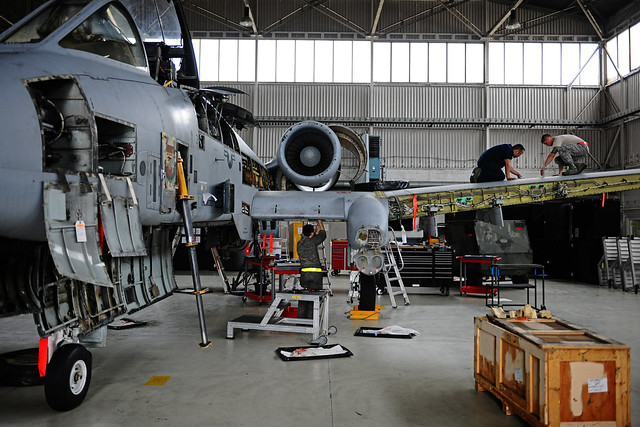
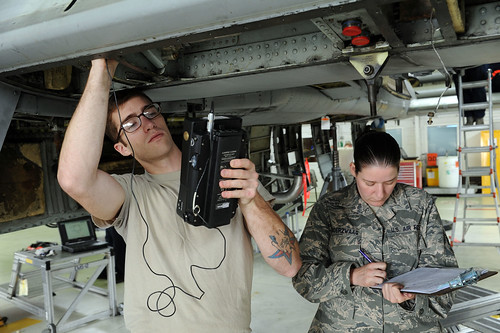
6/26/2012 - SPANGDAHLEM AIR BASE, Germany – Senior Airman Derrick McDonald, 52nd Equipment Maintenance Squadron nondestructive inspection journeyman, inspects the right wing bell crank of an A-10 Thunderbolt II while Staff Sgt. Angela Vanderzwaag, 52nd EMS nondestructive inspection journeyman, documents training requirements during a phase inspection at Hanger 2 here June 26. This inspection was part of a series of phase inspections that are done on aircraft every 500 hours. The 52nd EMS provides safe, reliable aircraft, equipment and munitions maintenance to the 52nd Fighter Wing in support of the United States Air Forces in Europe and NATO objectives. The maintenance flight is responsible for a variety of support functions including repair and reclamation, wheel and tire, inspection, refurbishment, and transient alert. (U.S. Air Force photo by Senior Airman Christopher Toon) Hi-res

6/26/2012 - SPANGDAHLEM AIR BASE, Germany – Staff Sgt. Angela Vanderzwaag, left, 52nd Equipment Maintenance Squadron nondestructive inspection journeyman, and Senior Airman Derrick McDonald, 52nd EMS nondestructive inspection journeyman, scan technical orders for phase inspection training at Hangar 2 here June 26. This inspection was part of a series of phase inspections that are done on aircraft every 500 hours. The 52nd EMS provides safe, reliable aircraft, equipment and munitions maintenance to the 52nd Fighter Wing in support of the United States Air Forces in Europe and NATO objectives. The maintenance flight is responsible for a variety of support functions including repair and reclamation, wheel and tire, inspection, refurbishment, and transient alert. (U.S. Air Force photo by Senior Airman Christopher Toon) Hi-res

Please note: According to the official caption of another related photo, in this picture Senior Airman Derek McDonald, 52nd Equipment Maintenance Squadron nondestructive inspection journeyman, inspects the main landing support trunnion of an A-10 Thunderbolt II.

Source

Sunday, July 1, 2012

A-10 makes debut at Aviation Expo Europe

Released by 52nd Fighter Wing Public Affairs

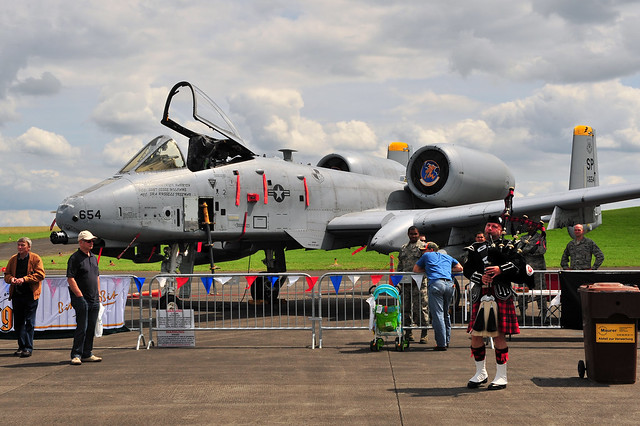
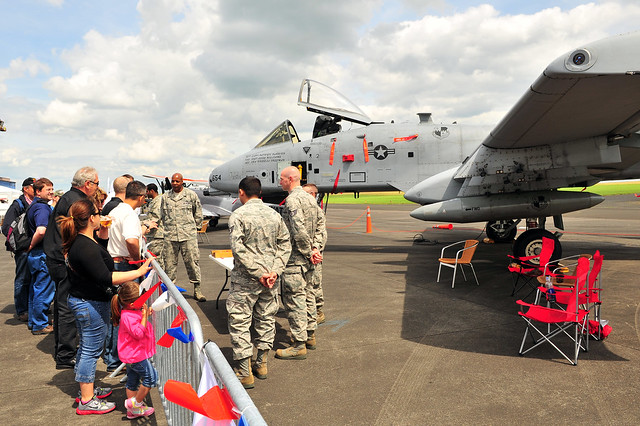
6/26/2012 - BITBURG, Germany – Visitors get a close-up view of an A-10 Thunderbolt II from the 81st Fighter Squadron during Aviation Expo Europe here June 23. The annual expo featured multiple aerial demonstrations and an aircraft sales and showcase floor. More than 5,000 exhibitors, vendors and visitors attended the three-day event. This year's expo included its first showcase of an A-10 aircraft at the new location at the Bitburg Airport. (U.S. Air Force photo by Airman 1st Class Dillon Davis) Hi-res

6/26/2012 - BITBURG, Germany – Visitors get a close-up view of an A-10 Thunderbolt II from the 81st Fighter Squadron during Aviation Expo Europe here June 23. (U.S. Air Force photo by Airman 1st Class Dillon Davis) Hi-res

Source

Note: Pictured is A-10C 82-0654 from the 81st Fighter Squadron (still with wrong tail marking AF 81-654, but with right marking on the ladder). Crew inscription: PLT: CAPT PATRICK PARRISH, DCC: SSGT JESSE WILLIAMS, ACC: SRA RUSSELL FREEMAN. Also note the huge dent on the nose, caused by a tanker boom.

Tuesday, June 5, 2012

USAF aircraft participate in coalition NATO event

by Senior Airman Natasha Stannard
52nd Fighter Wing Public Affairs

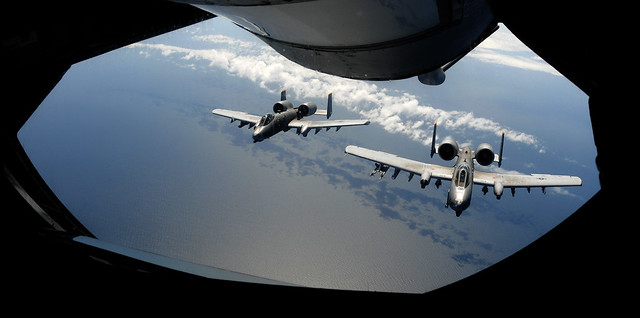
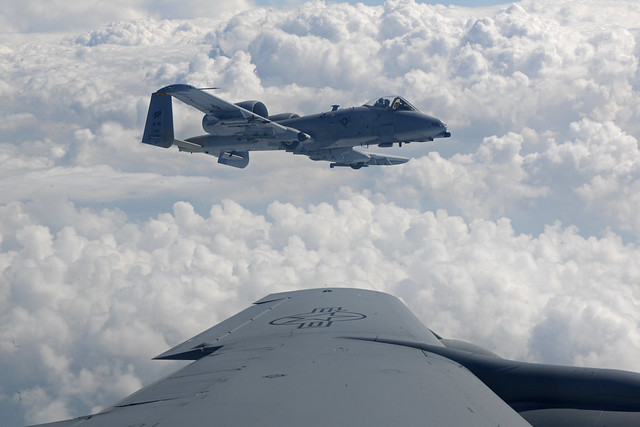
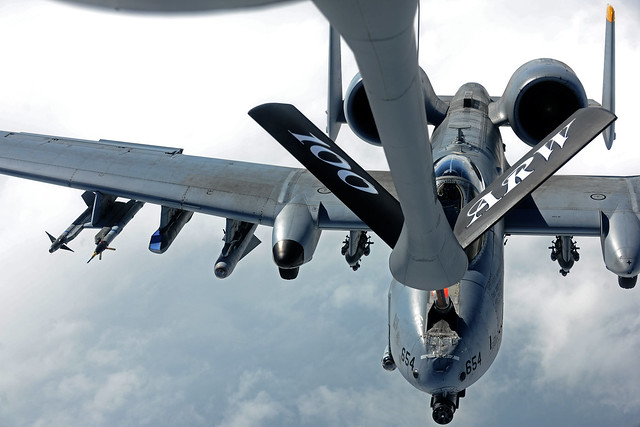
SWEDISH AIR SPACE -- Two A-10 Thunderbolt II aircraft, call signs Growler 11 and 12 from Spangdahlem Air Base, Germany, fly in formation in Swedish air space behind a 100th Air Refueling Wing KC-135 Stratotanker after receiving fuel during the Baltic Region Training Event XII May 30, 2012. BRTE XII was a NATO exercise that included support from several countries including the United States, France, Estonia and Latvia. (U.S. Air Force photo by Staff Sgt. Thomas Trower) Hi-res

6/4/2012 - SPANGDAHLEM AIR BASE, Germany -- U.S. Air Force 81st Fighter Squadron A-10 Thunderbolt IIs and a 100th Air Refueling Wing KC-135 Stratotanker participated in a NATO regional coalition training event at the Adazi Training Area in Riga, Latvia May 29 - 30.

The U.S. Air Force aircraft participated in the Baltic Region Training Event XII with French Dassault Mirage 2000 aircraft, Estonian L-39 jets, a Latvian M-17 helicopter and a Polish MiG-29.

The purpose of the event was to provide training opportunities to NATO's forward air controllers and air policing assets through close air support, air-to-ground support, air-to-air refueling and quick reaction alert intercept training.

"This exercise gave us the opportunity to put together different training aspects into one sortie," said Capt. Brent Fleming, 81st FS pilot. "Occasionally we'll fly and we'll air refuel from point a to point b. This mission tied together ferrying aircraft and employing tactically while under the constraints of a longer time on station and a seven hour flight, and still being able to do our mission of air-to-ground to and from the target area."

The A-10s stationed here participated in the event to uphold the standard of joint close air support procedures, tactics and operations to ensure all aircraft and ground support involved can communicate seamlessly. This is especially important for the nations involved in BRTE XII as they regularly support one another in deployed locations, Fleming said.

The KC-135 crew stationed out of Royal Air Force Mildenhall kept the mission going as they performed in-flight refuelling for the Mirage 2000 and the A-10. This also gave the aircraft crews the opportunity to practice air-to-air refuelling manuevers.

"It was great to have the KC-135 show the lengths the Air Force can reach and how quickly we can reach them," Fleming said. "In four hours, we were half way across Europe employing weapons."

The A-10s also helped the Polish MiG-29 hone in on its NATO air policing mission at the Lithuanian Air Base Šiauliai through special quick reaction alert intercept training and touch-and-go air manuevers.

"We take away a lot of practical benefit from BRTE XII," said Lithuanian Lt. Col. Leszek Błach, Polish Military Contingent commander. "With the touch-and-go we showed our presence in the Baltic region."

For Fleming, participating with five nations to ensure peace and stability throughout the region and deployed locations was unforgettable. Fleming said there were some weather issues, but they were able to employ and provide low-altitude CAS.

"This is the first time we've employed in Latvia," Felming said. "We've gone to Finland and Poland for airshows, but we've never flown there tactically. It was good to show them what we could do besides just being at an airshow."

Lt. Col. John Liller, 81st FS pilot, who led the A-10 two-ship, shared his sentiments about meeting the mission objectives.

"This was an experience of a lifetime to fly the A-10 Thunderbolt II to the Baltic Region and conduct intercepts with Polish MiG-29s," Liller said. "Our objective was to fully integrate A-10 tactics, techniques, and procedures with ground assets and bolster bonds of cooperation for future exercises. This could not have been done without the support from the men and women of the 52nd Fighter Wing, the KC-135 from Royal Air Force Mildenhall, and the outstanding job by the NATO forward air controllers executing joint close air support procedures."

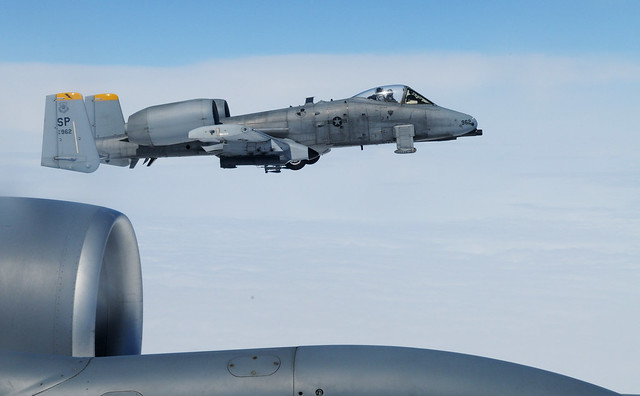
SWEDISH AIR SPACE -- A 52nd Fighter Wing A-10 Thunderbolt II from Spangdahlem Air Base, Germany, flies off the wing of a 100th Air Refueling Wing KC-135 Stratotanker from RAF Mildenhall, England, during Baltic Region Training Event XII, a multinational NATO exercise, May 30, 2012. BRTE XII included support from several countries including the United States, France, Estonia and Latvia. (U.S. Air Force photo by Staff Sgt. Thomas Trower) Hi-res

Note: Pictured is A-10C 81-0962 from the 81st Fighter Squadron.

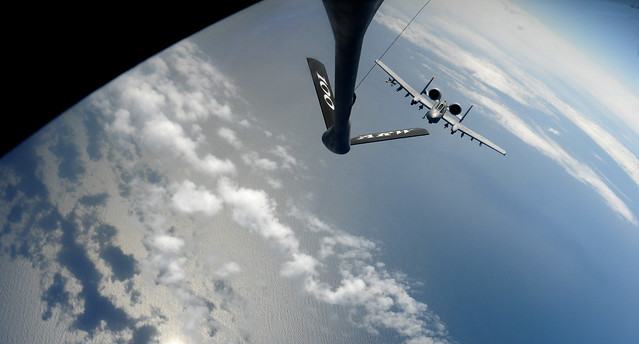
SWEDISH AIR SPACE -- An A-10 Thunderbolt II from Spangdahlem Air Base, Germany, approaches an RAF Mildenhall KC-135 Stratotanker for refueling during Baltic Region Training Event XII May 30, 2012. The NATO exercise included support from several countries including the United States, France, Estonia and Latvia. (U.S. Air Force photo by Staff Sgt. Thomas Trower) Hi-res

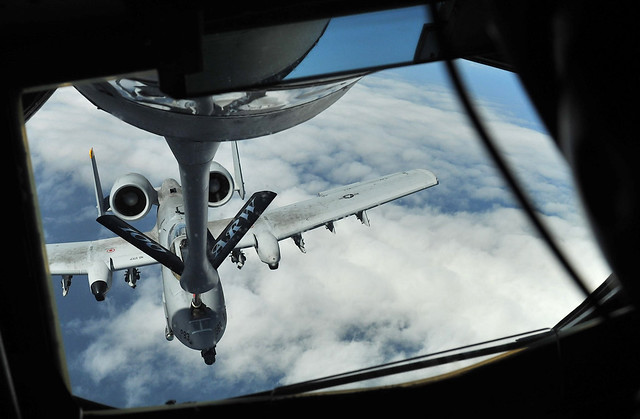
GERMANY – An A-10 Thunderbolt II, based out of Spangdahlem Air Base, Germany, receives fuel from a KC-135 Stratotanker, based out of RAF Mildenhall, England, in the skies over Germany May 30, 2012. The A-10 participated in the NATO and partner air forces' Baltic Region Training Event XII, a two-day exercise that started May 29, 2012. (U.S. Air Force photo by Senior Airman Jerilyn Quintanilla) Hi-res

Note: Pictured is A-10C 81-0983 from the 81st Fighter Squadron.

Source

Saturday, May 26, 2012

American WWI veterans honored during Memorial Day ceremony

By Tech. Sgt. Markus Maier
U.S. Air Forces in Europe Public Affairs

A-10C Thunderbolt II aircraft assigned to the 81st Fighter Squadron, Spangdahlem Air Base, Germany, perform a fly-over during a Memorial Day ceremony at the Lafayette Escadrille Memorial located on the outskirts of Paris, May 26, 2012. The memorial honors American pilots who volunteered to join the French Escadrille Lafayette and the Lafayette Flying Corps during World War I and also serves as a final resting place for the remains of 49 of those pilots. (U.S. Air Force photo by Tech. Sgt. Markus M. Maier) Hi-res

5/26/2012 - PARIS -- U.S. and French service members, veterans and civilians honored American World War I veterans during a Memorial Day ceremony at the Lafayette Escadrille Memorial located on the outskirts of Paris, May 26, 2012. The memorial honors American pilots who volunteered to join the French Escadrille Lafayette and the Lafayette Flying Corps during World War I and also serves as a final resting place for the remains of 49 of those pilots.

A-10C Thunderbolt II aircraft assigned to the 81st Fighter Squadron, Spangdahlem Air Base, Germany, perform a fly-over during a Memorial Day ceremony at the Lafayette Escadrille Memorial located on the outskirts of Paris, May 26, 2012. The memorial honors American pilots who volunteered to join the French Escadrille Lafayette and the Lafayette Flying Corps during World War I and also serves as a final resting place for the remains of 49 of those pilots. (U.S. Air Force photo by Tech. Sgt. Markus M. Maier) Hi-res

Source

Thursday, May 24, 2012

Joint in-flight refueling mission showcases aircraft interoperability

Released by 52nd Fighter Wing Public Affairs

5/24/2012 - SPANGDAHLEM AIR BASE, Germany – An A-10 Thunderbolt II from the 81st Fighter Squadron flies beside a 351st Air Refueling Squadron KC-135 Stratotanker out of Royal Air Force Mildenhall, England during an orientation flight for 25 52nd Fighter Wing Airmen and spouses here May 23. The Airmen and spouses flew on a 351st ARS KC-135 out of RAF Mildenhall during an in-flight refueling of 81st and 480th Fighter Squadron aircraft out of Spangdahlem AB. The 351st ARS and 52nd FW aircrew train together to enhance their interoperability to perform in-flight refueling missions. (U.S. Air Force photo by Airman 1st Class Matthew B. Fredericks) Hi-res

Note: Pictured is A-10C 81-0981, marked 81 FS, from the 81st Fighter Squadron.

5/24/2012 - SPANGDAHLEM AIR BASE, Germany – An A-10 Thunderbolt II pilot from the 81st Fighter Squadron lines up the aircraft to be refueled during an orientation flight for 25 52nd Fighter Wing Airmen and spouses here May 23. The Airmen and spouses flew on a 351st ARS KC-135 out of Royal Air Force Mildenhall, England during an in-flight refueling of 81st and 480th Fighter Squadron aircraft out of Spangdahlem AB. The 351st ARS and 52nd FW aircrew train together to enhance their interoperability to perform in-flight refueling missions. (U.S. Air Force photo by Airman 1st Class Matthew B. Fredericks) Hi-res

Note: Pictured is A-10C 82-0654 (still marked wrong as 81-0654 on it's tail!) from the 81st Fighter Squadron. Sniper XR targeting pod on station 10.

Saturday, May 5, 2012

Phase inspection keeps jets in the air

Released by 52nd Fighter Wing Public Affairs

5/4/2012 - SPANGDAHLEM AIR BASE, Germany – Airman from the 52nd Equipment Maintenance Squadron Maintenance Flight conduct a phase inspection on an A-10 Thunderbolt II in Hangar 2 here May 4. The phase inspections are separated into two categories. During a phase 1 inspection, the 52nd EMS Maintenance Flight members examine each A-10 after every 500 flying hours, and phase 2 inspections are performed ever 1,000 flying hours. These inspections allow the Airmen to check for deficiencies and perform preventative maintenance to ensure the aircraft is safe and operational for flight. (U.S. Air Force photo by Airman 1st Class Matthew B. Fredericks) Hi-res

Source (including 5 photos)

Saturday, April 28, 2012

Super Saber Performer

by Staff Reports 52nd Fighter Wing Public Affairs

4/26/2012 - SPANGDAHLEM AIR BASE, Germany -- Staff Sgt. Gary Saunders, 52nd Equipment Maintenance Squadron A-10 Maintenance floor chief, is the Super Saber Performer for the week of April 26 – May 2. (U.S. Air Force photo by Airman 1st Class Matthew B. Fredericks) Hi-res

His most memorable Air Force experience: My most memorable experience in the Air Force thus far has been when I served in Afghanistan supporting Operation Enduring Freedom. I recall launching my jet out with the wing commander piloting it. My jet came back with absolutely no munitions left. Note: Seems like he talked about the commander of an Air Expeditionary Wing in Afghanistan - either the 451st AEW at Kandahar Airfield or the 455th AEW at Bagram Airfield.

Source

Wednesday, April 18, 2012

Friends, family welcome Airmen home from deployment

Released by 52nd Fighter Wing Public Affairs


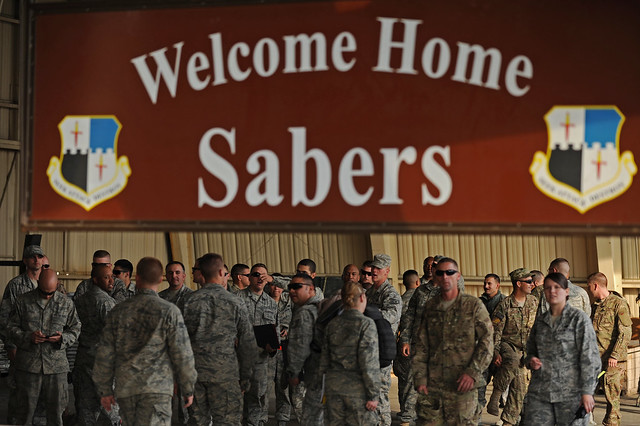
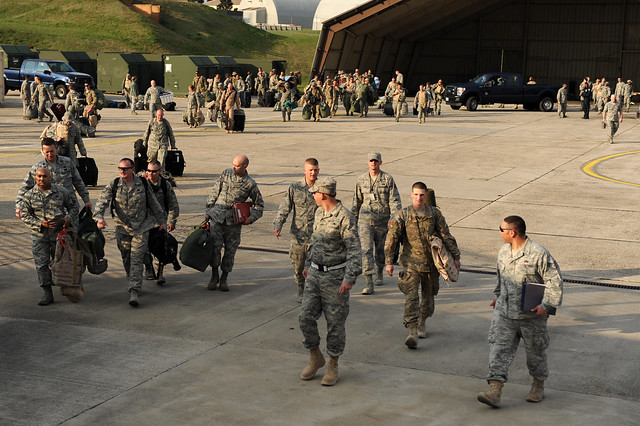
4/16/2012 - SPANGDAHLEM AIR BASE, Germany – Airmen from the 52nd Fighter Wing wait to process through customs on Ramp 3 here April 13. Family and friends waited at Hangar 3 to welcome home more than 70 Airmen from a deployment with 81st Fighter Squadron to Bagram Airfield, Afghanistan, who had been providing close-air support during Operation Enduring Freedom. (U.S. Air Force photo by Airman 1st Class Matthew B. Fredericks) Hi-res


4/16/2012 - SPANGDAHLEM AIR BASE, Germany – Airmen from the 52nd Fighter Wing walk towards their friends and families after a customs inspection on Ramp 3 here April 13. Family and friends waited at Hangar 3 to welcome home more than 70 Airmen from a deployment with 81st Fighter Squadron to Bagram Airfield, Afghanistan, who had been providing close-air support during Operation Enduring Freedom. (U.S. Air Force photo by Airman 1st Class Matthew B. Fredericks)


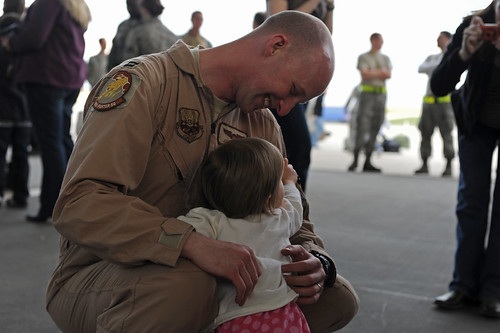
4/16/2012 - SPANGDAHLEM AIR BASE, Germany – Capt. John Cotman, 81st Fighter Squadron A-Flight commander, embraces his daughter on Ramp 3 here April 13. Family and friends waited at Hangar 3 to welcome home more than 70 Airmen from a deployment with 81st Fighter Squadron to Bagram Airfield, Afghanistan, who had been providing close-air support during Operation Enduring Freedom. (U.S. Air Force photo by Airman 1st Class Matthew B. Fredericks) Hi-res

Source (including 5 photos)

Thursday, April 12, 2012

Family, friends welcome Panthers home

Released by 52nd Fighter Wing Public Affairs


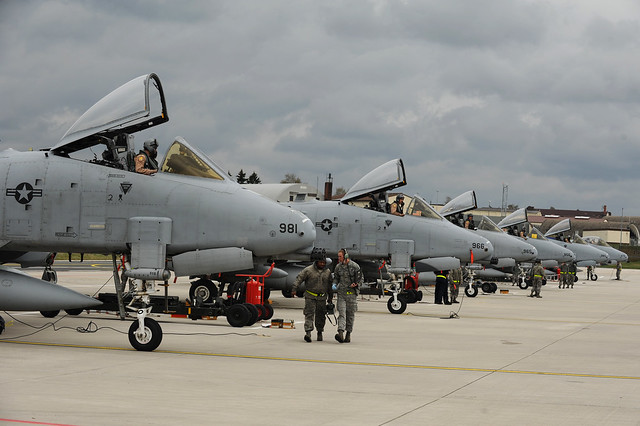
4/11/2012 - SPANGDAHLEM AIR BASE, Germany – A-10 Thunderbolt II pilots from the 81st Fighter Squadron prepare to exit their aircraft on Ramp 4 here April 10 after returning from a deployment to Bagram Airfield, Afghanistan. Friends and family waited by to greet six of the squadron's pilots who had been providing close air support during Operation Enduring Freedom. (U.S. Air Force photo by Airman 1st Class Matthew B. Fredericks) Hi-res

Note: Pictured (from left) are A-10Cs 81-0981 (marked "81 FS"), 81-0966 (marked "52 OG"), 81-0965, 81-0956, 81-0985 and 80-0275 from the 81st Fighter Squadron which were deployed as part of a "Total Force" A-10C team to Afghanistan in support of Operation Enduring Freedom. BTW: This incredible picture would become a milestone in the A-10 history books if the 81st FS should be really deactivated soon as proposed.


4/11/2012 - SPANGDAHLEM AIR BASE, Germany – Capt. Mike Krestyn, 81st Fighter Squadron pilot and chief of plans, climbs down from the cockpit of an A-10 Thunderbolt II on Ramp 4 here April 10. Krestyn was one of the squadron's six pilots returning from a deployment from Bagram Airfield, Afghanistan, providing close air support during Operation Enduring Freedom. (U.S. Air Force photo by Airman 1st Class Matthew B. Fredericks) Hi-res

Note: Pictured is A-10C 80-0275 from the 81st Fighter Squadron.


4/11/2012 - SPANGDAHLEM AIR BASE, Germany – Lt. Col. Joshua Ruddell, 81st Fighter Squadron pilot and director of operations, is welcomed home by his wife, Neva, and children, from left, Tyler, Carter and Bella on Ramp 4 here April 10 after returning from his deployment from Bagram Airfield, Afghanistan. Ruddell was one of the squadron's six pilots who had been providing close air support during Operation Enduring Freedom. (U.S. Air Force photo by Airman 1st Class Matthew B. Fredericks) Hi-res


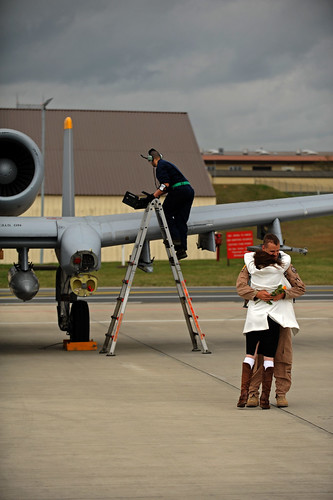
4/11/2012 - SPANGDAHLEM AIR BASE, Germany – Capt. Michael Dumas, 81st Fighter Squadron pilot and weapons training officer, receives a hug from his wife, Megan, on Ramp 4 here April 10. Dumas was one of the squadron's six pilots returning from a deployment from Bagram Airfield, Afghanistan, providing close air support during Operation Enduring Freedom. (U.S. Air Force photo by Airman 1st Class Matthew B. Fredericks) Hi-res

Source

Please note: This photo story is only about the six pilots who flew the six deployed 81st FS jets back home to Spang. I still don't know how many 81st FS pilots, crew chiefs and other maintainers were deployed to support the "Total Force" A-10C team, originally deployed to Kandahar Airfield, Afghanistan, and relocated later to Bagram Airfield due to a CAS reset within Afghanistan.

Tuesday, April 10, 2012

81st Fighter Squadron A-10Cs back home from Afghanistan

By Joachim Jacob, Warthog News Editor

According to the Dutch Scramble Messageboard, all of the six A-10Cs from the 81st Fighter Squadron, 52nd Fighter Wing (USAFE), Spangdahlem AB, Germany, which were combat-deployed as part of a "Total Force" A-10C team to Afghanistan in support of Operation Enduring Freedom, returned home today.

Deployed were:
A-10C 80-0275
A-10C 81-0956
A-10C 81-0965
A-10C 81-0966 (marked "52 OG")
A-10C 81-0981 (marked "81 FS")
A-10C 81-0985

And here's the original log, posted on Scramble (including arrival times):

A-10C 81stFS 81-981/SP y '81 FS' L16:32
A-10C 81stFS 81-966/SP y '52 OG' L16:34
A-10C 81stFS 81-965/SP y L16:36
A-10C 81stFS 81-956/SP y L16:38
A-10C 81stFS 81-985/SP y L16:42
A-10C 81stFS 80-275/SP y L16:45
(these six A-10s each were equipped with one external central fuel-
tank and two travel-pods under the belly)

Source:
ETAD 10-04-2012

Please note: This post will be further updated soon.

Saturday, March 10, 2012

QA helps improve maintenance efficiency

Released by 52nd Fighter Wing Public Affairs


3/8/2012 - SPANGDAHLEM AIR BASE, Germany – Staff Sgt. Michael Selfridge, right, 52nd Maintenance Operations Squadron aircraft maintenance inspector, inspects the hot-pit refueling of an A-10 Thunderbolt II from the 81st Fighter Squadron ramp three here March 6. The AMXS quality assurance section is made up of eight certified maintenance inspectors who inspect 81st and 480th Fighter Squadron aircraft maintenance processes. Quality assurance modernizes the Air Force's aircraft maintenance and training by tracking maintenance performance against metrics to improve efficiency, production, and reliability. (U.S. Air Force photo by Airman 1st Class Dillon Davis) Hi-res

Note: Pictured is A-10C 82-0654 (still marked wrong as 81-0654 on it's tail!) from the 81st Fighter Squadron, 52nd Fighter Wing (USAFE), Spangdahlem AB, Germany. Crew inscriptions: PLT: CAPT PATRICK PARRISH, DCC: SSGT JESSE WILLIAMS, ACC: SRA RUSSELL FREEMAN

Source

Wednesday, March 7, 2012

Investigators: Pilot error, weather contributed to A-10 crash near Spangdahlem

By Jennifer H. Svan
Stars and Stripes
Published: March 6, 2012

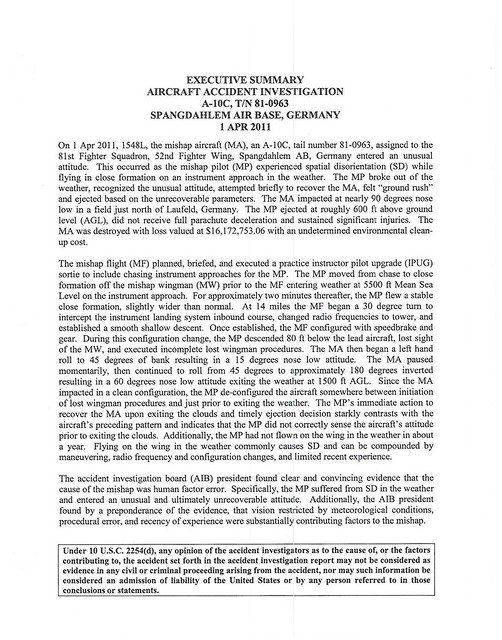
KAISERSLAUTERN, Germany — The pilot whose A-10 Thunderbolt II crashed on returning to Spangdahlem Air Base after a routine training mission last year became spatially disoriented while flying in thick clouds and lost control of his aircraft, an Air Force accident investigation board has found.

Lt. Col. Scott Hurrelbrink ejected less than two seconds before the $17 million aircraft hit the ground nose down and burned in a grass field just north of the sparsely populated town of Laufeld, near the city of Wittlich, according to the board's report, which Spangdahlem officials released Monday.

The board found "clear and convincing evidence that the cause of the mishap was human factor error," the report states. But investigators determined that poor weather, the pilot's lack of recent experience flying in close formation in heavy clouds and procedural errors on the part of the pilot and the flight lead also contributed.

"Flying on the wing in the weather is a specific maneuver which commonly causes spatial disorientation, and if minimally practiced will require even greater concentration on the part of a pilot," the report states.

Hurrelbrink was not named in the report, which the Air Force made available online, but he was identified by Spangdahlem officials after the accident.

A day after the crash, base officials said Hurrelbrink's injuries were not serious. But a base spokeswoman said in an email Tuesday that the pilot "sustained significant injuries," an assessment also in the report.

Base officials provided no other information Tuesday about the pilot, only that he is no longer assigned to the 81st Fighter Squadron.

Lt. Gen. Stephen Mueller, U.S. Air Forces in Europe vice commander, appointed Col. Peter Davey, the 603rd Air Operations Center commander at Ramstein Air Base, Germany, to be the board president and lead the investigation, which was conducted from June 1 to June 24, according to the report.

The crash occurred on the afternoon of April 1, after Hurrelbrink and the flight lead, who was not identified in the report, descended into clouds using the plane's instruments to guide them while returning to Spangdahlem.

Hurrelbrink lost sight of the flight lead at about 3,700 feet in what was described as a “thick cloud deck with poor visibility,” the report says.

Since Hurrelbrink "had to concentrate on the lead aircraft while flying formation, he had limited time to cross-check his own instruments and had no visible horizon," Davey wrote in explaining his opinion of the crash's cause. "Though this is a routine required skill, it still sets the conditions that led to the spatial disorientation."

Spatial disorientation can occur when a pilot cannot correctly interpret position or direction due to clouds, low-visibility or other conditions that prohibit the pilot from orienting to a visual horizon, 2nd Lt. Stephani Schafer, a base spokewoman, explained in an email.

After calling "lost wingman," Hurrelbrink banked left 15 degrees for only five seconds, instead of 15 seconds, a procedure designed to separate the aircraft and help the pilot orient his aircraft, among other things, the report found. Though the flight lead acknowledged the pilot's "lost wingman" call, he failed to communicate key parameters to Hurrelbrink, such as his own altitude, heading and airspeed, according to the report.

After emerging "from the clouds inverted, 60 degrees nose low" at about 1,500 feet, the pilot "immediately experienced 'ground rush' " — a visual misperception of how quickly the ground is approaching — "and made an initial attempt to pull to the horizon," the report says.

Assessing that he could not recover from the dive, the pilot "released the stick to eject," the report says.

The pilot appears lucky to have survived the crash. An accident simulation showed there were about two seconds from pulling the eject handle to impact with the ground, with the pilot landing less than 50 yards from the impact crater, according to the report. Fire damage to the parachute showed the canopy was not fully inflated at the time of exposure to the aircraft explosion, indicating Hurrelbrink did not get full deceleration, according to the report.

The report also notes the efforts of local residents on the scene. Several residents of Laufeld witnessed the crash and contacted emergency responders. Despite the proximity of the burning wreckage, the first two residents on scene cut the pilot's parachute lines and harness to disconnect him from the parachute and remained with him until professional help arrived.

The plane was carrying 1,150 rounds of training ammunition, Air Force officials said.

The environmental cleanup costs have yet to be determined, the report says.

The twin-engine, single-seat A-10, also known as the Warthog, is used to provide close air support for ground forces by attacking tanks and other targets. Since 2003, A-10s from the 81st Fighter Squadron have deployed four times to Afghanistan. In the month prior to the mishap, the squadron executed a short-notice deployment in support of operations in Libya, according to the report.

The Air Force plans to deactivate the 81st as part of proposed budget cuts in fiscal 2013.

Source

Tuesday, March 6, 2012

52 FW releases AIB report on A-10C crash in Germany

Relased by 52nd Fighter Wing Public Affairs

3/5/2012 - SPANGDAHLEM AIR BASE, Germany -- Spangdahlem Air Base officials released the results of their investigation into the April 1, 2011 crash of an A-10C Thunderbolt II, north of Laufeld, Germany as it returned to base on a training mission.

Concluding the investigation, the board president determined that the cause of the Spangdahlem-based A-10C crash was human factor error.

"Specifically, the mishap pilot suffered from spatial disorientation while flying in close formation on an instrument approach in weather. The mishap pilot broke out of the weather, recognized the unusual attitude, attempted briefly to recover the mishap aircraft, experienced "ground rush" and ejected based on the unrecoverable parameters. Additionally, the Board also found other contributing factors to include vision restricted by meteorological conditions, procedural error, and recency of experience."

The pilot survived the crash by ejecting before the aircraft impacted an unpopulated area near Laufeld. The aircraft was completely destroyed upon impact.

The USAFE vice-commander, Lt. Gen. Stephen Mueller, convened an Accident Investigation Board to investigate the crash, and designated Col. Peter Davey, 603rd Air Operations Center Commander, as the board president.

The convening authority approved the board president's report without comments.

The primary purpose of the board was to provide a publicly releasable report of the facts and circumstances surrounding the accident. An executive summary of the report is available at http://usaf.aib.law.af.mil/index.html.

The entire report is available at http://usaf.aib.law.af.mil/. For more information contact the USAFE Public Affairs Office at 011-49-6371-47-6558 or pa.ops@ramstein.af.mil.

Source

Sunday, March 4, 2012

Spangdahlem A-10C crash report released

By Joachim Jacob, Warthog News Editor

It's official now: The "Hog" which crashed on April 1, 2011, near Laufeld, Germany, was A-10C 81-0963 from the 81st Fighter Squadron, 52nd Fighter Wing (USAFE), Spangdahlem AB, Germany.


Executive Summary


Full Narrative

Please note: This breaking news will be updated soon.

Sunday, February 26, 2012

81st Fighter Squadron A-10Cs caught at Spangdahlem February 22, 2012

At Spangdahlem AB, Germany, Warthog News contributor Edwin Huskens from Belgium had the opportunity to take the following shots:


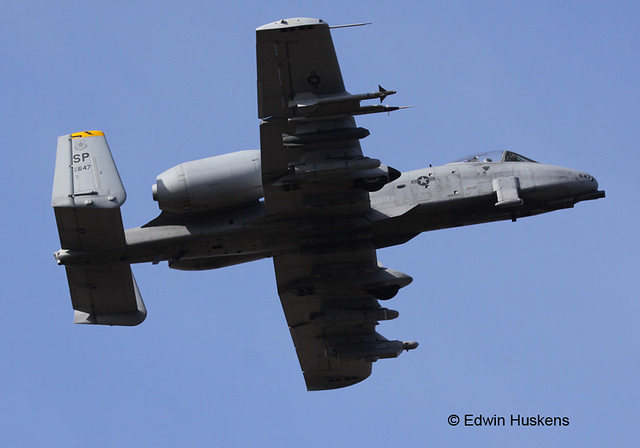
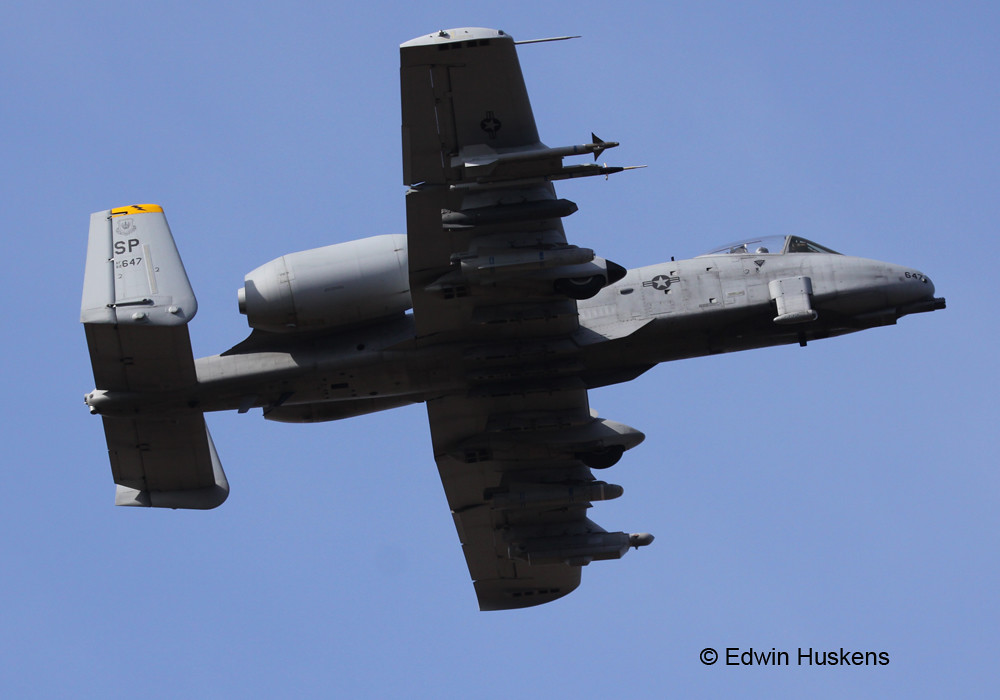
A-10C 81-0976 from the 81st Fighter Squadron. (Photo by Edwin Huskens) Full size

Note: According to Scramble, this clean "Hog" came back from SABCA after maintenance.

On that day, Edwin spotted the following A-10Cs: 81-0960, 81-0991, 81-0992, 82-0646, 82-0647, 82-0654, and the arrival of 81-0976.

See: A day in the Eifel, ETAD Spangdahlem-ETSB Büchel 22/02/2012


A-10C 82-0647. (Photo by Edwin Huskens) Full size

Friday, February 17, 2012

81st Fighter Squadron have been identified as the overseas A-10C squadron to be retired

By Joachim Jacob, Warthog News Editor

I'ts official now: The 81st Fighter Squadron, 52nd Fighter Wing (USAFE), Spangdahlem AB, Germany, have been identified for inactivation in fiscal year 2013.

On Thursday, the Pentagon released additional details about planned reductions in the U.S. military presence in Europe as part of a budget-cutting drive.

One of the changes: Deactivate the 81st Fighter Squadron of A-10 aircraft at Spangdahlem Air Base, Germany, during 2013. The change will affect about 525 U.S. airmen, who will be reassigned based on the needs of the Air Force.


Related news coverage:

Spangdahlem A-10 squadron to shut down


By Jill Laster - Staff writer
Air Force Times
Posted: Thursday Feb 16, 2012 16:03:48 EST

The Air Force will lose an A-10 squadron in Germany as well as an air control squadron in Italy as part of proposed budget cuts in fiscal 2013, a senior defense official said Thursday.

The 81st Fighter Squadron at Spangdahlem Air Base, Germany, would be inactivated under the Air Force's plan, eliminating 20 A-10s and 525 airmen's positions. The 603rd Air Control Squadron at Aviano Air Base, Italy, would also be cut along with 336 positions.

The defense official, speaking to reporters on background during a press briefing, said the U.S. plans to reduce its force numbers in Europe from 80,000 to 70,000 over the next five years. Those cuts include the loss of two Army brigades and 2,500 soldiers in Germany.

Source


Force structure changes hit 52nd Fighter Wing


by Staff Reports
52nd Fighter Wing Public Affairs

2/17/2012 - SPANGDHALEM AIR BASE, Germany -- Air Force Secretary Michael B. Donley and Air Force Chief of Staff Gen. Norton A. Schwartz announced detailed force structure changes to take effect in Fiscal Year 2013 at a press conference at the Pentagon Feb. 3.

The Air Force will cut 286 aircraft to include 123 fighters, 133 mobility aircraft and 30 intelligence, surveillance and reconnaissance platforms. Among the fighter aircraft that will be retired are 102 A-10 Thunderbolt IIs, and this reduction includes the A-10s of the 81st Fighter Squadron.

According to the USAF Force Structure Changes: Sustaining Readiness and Modernizing the Total Force white paper, [Air Force leadership] has accepted the risk in our Combat Air Forces by retiring or reclassifying aircraft from seven squadrons: five A-10 squadrons, one F-16 squadron and one training/support coded F-15 Aggressor squadron.

"There are still going to be 246 A-10s left in the inventory," Schwartz said. "We are doing close-air support with B-52s, with B-1s, certainly with F-16s and F-15s and AC-130 gunships."

The bottom line, he said, is there are plenty of assets that can deliver pinpoint close-air support.

"The United States Army and the United States Marine Corps and our own battlefield Airmen can rely on having plenty of close-air support provided by the United States Air Force from above," the general said.

These force structure changes mean a reduction of 9,000 Airmen - 3,900 active duty, 5,100 Air Guardsmen and 900 Air Force Reservists. Officials expect all these reductions can be made voluntarily.

Even though the Panthers have been identified as the overseas A-10 squadron to be retired, Col. Chris Weggeman, 52nd Fighter Wing commander, says the future of Spangdahlem AB still remains bright.

"As a service, we've been opening and closing squadrons for more than 60 years in response to the demands of time, and our base has weathered these storms along the way," he said.

The colonel also stressed that regardless of the type and number of aircraft assigned to the wing, "we have a massive capacity to provide ready and responsive combat power around the globe as recently demonstrated during Operation Odyssey Dawn."

The colonel equated the change to a smart tablet or phone with a robust capacity to support people during their daily lives by adding and subtracting a multitude of "apps" to meet individual needs.

"Spangdahlem will continue to be that smart tablet or phone," he said. "What the Air Force will continue to do is change the 'apps' we're running to ensure the greatest capability and capacity exists for us to achieve enduring mission success.

"The mighty Saber nation remains a strong and vital part of our U.S. Air Forces in Europe arsenal in the Eifel thanks to the dedication, strength and flexibility of our German-American friendship ... dare I say no one comes close!"

For more information on service changes or the Fiscal Year 2013 budget announced Feb. 13, visit http://www.af.mil or http://www.spangdahlem.af.mil.

(Editor's Note: Information used in this article came from Jim Garamone, American Forces Press Service.)

Source


FY2013 budget cuts to impact U.S. Air Forces in Europe


from U.S. Air Forces in Europe Public Affairs

2/17/2012 - WASHINGTON (AFNS) -- The Air Force released its fiscal 2013 budget Feb. 13 and stressed the need for difficult budgetary cuts to meet the new defense strategy while maintaining the service's agility, flexibility and readiness. These cuts include several impacts to force structure in Europe.

The Air Force is requesting $154.3 billion in the president's 2013 budget, a reduction of five percent from the $162.5 billion the service received in fiscal 2012. The impact of this reduction to U.S. Air Forces in Europe will include the inactivation of the 81st Fighter Squadron at Spangdahlem Air Base and the retirement of its 20 A-10 fighter aircraft. The Air Control Squadron at Aviano Air Base in Italy will also inactivate. More details on Air Force wide force structure changes and the impact to personnel will be announced in March. Both units will inactivate by the end of Fiscal Year 2013.

According to officials at U.S. European Command, the United States has an enduring interest in supporting peace, prosperity, unity and freedom in Europe, as well as bolstering the strength and vitality of NATO. Despite the announced force structure changes, the U.S. will maintain a robust military presence in Europe.

Budget reductions affect the entire Department of Defense and according to Maj. Gen. Edward L. Bolton Jr., the deputy assistant secretary for budget, "The Air Force made some very difficult choices. But it was our priority to tightly align with the new strategy and also stay within the fiscal environment as a result of the realities we are facing economically."

The Air Force Strategic Choices and Budget Priorities paper, released by Secretary of the Air Force Michael Donley and Air Force Chief of Staff Gen. Norton Schwartz on Jan. 27, calls for streamlining of the force, making it smaller and more efficient with care to not create a hollow force.

While the Air Force is working to adjust to a new strategic environment, the Commander of U.S. Air Forces in Europe emphasized the continuing importance of USAFE's forward presence.

"Despite the changes to our force structure and budget, close cooperation with Europe remains key to our national security strategy, and USAFE is a major part of that," said Gen. Mark A. Welsh III. "We are strategically located and provide critical capabilities to NATO, EUCOM, AFRICOM and CENTCOM. From mobility, to communications, to logistics, to command and control, to contingency response ... USAFE remains vital."

Under the Budget Control Act, the Department of Defense is required to reduce expenditures by $487 billion over the next 10 years with a reduction of $259 billion over the next five.

"It is worth noting that our budget has reduced by 12 percent in real terms since FY09," Bolton said. "So we have seen a consistent trend of reductions in the budget.

"The Air Force budget portion of the Budget Control Act reductions over the next five years is $54 billion," Bolton said.

The Air Force's portion is not a result of simply dividing responsibility between the services. Instead, the budget amount is strategy driven, while maintaining a properly equipped force with the ability to deter, deny and defeat an opportunistic aggressor in a combined campaign anytime, anywhere, he added.

"The strategy requires a different force structure and different tools; the Air Force is realigning the total force to address the future," Bolton said.

The service has drawn down many times in the past, but never as a nation still at war. Previous size reductions focused more on maintaining force structure, which left the Air Force with a hollow force, he said.

"It is really about balancing risk among the themes of force structure, readiness, modernization and taking care of our people," Bolton said. "We have sized the force to the strategy within the fiscal constraints we are facing."

The Air Force is looking at a nearly $3 billion reduction in procurement cost because the service divested and is purchasing less hardware. Also, there is a reduction of about $500 million in research, development, testing and evaluation, but the Air Force continued its focus on modernizing key components that will maintain the service's technological edge, Bolton said.

"Funding for intelligence, surveillance and reconnaissance and space remain a priority," he added. "We will continue to develop programs in ISR ensuring we are supplying this skill set to the joint warfighter and coalition partners."

According to Bolton, funding also remains in place for the F-35 Lightning II joint strike fighter -- the centerpiece for future modernization to be able to prevail in contested environments.

"Ensuring fiscal goals are met and fleet modernization continues are only half of the goal in the new strategy," said Bolton. "Taking care of Airmen and their families is a key component and cannot get lost in talking of mere numbers.

"We are reducing the force by 9,900 Airmen, which will reduce the end strength of active duty, Guard and Reserve to around a 501,000 total force," he said. "This allows us to appropriately size the force structure to the strategy and hardware we are going to have in the inventory."

The Air Force is proposing a 1.7 percent military pay raise in fiscal 2013 and a 4.2 percent raise in basic allowance for housing and 3.4 percent raise in the basic allowance for subsistence as a continuing growth of compensation for service.

"We are budgeting more than $700 million for family programs including child and youth programs and child development centers," Bolton said. "We will continue to take care of our folks; we just need to ensure it is being done efficiently under tighter fiscal constraints."

Housing is a key ingredient to taking care of Airmen and the Air Force is close to reaching its goal of 53,000 privatized housing units force-wide with over 40,000 units in place and the remaining units to be ready in fiscal 2013.

"We've increased our family housing budget by $93 million and this will allow us to meet our goal," Bolton said. "Completing this transition is important because we have found through privatization we are able to increase the quality of housing for our Airmen and their families."

Looking back to the 2011 requirements -- military action and support in Iraq and Afghanistan, supporting NATO missions in Libya, along with humanitarian support to Japan following a major earthquake -- Bolton reinforced the reach and responsibility placed on today's Airmen and emphasized the importance of providing them the tools required for a versatile force.

"We will continue to do everything we can to provide them with the tools they need to continue to be the best Air Force in the world for decades to come," Bolton said.

Editor's note: The U.S. Air Force Public Affairs Agency, USAFE Public Affairs and EUCOM Public Affairs contributed to this story

Source


What the FY13 Budget means to USAFE


Commentary by Gen. Mark A. Welsh III
U.S. Air Forces in Europe commander

2/17/2012 - RAMSTEIN AIR BASE, Germany -- Since the first Gulf War, the U.S. has been engaged continuously in combat operations and U.S. Air Forces in Europe have played a critical role. Not only have we deployed thousands of our Airmen and assets, we have also served as an essential support platform enabling the long-term projection and sustainment of combat power throughout the U.S. Euprean Command, Central Command and Africa Command areas of responsibility. At the same time, NATO has increased both in size and scope of operations. Through all this, USAFE has steadily increased engagement and strengthened relations with our partners and Allies. We demonstrate the value of forward-based forces every day.

However, our challenges today are many and changing: a global economic slowdown, shrinking defense budgets, continuing operations in Afghanistan and the rise of missile threats to the U.S. and our allies. We're also witnessing a significant transition in the command's mission as we inactivate 17th Air Force and assume the role of air component to U.S. Africa Command in addition to our traditional role as the air component to U.S. European Command. We must meet these challenges head on to maintain our effectiveness and capabilities within a much larger area of responsibility.

Dealing with the same challenges on a global scale, the Department of Defense recently concluded a thorough review of our defense strategy and has begun a transition to a new approach that emphasizes future challenges, supports federal deficit reduction, and accounts for the declining costs of operations in Iraq and Afghanistan. Operating within constrained budgets is simply a reality. On February 13, the President presented a proposed budget to Congress that reflects these strategic changes and reductions, and includes a reduction of about $8 billion, or about 5%, in FY13 for the Air Force. Over the next 10 years, the DoD will need to cut more than $487 billion; $54 billion will come from Air Force accounts. Further, within the next year, the Air Force will bring the Total Force end strength down by around 9,900 Airmen.

What do these reductions and strategy changes mean for USAFE?

For the DoD and the entire Air Force, all of this means a shift in focus and a change in how we do business. Our senior leaders, including the President, have determined that our national focus needs to emphasize Asia and the Middle East. However, the new strategy also calls for continued engagement in Europe and Africa. As recent operations in Libya proved, USAFE's forward presence and close relationships within NATO and throughout our entire area of responsibility are of critical importance.

We must also target investments to ensure we have the resources to execute the missions of the future. We will be smaller, but we will be effective and well-trained. Let me be clear, even with these budget cuts, our military and our Air Force are by far the best resourced, best trained and best equipped in the world. We can and will adapt to the new paradigm. And as we always have in the past, we will meet these challenges head on.

Of course, changes to our strategic focus and reductions in Defense spending will change how USAFE looks in the future. The 81st Fighter Squadron at Spangdahlem will be inactivated as part of an overall reduction of five A-10 squadrons. In addition, the 603rd Air Control Squadron at Aviano will be inactivated. While personnel reductions Air Force wide will often hit close to home, what that means for USAFE is still unclear.

However, this is not just about downsizing. It's about adapting to a changing environment. As Ballistic Missile Defense becomes more critical, our investment and participation in Integrated Air and Missile Defense in theater is increasing. We are also taking a hard look at all of our installations to ensure we are operating efficiently at every location and that we are postured to support future operations. There are certainly more changes to come, but we will work through them all carefully and we will ensure our people are taken care of.

The bottom line: USAFE has been and will remain critical to our national defense strategy. We have an expanding mission in terms of geography and operations, and the new strategy will continue to draw heavily on our forces and our enduring capabilities -- mobility access and throughput; communications throughput; logistical support and throughput; contingency response; and command and control in Intelligence, Surveillance and Reconnaissance, Air Operations, ballistic missile defense, and humanitarian response. We will also continue to rely on and partner with our close friends and Allies, especially those who host our bases, personnel and families.

I know change is never fun, but it is necessary ... it is an opportunity to get better at what we do and there is no doubt in my mind that we will. As we move into the future together, let me thank you for all you do to ensure freedom's future.

Additional Info

The FY13 budget overview available on-line at http://www.saffm.hq.af.mil/budget/ provides a great look at many of the efforts we will continue to pursue from training, to building partnerships, to supporting our Allies, and more.

Source


See also:
Panetta Outlines U.S. Troop Changes in Europe
Pentagon lays out significant cuts to U.S. forces in Europe
USEUCOM Releases Command Statement on Force Posture

Please note: This breaking news will be further updated soon.
Thursday, February 16, 2012

Super Saber Performer

by Staff Reports
52nd Fighter Wing Public Affairs


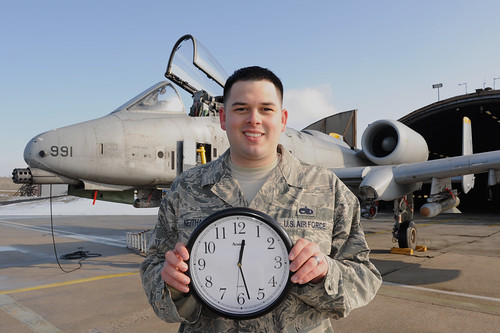
2/16/2012 - SPANGDAHLEM AIR BASE, Germany -- Staff Sgt. Zach Neithamer, 52nd Maintenance Operations Squadron 81st Aircraft Maintenance Unit scheduler, is the Super Saber Performer for the week of Feb. 16-23. (U.S. Air Force photo by Airman Senior Airman Natasha Stannard) Hi-res

Most memorable Air Force experience [quoted in his profile - Warthog News]: Stepping outside my career field and being trained as an engine troop on A-10 Thunderbolt IIs while deployed to Kandahar Airfield, Afghanistan. We completed 13 engine swaps to keep jets in the sky during the first democratic elections in Afghanistan.

Note: Pictured is A-10C 81-0991 from the 81st Fighter Squadron.

Source

Tuesday, February 14, 2012

AMUs face off for load crew of the year

Released by 52nd Fighter Wing Public Affairs


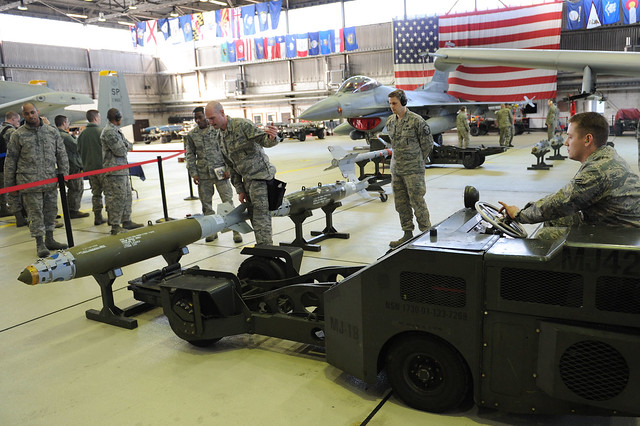
2/10/2012 - SPANGDAHLEM AIR BASE, Germany – Staff Sgt. Matthew Bonney, 81st Aircraft Maintenance Unit weapon load crew chief, guides Senior Airman Forrest Womack, 81st AMU weapon load crew member, while he uses an MJ-1 Jammer to pick up a GBU-38 bomb during the load crew of the year competition at Hangar 1 here Feb. 10. Each of the three load crews won a quarterly competition to participate in this event. The winner will be announced at the wing annual awards March 9 and will represent Spangdahlem AB in a U.S. Air Forces in Europe load crew competition later this year. The 81st and 480th AMUs maintain aircraft that deliver precise, full-spectrum capability for the current fight. (U.S. Air Force photo by Senior Airman Christopher Toon) Hi-res

Source

Friday, January 27, 2012

'A-Team' A-10s, Apaches hone CSAR, CAS skills

by Senior Airman Natasha Stannard
52nd Fighter Wing Public Affairs


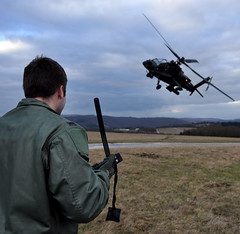
BAUMHOLDER, Germany – U.S. Air Force 1st Lt. Bob Carpenter, 81st Fighter Squadron pilot, uses a combat survivor evader locater radio to communicate that a U.S. Army AH-64 Apache helicopter that has arrived to rescue him during a joint training exercise at the Baumholder Major Training Area here Jan. 23. This training integrates U.S. Army and Air Force resources to more accurately simulate the real-life close air support and combat search and rescue scenarios encountered in deployed locations. The goal of this training is to develop tactics, techniques and procedures between military branches to enhance interoperability. (U.S. Air Force photo by Senior Airman Natasha Stannard) Hi-res

1/27/2012 - BAUMHOLDER, Germany -- A joint close air support and combat search and rescue exercise involving U.S. Air Force A-10 Thunderbolt II pilots and U.S. Army AH-64 Apache helicopter pilots took place for the first time at the Baumholder Major Training Area here Jan. 23 - 26.

A-10 pilots who participated in this joint training are assigned to Spangdahlem Air Base's 81st Fighter Squadron and the AH-64 Apache helicopter pilots are assigned to Illesheim Army Airfield's Company C, the 2-159 Attack Reconnaissance Battalion, 25th Infantry Division.

The training simulated real-life CSAR and CAS scenarios. Its purpose was to establish joint tactics, techniques, and procedures for future deployment operations.

"We frequently work with Apache pilots downrange, and the ability to train with them now allows us to sharpen our skills prior to future deployments," said U.S. Air Force Lt. Col. John Briner, 81st FS commander.

Close air support is essential to the recovery of surviving service members in CSAR situation, but nothing is accomplished on either end without proper communication, which was the focus of the exercises, explained U.S. Air Force 1st Lt. Bob Carpenter, 81st FS pilot.

"It's important everyone has the same level of understanding of what needs to be done and how to do it," Carpenter said of joint rescue missions. "The survivor on the ground needs to be picked up, and if all elements aren't working like a well oiled machine, that may not happen,"

Army and Air Force often work together in these rescues, but because they are from different military branches, they have different procedures, rules and even lingo. Training before real events gives them the opportunity to clear anything that may not be understood and establish joint procedures.

"The integration we're performing here is paramount training," said U.S. Army Chief Warrant Officer 3 Karl Metz, 2-159 ARB Apache helicopter pilot. "We're learning each other's language and tactics, and in doing so, we have a baseline to grow from for when we're actually deployed. Today we got to integrate with A-10 pilots, and the most successful piece is learning their language. I know I will deploy with A-10s, and being able to work with them now is instrumental."

The Air Force pilots who were "rescued" in this training scenario used combat survivor evader locater radios to communicate and assist the A-10 pilots performing CAS. Pilots carry these radios along with a survival kit if they have to eject themselves from their aircraft.

These radios allow those being rescued to relay to the A-10 pilots their location and what hazards are in the area. The A-10 pilots then relay this information to the Apache pilots performing CSAR, lead them to the rescue pick-up area and simulate clearing the area of enemy threats.

"We're learning different capabilities and limits of each platform, and how our different capabilities can combine our strengths in order to prosecute targets more effectively," Briner said of the two aircraft working together.

Carpenter said practicing these scenarios now ensures once these two aircraft are deployed together, they can seamlessly seek, attack and destroy any enemies trying to keep them from their most important mission: rescuing their brethren.

"We do this for the guys on the ground," Metz said. "We'll do anything it takes to get service members to safety. Our job isn't to kill - it's to keep our guys alive, and we're really good at our job."


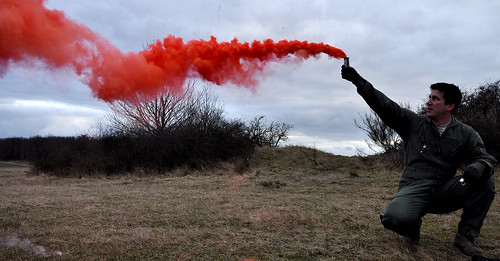
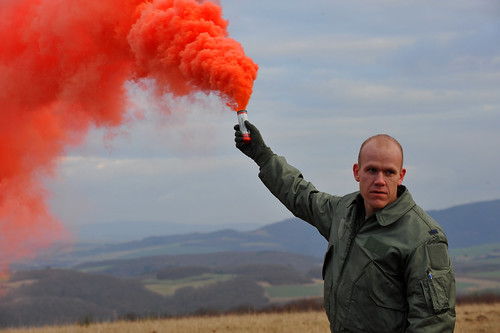
BAUMHOLDER, Germany – U.S. Air Force Capt. James Schmidt, 81st Fighter Squadron pilot, raises a signal smoke flare during joint forces close air support and combat search and rescue training at the Baumholder Major Training Area here Jan. 23 to signal a U.S. Army AH-64 Apache helicopter crew participating in the training. (U.S. Air Force photo by Senior Airman Natasha Stannard) Hi-res

Source

See also:
Warthogs take flight with U.S. Army

Tuesday, January 24, 2012

Warthogs take flight with U.S. Army

Released by 52nd Fighter Wing Public Affairs


BAUMHOLDER, Germany – U.S. Air Force 1st Lt. Matthew Kading, 81st Fighter Squadron pilot, raises a signal smoke flare during joint forces combat search and rescue training at the Baumholder Major Training Area here Jan. 23. The training integrates U.S. Army and Air Force resources to more accurately simulate the real-life CSAR and close air support scenarios encountered in deployed locations. The goal of this training is to build a stronger partnership between the military branches to enable pilots to train like they fight. (U.S. Air Force photo by Airman 1st Class Dillon Davis) Hi-res


BAUMHOLDER, Germany – A U.S. Air Force A-10 Thunderbolt II assigned to the 81st Fighter Squadron simulates close-air support during joint forces combat search and rescue training at the Baumholder Major Training Area here Jan. 23. The training integrates U.S. Army and Air Force resources to more accurately simulate the real-life CSAR and close air support scenarios encountered in deployed locations. The goal of this training is to build a stronger partnership between the military branches to enable pilots to train like they fight. (U.S. Air Force photo by Airman 1st Class Dillon Davis) Hi-res

Note: A very good overhead shot but presented by USAF in a very bad photo quality.


BAUMHOLDER, Germany – A U.S. Army AH-64 Apache takes off during joint forces combat search and rescue training at the Baumholder Major Training Area here Jan. 23. The training integrates U.S. Army and Air Force resources to more accurately simulate the real-life CSAR and close air support scenarios encountered in deployed locations. The goal of this training is to build a stronger partnership between the military branches to enable pilots to train like they fight. (U.S. Air Force photo by Airman 1st Class Dillon Davis.) Hi-res

Background info:
U.S. Army Garrison Baumholder

BTW: Related to that, I remember the glory old days of A-10 TDY's to their Forward Operation Locations (FOL's) in Germany... (including the legendary "Autobahn" landing or stop-over spots...) Please check: German Autobahn

Request: Anybody who likes to provide me historic A-10 shots, taken on air bases in Germany? If yes, I would be very grateful for any related support!