Today, from W. Garth Smith, MetaVR, Inc., I got the following e-mail:
Hello James,
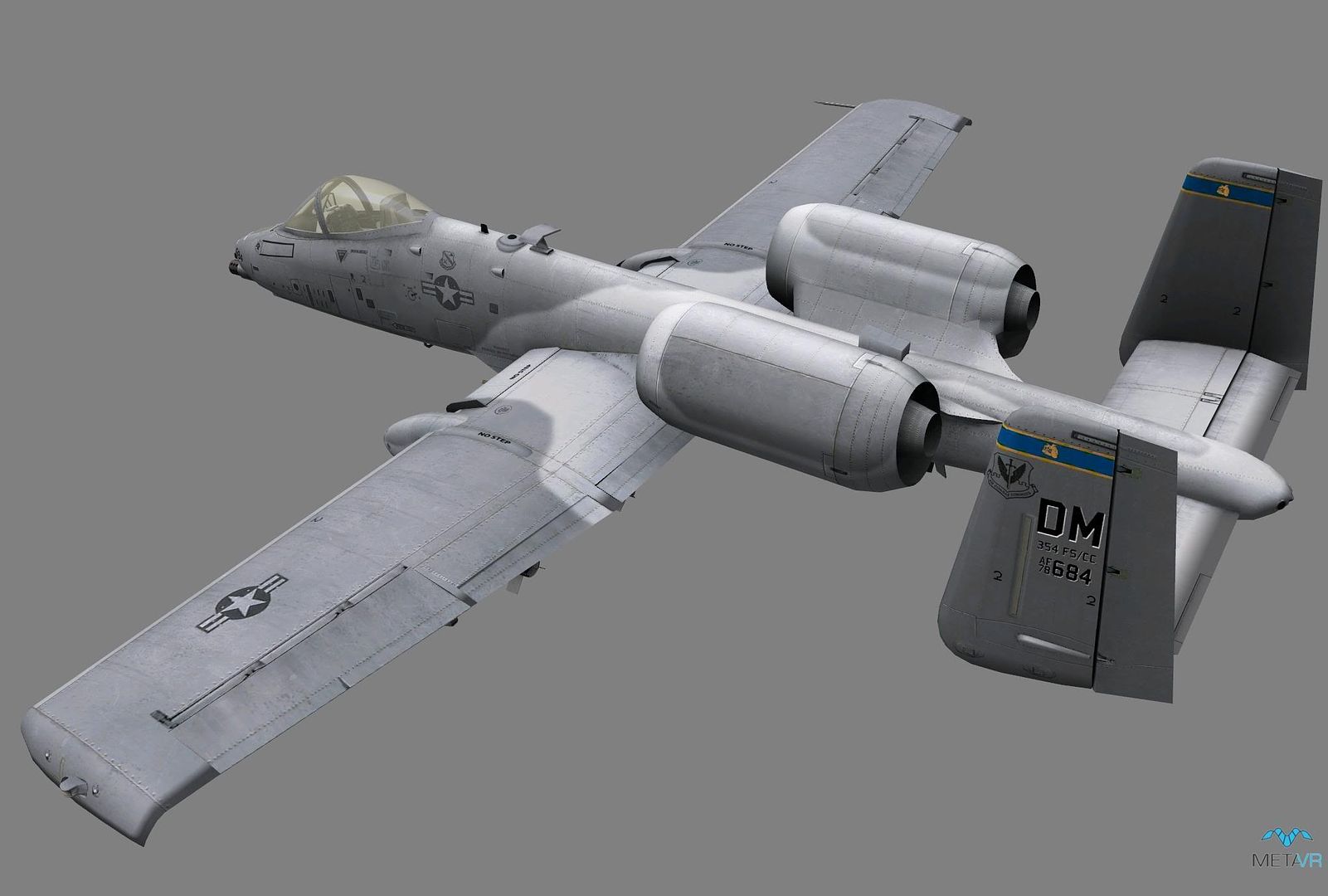
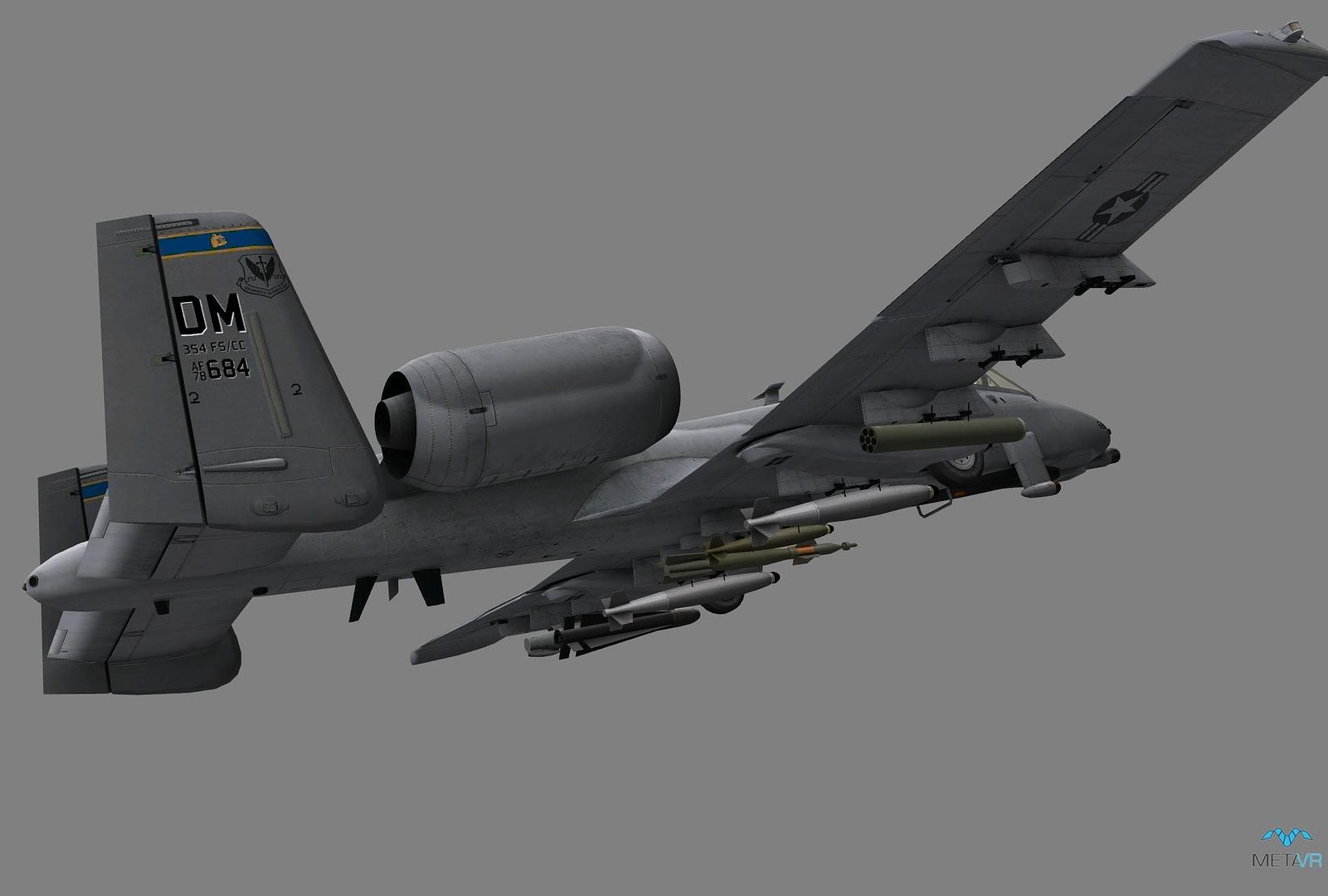
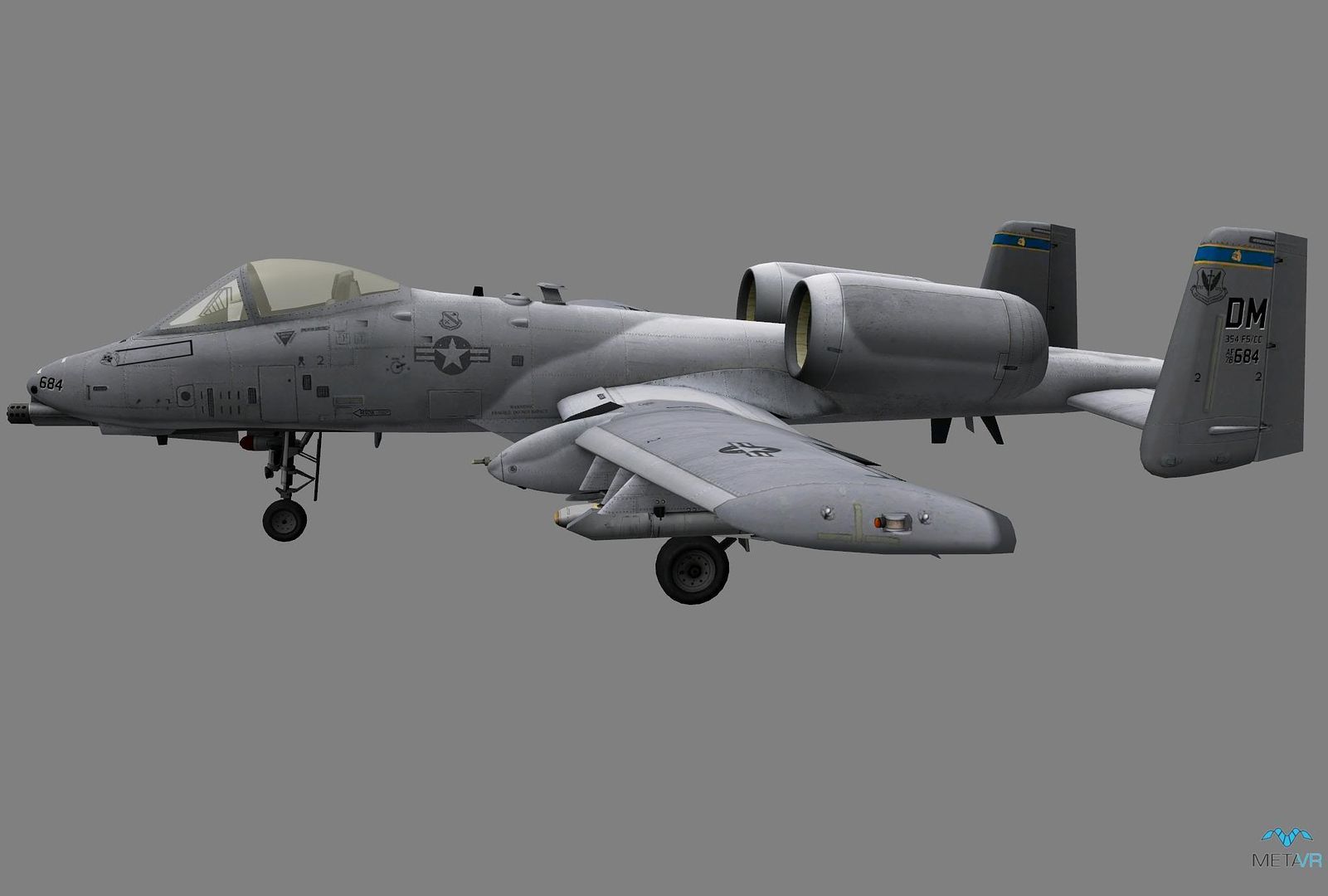
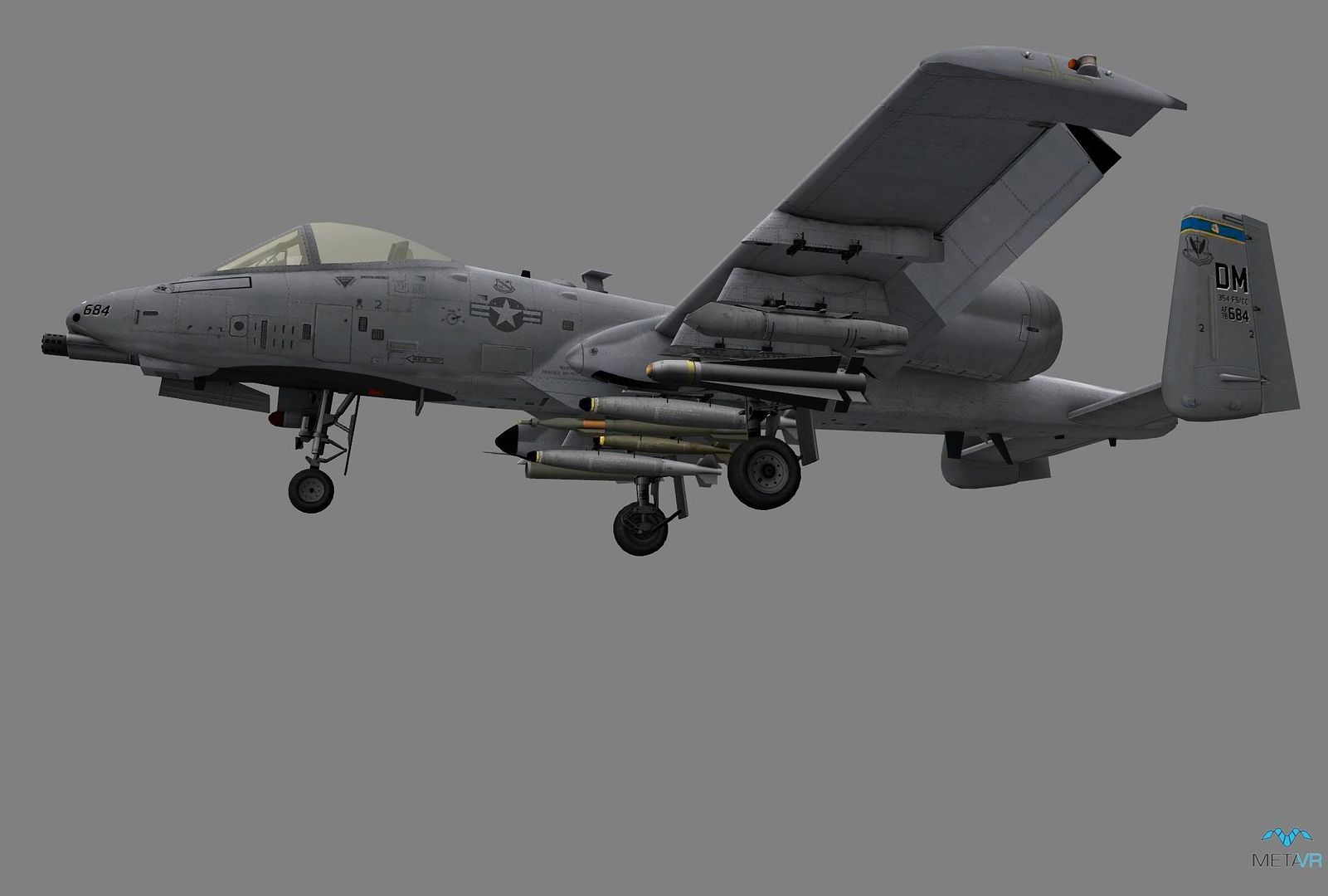
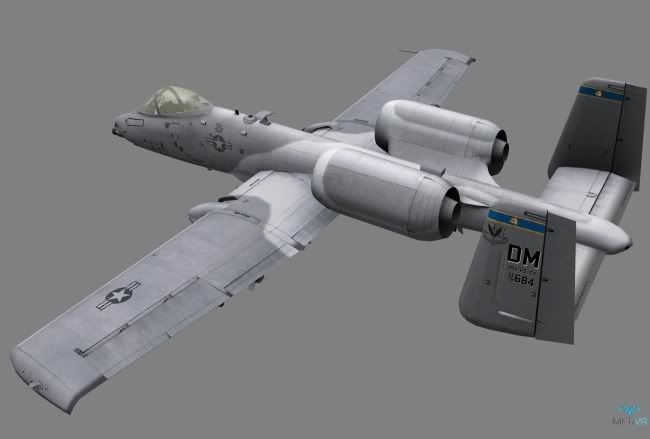
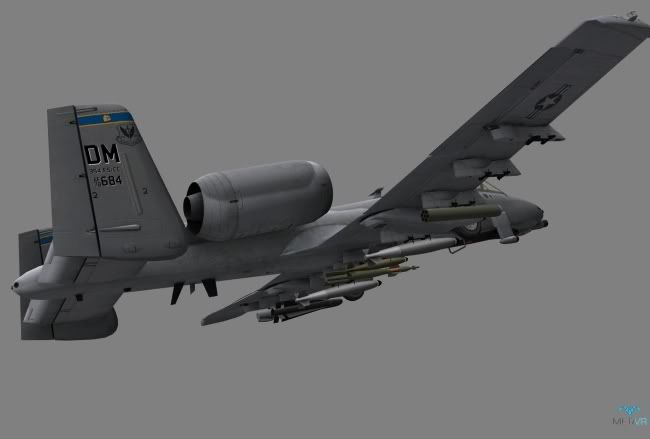
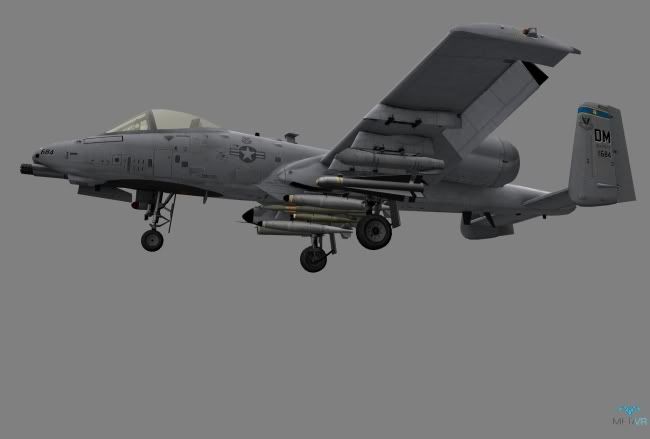
thanks for your feedback on the http://warthognews.blogspot.com site. we updated the textures to reflect the bulldog logo. please see attached image. we redid our video as well of an A-10 support mission. we think that the model is substantially improved. thank you for your feedback
regards
garth
Watch the video
Showing posts with label A-10 simulator. Show all posts
Showing posts with label A-10 simulator. Show all posts
Monday, May 17, 2010


Monday, May 10, 2010
Latest feedback from MetaVR, Inc.
Yesterday, I got the following kind e-mail from W. Garth Smith, MetaVR, Inc.:
Hello J.J.,
we have made an improved aircraft based upon your input
would you be so kind as to give us feedback on this revised model? we will proived full credit to your for your input onpon the web site for this model once it is finalized
regards
wgs
Find out about MetaVR's new JTAC MiniDome collaboration with Immersive Display Solutions: http://www.metavr.com/downloads/MetaVR_IDS_JTAC-MiniDome-2009.pdf
W. Garth Smith
MetaVR, Inc.
80 Somerset Rd.
Brookline, MA 02445 USA
URL: http://www.metavr.com
e-mail: wgsmith@metavr.com
phone: US 617-739-2667
fax: US 617-249-0151
Latest screen shots, associated to the e-mail:

Full size

Full size

Full size

Full size
Very impressive preview screen shots, Garth! On a first view, it looks very good to me. Please give me time to re-check all of them. Then you will be get latest notes by me.
Update May 11, 2010:
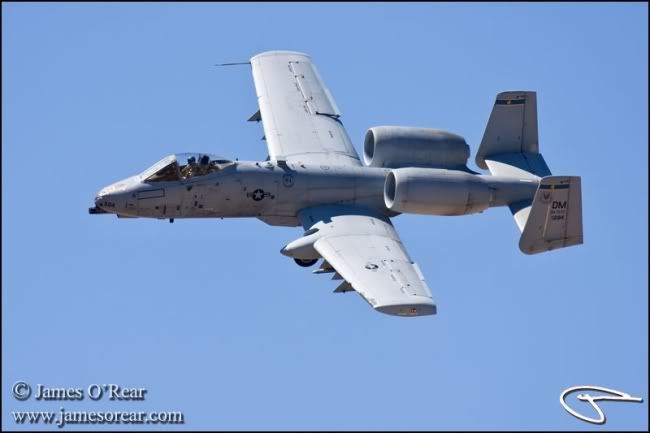
Feedback from aviation photographer and Warthog News contributor James O' Rear from United States, e-mailed to me today: Not sure if they're working off of Federal Standard paint colors but my observations show the grey shades with much less contrast. Also, 684 does not have a shield above the star and bar, there is a Bulldogs monochrome logo below and just behind the satellite antenna. See my Flickr image below for confirmation, can supply them with a large image if need be.

A-10C 78-0684 from the 354th Fighter Squadron, 355th Fighter Wing, taken on March 20, 2010, during the combat search and rescue demo at Davis-Monthan AFB, Arizona. (Photo by James O'Rear) Full size
Thank you very much for your feedback, James. A hi-res version of this picture would be very great. But what I really want are close-up shots of all the aircraft markings.
Update May 12, 2010
Latest known A-10C 78-0684 OEF deployment pictures:

An A-10C Thunderbolt II with the 354th Expeditionary Fighter Squadron flies over Kandahar Airfield, Afghanistan, January 1, 2010, as it completes ten thousand hours of flying during the squadron's six-month deployment. The aircraft is A-10C 78-0684, marked 354 FS/CC as the commander's jet (or 354th FS's "squadron bird"), and flown on this mission by Lt. Col. Michael Millen, 354th Expeditionary Fighter Squadron commander. Visible combat loadout: station 1: empty, station 2: Sniper XR Targeting Pod, station 3: empty LAU-117 single-rail launcher for AGM-65 Maverick, station 4: GBU-38 (JDAM), station 5: GBU-12, station 6 (center station): empty, station 7: Mk-82, station 8: GBU-38 (JDAM), station 9: LAU-131 Rocket Pod, station 10: empty, station 11: empty. (U.S. Air Force photo by Staff Sgt. Dayton Mitchell) Hi-res

Lt. Col. Michael Millen, commander of the 354th Expeditionary Fighter Squadron, flies the ten thousandth hour for the A-10C Thunderbolt II squadron, wrapping up a six-month deployment to Kandahar Airfield, Afghanistan, January 1, 2010. In his cockpit, Lt. Col. Millen has a "354 EFS A-10C Flag Flying Request Form". (U.S. Air Force photo by Tech. Sgt. Efren Lopez) Hi-res
Note: Close-up of the left markings below the canopy (clear visible is the Bulldog head). Please note: The black-painted frame is still blank and not includes ranks and names of pilot, dedicated crew chief and assistant crew chief - as usual.

Airmen gather to celebrate the 354th Expeditionary Fighter Squadron's landmark accomplishment, ten thousand hours of flying, and approximately 2,500 sorties during the squadron's six-month deployment to Kandahar Airfield, Afghanistan, January 1, 2010. The aircraft is A-10C 78-0684, marked 354 FS/CC as the commander's jet (or 354th FS's "squadron bird"). (U.S. Air Force photo by Tech. Sgt. Efren Lopez) Hi-res
Note: Close-up of the tail markings.
OEF returning shot:

A-10C 78-0684 with blue fin flashes and special-marked 354 FS/CC (as the 354th Fighter Squadron commander's jet. (Photo by Ned Harris) Full size
As reported by Warthog News contributor Ned Harris from United States, the first six A-10Cs from the 354th Expeditionary Fighter Squadron returned home to Davis-Monthan AFB, Arizona, from Afghanistan January 24, 2010. They landed at 2:30 PM local time (MST). Each aircraft carried an external fuel tank on center station 6. The return of the remaining six aircraft is expect for either Monday or Tuesday about the same time of day. The 354th EFS is returning from a six-month combat deployment for Operation Enduring Freedom to the 451st Air Expeditionary Wing at Kandahar Airfield, Afghanistan. It was the first A-10 combat deployment to this location.
Note: A-10C 78-0684 with blue fin flashes and special-marked 354 FS/CC (as the 354th Fighter Squadron commander's jet. (Photo by Ned Harris)
Hello J.J.,
we have made an improved aircraft based upon your input
would you be so kind as to give us feedback on this revised model? we will proived full credit to your for your input onpon the web site for this model once it is finalized
regards
wgs
Find out about MetaVR's new JTAC MiniDome collaboration with Immersive Display Solutions: http://www.metavr.com/downloads/MetaVR_IDS_JTAC-MiniDome-2009.pdf
W. Garth Smith
MetaVR, Inc.
80 Somerset Rd.
Brookline, MA 02445 USA
URL: http://www.metavr.com
e-mail: wgsmith@metavr.com
phone: US 617-739-2667
fax: US 617-249-0151
Latest screen shots, associated to the e-mail:
Full size
Full size

Full size
Full size
Very impressive preview screen shots, Garth! On a first view, it looks very good to me. Please give me time to re-check all of them. Then you will be get latest notes by me.
Update May 11, 2010:
Feedback from aviation photographer and Warthog News contributor James O' Rear from United States, e-mailed to me today: Not sure if they're working off of Federal Standard paint colors but my observations show the grey shades with much less contrast. Also, 684 does not have a shield above the star and bar, there is a Bulldogs monochrome logo below and just behind the satellite antenna. See my Flickr image below for confirmation, can supply them with a large image if need be.
A-10C 78-0684 from the 354th Fighter Squadron, 355th Fighter Wing, taken on March 20, 2010, during the combat search and rescue demo at Davis-Monthan AFB, Arizona. (Photo by James O'Rear) Full size
Thank you very much for your feedback, James. A hi-res version of this picture would be very great. But what I really want are close-up shots of all the aircraft markings.
Update May 12, 2010
Latest known A-10C 78-0684 OEF deployment pictures:
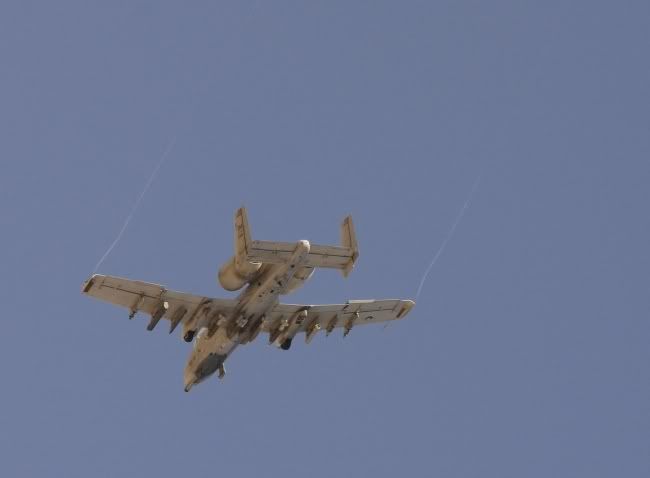
An A-10C Thunderbolt II with the 354th Expeditionary Fighter Squadron flies over Kandahar Airfield, Afghanistan, January 1, 2010, as it completes ten thousand hours of flying during the squadron's six-month deployment. The aircraft is A-10C 78-0684, marked 354 FS/CC as the commander's jet (or 354th FS's "squadron bird"), and flown on this mission by Lt. Col. Michael Millen, 354th Expeditionary Fighter Squadron commander. Visible combat loadout: station 1: empty, station 2: Sniper XR Targeting Pod, station 3: empty LAU-117 single-rail launcher for AGM-65 Maverick, station 4: GBU-38 (JDAM), station 5: GBU-12, station 6 (center station): empty, station 7: Mk-82, station 8: GBU-38 (JDAM), station 9: LAU-131 Rocket Pod, station 10: empty, station 11: empty. (U.S. Air Force photo by Staff Sgt. Dayton Mitchell) Hi-res
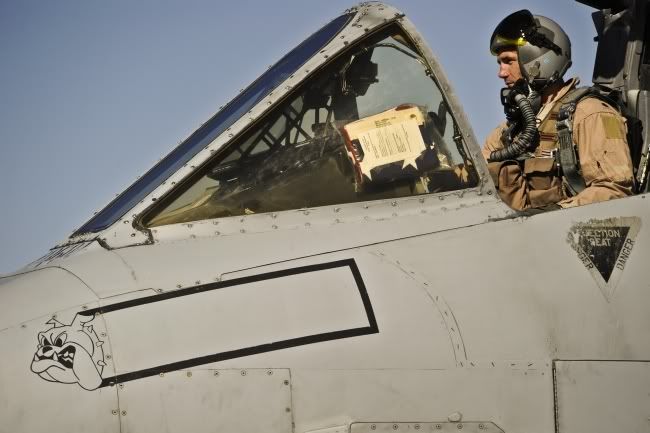
Lt. Col. Michael Millen, commander of the 354th Expeditionary Fighter Squadron, flies the ten thousandth hour for the A-10C Thunderbolt II squadron, wrapping up a six-month deployment to Kandahar Airfield, Afghanistan, January 1, 2010. In his cockpit, Lt. Col. Millen has a "354 EFS A-10C Flag Flying Request Form". (U.S. Air Force photo by Tech. Sgt. Efren Lopez) Hi-res
Note: Close-up of the left markings below the canopy (clear visible is the Bulldog head). Please note: The black-painted frame is still blank and not includes ranks and names of pilot, dedicated crew chief and assistant crew chief - as usual.
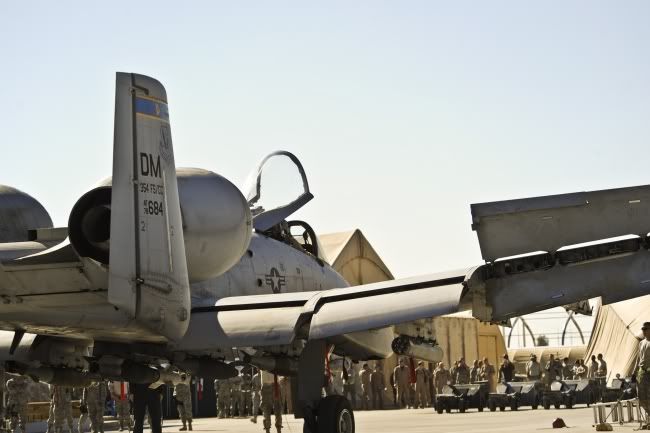
Airmen gather to celebrate the 354th Expeditionary Fighter Squadron's landmark accomplishment, ten thousand hours of flying, and approximately 2,500 sorties during the squadron's six-month deployment to Kandahar Airfield, Afghanistan, January 1, 2010. The aircraft is A-10C 78-0684, marked 354 FS/CC as the commander's jet (or 354th FS's "squadron bird"). (U.S. Air Force photo by Tech. Sgt. Efren Lopez) Hi-res
Note: Close-up of the tail markings.
OEF returning shot:
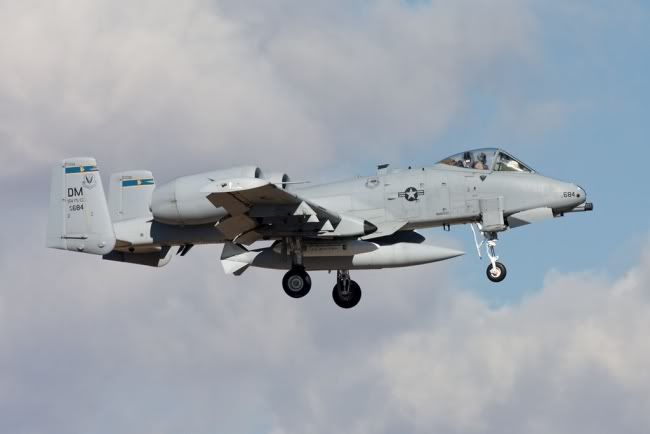
A-10C 78-0684 with blue fin flashes and special-marked 354 FS/CC (as the 354th Fighter Squadron commander's jet. (Photo by Ned Harris) Full size
As reported by Warthog News contributor Ned Harris from United States, the first six A-10Cs from the 354th Expeditionary Fighter Squadron returned home to Davis-Monthan AFB, Arizona, from Afghanistan January 24, 2010. They landed at 2:30 PM local time (MST). Each aircraft carried an external fuel tank on center station 6. The return of the remaining six aircraft is expect for either Monday or Tuesday about the same time of day. The 354th EFS is returning from a six-month combat deployment for Operation Enduring Freedom to the 451st Air Expeditionary Wing at Kandahar Airfield, Afghanistan. It was the first A-10 combat deployment to this location.
Note: A-10C 78-0684 with blue fin flashes and special-marked 354 FS/CC (as the 354th Fighter Squadron commander's jet. (Photo by Ned Harris)
Sunday, February 21, 2010
MetaVR A-10 Afghanistan simulator wallpaper and demo clip
On February 19, 2010, W. Garth Smith from MetaVR, Inc., San Antonio, Texas, e-mailed me the following two interesting links:

Full size

Related demo clip of this virtual Hog: MetaVR Virtual Reality Scene Generator (VRSG) Recorded Real-Time Scenario of an A-10 Mission Set in Virtual Afghanistan
Some corrections from me:
My deep respect to the entire MetaVR team for their digital work. But sorry, as an A-10 enthusiast, please let me post some corrections. I would be very grateful if you integrate all of that in your next upgrades.
- Both the screenshot and the demo clip are depicting A-10 79-0135 (see shortened number "90135" in front of the canopy) from the 74th Fighter Squadron "Flying Tigers", 23rd Fighter Group, 23rd Wing (tailcode FT), now at Moody AFB, Georgia, with their unique shark mouth but with wrong tailcode AK and fin-cap colors of the 354th Fighter Wing (PACAF), Eielson AFB, Alaska.
- A-10s of the former 355th Fighter Squadron, 354th Fighter Wing (PACAF), Eielson AFB, Alaska, usualy were marked with black fin-caps. In exception, at least the Hogs of the 354th Fighter Wing commander and the 354th Operations Group commander were special-marked with black and blue fin-caps:

Three O/A-10 Thunderbolt II's from the 355th Fighter Squadron, 354th Fighter Wing, Eielson AFB, Alaska, sit outside of the "Hog Pen" here awaiting training missions on April 7, 2005. Visible in the foreground is 81-0979, special-marked as 354th OG commander's aircraft. (U.S. Air Force poto by Senior Airman Joshua Strang) Hi-res
- The 355th FS was inactivated on 15 August 2007 as a result of BRAC 2005.
- I'm surprised that the rendered Hog lacks the GPS dome just behind the cockpit. This dome is part of the Embedded Global Positioning System/Inertial Navigation System (EGI), upgraded 1999 - 2003.
- A-10s of Operation Enduring Freedom never were armed with AIM-9 Sidewinder air-to-air missiles on a Dual Rail Adapter (DRA) as visible on station 11 on the rendered Hog. Background: As A-10s joined Operation Enduring Freedom in spring 2002, there were no air-to-air threaths.
- By comparing the screenshot with the first USAF shot of "The real aircraft" (see below), it's clear that the bomb on station 5 on the screenshot is not in the right position (too far back). In fact, dumb Mk. 82 bombs and also GBU-38 JDAM precision bombs on stations 4, 5, 7 and 8 have the same front-end level.
- The pilot in the screenshot looks to me like standing in the cockpit, but not like sitting in the cockpit.
The real aircraft:

A-10C 79-0135 from the 74th Fighter Squadron "Flying Tigers" during a combat mission in support of Operation Enduring Freedom in Afghanistan November 7, 2008. AN-AAQ-28 LITENING AT targeting pod on station 10, BLOS antenna behind the cockpit. (U.S. Air Force photo by Staff Sgt. Aaron Allmon) Hi-res

A-10C 79-0135 from the 74th Fighter Squadron "Flying Tigers" during a combat mission in support of Operation Enduring Freedom in Afghanistan November 7, 2008. (U.S. Air Force photos by Staff Sgt. Aaron Allmon) Hi-res

A-10C 79-0135 from the 74th Fighter Squadron "Flying Tigers" during a combat mission in support of Operation Enduring Freedom in Afghanistan November 7, 2008. (U.S. Air Force photo by Staff Sgt. Aaron Allmon) Hi-res

A-10C 79-0135 from the 74th Fighter Squadron "Flying Tigers" during a combat mission in support of Operation Enduring Freedom in Afghanistan November 7, 2008. (U.S. Air Force photo by Staff Sgt. Aaron Allmon) Hi-res

A two-ship A-10 Thunderbolt II formation flies a combat mission over Afghanistan on November 7, 2008. The aircraft are A-10C 79-0135 (foreground) and A-10C 80-0272, both from the 74th Fighter Squadron "Flying Tigers". (U.S. Air Force photo by Staff Sgt. Aaron Allmon) Hi-res

A-10C 79-0135 from the 74th Fighter Squadron arrives at Spangdahlem AB, Germany, February 6, 2009, after departing Bagram AB, Afghanistan, for inspections in case of possible wing cracks. Clear visible are the aircraft's real unit markings (including the shortened serial number 0135 on the left main landing gear sponson). (Photo by Matthias Bienentreu) Full size
Full size

Related demo clip of this virtual Hog: MetaVR Virtual Reality Scene Generator (VRSG) Recorded Real-Time Scenario of an A-10 Mission Set in Virtual Afghanistan
Some corrections from me:
My deep respect to the entire MetaVR team for their digital work. But sorry, as an A-10 enthusiast, please let me post some corrections. I would be very grateful if you integrate all of that in your next upgrades.
- Both the screenshot and the demo clip are depicting A-10 79-0135 (see shortened number "90135" in front of the canopy) from the 74th Fighter Squadron "Flying Tigers", 23rd Fighter Group, 23rd Wing (tailcode FT), now at Moody AFB, Georgia, with their unique shark mouth but with wrong tailcode AK and fin-cap colors of the 354th Fighter Wing (PACAF), Eielson AFB, Alaska.
- A-10s of the former 355th Fighter Squadron, 354th Fighter Wing (PACAF), Eielson AFB, Alaska, usualy were marked with black fin-caps. In exception, at least the Hogs of the 354th Fighter Wing commander and the 354th Operations Group commander were special-marked with black and blue fin-caps:
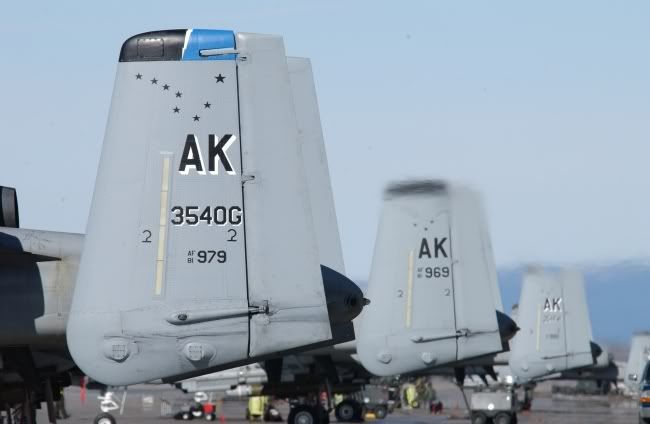
Three O/A-10 Thunderbolt II's from the 355th Fighter Squadron, 354th Fighter Wing, Eielson AFB, Alaska, sit outside of the "Hog Pen" here awaiting training missions on April 7, 2005. Visible in the foreground is 81-0979, special-marked as 354th OG commander's aircraft. (U.S. Air Force poto by Senior Airman Joshua Strang) Hi-res
- The 355th FS was inactivated on 15 August 2007 as a result of BRAC 2005.
- I'm surprised that the rendered Hog lacks the GPS dome just behind the cockpit. This dome is part of the Embedded Global Positioning System/Inertial Navigation System (EGI), upgraded 1999 - 2003.
- A-10s of Operation Enduring Freedom never were armed with AIM-9 Sidewinder air-to-air missiles on a Dual Rail Adapter (DRA) as visible on station 11 on the rendered Hog. Background: As A-10s joined Operation Enduring Freedom in spring 2002, there were no air-to-air threaths.
- By comparing the screenshot with the first USAF shot of "The real aircraft" (see below), it's clear that the bomb on station 5 on the screenshot is not in the right position (too far back). In fact, dumb Mk. 82 bombs and also GBU-38 JDAM precision bombs on stations 4, 5, 7 and 8 have the same front-end level.
- The pilot in the screenshot looks to me like standing in the cockpit, but not like sitting in the cockpit.
The real aircraft:
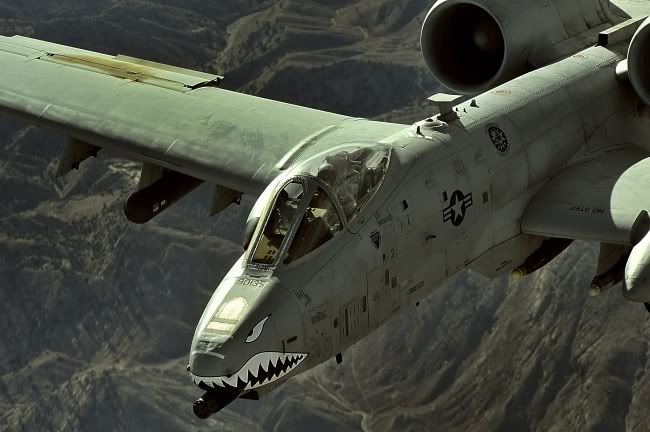
A-10C 79-0135 from the 74th Fighter Squadron "Flying Tigers" during a combat mission in support of Operation Enduring Freedom in Afghanistan November 7, 2008. AN-AAQ-28 LITENING AT targeting pod on station 10, BLOS antenna behind the cockpit. (U.S. Air Force photo by Staff Sgt. Aaron Allmon) Hi-res
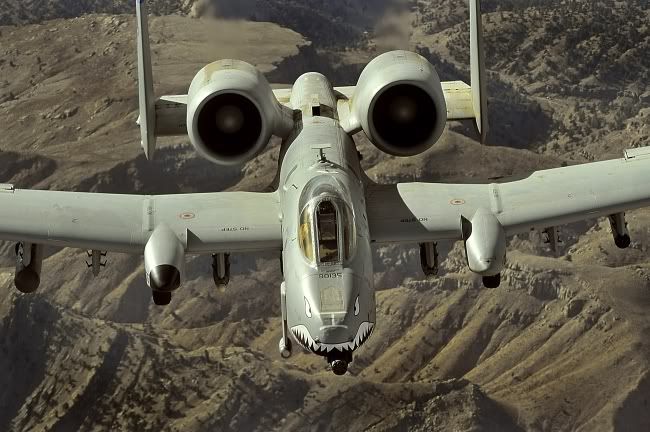
A-10C 79-0135 from the 74th Fighter Squadron "Flying Tigers" during a combat mission in support of Operation Enduring Freedom in Afghanistan November 7, 2008. (U.S. Air Force photos by Staff Sgt. Aaron Allmon) Hi-res
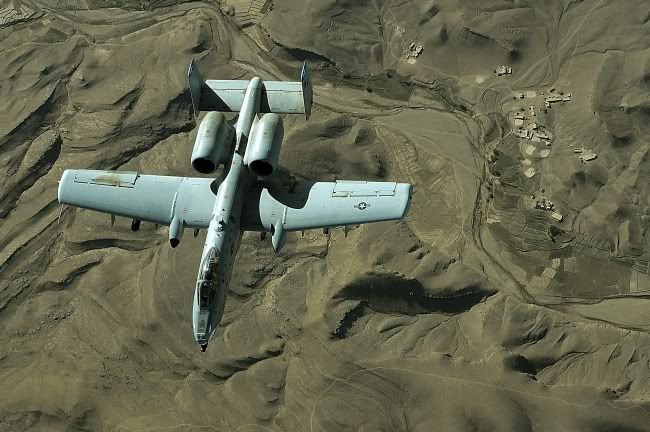
A-10C 79-0135 from the 74th Fighter Squadron "Flying Tigers" during a combat mission in support of Operation Enduring Freedom in Afghanistan November 7, 2008. (U.S. Air Force photo by Staff Sgt. Aaron Allmon) Hi-res
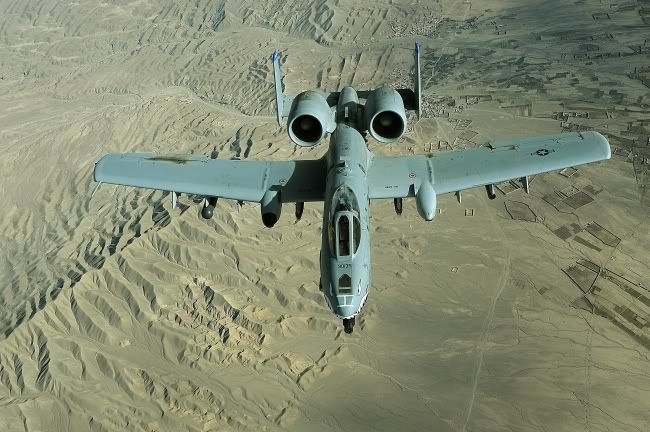
A-10C 79-0135 from the 74th Fighter Squadron "Flying Tigers" during a combat mission in support of Operation Enduring Freedom in Afghanistan November 7, 2008. (U.S. Air Force photo by Staff Sgt. Aaron Allmon) Hi-res
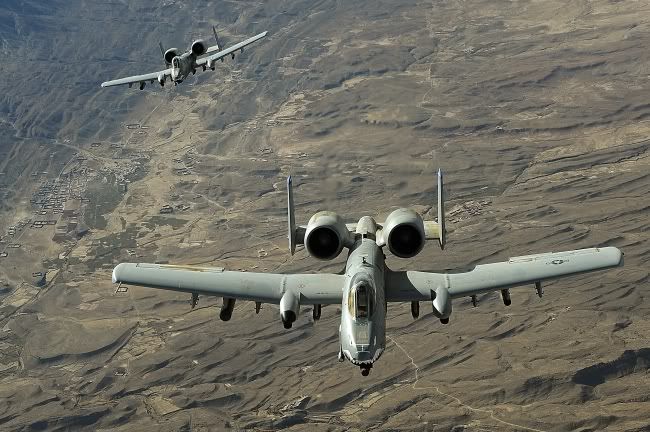
A two-ship A-10 Thunderbolt II formation flies a combat mission over Afghanistan on November 7, 2008. The aircraft are A-10C 79-0135 (foreground) and A-10C 80-0272, both from the 74th Fighter Squadron "Flying Tigers". (U.S. Air Force photo by Staff Sgt. Aaron Allmon) Hi-res
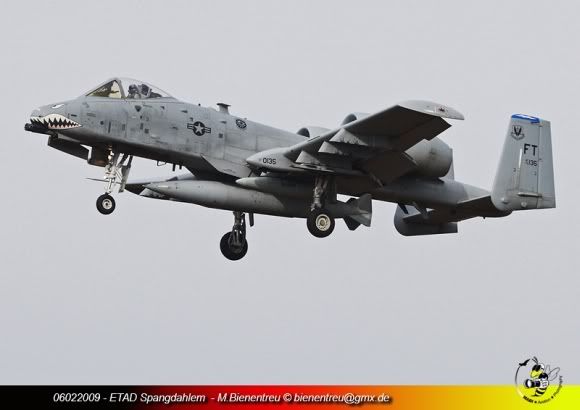
A-10C 79-0135 from the 74th Fighter Squadron arrives at Spangdahlem AB, Germany, February 6, 2009, after departing Bagram AB, Afghanistan, for inspections in case of possible wing cracks. Clear visible are the aircraft's real unit markings (including the shortened serial number 0135 on the left main landing gear sponson). (Photo by Matthias Bienentreu) Full size
Monday, June 8, 2009
A-10 Simulator Trains Pilots for Real-World Scenarios
by Tech. Sgt. Sarah Pokorney
124th Wing Public Affairs
6/7/2009 - GOWEN FIELD, Boise, Idaho -- A-10 pilots here began training June 3 on a newly upgraded full mission trainer to simulate real-world missions in dangerous war zones.
Known to 190th Fighter Squadron pilots as the "virtual hog", the new simulator mimics equipment and capabilities of the new A-10C model aircraft with fully operational hands-on controls and two large multi-function color displays that provide a moving map display. It can replicate the failure of every moving part of the A-10C and provides a safe and realistic environment for complex emergency procedures training.
"We are lucky to have it. It allows us, in a static environment, to perfect the new C-model system and use the live flying time to practice the tactical applications," said 190th A-10 pilot 1st Lt. Andrew Labrum.
From the exterior, the simulator looks like a freestanding black box the size of a single car garage. The opening on one end reveals a dark cave-like passage extending deep into the heart of the trainer to the cockpit.
Once seated in the cockpit, the pilot is surrounded on all sides by a faint glow emitting from flat displays. After the pilot takes the controls, a full field of vision display illuminates with a vivid landscape in hostile territory.
The extensive simulator upgrade required a team of technicians five days to complete and was funded by the Air Combat Command for training and equipment.
The simulator was upgraded to reflect the Precision Engagement modifications currently being made to convert the A-10 A+ model aircraft to A-10C models. This allows them to identify and strike targets from higher altitudes and greater distances without sacrificing accuracy. Idaho's A-10C conversions are scheduled to be complete by November.
"These improvements allow us to employ smart weapons like Joint Direct Attack Munitions and Wind Corrected Munitions Dispensers," said Labrum.
In addition to the upgraded simulator, the 190th has five hands-on-throttle-and-stick trainers that are just two months old. The HOTAS do not have the enclosed environment of the FMT but they do offer effective interactive training with a 56 inch flat-panel display, touch-screen instrument panel and hands-on controls.
"The simulators display classified and unclassified locations with real threats and targets that we can react to," said 190th A-10 pilot 1st. Lt. Ryan Brown.
In the near future, the simulators will be connected to a virtual battle space where pilots can train alongside pilots from around the globe. This prepares them to react to a variety of scenarios with squadrons they may serve with in-theater. The experience gained from this virtual battle space is essential to testing A-10C war fighting capabilities, preventing collateral damage and ultimately saving lives.

Lt. Col. Anthony "Sumo" Brown of the 190th Fighter Squadron conducts training on the upgraded A-10C Full Mission Trainer (FMT). The (FMT) simulator mimics the real-world A-10C with fully operational hands-on controls and instrument panel, providing pilots with a safe and realistic training environment. (U.S. Air Force photo by Staff Sergeant Robert Barney) Hi-res

1st Lt. Ryan "Leroy" Brown of the 190th Fighter Squadron conducts training on the upgraded A-10C Full Mission Trainer (FMT). (U.S. Air Force photo by Staff Sergeant Robert Barney)

1st Lt. Andrew "Shorn" Labrum of the 190th Fighter Squadron explains the recent upgraded A-10C Full Mission Trainer (FMT). (U.S. Air Force photo by Staff Sergeant Robert Barney)
Source
124th Wing Public Affairs
6/7/2009 - GOWEN FIELD, Boise, Idaho -- A-10 pilots here began training June 3 on a newly upgraded full mission trainer to simulate real-world missions in dangerous war zones.
Known to 190th Fighter Squadron pilots as the "virtual hog", the new simulator mimics equipment and capabilities of the new A-10C model aircraft with fully operational hands-on controls and two large multi-function color displays that provide a moving map display. It can replicate the failure of every moving part of the A-10C and provides a safe and realistic environment for complex emergency procedures training.
"We are lucky to have it. It allows us, in a static environment, to perfect the new C-model system and use the live flying time to practice the tactical applications," said 190th A-10 pilot 1st Lt. Andrew Labrum.
From the exterior, the simulator looks like a freestanding black box the size of a single car garage. The opening on one end reveals a dark cave-like passage extending deep into the heart of the trainer to the cockpit.
Once seated in the cockpit, the pilot is surrounded on all sides by a faint glow emitting from flat displays. After the pilot takes the controls, a full field of vision display illuminates with a vivid landscape in hostile territory.
The extensive simulator upgrade required a team of technicians five days to complete and was funded by the Air Combat Command for training and equipment.
The simulator was upgraded to reflect the Precision Engagement modifications currently being made to convert the A-10 A+ model aircraft to A-10C models. This allows them to identify and strike targets from higher altitudes and greater distances without sacrificing accuracy. Idaho's A-10C conversions are scheduled to be complete by November.
"These improvements allow us to employ smart weapons like Joint Direct Attack Munitions and Wind Corrected Munitions Dispensers," said Labrum.
In addition to the upgraded simulator, the 190th has five hands-on-throttle-and-stick trainers that are just two months old. The HOTAS do not have the enclosed environment of the FMT but they do offer effective interactive training with a 56 inch flat-panel display, touch-screen instrument panel and hands-on controls.
"The simulators display classified and unclassified locations with real threats and targets that we can react to," said 190th A-10 pilot 1st. Lt. Ryan Brown.
In the near future, the simulators will be connected to a virtual battle space where pilots can train alongside pilots from around the globe. This prepares them to react to a variety of scenarios with squadrons they may serve with in-theater. The experience gained from this virtual battle space is essential to testing A-10C war fighting capabilities, preventing collateral damage and ultimately saving lives.

Lt. Col. Anthony "Sumo" Brown of the 190th Fighter Squadron conducts training on the upgraded A-10C Full Mission Trainer (FMT). The (FMT) simulator mimics the real-world A-10C with fully operational hands-on controls and instrument panel, providing pilots with a safe and realistic training environment. (U.S. Air Force photo by Staff Sergeant Robert Barney) Hi-res

1st Lt. Ryan "Leroy" Brown of the 190th Fighter Squadron conducts training on the upgraded A-10C Full Mission Trainer (FMT). (U.S. Air Force photo by Staff Sergeant Robert Barney)

1st Lt. Andrew "Shorn" Labrum of the 190th Fighter Squadron explains the recent upgraded A-10C Full Mission Trainer (FMT). (U.S. Air Force photo by Staff Sergeant Robert Barney)
Source
Tuesday, February 17, 2009
81st Fighter Squadron Receives Simulator Upgrades
by Staff Sgt. Logan Tuttle
52nd Fighter Wing Public Affairs
2/17/2009 - SPANGDAHLEM AIR BASE, Germany -- The 81st Fighter Squadron recently received a new A-10 Thunderbolt simulator along with upgrades to their only other simulator from Boeing.
The project cost approximately $ 4.5 million, and took a team from Boeing 12 days to set up, from the time they arrived here, to the time the new unit and upgrades were completed.
"The [equipment] was shipped to us from Mesa, Ariz. It was in 23 crates, and took up an entire airplane," said Andy Gilbert, the project lead from Boeing. "We've had excellent support from the unit as far as getting forklifts and stuff we needed."
The benefits of the upgrades include a better visibility database, the ability to see the wings of the plane, new software and moving map capabilities. The two simulators can now fly together for two-ship missions, as well as hook up and fly with other simulators anywhere in the world, over a distributed mission network.
Mr. Gilbert said one of the biggest improvements made are the volumetric clouds, which give the simulators the ability to provide adverse weather conditions similar to what pilots at Spangdahlem could experience.
Capt. Papa Roche, one of the pilots who tested the upgrades, felt that having the 360-degree screen was one of the most noticeable differences. Although you can never replace flying in a real aircraft, he said, the simulators function accurately and he thinks they'll see a significant increase in the amount the simulators are used.
1st Lt. Patrick Parrish, another pilot who tested the new simulator said it would be useful to add to the pilot's training as a supplement to real flying, especially for practicing emergency procedures.
"The simulators give pilots the ability to practice, they simulate everything without the cost and time to put the airplane in the air, and the [simulator]is more forgiving," said Mr. Gilbert.
Source

Capt. Papa Roche, an A-10 pilot with the 81st Fighter Squadron, tests a new A-10 simulator on February 6th, 2009. This is the second 81st FS simulator. Boeing sent a team to install the new simulator and vital software upgrades for both systems. (U.S. Air Force photo by Airman 1st Class Nicholas Wilson) Hi-res
52nd Fighter Wing Public Affairs
2/17/2009 - SPANGDAHLEM AIR BASE, Germany -- The 81st Fighter Squadron recently received a new A-10 Thunderbolt simulator along with upgrades to their only other simulator from Boeing.
The project cost approximately $ 4.5 million, and took a team from Boeing 12 days to set up, from the time they arrived here, to the time the new unit and upgrades were completed.
"The [equipment] was shipped to us from Mesa, Ariz. It was in 23 crates, and took up an entire airplane," said Andy Gilbert, the project lead from Boeing. "We've had excellent support from the unit as far as getting forklifts and stuff we needed."
The benefits of the upgrades include a better visibility database, the ability to see the wings of the plane, new software and moving map capabilities. The two simulators can now fly together for two-ship missions, as well as hook up and fly with other simulators anywhere in the world, over a distributed mission network.
Mr. Gilbert said one of the biggest improvements made are the volumetric clouds, which give the simulators the ability to provide adverse weather conditions similar to what pilots at Spangdahlem could experience.
Capt. Papa Roche, one of the pilots who tested the upgrades, felt that having the 360-degree screen was one of the most noticeable differences. Although you can never replace flying in a real aircraft, he said, the simulators function accurately and he thinks they'll see a significant increase in the amount the simulators are used.
1st Lt. Patrick Parrish, another pilot who tested the new simulator said it would be useful to add to the pilot's training as a supplement to real flying, especially for practicing emergency procedures.
"The simulators give pilots the ability to practice, they simulate everything without the cost and time to put the airplane in the air, and the [simulator]is more forgiving," said Mr. Gilbert.
Source

Capt. Papa Roche, an A-10 pilot with the 81st Fighter Squadron, tests a new A-10 simulator on February 6th, 2009. This is the second 81st FS simulator. Boeing sent a team to install the new simulator and vital software upgrades for both systems. (U.S. Air Force photo by Airman 1st Class Nicholas Wilson) Hi-res
Subscribe to:
Posts (Atom)


 Posts
Posts