Showing posts with label Green Flag East. Show all posts

Saturday, February 28, 2009

354th FS hones CAS skills, capabilities at Green Flag East

by Staff Sgt. Jake Richmond
355th Fighter Wing Public Affairs
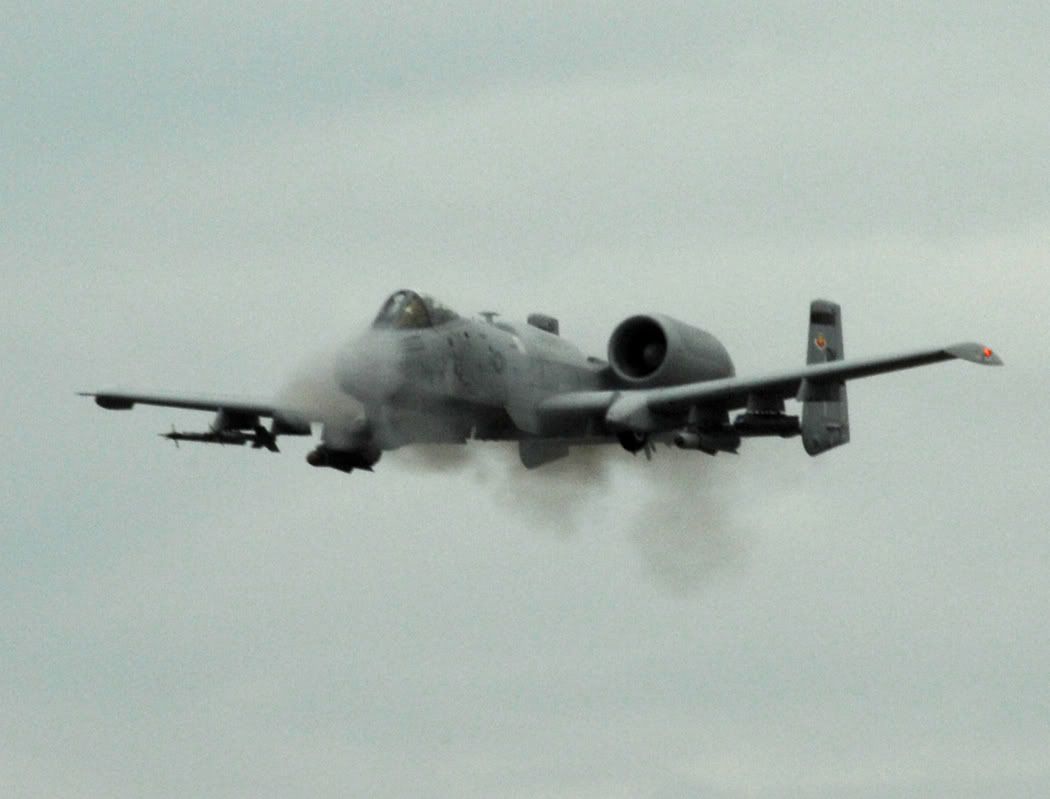


An A-10C from the 354th Fighter Squadron fires 30mm rounds from its GAU-8 cannon during moving-target strafe training at Green Flag East, a close-air support exercise in Louisiana. (U.S. Air Force photo by Staff Sgt. Jake Richmond) Hi-res

2/27/2009 - DAVIS-MONTHAN AIR FORCE BASE, Ariz. -- Members of the 354th Fighter Squadron returned today from their two-week participation in Green Flag East, a permanent-party exercise contingent at Barksdale AFB, La. The ongoing exercise is specifically designed to train flying units that perform air-to-ground combat.

The 354th FS attended GFE in preparation for their upcoming Air Expeditionary Force window.

"The training at Green Flag East relates directly to the missions CAS aircraft perform in Iraq and Afghanistan today," said Lt. Col. Michael Millen, 354th FS commander. "Green Flag is considered a must-do before an AEF spin-up, and it's been excellent training for the Bulldogs."

The purpose of the exercise is to train pilots together with Joint Terminal Attack Controllers and Army ground forces at the Joint Readiness Training Center at Fort Polk, La. And, thanks to unique agreements with three local governments and the existence of a one-of-a-kind simulated village, units can conduct that training in four separate urban environments.

Maj. Brendan O'Brien, the director of operations for Barksdale's 548th Combat Training Squadron, said pilots and ground troops use real people and vehicles in the cities of Oakdale, Leesville and Deridder, La., to mimic the process of accurately locating and tracking enemy and friendly forces - in an area with active roads and occupied buildings - all the way up to the moment when the target would be engaged with weapons.

The fourth location, aptly named "CAS Town," is located on military-owned land within restricted air space. There, contracted employees act like good guys and bad guys, and JTACs are tasked with identifying them correctly. Then, pilots have to avoid the simulated friendlies and other collateral damage, while the "enemies" are visibly firing simulated weapons at the aircraft. The village is also complete with strategically placed pyrotechnics, which ignite as soon as the imaginary munitions hit their target.

Even though no bombs are dropped and no bullets are fired, Colonel Millen said it still provides an immensely important and distinctive training arena for a difficult part of the CAS mission.

"Our focus here is almost entirely on urban CAS, and it's not easy," he said. "Cities are busy places, and trying to find and track the bad guys among thousands of non-combatants is difficult."

And it's not just the environment that presents the challenge. The GFE exercise planners, like Major O'Brien, constantly work to develop demanding training scenarios that reflect what warfighters are seeing downrange.

"Every time a unit comes in (to Green Flag), we pick the brains of the guys who recently came back from a deployment," Major O'Brien said. "Those guys have seen it up close and personal, and they help keep our training fresh and relevant."

Another part of the deployment training is getting pilots, JTACs and ground forces working comfortably in unison with new digital equipment being used in real combat zones - specifically, the new Tactical Air Control Party, Close Air Support System.

"This was the first time we've had a full unit of A-10Cs with digital capability working with JTACs and ground forces using TACP CASS," Colonel Millen said. "It's really perfect training to help our pilots get familiar with the kinds of combat situations they'll see on their deployments and help develop the tactics they'll be using."

Without TACP CASS, a pilot responding to a troops-in-contact, or TIC, would have to wait until he was in radio range of a JTAC to get much of the information necessary to conduct CAS. Using TACP CASS, JTACs can now digitally send crucial details to the cockpit before the pilot arrives at the engagement.

"A pilot can be en route to a TIC and have very good situational awareness on friendly and enemy positions and ground commanders' intent," said Capt. Andy Pitts, a former F-16 pilot who's now the operations officer in charge for GFE. "Before, pilots didn't really know the situation until they arrived."

Staff Sgt. Tyler Woodson, a JTAC assigned to the Georgia Air National Guard's 165th Air Support Operations Squadron, was also participating in GFE. He said "it's nice to give pilots a good picture of what's going on without having to say much -- and that has noticeable benefits in the fight."

"The technology really makes it easier," Sergeant Woodson said. "From the time the aircraft checks in with us to the time munitions hit the ground is a lot faster than before."

He said he and his fellow JTACs were making the most of their time to learn new and better ways to work with the air component of the CAS process, especially since they all have the same goal.

"There's nothing like the opportunity to go out and give guys on the ground the help they need," he added. "To know in your heart and mind that good guys are going home because you did your job right...that's why we do this."

Source
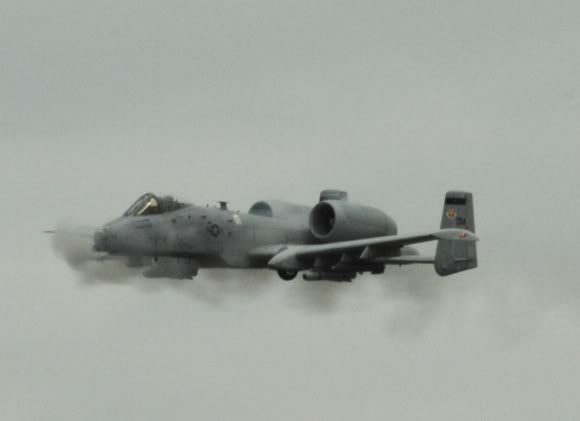


An A-10C from the 354th Fighter Squadron fires 30mm rounds from its GAU-8 cannon during moving-target strafe training at Green Flag East. (U.S. Air Force photo by Staff Sgt. Jake Richmond) Hi-res


An A-10C from the 354th Fighter Squadron approaches a target and prepares to fire 30mm rounds from its GAU-8 cannon during training at Green Flag East. (U.S. Air Force photo by Staff Sgt. Jake Richmond) Hi-res


Two Joint Terminal Attack Controllers coordinate a close-air support attack as an A-10C from the 354th Fighter Squadron, dropping flares, approaches to perform moving-target strafe training during Green Flag East, an exercise in Louisiana for flying units that perform air-to-ground combat. (U.S. Air Force photo by Staff Sgt. Jake Richmond) Hi-res


Rounds from an A-10's 30mm GAU-8 cannon impact the ground during moving-target strafe training, a part of the Air Force's Green Flag East exercise in Louisiana. Davis-Monthan's 354th Fighter Squadron participated in GFE for two weeks to enhance their close-air support tactics and capabilities. (U.S. Air Force photo by Staff Sgt. Jake Richmond) Hi-res

Wednesday, February 25, 2009

Exercise offers A-10 crews chance to hone warfighting skills

by Casey E. Bain
U.S. Joint Forces Command

2/24/2009 - BARKSDALE AIR FORCE BASE, La. (AFNS) -- Airmen are improving their warfighting skills as they train to conduct close-air-support missions for ground forces in preparation for deployments to Iraq and Afghanistan during Exercise Green Flag East here.

The exercise is in partnership with the Joint Readiness Training Center at Fort Polk, La., and with support from U.S. Joint Forces Command's Joint Fires Integration and Interoperability Team.

A-10 Thunderbolt II aircrews from the 354th Fighter Squadron from Davis-Monthan Air Force Base, Ariz., are currently participating in the training.

"Green Flag East provides us with the environment that best replicates what we'll experience once deployed," said Maj. James Krischke, an A-10 pilot and 354th FS assistant director of operations. "I don't think people realize how carefully organized and orchestrated our military operations have become. Our goal is to minimize collateral damage and eliminate fratricide in combat. The Green Flag team provides our squadron with the opportunity to improve those skills we need to reach our goal before we deploy and fight."

Joint Fires Integration and Interoperability Team members helped Green Flag East staff members enhance joint close-air-support training for aircrews, joint terminal attack controllers, and joint fires observers for the past two years.

"Green Flag has done a remarkable job of providing a world-class CAS environment for the aircrews, JTACs, and JFOs that train here," said Navy Lt. Cmdr. Chris Olson, JFIIT lead at GFE. "Our job is to help integrate those assets and bridge the gaps between the services, both in terms of technology and tactics, techniques, and procedures, so they can improve their combat effectiveness while reducing the potential of fratricide and collateral damage on an ever-evolving battlefield."

Green Flag East staff members work with Joint Readiness Training Center officials to integrate joint assets for a realistic and rigorous training environment that replicates many of the same conditions found in Iraq and Afghanistan.

"The joint training between Green Flag and JRTC is excellent," said Army Staff Sgt. Jeffrey Roten, a Joint Readiness Training Center training mentor and ground liaison officer for Green Flag East. "Anytime you get the chance to work with the Air Force it makes you a better warfighter for the Army. I will take the lessons that I learn from this exercise and apply them back at JRTC to help improve CAS integration for our Army fires supporters that are preparing to deploy downrange."

Green Flag East provides many opportunities for aircrews to train with resources and assets that they don't have readily available at their home station.

"There is so much that we want our aircrews to experience before they leave Green Flag," said Maj. Brendan O'Brien, director of operations for Green Flag East. "Their experience will include working with JTACs and JFOs in a realistic and dynamic air-to-ground environment; flying with and using advanced targeting pods and practicing with new technologies. We want our fighter pilots to be exposed to intense combat scenarios with realistic tactical problems to solve so they will leave here confident in the knowledge they've learned and ready for the challenges that lie ahead."

According to Green Flag East leaders, the opportunity for aircrews, JTACs, and Army JFOs to improve the coordination, synchronization, and execution of close-air-support in this near-real-world environment will help the joint team accomplish its mission and put bombs on target more effectively in the heat of battle.

"We take pride in providing the best possible predeployment combat training for our fighter crews, intelligence, maintenance, and logistics team to ensure they are prepared for the asymmetric fight they will face in theater," Major O'Brien said. "Green Flag East strives to be a premier training venue that replicates that fight and we do it as a joint team. Working with organizations like JRTC, JFIIT, and others allows us to provide the quality training that our fighter pilots and entire warfighting team needs and deserves."

Joint Readiness Training Center training mentors also realize the importance of working with aircrews at Green Flag East to improve air-ground integration between fighter pilots, JTACs, JFOs and brigade combat teams.

"CAS is such a combat multiplier for our maneuver forces," Sergeant Roten said. "We've got to learn how to fully take advantage of its capabilities before we actually need it on the battlefield - this exercise will really help us to improve that mission-essential air-ground integration that's vital to our team's success."

The benefits of this enhanced joint training are evident to many of the leaders and fighter pilots who train here.

"This is the only exercise that intentionally seeks to replicate the operational flow of Operation Iraqi Freedom and Operation Enduring Freedom," Major Krischke said. "We get the opportunity to work with many of the same assets that we will see in theater in just a few short months. It's a fundamental building-block approach to training aircrews that can't be found anywhere else."

Source


An A-10 Thunderbolt II pilot prepares for a close-air-support mission with the assistance of a ground crewmember during Green Flag East 09-04 on February 23rd, 2009, at Barksdale AFB. According to the number on the ejection seat, the aircraft must be 80-0238. (U.S. Air Force photo by Casey Bain) Hi-res

Note: The associated picture is new on the web. But the news article itself is an edited and shortened version of the original article USJFCOM joint fires team preps A-10 aircrews for combat, already posted on this blog.

Monday, February 23, 2009

USJFCOM joint fires team preps A-10 aircrews for combat

U.S. Joint Forces Command's Joint Fires Integration and Interoperability Team is working closely with the Army's Joint Readiness Training Center at the Air Force's Green Flag East to prepare A-10 Thunderbolt pilots for deployment.

By Casey E. Bain
JFIIT, USJFCOM

(BARKSDALE AIR FORCE BASE, LA. - Feb. 23, 2009) - The Air Force's Green Flag East (GFE), in partnership with the Joint Readiness Training Center (JRTC) at Ft. Polk, La., and with support from U.S. Joint Forces Command's (USJFCOM) Joint Fires Integration and Interoperability Team (JFIIT), is improving warfighting skills of fighter pilots conducting close air support (CAS) missions for ground forces as those pilots prepare for deployments to Iraq and Afghanistan.

The 354th Fighter Squadron, an A-10C Thunderbolt unit from Davis-Monthan Air Force Base, Az., currently participating in the ongoing GFE 09-04 training rotation, is honing its CAS skills here.

"Green Flag East provides us with the environment that best replicates what we'll experience once deployed," said Air Force Maj. James Krischke, A-10 fighter pilot and assistant director of operations, 354th Fighter Squadron. "I don't think people realize how carefully organized and orchestrated our military operations have become. Our goal is to minimize collateral damage and eliminate fratricide in combat. The Green Flag team provides our squadron with the opportunity to improve those skills we need to reach our goal before we deploy and fight."

JFIIT has helped GFE enhance joint CAS training for aircrews, joint terminal attack controllers (JTACs), and joint fires observers (JFOs) for the past two years.

"Green Flag has done a remarkable job of providing a world-class CAS environment for the aircrews, JTACs, and JFOs that train here," said Navy Lt. Cmdr. Chris Olson, JFIIT lead at GFE. "Our job is to help integrate those assets and bridge the gaps between the services, both in terms of technology and tactics, techniques, and procedures (TTP), so they can improve their combat effectiveness while reducing the potential of fratricide and collateral damage on an ever-evolving battlefield."

GFE works with JRTC to integrate joint assets for a realistic and rigorous training environment that replicates many of the same conditions found in Iraq and Afghanistan.

"The joint training between Green Flag and JRTC is excellent," said Army Staff Sgt. Jeffrey Roten, JRTC training mentor and ground liaison officer for GFE. "Anytime you get the chance to work with the Air Force it makes you a better warfighter for the Army. I will take the lessons that I learn from this exercise and apply them back at JRTC to help improve CAS integration for our Army fires supporters that are preparing to deploy downrange."

GFE provides many opportunities for aircrews to train with resources and assets not available at their home station.

"There is so much that we want our aircrews to experience before they leave Green Flag," said Air Force Maj. Brendan O'Brien, director of operations, GFE. "Their experience will include working with JTACs and JFOs in a realistic and dynamic air-to-ground environment; flying with and using advanced targeting pods; practicing with new technologies and TTP, like digitally aided CAS; working counter-improvised explosive device scenarios at JRTC, and much more."

"We want our fighter pilots to be exposed to intense combat scenarios with realistic tactical problems to solve so they will leave here confident in the knowledge they've learned and ready for the challenges that lie ahead," added O'Brien.

According to GFE leaders, the opportunity for aircrews, JTACs, and Army JFOs to improve the coordination, synchronization, and execution of CAS in this near-real-world environment will help the joint team accomplish its mission and put bombs on target more effectively in the heat of battle.

"We take pride in providing the best possible pre-deployment combat training for our fighter crews, intelligence, maintenance, and logistics team to ensure they are prepared for the asymmetric fight they will face in theater," said O'Brien. "Green Flag East strives to be a premier training venue that replicates that fight and we do it as a joint team. Working with organizations like JRTC, JFIIT, and others allows us to provide the quality training that our fighter pilots and entire warfighting team needs and deserves."

JRTC training mentors also realize the importance of working with aircrews at GFE to improve air-ground integration between fighter pilots, JTACs, JFOs, and brigade combat teams.

"CAS is such a combat multiplier for our maneuver forces," added Roten. "We've got to learn how to fully take advantage of its capabilities before we actually need it on the battlefield - this exercise will really help us to improve that mission-essential air-ground integration that's vital to our team's success."

The benefits of this enhanced joint training are evident to many of the leaders and fighter pilots who train here.

"This is the only exercise that intentionally seeks to replicate the operational flow of Operation Iraqi Freedom and Operation Enduring Freedom," said Krischke. "We get the opportunity to work with many of the same assets that we will see in theater in just a few short months - it's a fundamental building-block approach to training aircrews that can't be found anywhere else."

Source