Showing posts with label 127th Wing. Show all posts

Monday, June 11, 2012

Swapping out cargo for deployment

By 127th Wing Public Affairs Airmen from the 127th Wing reload cargo placed in individual shipping units (ISUs) from a C-130 to a KC-135 to ship to Estonia on June 8, 2012, at Selfridge Air National Guard Base, Mich. The cargo equipment is headed to Saber Strike 12, a US Army European command-led theater security cooperation exercise conducted in the Baltic States (Estonia, Latvia and Lithuania). The plane swap led to repacking the cargo into ISUs of a smaller size. (USAF photo by John S. Swanson) Hi-res

6/8/2012 - Selfridge Air National Guard Base, Mich. -- Airmen from many 127th Wing squadrons reloaded cargo placed in individual shipping units (ISUs) from a C-130 Hercules to a KC-135 Stratotanker to ship to Estonia on June 8, 2012. The cargo equipment is headed to Saber Strike 12, a US Army European command-led theater security cooperation exercise being conducted in the Baltic States (Estonia, Latvia and Lithuania).

The cargo was originally to deploy aboard a C-130, but when the cargo plane from out of town had maintenance issues that could not be solved immediately at Selfridge, the 127th Air Refueling Group was able to short-notice prepare a KC-135 and flight crew to get the cargo to the exercise. The plane swap led to repacking the cargo into ISUs of a smaller size.

The 127th Wing has approximately 150 personnel and both KC-135s and A-10s already in place for the two-week exercise.

Source (including 13 photos)

Wednesday, June 6, 2012

Michigan ANG Deploys to Estonia

by TSgt. Dan Heaton
127th Wing Public Affairs

6/6/2012 - SELFRIDGE AIR NATIONAL GUARD, Mich. -- Approximately 150 Citizen-Airmen of the Michigan Air National Guard are deploying to Estonia for two weeks to support Saber Strike 2012, a multi-national exercise this month in Estonia and Latvia. The deployment will include A-10 Thunderbolt II and KC-135 Stratotanker aircraft from Selfridge Air National Guard Base and personnel from the 127th Wing at Selfridge, the 110th Airlift Wing in Battle Creek, the Combat Readiness Training Center in Alpena and Michigan Joint Forces Headquarters in Lansing. The exercise promotes regional stability and security, strengthens international military partnering and fosters trust while improving interoperability between participating nations.

The exercise is taking place in mid-June.

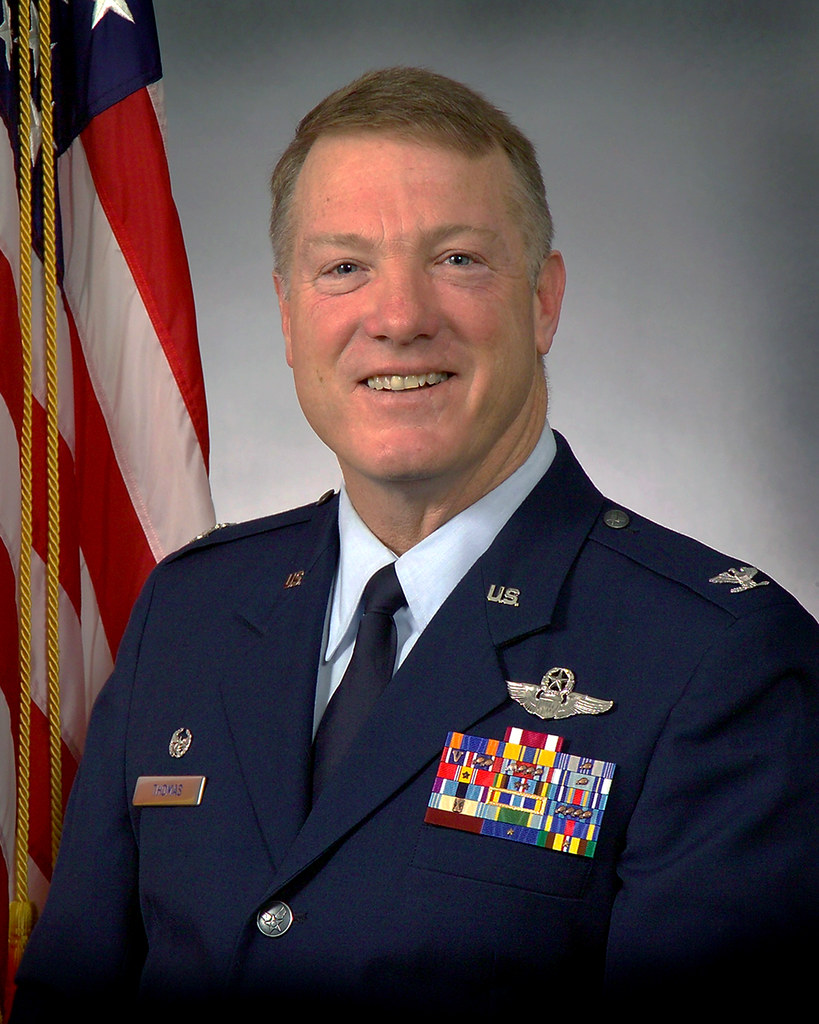
"In this exercise, we will not only be integrating and working closely with the U.S. Army, but also working alongside our allies in Estonia, Latvia and several other European nations," said Col. Michael Thomas, the 127th Wing commander at Selfridge. "This exercise is also somewhat unique for us in that it integrates personnel from every portion of the Michigan Air National Guard and two different types of aircraft."

Saber Strike 2012 involves approximately 2,000 personnel from eight countries. This, the second year of the Saber Strike exercise program, is part of an ongoing cooperative training effort primarily focused on the three nations of the Baltic States: Latvia, Lithuania, and Estonia. This exercise prepares participants to operate successfully in a joint, multinational, integrated environment with host-nation support from civil and governmental agencies. In addition to the U.S. Army Europe, Estonia, Latvia, and Lithuania, other participants include: Canada, Finland, France and the UK.

The Michigan Air National Guard will be providing close-air-support to the operation via the A-10 and will provide aerial refueling capabilities to the overall exercise via the KC-135. Both types of aircraft are in high demand by theater commanders around the world and 127th Wing personnel have deployed with both types of aircraft to Afghanistan and surrounding areas during 2012.

"An added benefit to participating in this operation is the opportunity to further strengthen Michigan's long-standing partnership with the people of Latvia," Thomas said.

The Latvian military and the Michigan National Guard are partners in the State Partnership for Peace program. This year marks the 20th anniversary of that partnership. The SPP was established to help former Eastern Bloc countries transition to democracy following the collapse of the Soviet Union by linking the National Guard forces of several states with the militaries of those countries. The program has since been expanded to other parts of the world and includes more than 60 partnerships between state National Guards and foreign militaries. Michigan recently added a second partnership with Liberia in Africa.

The 127th Wing of the Michigan Air National Guard is comprised of approximately 1,700 Citizen-Airmen assigned to Selfridge Air National Guard Base in metropolitan Detroit. The 127th provides highly skilled Airmen in support of Air Combat Command, Air Mobility Command and Air Force Special Operations Command. The Wing flies the KC-135 Stratotanker, an aerial refueling aircraft that gives the Air Force global reach, and the A-10 Thunderbolt II, a close-air-support attack aircraft more popularly known as the Warthog.

Source

Note: This deployment or TDY is really a big surprise for me. And so I hope, some of my Warthog News contributors from Portugal will get the opportunity to catch the "Hogs" during their stopovers at Lajes Field, Azores. Maybe they will be escorted by some of their own tankers.

Friday, May 4, 2012

Training Matters at Grayling Air Gunnery Range

by TSgt. Dan Heaton
127th Wing Public Affairs

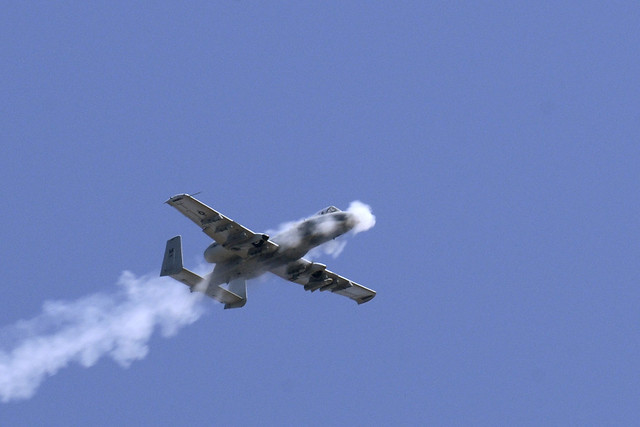
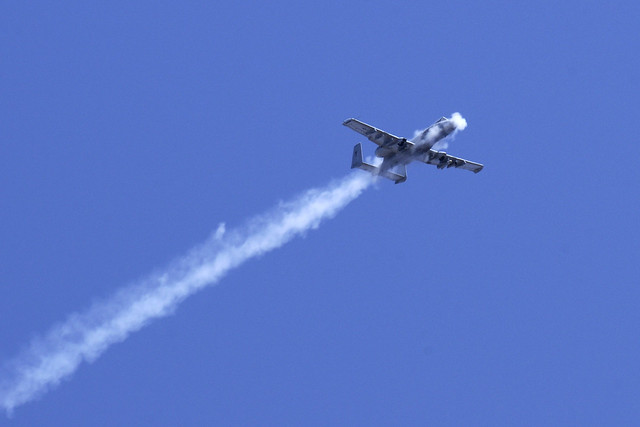
An A-10 Thunderbolt II from the 107th Fighter Squadron, Michigan Air National Guard, fires its primary weapon, the 30- millimeter GAU-8 Gatling Gun, during a training mission at the Grayling Aerial Gunnery Range, near Grayling, Mich., April 24, 2012. The Grayling range provides a wide variety of training scenarios for both aircraft and various ground personnel. More than 1,700 air missions are flown every year at the range. (U.S. Air Force photo by TSgt. David Kujawa) Hi-res

5/2/2012 - GRAYLING AIR GUNNERY RANGE, Mich. -- To the casual visitor, perhaps, the aerial gunnery range near Grayling, Mich., is primarily focused on helping military fighter pilots with their target practice.

Senior Master Sgt. Alan VanPate sees it a little differently.

"When the 107th Fighter Squadron went over to Afghanistan, all of their pilots came home safe. Even more importantly, they did not have a single instance of their ordnance coming too close to our guys on the ground," said VanPate, the senior enlisted Airman at the range. "Instead, they engaged with the enemy and helped Soldiers and Marines on the ground to come home safe. That's what we train for in Grayling."

Operated by the Michigan Air National Guard, the Grayling Aerial Gunnery Range provides realistic and relevant training opportunities for a variety of U.S. military aircraft, as well as Joint Terminal Attack Controllers and related ground personnel. In a typical year, the range will be the site of some 1,700 or so air missions and will be used as a training location by 300 or more ground personnel.

"The focus is on providing training as close as we can get it to what our personnel are going to experience when they deploy," said Lt. Col. Timothy Brock, a Michigan Air National Guard pilot who serves as the range operations officer. "One of the reasons we have expanded the training opportunities here for JTACs and other ground personnel is because working with those ground-based controller is what our pilots do in places like Afghanistan."

In a valley along the edge of the massive Camp Grayling military reservation, the Grayling range features a small village setting; a variety of different types of vehicles made from sheet metal and plywood; a variety of bunkers, and other shelters and, in the middle of it all, a couple of large white buildings with red crosses painted on the top - you're not supposed to hit those.

Aircraft carrying practice bombs, rockets and guns can come at the targets from just about any direction and any angle. They are in constant contact with range controllers in one of two nearby towers and very possibly with any JTAC personnel - Air Force enlisted members who embed with infantry and related ground units to help coordinate air power support who may be training in the area. Depending on the type of aircraft and the training needs of the various participants, the aircraft will make several "attacks" on various designated targets. The ordnance carried by the aircraft are all "practice" versions of the real thing - the ballistics of the ordnance is the same but instead of a full load of explosives, they are equipped with roughly the equivalent of a shotgun shell's worth of explosives in a smaller, lighter bomb, just enough to make some smoke on impact to help all involved better track exactly where the munitions hit.

Many of the aircraft that visit the range are more or less "local" to the Midwest, such as A-10 Thunderbolt II's from the 107th Fighter Squadron at Selfridge Air National Guard Base, Mich., and Toledo-based F-16 Fighting Falcons from the Ohio Air National Guard's 180th Fighter Squadron. The range also provides training to active duty Air Force B-52 Stratofortresses, Navy and Marine Corps F-18 Super Hornets, various Army attack helicopters and other aircraft.

Brock said the range began seeking out JTAC and other ground troops to train at the base several years ago, because of the 200 aircraft or more per month that visit the range in the summer.

"Now, we've begun to see situations where we have JTAC units that send their people here for training and then the aircraft come here, because they want to work with the ground forces," he said. "It is a training multiplier."

In situations like that, the visiting aircraft may utilize the air field at the Alpena Combat Readiness Training Center as a staging site for several days. The Alpena CRTC is about 50 miles from the air gunnery range and is the higher headquarters for the range.

VanPate and another Airmen assigned to the range are both JTAC instructor qualified and the facility also includes a virtual training center useful for more junior JTAC personnel.

In addition to U.S. personnel, the Grayling range is also utilized as a training site for several allied nations for their JTAC-equivalent personnel. In addition to JTACs and related personnel, Air Force civil engineer units are typically utilized to build many of the target structures on the base, saving money in construction costs and providing training to those units at the same time. All together, about 300 JTACs and more than 1,300 other ground personnel train at the range in a typical year.

"This is really a value-added proposition for Michigan, for the Guard and for the local communities," Brock said. "We are bringing in a variety of units here, enhancing the training environment for our Michigan Guardsmen and being a contributing part of the local economy."

An A-10 Thunderbolt II from the 107th Fighter Squadron, Michigan Air National Guard, fires its primary weapon, the 30- millimeter GAU-8 Gatling Gun, during a training mission at the Grayling Aerial Gunnery Range, near Grayling, Mich., April 24, 2012. The Grayling range provides a wide variety of training scenarios for both aircraft and various ground personnel. More than 1,700 air missions are flown every year at the range. (U.S. Air Force photo by TSgt. David Kujawa) Hi-res

An A-10 Thunderbolt II from the 107th Fighter Squadron turns after dropping ordnance at the Grayling Aerial Gunnery Range, near Grayling, Mich., April 24, 2012. The Grayling range provides a wide variety of training scenarios for both aircraft and various ground personnel. More than 1,700 air missions are flown every year at the range. (U.S. Air Force photo by TSgt. Dan Heaton) Hi-res

An A-10 Thunderbolt II from the 107th Fighter Squadron flies over the Grayling Aerial Gunnery Range, near Grayling, Mich., April 24, 2012. The Grayling range provides a wide variety of training scenarios for both aircraft and various ground personnel. More than 1,700 air missions are flown every year at the range. (U.S. Air Force photo by TSgt. David Kujawa) Hi-res

This "village" at the Grayling Aerial Gunnery Range, near Grayling, Mich., is actually one of the targets that can be used for training during attack missions of military aircraft. Using precision munitions, Air Force aircraft can target specific buildings within the compound. The goal is to provide pilots and ground controllers the most realistic and relevant training possible before a deployment. (U.S. Air Force photo by TSgt. David Kujawa) Hi-res
Senior Master Sgt. Alan VanPate communicates with an aircraft while in a control tower at the Grayling Aerial Gunnery Range, near Grayling, Mich., April 24, 2012. VanPate is a joint terminal attack controller and helps to provide training to visiting JTAC personnel to the Grayling range. JTACs are Air Force enlisted members who embed with infantry or other U.S. Army or Marine Corps ground forces to provide coordination of air power support with the Soldiers or Marines on the ground. (U.S. Air Force photo by TSgt. David Kujawa) Hi-res

Source

Sunday, April 22, 2012

Lajes supported redeployment of CONUS-based A-10Cs

By Joachim Jacob, Warthog News Editor

The following stand-alone photo was released by 65th Air Base Wing Public Affairs

Original photo caption: Transient alert members from the 65th Operations Support Squadron park twelve incoming A-10C Thunderbolts from the 442nd Fighter Wing on their way back to their home base after a deployment mission April 12. (U.S. Air Force photo by Lucas Silva) Hi-res

Note: Pictured is A-10C 81-0998 from the 107th Fighter Squadron, 127th Wing (Michigan ANG). It belonged to the CONUS (Continental United States)-based part of the recently deployed "Total Force" A-10C team which included six A-10Cs from the 107th Fighter Squadron, 127th Wing (Michigan ANG), Selfridge ANGB (tailcode MI), three A-10Cs from the 47th Fighter Squadron, 917th Fighter Group (AFRC), Barksdale AFB, Louisiana (tailcode BD), and three A-10Cs from the 303rd Fighter Squadron, 442nd Fighter Wing (AFRC), Whiteman AFB, Missouri (tailcode KC). The six other deployed A-10Cs belonged to the 81st Fighter Squadron, 52nd Fighter Wing (USAFE), Spangdahlem AB, Germany (tailcode SP), which returned home separately.

Sunday, April 1, 2012

Flight Operations

Released by 127th Wing Public Affairs


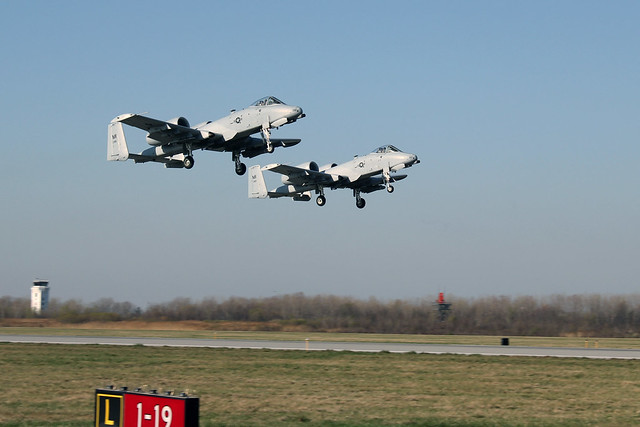
Two A-10 Thunderbolt II aircraft take off in tandem from Selfridge Air National Guard Base, Mich., March 28, 2012. The aircraft are operated by the 107th Fighter Squadron, which will turn 95 years old in the summer of 2012. The squadron was established on 27 August, 1917, for service during World War I, making it one of the oldest flying units in the military. (U.S. Air Force photo by TSgt. Dan Heaton) Hi-res


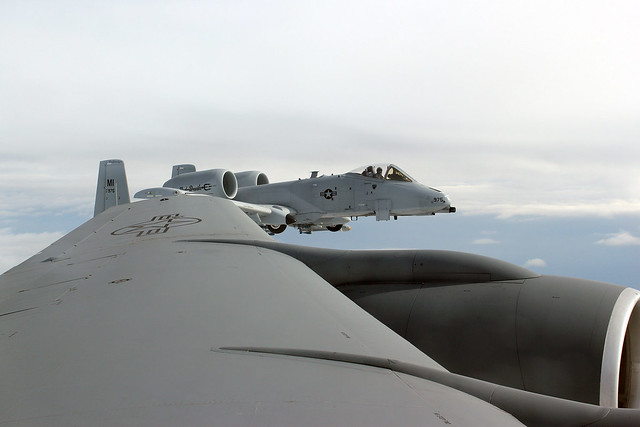
An A-10 Thunderbolt II flown by a pilot of the 107th Fighter Squadron holds position of the wing of a KC-135 Stratotanker, flown by the 171st Air Refueling Squadron, March 27, 2012. Both squadrons are part of the 127th Wing and based at Selfridge Air National Guard Base, Mich. The A-10 was waiting for its turn to receive fuel from the KC-135. (U.S. Air Force photo by TSgt. Dan Heaton) Hi-res

Tale of Two Jobs: Teacher? Ejection Seat Technician? Both Hats Fit Michigan Airman

by TSgt. Dan Heaton
127th Wing Public Affairs


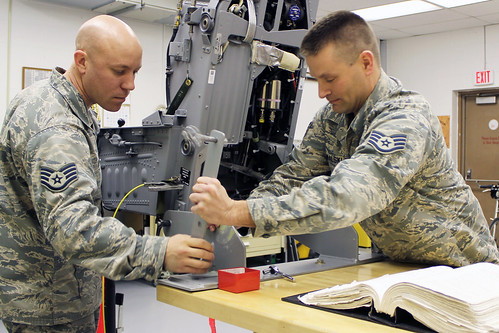
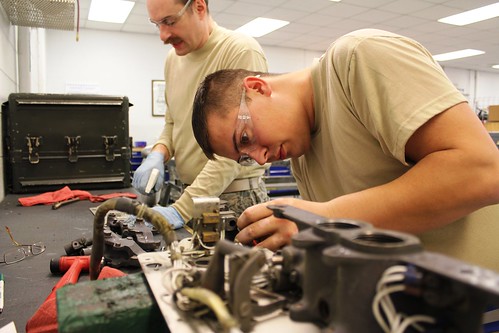
Staff Sgt. Jared Kowalski (right) and Staff Sgt. Nathan Henkel perform routine, scheduled maintenance on the ACES-II ejection seat system in their role as egress technicians for the 127th Maintenance Squadron at Selfridge Air National Guard Base, Mich. The seat is used on the A-10 Thunderbolt II aircraft, which may be eliminated from Selfridge under a pending Air Force budget proposal. (U.S. Air Force photo by TSgt. Dan Heaton) Hi-res

3/20/2012 - SELFRIDGE AIR NATIONAL GUARD BASE, Mich. -- What does teaching special education in middle school and fixing ejection chairs loaded with explosives have in common? Maybe more than you would think, says a man who does both.

"The military teaches patience and attention to detail," said Staff Sgt. Jared Kowalski, an egress technician with the 127th Maintenance Squadron at Selfridge Air National Guard Base.

In his classroom, it is patience that makes Kowalski such a strong educator, said Sharon Remillard, a paraprofessional who works alongside Kowalski.

"He has the time and the patience to not only work with the kids in his class, but to be supportive to all our kids," Remillard said.

Kowalski's full-time job is teaching math to cognitively impaired students in a special education program at Clawson Middle School in Clawson, Mich. One weekend a month, he puts on a uniform and serves as a member of the Michigan Air National Guard at Selfridge. For many Citizen-Airmen in the Air National Guard, the job they do in uniform is similar to their pursuits in the civilian world. There are, for example, plenty of local police officers who also serve in the 127th Security Forces Squadron and nurses and other medical technicians who serve as part of the 127th Medical Group.

"Being in the Air Force helped me get my start," said Senior Master Sgt. Tim Horvath, a member of the Michigan Air National Guard and a police officer for the suburban Detroit community of Westland. "I think it helps a lot of young people get their start, no matter what career they choose."

Horvath began his military career as a medic about 25 years ago. He used that experience to help land a job as a city paramedic, a job he worked in for about a dozen years, before deciding to move into police work in 1999. He remained in the medical field for another decade in the Air National Guard, before taking on a leadership role as the first sergeant for the 127th Civil Engineer Squadron at Selfridge.

"The leadership skills I learned in the military have a direct relationship to what I do in law enforcement," Horvath said.

Horvath, Kowalski and others at Selfridge are eagerly awaiting for news from Washington D.C. about the potential future of their military careers. According to an Air Force proposal, the A-10 squadron at Selfridge is to be eliminated, with no replacement aircraft. Such a move is expected to eliminate about 400 part-time and 200 full-time positions at Selfridge. Congress is considering that proposal, along with various counter proposals being put forward by Selfridge supporters.

The next step in that process is a review of the military fiscal year 2013 budget proposal by the U.S. Senate Armed Services Committee, which is chaired by U.S. Sen. Carl Levin, D-Mich. The hearing is scheduled for Tuesday, March 20.

"I want to continue to serve," said Horvath. "But more important than just what I want for myself, I want the opportunities to continue to exist for our younger Airmen who have served just a few years and are just beginning their military career. Keeping those opportunities open for young people in this region, I think that benefits the whole community. So many people learn and grow from their experiences in the National Guard, I would just hate to see fewer of those opportunities in the future."

No exact statistics are kept, at least locally, but Guard leaders at Selfridge say it is fairly common for younger members of the Air National Guard to use their military skills - coupled with college benefits - as a springboard for their civilian careers.

"The converse to that is also true," said Col. Philip Sheridan, vice commander of the 127th Wing at Selfridge. "So many times in the Guard, we benefit from the skills people bring from their civilian job with them either to drill weekend or to a deployment."

Sheridan said he's lost track of how many young people he's known over his nearly 30-year career as a military officer who have used the military as the means to begin a successful career.

Few of those careers, however, have probably been as different from their military career as is Kowalski's. But for him, the two divergent careers just made sense.

He first enlisted in the Air National Guard in 2004 while he was still a college student. Other family members had served in various branches of the military in the past and he felt a call to do the same. And, he says, "a little help with paying for college didn't hurt."

A similar feeling of a call to service led him to want to work as a special education teacher. After graduating from college, he was hired by the Clawson school district and began working as a teacher.

"I really enjoy working with my students," Kowalski said. "It is a population that I think a lot of people forget about, but I just have a heart for these kids."

On the base, Kowalski generally serves one weekend a month, a couple of weeks in the summer and then is on call for potential extended duty, based on the needs of the Air Force.

The egress section of the 127th Maintenance Squadron is a relatively small shop of about a half-dozen Airmen. They are charged with maintaining the ACES-II ejection seats that are used in the A-10 Thunderbolt II aircraft flown by the 107th Fighter Squadron at Selfridge. The same type of seat, with minor modifications, is found in most of the Air Force's high-performance aircraft. The seat is equipped with an explosive charge that can propel a pilot out of a damaged or otherwise failing aircraft.

"Our shop motto is 'guaranteed for one-time use,'" said Technical Sgt. Eric Coss, the section supervisor. "The system we work on is the one thing that, after everything else has failed on the aircraft, this is the thing that cannot fail."

Being a relatively small group, all the Airmen in the egress shop need to be able to get along well, Coss and others said.

"Jared is a good part of our team," said Staff Sgt. Nathan Henkel. "He brings a positive attitude, a positive light to the shop."

Staff Sgt. Fran Dixon is another Citizen-Airman who works in two unrelated careers. In uniform, she is an electrician. In her full-time civilian career, she works for American Express and helps to coordinate travel needs for various Fortune 500 companies.

"No, there's not much overlap between being an electrician and a travel agent," she laughed.

Still, she said, her Guard job has served her well.

"Working around the house, I never would have known how to take care of things they way that I have over the years, had it not been for what I learned in the military along the way," she said.

"But it's not just that. I'm proud to wear the uniform and to do my small part and serve our country," she said.

With changes pending to the A-10 aircraft operations at Selfridge, Kowalski and other Airmen who work directly on that that aircraft and its systems are anxious to learn how they will be impacted by the proposed reduction in personnel.

"I'm a very goal-orientated person," Kowalski said. "One of my goals is to serve 20 years in the Air National Guard if I can. I enjoy the camaraderie of the people I work with and I take pride, our whole shop takes pride in working around the jet, being part of the team."

"The Air Force has taught me things and puts focus on values like 'Excellence In All We Do,' that I try to pass on to my students," he said. "I would like to continue to be a part of that."

Source

A-10 Crew Chief Ops

Released by 127th Wing Public Affairs


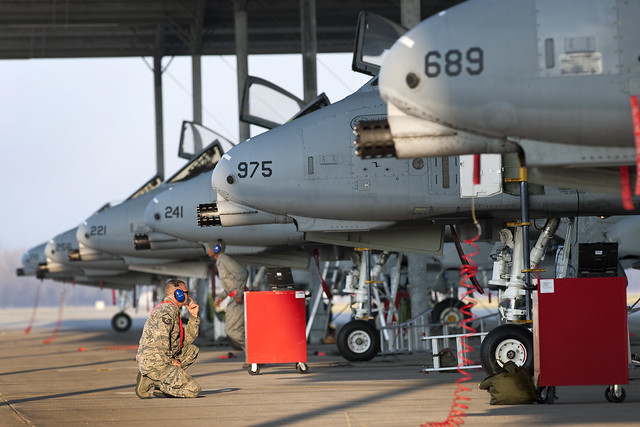
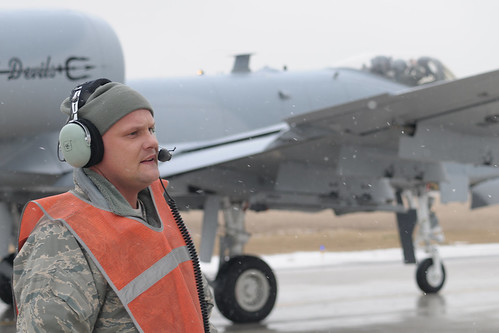
A crew chief from the 127th Aircraft Maintenance Squadron wears hearing protection and a reflective belt as he performs a visual inspection of an A-10 Thunderbolt II aircraft during pre-flight operations at Selfridge Air National Guard Base, Mich., March 21, 2012. Depending on their work environment, Airmen utilize a variety of safety devices, such as the hearing protectors and belt, to minimize accidents not only around military aircraft but in all working conditions. (U.S. Air Force photo by MSgt. Terry Atwell) Hi-res


Airman 1st Class Alecia Harris, a crew chief with the 127th Aircraft Maintenance Squadron, buttons up a panel on an A-10 Thunderbolt II prior to the aircraft taxing to the runway at Selfridge Air National Guard Base, Mich., March 21, 2012. Working under supervision of noncommissioned officers, junior enlisted personnel in the U.S. Air Force often work directly on and around aircraft or other complex systems. The aircraft pilot is Lt. Col. Doug Champagne, commander of the 127th Operations Group. (U.S. Air Force photo by MSgt. Terry Atwell) Hi-res


A group of crew chiefs from the 127th Aircraft Maintenance Squadron confer during pre-flight preparations for several A-10 Thunderbolt II aircraft at Selfridge Air National Guard Base, Mich., March 21, 2012. The aircraft are flown by the pilots of the 107th Fighter Squadron. One of the oldest flying units in the military, the 107th FS will turn 95 years old this summer. (U.S. Air Force photo by MSgt. Terry Atwell) Hi-res


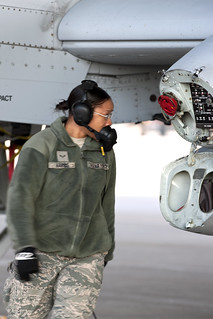
Airman 1st Class Alecia Harris looks at a panel during a walk-around inspection of an A-10 Thunderbolt II aircraft during pre-flight operations at Selfridge Air National Guard Base, Mich., March 21, 2012. Harris is a crew chief with the 127th Aircraft Maintenance Squadron. (U.S. Air Force photo by MSgt. Terry Atwell) Hi-res

Note: Pictured are A-10Cs 78-0689, 78-0975, 80-0221, 80-0241, 80-0255 and 80-0256 from the 107th Fighter Squadron.

Thursday, March 15, 2012

New Fact Sheet Profiles 107th FS

Released by 127th Wing Public Affairs

3/15/2012 - SELFRIDGE AIR NATIONAL GUARD BASE -- A new fact sheet profiling the 107th Fighter Squadron has been added to the 127th Wing page. The fact sheet, which lists the recent deployments of the squadron and offers a glimpse at the 95-year history of the squadron, is available by clicking in the link. It includes an image of the squadron patch.

Please note: And here's the fact sheet's content, copied from the PDF:

U.S. Air Force Fact Sheet
107th Fighter Squadron


Flying the A-10 Thunderbolt II, the 107th Fighter Squadron is one of the oldest flying units in the U.S. Air Force. Known as "The Red Devils," the squadron has served on multiple deployments in recent years, including launching aircraft to defend sovereign U.S. airspace on Sept. 11, 2001.

The 107th Fighter Squadron is a component of the 127th Operations Group of the 127th Wing and is a part of the Michigan Air National Guard. The unit is based at Selfridge Air National Guard Base and is comprised of approximately 28 pilots and 45 support personnel. The 107th FS is closely supported by the 127th Maintenance Group which maintains the A-10 aircraft assigned to Selfridge.

History
The 107th was first organized as the 107th Aero Squadron at Kelly Field, Texas, on 27 Aug. 1917 in response to the U.S. entry into World War I earlier that year. The unit was demobilized and disbanded in March 1919, following the conclusion of the war. In 1925, a squadron of 20 officers and 90 enlisted men began meeting weekly in a Detroit garage and created the Michigan National Guard's first flying unit. On 7 May 1926, the unit received federal recognition and was designated the 107th Observation Squadron. Through more than 20 major aircraft and related name changes, the unit has been in operation as the 107th ever since. After more than 40 years of operations at Detroit-Metropolitan Airport, the unit has been assigned to Selfridge since 1971. It was designated as the 107th Fighter Squadron on 15 March 1992 and began flying the A-10 Thunderbolt II on 2 May 2009.

Major Deployments
1940-1946: Activated for World War II. Assignments included: Anti-submarine patrols along U.S. East Coast; tactical reconnaissance in the European Theater. Primary aircraft included P-51 and F-6.
1951-52: Mobilized to Luke AFB in Arizona as part of a pilot training wing during the Korean War. Primary aircraft: F-84.
1997 to Kuwait for Operation Sothern Watch. Primary aircraft: F-16
1999 to Incirlik, Turkey, in support of Operation Northern Watch. Primary aircraft: F-16
2001 to Prince Sultan Air Base, Saudi Arabia for Operation Southern Watch. Primary aircraft: F-16
Spring 2003 to Incirlik, Turkey, in support of Operation Northern Watch -- which marked the first time since World War II the unit dropped weapons (over Iraq). Primary aircraft: F-16
2004 for Operation Iraqi Freedom as the first USAF F-16 unit based in Iraq, at Kirkuk Air Base (the unit participated in the Battle for Fallujah). Primary aircraft: F-16
2007 for Operation Iraqi Freedom based at Balad Air Base. Primary aircraft: F-16
2011-12 to Kandahar, Afghanistan. Primary aircraft: A-10.

Source

Sunday, March 11, 2012

127th Operations Group and 107th Fighter Squadron Change of Command

Released by 127nd Wing Public Affairs


Col. Michael Thomas, 127th Wing commander, hands the 127th Operations Group guidon to Lt. Col. Douglas Champagne as Champagne formally assumes command of the group. Champagne previously served as the commander of the 107th Fighter Squadron at Selfridge Air National Guard Base and recently led the squadron on a deployment to Afghanistan, the sixth combat deployment of Champagne's career. Behind the flag is SMSgt. Ethan Boyd, the first sergeant for the 127th Operations Group, and Lt. Col. Emmanuel Saridakis, who took command of the 107th Fighter Squadron in the same ceremony, March 10, 2012. (U.S. Air Force photo by TSgt. David Kujawa) Hi-res


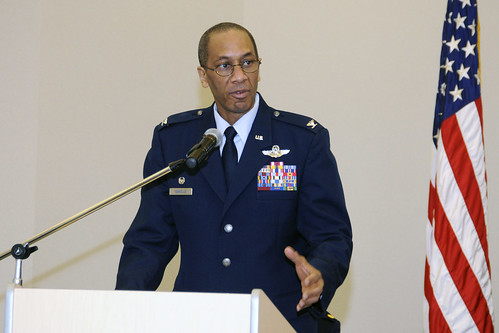
Col. Leonard Isabelle addresses the 127th Operations Group at Selfridge Air National Guard Base, Mich., moments before relinquishing command of the group to Lt. Col. Douglas Champagne in a March 10, 2012, change of command ceremony. Isabelle is moving to a position at Joint Forces Headquarters in Lansing, Mich. The 127th Operations Group flies the A-10 Thunderbolt II aircraft. (U.S. Air Force photo by TSgt. David Kujawa) Hi-res


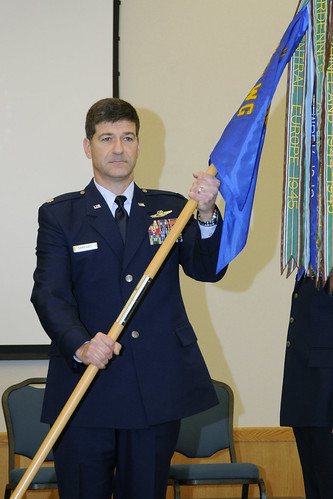
Lt. Col. Emmanuel Saridakis holds the 107th Fighter Squadron guidon after assuming command of the squadron during a March 10, 2012, ceremony at Selfridge Air National Guard Base, Mich. Saridakis, an A-10 Thunderbolt pilot, relieved Lt. Col. Douglas Champagne, who took command of the 127th Operations Group. The banners on the guidon reflect the almost 100-year history of the 107th FS. (U.S. Air Force photo by TSgt. David Kujawa) Hi-res


After this photo release, 127th Fighter Wing Public Affairs released the following news article:


Champagne, Saridakis Take New Leadership Roles


127th Wing Public Affairs

3/10/2012 - SELFRIDGE AIR NATIONAL GUARD BASE, Mich. -- Two combat veterans took on new duties as the Michigan Air National Guard's 127th Operations Group and 107th Fighter Squadron witnessed a change of command ceremony Saturday, March 10 at Selfridge Air National Guard Base. Lt. Col. Douglas Champagne took command of the Operations Group and Lt. Col. Emmanuel Saridakis took command of the Fighter Squadron in a ceremony in front of a formation of the group's pilots, maintenance and support personnel and other wing officers and Airmen.

The group and squadron operate the A-10 Thunderbolt II aircraft.

Lt. Col. Champagne earned his commission in the U.S. Air Force in 1987, serving on active duty through June 1996. Upon leaving active duty, he immediately joined the Michigan Air National Guard, serving as a full time member of the 107th Fighter Squadron. He has served the unit in various positions, including chief of weapons, chief of scheduling and training, chief of safety, director of operations and, most recently, as the squadron commander. Champagne is a command pilot with over 3,000 flying hours in the F-16 Falcon and over 500 flying hours in the A-10. His service includes more than 500 hours of combat flying missions on six overseas deployments in support of Operations Desert Shield, Desert Storm, Desert Calm, Iraqi Freedom, and Enduring Freedom. On Sept. 11, 2001, Champagne flew in the first fully armed combat air patrol over Detroit.

After accepting the flag as the 127th Operations Group commander, Champagne challenged the Airmen witnessing his stepping into a new leadership role to all be leaders.

"It's leadership that will take this group through the most turbulent times we've faced in our history," he said. "This simple act of positively influencing others will make us successful."

Champagne replaced Col. Leonard Isabelle, who is moving to a position at Joint Force Headquarters-Michigan.

Lt. Col. Saridakis replaced Champagne as 107th Fighter Squadron commander. Saridakis joined the Air National Guard in 1997, as a member of the 107th Fighter Wing in Massachusetts. He later served with the 110th Fighter Wing in Battle Creek, Mich., and the 175th Wing, Maryland. From 2006 to 2011 Saridakis served as the chief of the close attack branch at Headquarters, Air Combat Command, Joint Integration Division, responsible for enhancing the USAF's close air support, forward air controller, special operations, and other joint air-to-ground integration capabilities. Saridakis served on active duty 1989-1997, gaining his commission through the Air Force Reserve Officer Training Corps (ROTC) at Cornell University. Saridakis earned his wings through the Euro-NATO Joint Jet Pilot Training (ENJJPT) at Sheppard AFB, Texas, in 1990. He has been with the 107th Fighter Squadron since 2009.

Upon his acceptance of the 107th Fighter Squadron flag, Saridakis told the Airmen of his new command, many of whom had just returned from a tour of duty in Afghanistan: "Your commitment and hard work is that which will sustain our combat readiness."

The leadership changes come as the unit braces against the unknown impacts of an Air Force budget proposal for fiscal year 2013 which has called for the deletion of the A-10 aircraft at Selfridge, a base which has hosted fighter aircraft for almost 100 years. Saridakis addressed this by telling the audience of family, friends, Base Community Council members, and elected officials, "The spirit of aviation will go from one aircraft to the next ... but we cannot afford a rest, and we cannot afford to focus on things we cannot control. We must be what our Air National Guard value statement says we are: equally capable, equally proficient, and equally accessible (to the active duty force)."

With approximately 1,700 Airmen assigned, the 127th Wing of the Michigan Air National Guard is the host organization at Selfridge, flying the KC-135 Stratotanker, an aerial refueler, and the A-10 Thunderbolt II, also known as the Warthog, which is an air-to-ground attack fighter. The Airmen at Selfridge support the Air Combat Command, Air Mobility Command and the Air Force Special Operations Command. to In addition to the 127th Wing, Selfridge is home to numerous other military and federal agencies, which fly a variety of helicopters and small, light fixed-wing aircraft.

More information on the 127th Wing and Selfridge Air National Guard Base is available at www.127wg.ang.af.mil.

Source


Related photo from the Warthog News archives:


Lt. Col. Emmanuel Saridakis runs through his pre-flight checklist after strapping into the cockpit of an A-10 Thunderbolt II aircraft at Selfridge Air National Guard Base, Mich., Feb. 14, 2012. Saridakis is a pilot with the 107th Fighter Squadron. The A-10s at Selfridge have resumed a regular local flying and training schedule, following the return of local Airmen from a deployment to Afghanistan. (U.S. Air Force photo by TSgt. Dan Heaton) Hi-res


Related news media coverage:

Facing loss of A-10 Thunderbolt II, Selfridge Air National Guard members welcome new commanders


By Dustin Block
MLive
Published: Saturday, March 10, 2012, 7:29 PM; Updated: Sunday, March 11, 2012, 1:23 PM

Guard members who operate the A-10 Thunderbolt II at Selfridge Air National Guard Base shouldn't focus on the possibility of the aircraft being eliminated from the base in 2013, according to the new commander of the 107th Fighter Squadron.

"The spirit of aviation will go from one aircraft to the next ... but we cannot afford a rest, and we cannot afford to focus on things we cannot control," said Lt. Col. Emmanuel Saridakis, who took command of the fighter squadron on Saturday. "We must be what our Air National Guard value statement says we are: equally capable, equally proficient, and equally accessible (to the active duty force)."

Saridakis was joined by Lt. Col. Douglas Champagne participated at Saturday's change of command ceremony at Selfridge. Champagne is the new head of the 127th Operations Group. The 127th Operations Group and the 107th Fighter Squadron operate 24 Thunderbolts, also known as Warthogs, which would be deleted from Selfridge next year under a proposed Air Force budget. The move would eliminate 720 jobs at the base.

With approximately 1,700 Airmen assigned, the 127th Wing of the Michigan Air National Guard is the host organization at Selfridge, flying the KC-135 Stratotanker, an aerial refueler, and the Thunderbolt, which is an air-to-ground attack fighter. The airmen at Selfridge support the Air Combat Command, Air Mobility Command and the Air Force Special Operations Command. to In addition to the 127th Wing, Selfridge is home to numerous other military and federal agencies, which fly a variety of helicopters and small, light fixed-wing aircraft.

Champagne earned his commission in the U.S. Air Force in 1987, serving on active duty through June 1996. Upon leaving active duty, he immediately joined the Michigan Air National Guard, serving as a full time member of the 107th Fighter Squadron. He has served the unit in various positions, including chief of weapons, chief of scheduling and training, chief of safety, director of operations and, most recently, as the squadron commander. Champagne is a command pilot with over 3,000 flying hours in the F-16 Falcon and over 500 flying hours in the A-10.

His service includes more than 500 hours of combat flying missions on six overseas deployments in support of Operations Desert Shield, Desert Storm, Desert Calm, Iraqi Freedom, and Enduring Freedom. On Sept. 11, 2001, Champagne flew in the first fully armed combat air patrol over Detroit.

Champagne replaced Col. Leonard Isabelle, who is moving to a position at Joint Force Headquarters-Michigan.

Saridakis replaced Champagne as 107th Fighter Squadron commander. Saridakis joined the Air National Guard in 1997, as a member of the 107th Fighter Wing in Massachusetts. He later served with the 110th Fighter Wing in Battle Creek, Mich., and the 175th Wing, Maryland. From 2006 to 2011 Saridakis served as the chief of the close attack branch at Headquarters, Air Combat Command, Joint Integration Division, responsible for enhancing the USAF's close air support, forward air controller, special operations, and other joint air-to-ground integration capabilities.

Saridakis served on active duty 1989-1997, gaining his commission through the Air Force Reserve Officer Training Corps (ROTC) at Cornell University. Saridakis earned his wings through the Euro-NATO Joint Jet Pilot Training (ENJJPT) at Sheppard AFB, Texas, in 1990. He has been with the 107th Fighter Squadron since 2009.

Source


Lt. Col. Douglas Champagne takes command at Selfridge


The Macomb Daily
Published: Sunday, March 11, 2012

Two combat veterans are taking on new duties with the Michigan Air National Guard.

The Guard's 127th Operations Group and 107th Fighter Squadron had a change of command ceremony on Saturday at Selfridge Air National Guard Base in Harrison Township.

Lt. Col. Douglas Champagne took command of the Operations Group, and Lt. Col. Emmanuel Saridakis took command of the Fighter Squadron in front of a formation of the group's pilots, maintenance and support personnel and other wing officers and airmen.

The group and squadron operate the A-10 Thunderbolt II aircraft.

On Sept. 11, 2001, Champagne flew in the first fully armed combat air patrol over Detroit. He replaces Col. Leonard Isabelle, who is moving to a position at Joint Force Headquarters-Michigan.

Champagne earned his commission in the U.S. Air Force in 1987, serving on active duty through June 1996. Upon leaving active duty, he immediately joined the Michigan Air National Guard, serving as a full-time member of the 107th Fighter Squadron. He has served the unit in various positions, including chief of weapons, chief of scheduling and training, chief of safety, director of operations and, most recently, as the squadron commander.

Champagne is a command pilot with over 3,000 flying hours in the F-16 Falcon and over 500 flying hours in the A-10. His service includes more than 500 hours of combat flying missions on six overseas deployments in support of operations Desert Shield, Desert Storm, Desert Calm, Iraqi Freedom, and Enduring Freedom. On Sept. 11, 2001, Champagne flew in the first fully armed combat air patrol over Detroit.

After accepting the flag as the 127th Operations Group commander, Champagne issued a challenge to the assembled airmen.

"It's leadership that will take this group through the most turbulent times we've faced in our history," he said. "This simple act of positively influencing others will make us successful."

Champagne replaced Col. Leonard Isabelle, who is moving to a position at Joint Force Headquarters-Michigan.

Saridakis replaced Champagne as 107th Fighter Squadron commander. Saridakis joined the Air National Guard in 1997, as a member of the 107th Fighter Wing in Massachusetts. He later served with the 110th Fighter Wing in Battle Creek, and the 175th Wing, Maryland. From 2006 to 2011.

Saridakis served as the chief of the close attack branch at Headquarters, Air Combat Command, Joint Integration Division.

Saridakis served on active duty 1989-1997, gaining his commission through the Air Force Reserve Officer Training Corps at Cornell University. He earned his wings through the Euro-NATO Joint Jet Pilot Training at Sheppard AFB, Texas, in 1990. He has been with the 107th Fighter Squadron since 2009.

The leadership changes come as the unit braces against the unknown impacts of an Air Force budget proposal for fiscal year 2013 which has called for the deletion of the A-10 aircraft at Selfridge, a base which has hosted fighter aircraft for almost 100 years.

"The spirit of aviation will go from one aircraft to the next ... but we cannot afford a rest, and we cannot afford to focus on things we cannot control, “Saridakis said. "We must be what our Air National Guard value statement says we are: equally capable, equally proficient, and equally accessible (to the active duty force)."

With approximately 1,700 airmen assigned, the 127th Wing of the Michigan Air National Guard is the host organization at Selfridge, flying the KC-135 Stratotanker, an aerial refueler, and the A-10 Thunderbolt II, also known as the Warthog, which is an air-to-ground attack fighter.

In addition to the 127th Wing, Selfridge is home to numerous other military and federal agencies, which fly a variety of helicopters and small, light fixed-wing aircraft.

Source


Please note: This post will be further updated soon.

Saturday, February 18, 2012

Vadnais: Strong Guard Strengthens America

by TSgt. Dan Heaton
127th Wing Public Affairs


Major Gen. Gregory J. Vadnais, adjutant general of Michigan, makes a point during a Feb. 17, 2012, news conference at Selfridge Air National Guard Base, Mich. Vadnais spoke about the value the National Guard provides to the nation and the key role the Guard plays in national defense. (U.S. Air Force photo by John S. Swanson) Hi-res
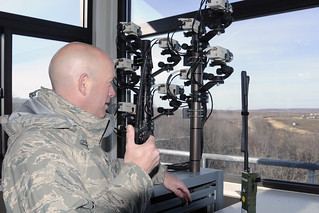


2/17/2012 - SELFRIDGE AIR NATIONAL GUARD BASE, Mich. -- A strong militia makes for a strong America, Michigan's top soldier said today.

And Major Gen. Gregory J. Vadnais aims to keep it that way.

Vadnais, the adjutant general of Michigan's Army and Air National Guard, is seeking to maintain the current levels of personnel, aircraft and mission assignments in Michigan - possibly seeking to grow those numbers - even in the face of overall declines in the nation's military spending.

"Put simply, it makes the most economic sense for our nation to put more of its resources into the National Guard, rather than the active duty force," the general said during a Feb. 17, 2012, news conference at Selfridge Air National Guard Base.

During the news conference, the general pointed out that the total cost of operating a squadron of 24 A-10 Thunderbolt II attack aircraft in an Air National Guard unit is about $26 million per year. The same squadron in an active duty Air Force unit costs about $52 million per year - almost exactly twice as much.

The Air Guard's 127th Wing flies A-10s at Selfridge, but that unit, the 107th Fighter Squadron and its various supporting elements, is scheduled to be eliminated as part of an Air Force plan to reduce the number of A-10s in the overall inventory. That plan, along with a plan to eliminate a squadron of cargo aircraft slated to locate at a base in Battle Creek, Mich., will eliminate about 630 jobs in the Michigan Air National Guard - about a quarter of the total positions in the organization.

"The loss of the A-10 squadron at Selfridge air National Guard Base would be detrimental to the entire area," said Macomb County Executive Mark Hackel, one of several local elected and community leaders who attended Vadnais' news conference in a show of support for local Airmen. "Hundreds of jobs would be eliminated as a result of the plan, causing economic hardship to local families."

As the general spoke at Selfridge, a pair of A-10s were preparing to fly on a training mission. The pilots, engine mechanics, weapons loaders, crew chiefs and related A-10 personnel from Selfridge recently returned home after a 4-month deployment in Afghanistan. The 325 or so personnel who participated in that deployment have resumed a regular training schedule at the base, even in light of proposed cuts to their organization, to be ready to answer the next call.

Elsewhere on the base, Airmen from the Michigan Air National Guard's KC-135 Stratotanker unit, the 171st Air Refueling Squadron, are packing up to leave later in the month for a deployment to the Pacific Ocean region. Under the current Air Force proposals, an additional four KC-135s are to be stationed at Selfridge, in addition to the eight currently at the base.

"Our fighter squadron, our tanker squadron, civil engineers, security police - you name the squadron, they have been deployed time and time again and have served this nation well," said Col. Michael Thomas, the 127th Wing commander at Selfridge. "We sent our fighters into the sky on Sept. 11, 2001, and it has not stopped since. Our people are highly-trained, highly-motivated, and to say we are highly-experienced is an understatement."

Vadnais said he is also making a case to the nation's elected leaders in Washington D.C. that Michigan has borne too much of the brunt of past military reductions and that, with the Great Lakes State still recovering from a recession and the restructuring of the auto industry, making cuts to the military spending is simply unfair to the residents of the state.

Three major Air Force bases have closed in the state since 1977 and an Army garrison closed in 2005. Meanwhile, Vadnais said, Michigan ranks last among the 50 states in the number of Dept. of Defense employees and the per capita DoD payroll in the state.

"We all understand that the nation has to reduce spending. We get that. We are taxpayers, too," Vadnais said. "But what I am asking for is two things - fairness in who is sharing in the pain of any cuts and doing what makes the most economic sense for the nation as a whole. And that means keeping and strengthening our low-cost, well-trained forces in the National Guard."

Source

Thursday, February 16, 2012

Selfridge A-10s Resume Regular Flying, Training Schedule

by TSgt. Dan Heaton
127th Wing Public Affairs


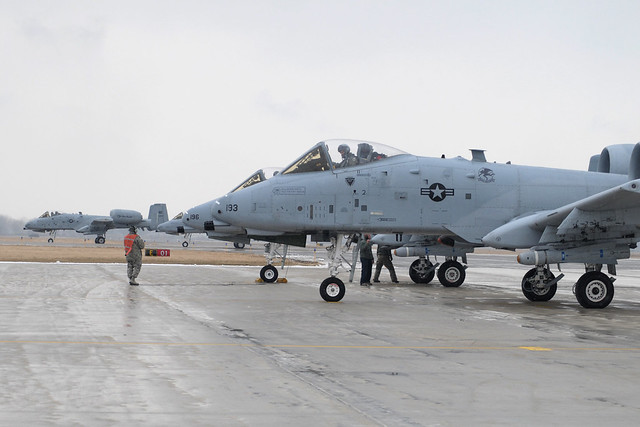
Crew chiefs with the 127th Aircraft Maintenance Squadron at Selfridge Air National Guard Base, Mich, perform final checks for A-10 Thunderbolt Ii Aircraft of the 107th Fighter Squadron on Feb. 14, 2012. The A-10 Aircraft of the 107th fighter squadron recently returned from a 4-month deployment to Afghanistan. (U.S. Air Force photo by Rachel Barton) Hi-res
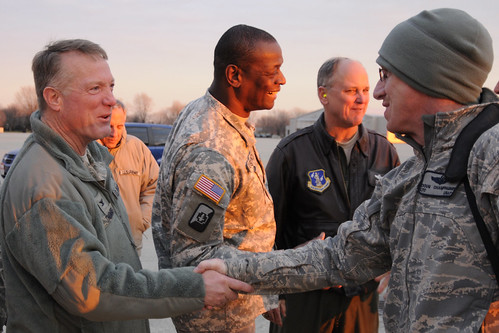
Note: Pictured in the foreground are A-10Cs 79-0193 and 196.

2/15/2012 - SELFRIDGE AIR NATIONAL GUARD BASE, Mich. -- The sound of freedom has returned in full force to the skies over southeastern Michigan.

The 107th Fighter Squadron has resumed a full, regular flying schedule this week at Selfridge Air National Guard Base, following a short stand-down period after a deployment to Afghanistan. The squadron, known as the "Red Devils," flies the A-10 Thunderbolt II attack aircraft.

"While I am extremely proud of the accomplishments of the 107th Expeditionary Fighter Squadron during our most recent deployment to Afghanistan, it is time now to focus on our future," said Lt. Col. Douglas Champagne, commander of the fighter squadron, which added the "expeditionary" to its unit name during the unit's forward deployment to Kandahar airbase in Afghanistan. "Our scorecard has been submitted and it speaks for itself."

The future is uncertain for the 107th Fighter Squadron, a unit which traces its history back to World War I. The Air Force's Fiscal Year 2013 budget plan calls for the elimination of the A-10 mission assigned to the Fighter Squadron - along with the 127th Operations Group and 127th Maintenance Group that support it - as part of a larger plan to reduce the number of aircraft and personnel in the service. That plan is being challenged by some members of Congress and by the adjutant general of Michigan, Maj. Gen. Gregory J. Vadnais.

In addition to the changes at Selfridge, the Air Force also said it will cancel a previously announced plan to locate a squadron of C-27 Spartan cargo aircraft to the Michigan Air National Guard base in Battle Creek. The changes at Selfridge and Battle Creek, together with ripple effect changes elsewhere in the state, means that the Michigan Air National Guard stands to lose roughly a quarter of its entire force, roughly 673 positions. Vadnais pointed out that those cuts to Michigan are disproportionate to those being suffered by other states and are being made in a state where the total amount of Dept. of Defense payroll spending per capita already ranks dead last among the 50 states.

Even as the future of the A-10 and the eventual shape and size of the Michigan Air National Guard is debated, Champagne said the Airmen at Selfridge are committed to ensuring that they maintain a high degree of readiness.

"It is imperative that we don't lose focus on what lies ahead of us," Champagne said. "Our country faces turbulent times with fiscal difficulties and uncertainty around every corner. We, in the Air National Guard, remain committed to giving the American public exactly what they deserve -- the most bang for their buck. The ANG costs less, we do more and we are keenly focused on being ready for our next call, whatever that call may be."

During the 4-month deployment, the squadron recorded approximately 8,300 flight hours in roughly 2,000 sorties, or flight missions. Approximately 325 Airmen from the 127th Operations Group and the 127th Maintenance Group at Selfridge participated in the deployment, returning home in January. All of the units are part of the 127th Wing of the Michigan Air National Guard and are home-stationed at Selfridge. Most of the Airmen in the Wing are traditional members of the Air National Guard, meaning they generally perform their military duties one weekend a month and stand ready for additional duties and assignments, as needed. The Air National Guard as a whole provides about 21 percent of the total available manpower of the U.S. Air Force, while consuming about 11 percent of the Air Force's budget.

During the unit's deployment, the remaining A-10s and their pilots at Selfridge maintained a greatly reduced flying schedule. With the return of the full schedule, the unit's aircraft will be more frequent sights and sounds in the region again.

Though populated by many Airmen who have now served on multiple deployments in recent years, the 127th Wing follows a strict training cycle to ensure that it's Airmen live up to the unit's motto: "We Stand Ready."

"Through our recent deployment to Afghanistan and now resuming a full flying schedule here at Selfridge, our maintenance Airmen have proven that they take a back seat to no one," said Major Kurtis Ring, commander of the 127th Aircraft Maintenance Squadron. "Our organization includes Airman who have worked on multiple different types of air frames, and possess a skill level that simply cannot be matched anywhere in the world. We look forward to be able to continue to provide our skilled, motivated Airmen to meet the needs of our state and our nation."

The proposed Air Force budget also calls for an increase in the number of KC-135 Stratotankers assigned to Selfridge, rising from eight aircraft to 12.

No timeline for any of the proposed changes has been announced.

With approximately 1,700 Airmen assigned, the 127th Wing of the Michigan Air National Guard is the host organization at Selfridge, flying the KC-135 Stratotanker, an aerial refueler, and the A-10 Thunderbolt II, also known as the Warthog, which is an air-to-ground attack fighter. In addition to the Wing, Selfridge is home to numerous other military and federal agencies, which fly a variety of helicopters and small, light fixed-wing aircraft.

More information on the 127th Wing and Selfridge Air National Guard Base is available at www.127wg.ang.af.mil.


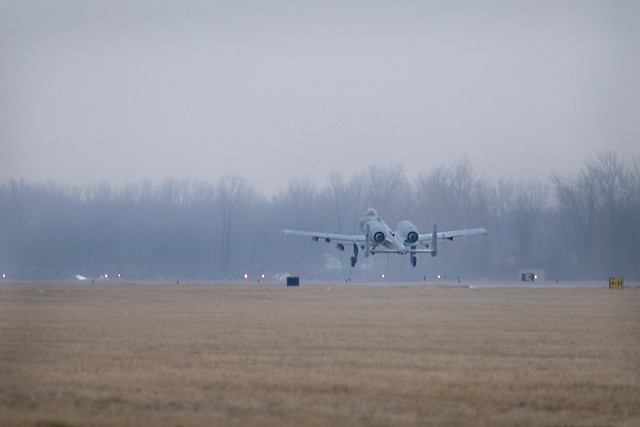
An A-10 Thunderbolt II from the 107th Fighter Squadron takes off from Selfridge Air National Guard Base, Mich., Feb. 14, 2012. The A-10 Aircraft of the 107th fighter squadron recently returned from a 4-month deployment to Afghanistan. (U.S. Air Force photo by Rachel Barton) Hi-res
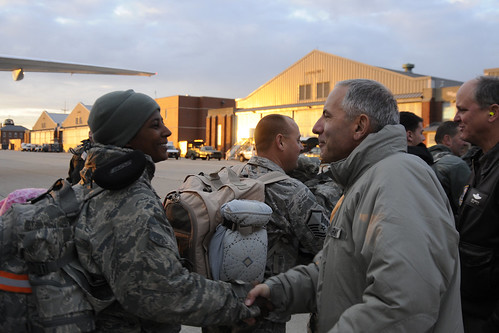


With the snow flying, Senior Airman Amanda Post makes a final check of a technical order shortly before an A-10 Thunderbolt II aircraft taxies to the runway for take off at Selfridge Air National Guard Base, Mich., Feb. 14, 2012. The aircraft's pilot is Lt. Col. Emmanuel Saridakis, a member of the 107th Fighter Squadron at Selfridge. Post is a crew chief assigned to the 127th Aircraft Maintenance Squadron. The A-10s at Selfridge have resumed a regular local flying and training schedule, following the return of local Airmen from a deployment to Afghanistan. (U.S. Air Force photo by TSgt. Dan Heaton) Hi-res


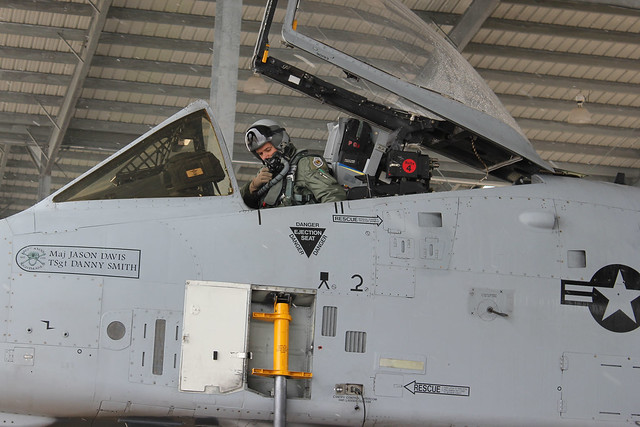
Lt. Col. Emmanuel Saridakis runs through his pre-flight checklist after strapping into the cockpit of an A-10 Thunderbolt II aircraft at Selfridge Air National Guard Base, Mich., Feb. 14, 2012. Saridakis is a pilot with the 107th Fighter Squadron. The A-10s at Selfridge have resumed a regular local flying and training schedule, following the return of local Airmen from a deployment to Afghanistan. (U.S. Air Force photo by TSgt. Dan Heaton) Hi-res

Note: Pictured is A-10C 79-0193. Crew inscription: Maj JASON DAVIS, TSgt DANNY SMITH. No ladder door art.


SSgt. Christopher Manley, a 127th Aircraft Maintenance Squadron Crew Chief at Selfridge Air National Guard Base, Mich., performs pre-flight checks on an A-10 Thunderbolt II Aircraft, in full communication with the pilot prior to taxing for take-off, Feb 14, 2012. (U.S. Air Force photo by Rachel Barton) Hi-res


TSgt. John Adams, a 127th Aircraft Maintenance Squadron Crew Chief at Selfridge Air National Guard Base, Mich., performs final checks on an A-10 Thunderbolt II Aircraft at the End of Runway, immediately prior to aircraft take-off on Feb. 14, 2012. (U.S. Air Force photo by Rachel Barton) Hi-res

Source

Tuesday, February 7, 2012

LOXing the Fleet: Always a Cold Day

by TSgt. Dan Heaton
127th Wing Public Affairs


Vapor swirls around a liquid oxygen servicing cart Feb. 5, 2012, as Airman 1st Class Zak Skelton prepares to service an A-10 Thunderbolt II aircraft at Selfridge Air National Guard Base, Mich. Skelton is a crew chief with the 127th Aircraft Maintenance Squadron, a component of the Michigan Air National Guard. (U.S. Air Force photo by TSgt. David Kujawa) Hi-res

2/7/2012 - SELFRIDGE AIR NATIONAL GUARD BASE, Mich. -- Three hundred degrees below zero.

Some days are much, much colder than others on the flight line at Selfridge Air National Guard Base. Take LOX servicing day, for example.

LOX - shorthand for liquid oxygen - is used by the Air Force to provide breathing oxygen for pilots in its fighter aircraft. When oxygen gets down below 300 degrees or so below zero, it becomes a liquid and takes up considerably less space than does its more common gas form. The Air Force, and other operators of high-performance aircraft, use liquid oxygen on aircraft so that they are able to provide a substantial supply of oxygen to the aircraft's pilot and crew without taking up a lot of space and adding extra weight with large, bulky air tanks.

Wearing doubled gloves, a leather apron and a full face mask, Airman 1st Class Zak Skelton needs only a few minutes per aircraft to ensure that each of the A-10 Thunderbolt II's on the flight line at Selfridge are topped off with LOX and ready for the next mission.

Skelton, and other crew chiefs with the 127th Aircraft Maintenance Squadron at Selfridge, generally refill the aircraft LOX tank in each A-10 once per week, or more often if needed. The crew chiefs refer to the process as "LOXing the fleet."

Depending on the duration of the flight and the particular pilot who flies in the aircraft, each A-10 can fly 2-3 sorties before it needs to be refilled with LOX again, said TSgt. Juan Lopez, who has been working as an A-10 crew chief in the Michigan Air National Guard for about 16 years, first in Battle Creek and for the past couple of years at Selfridge. He has more than 34 years of total service in the military.

"Every pilot is a little different," Lopez said. "Some use more air than others. And, naturally it depends on how long they fly."

Each A-10 can hold about five liters of LOX.

Because liquid oxygen boils at approximately 298 degrees below zero, handling it requires special precautions, such as the gloves and face shield Skelton put on prior to re-filling the aircraft. A cloud of escaping cold, white vapor is a regular feature of LOX operations.

Skelton also pointed out that since LOX is pure oxygen, it is highly flammable, so safety is key to working with it.

Skelton recently completed his initial technical school as a crew chief at Sheppard Air Force Base in Texas, spending almost six months in school. That was followed by about a month of hands-on training at Davis-Monthan Air Force Base in Arizona. He's been a member of the Michigan Air National Guard for about two years.

In addition to his duties and training as an A-10 crew chief in the Air National Guard, Skelton is a student in the aircraft technology program at Lansing Community College. He said he hopes to work in the civilian aircraft industry after he completes his college degree, while continuing to serve in the Michigan Air National Guard.

Source (including four more pictures)


Close-up view of the amazing air intake cover with the inscription: 127TH AMXS WE FIX NIGHTMARES

Sunday, February 5, 2012

A-10 Safety

Released by 127th Wing Public Affairs


Staff Sgt. Brandon Cook inserts safety pins on an A-10 Thunderbolt II at Selfridge Air National Guard Base, Mich., Feb. 4, 2012. Cook is a member of the 127th Maintenance Group, which maintains the A-10s at Selfridge. (U.S. Air Force photo by TSgt. Dan Heaton) Hi-res

Note: Please take a closer look on the left engine's air intake cover's inscription: "... MXS WE FIX NIGHTMARES"

Cleaning Day in the Armaments Bay

by TSgt. Dan Heaton
127th Wing Public Affairs


Senior Airman Mike Vogel and SSgt. Jason Turner, both members of the 127th Aircraft Maintenance Squadron, work on cleaning and inspecting a MAU-50 Light Duty Ejector Rack at Selfridge Air National Guard Base, Mich., Feb. 4, 2012. The MAU-50 is used to carry munitions on the A-10 Thunderbolt II aircraft, operated by the 107th Fighter Squadron at Selfridge. (U.S. Air Force photo by TSgt. Dan Heaton) Hi-res


2/5/2012 - SELFRIDGE AIR NATIONAL GUARD BASE, Mich. -- In the hangar, past the bomb racks and then around the corner.

This is where the armament troops work at Selfridge. And today is cleaning day. But in the Air Force, that means more than just grabbing a broom and sweeping up.

With brushes, solvent, ratchet sets and technical orders, today is the day the MAU-40 Bomb Ejector Racks are being cleaned.

"This is an 18-month inspection," explained Technical Sgt. Lucky Foate, a 19-year veteran of the Air National Guard. "Once every 18 months, we bring this in to the back shop, tear them down, give them a thorough inspection of every piece and every part, clean them up and return them to service."

The MAU-40 is used on the A-10 Thunderbolt II aircraft. The rack holds the bombs carried by the A-10, an air-to-ground attack aircraft that has been used extensively by the Air Force in Afghanistan in recent years. These particular MAU-40s are maintained by the 127th Aircraft Maintenance Squadron, which is part of the Michigan Air National Guard. The Michigan Guard's A-10 pilots and maintainers returned home in January after a four-month deployment to Afghanistan. The MAU-40 is just one of hundreds of parts that makes the A-10 a fearsome opponent on the battlefield.

Foate has worked on several different aspects of aircraft munitions over the years. He started off working on the armament systems on F-16 Fighting Falcons for the Michigan Air National Guard in the early 1990s. In the mid-2000s, he moved to Florida and transferred to the Florida Air National Guard. About a year ago, he returned to Michigan and resumed his service with the 127th at Selfridge Air National Guard Base. Over the years, he's worked as a weapons loader, on communications systems and now he's back in the back shop again, maintaining armament systems.

"You know, I enjoy it. To be honest, I've enjoyed most everything I've done in the Guard," said Foate, who works as an electrician in his civilian job.

On the other side of the workshop, SSgt. Jason Turner and Senior Airman Mike Vogel are cleaning an MAU-50. It looks somewhat similar to the -40 and both are used to hang munitions on the A-10. The MAU-50 light duty ejector rack used for a variety of different weapon and defensive systems. Turner and Vogel are giving the -50s their scheduled cleaning and inspection as well.

The two men came to the Guard through different paths. Turner served on active duty in the Air Force, serving in England for a time. After he was discharged from the Air Force, he went 16 years with no military affiliation until he bumped into an Air Force recruiter in a Home Depot store. He's now been in the Guard for six years. Vogel worked in vehicle maintenance with the Michigan Army National Guard for four years. During a deployment to Kuwait, he worked with a team that added additional armor to military vehicles. After returning home to Michigan, he was playing softball in a recreation league and some people on the other team recruited him into the Air National Guard. That was about 5 years ago.

"And the rest is history," Vogel said. "Basically, I just moved to the other side of the base."

Selfridge is home to units from all branches of military service.

The three Airmen are all traditional members of the Air National Guard, serving generally one weekend per month, two weeks of duty in the summer and then standing ready for calls to deployment.

"It has been a pretty good ride for me," Foate said. "I like what I do when I come out here and put in my weekend."

Source

Command chief: Airmen must be 'more flexible than ever'

by TSgt. Dan Heaton
127th Wing Public Affairs

2/5/2012 - SELFRIDGE AIR NATIONAL GUARD BASE, Mich. -- Air National Guard Airmen will need to be more flexible in their careers than ever before as the nation's military restructures for the future.

"You might have to side step, a back step, a lateral move all with the focus on moving forward. That's likely to be the career path for new Airmen today," said Chief Master Sgt. Denise Jelinski-Hall, the senior enlisted leader for the National Guard Bureau. "We have to be more flexible than we have ever been before."

Jelinski-Hall made her comments during a Feb. 4 town hall meeting attended by most of the roughly 1,400 enlisted Airmen who make up the 127th Wing at Selfridge Air National Guard Base, Mich. Her visit was part of a whirlwind tour of major National Guard facilities in Michigan and included stops at the Combat Readiness and Training Center in Alpena, Camp Graying, Joint Forces Headquarters in Lansing and Fort Custer and 110th Airlift Wing, both in Battle Creek.

Jelinski-Hall's visit with the Selfridge Airmen came a day after Air Force officials announced a plan that my bring big changes to the assigned missions at the base, including a proposed elimination of the mission to operate A-10 Thunderbolt II aircraft at the base and an increase in the number of KC-135 Stratotanker aircraft assigned to Selfridge. The proposal is now before Congress for consideration.

"You might have to re-train, you might have to change your plans. That is part of being the most dependable and reliable Airmen you can be," Jelinski-Hall told a ground of recent enlistees during her visit to Selfridge.

Among those who heard the chief speak was Justin Forton, who enlisted in the Michigan Air National Guard about five months ago. Forton is waiting for his report date to attend Basic Military Training and officially earn the title of "Airman" in the Air Force.

Forton, who plans to become a member of the 127th Security Forces Squadron at Selfridge after his initial training is complete, said the chief's message was a simple one.

"Keep your head held high, focus on your career and focus on what you are doing," Forton said.

Jelinski-Hall spent most of her career as a member of the Hawaii Air National Guard after serving both on active duty and as a member of the California Air National Guard.

A key part of her job as a senior enlisted advisor is to seek out the concerns of and the issues facing the enlisted force of the National Guard and sharing those concerns with the senior leadership of the Guard. She reports directly to Gen. Craig R. McKinley, chief of the National Guard Bureau. Jelinski-Hall urged Airmen to rely on each other and to use their enlisted leaders as resources during times of stress and uncertainty, such as what is now facing in the Air National Guard as the nation's military is re-aligned.

"I need you to stay focused and to be the very best Airman you can be and let leadership do what needs to be done at their level to determine the way forward," she said.

Source

Saturday, February 4, 2012

Air Force announcement impacts Michigan Air National Guard assets at Selfridge

By 127th Wing Public Affairs

2/3/2012 - SELFRIDGE AIR NATIONAL GUARD BASE, Mich. -- Air Force officials announced proposed force structure changes which support the new DoD strategic guidance retiring 286 aircraft over the next five years, including 227 in fiscal year 2013. Included in this are changes to the Michigan Air National Guard at both Battle Creek and Selfridge Air National Guard Bases.

According to Secretary of the Air Force, Michael Donley, the Air Force is shaping itself for future challenges by realigning Air Force assets with the Defense Department's new strategic guidance.

The new strategic guidance requires the joint force to be capable of fighting one large scale, combined arms campaign with sufficient combat power to also deny a second adversary, and de-emphasized large-scale, prolonged stability operations. The Air Force's approach to this new strategy is to retire fighter, mobility, and ISR, Intelligence Surveillance and reconnaissance craft, which are beyond those needed to meet the capacity requirements of the new strategic guidance.

The announcement today stated that the the Air Force would eliminate the A-10 Thunderbolt II mission from the 127th Wing at Selfridge Air National Guard Base, while the unit would also gain four additional KC-135 aerial refueling aircraft.

"Obviously the message is clear that we will continue flying operations at... Selfridge; but these changes aren't a one for one trade. We are still awaiting AF determination of non-flying mission adjustments and the next affects of the projected cuts. This is a process, and we are in the early stages. More details will follow in the coming weeks with greater fidelity on the future missions or manning for our state," said Maj. Gen. Gregory Vadnais, Director and Adjutant General of the Michigan National Guard. "We expect to get more information on the full impact of these proposals in March - that is when our leadership will be able to share specific future mission information and manpower numbers."

The AF announcement specifies the Total Force structure changes will save $8.7 Billion over the next five years via reductions across Air Force Active Duty, Air National Guard, and Air Force Reserve components.

Col Michael Thomas, 127th Wing commander, stated, "Similar to past BRAC recommendations, these initial proposals will likely change throughout the authorization process. We will remain focused on our current missions and the safety of our Airmen while these proposals are going through that process.

"We know the Air National Guard leadership is working hard to reach fiscally responsible decisions that benefit the force at large, including Airmen at this wing. However, this unit has earned more than a decade of combat experience and we want to retain that experience in the most cost effective way possible. Regardless of the final Congressional decision, the Airmen of the 127th Wing will continue to fulfill their missions with the professionalism and dedication that we've always displayed."

For fiscal years 2014-2017 the Air Force plans to reduce 50-plus aircraft from its inventory, continue to reshape the missions between the Total Force, and increase Reserve Component participation in the Intelligence, Surveillance and Reconnaissance as well as cyber missions.

Implementation of these actions will occur only after completion of appropriate environmental analyses. The Air Force is scheduled to announce related force structure manpower changes in March.

"There is no change to the Michigan Army Guard contemplated in the FY 13 reduction," said Vadnais. "But let's be honest, changes of this magnitude tend to have a trickledown effect, making every service member in Michigan, where unemployment numbers are already high, very nervous. I want to assure my Soldiers and Airmen that I will do everything I possibly can to ensure that the uniquely talented men and women of the Michigan Air and Army National Guard maintain their missions in service to their state and country."

Source

Tuesday, January 10, 2012

Selfridge Airmen to Return Home [Update]


Col. Michael Thomas welcomes home members of the Michigan Air National Guard at Selfridge Air National Guard Base, Mich., Jan. 9, 2012. The Airmen returned home after a 4-month deployment to Afghanistan, where they flew, maintained and supported the A-10 Thunderbolt II aircraft. The Airmen are all members of the 127th Wing at Selfridge, of which Thomas is the commander. (U.S. Air Force photo by TSgt. Dave Kujawa) Hi-res

by TSgt. Dan Heaton
127th Wing Public Affairs

1/9/2012 - SELFRIDGE AIR NATIONAL GUARD BASE, Mich. -- Approximately 300 Airmen of the Michigan Air National Guard returned to Selfridge Air National Guard Base Monday, Jan. 9, after a four-month deployment to Afghanistan. The Airmen operated and maintained the A-10 Thunderbolt II aircraft while deployed, serving with the 451st Air Expeditionary Wing, based at Kandahar Airfield. [...]


Major Gen. Gregory J. Vadnais, the adjutant general of Michigan, welcomes home a group of Airmen at Selfridge Air National Guard Base, Mich., Jan. 9, 2012. The Airmen, all members of the 127th Wing at Selfridge, were returning home after a 4-month deployment to Afghanistan. (U.S. Air Force photo by TSgt. Dave Kujawa) Hi-res


Hundreds of friends and family members welcome home members of the Michigan Air National Guard at Selfridge Air National Guard Base, Mich., Jan. 9, 2012. The Airmen returned home after a 4-month deployment to Afghanistan, where they flew, maintained and supported the A-10 Thunderbolt II aircraft. The Airmen are all members of the 127th Wing at Selfridge. (U.S. Air Force photo by TSgt. David Kujawa) Hi-res

Source (Including 7 photos and a video)


Please note: The rest of this news article is identical with it's previous version, already published on January 6, 2012. See: Selfridge Airmen to Return Home


This video is available now also on YouTube:


Comment: Welcome home, 107th Expeditionary Fighter Squadron and all of your supporters!

Friday, January 6, 2012

Selfridge Airmen to Return Home

by TSgt. Dan Heaton
127th Wing Public Affairs

1/6/2012 - SELFRIDGE AIR NATIONAL GUARD BASE, Mich. -- Approximately 300 Airmen of the Michigan Air National Guard are returning to Selfridge Air National Guard Base this month, after a four-month deployment to Afghanistan. The Airmen operated and maintained the A-10 Thunderbolt II aircraft while deployed, serving with the 451st Air Expeditionary Wing, based at Kandahar Airfield.

"The safe return of our Michigan Airmen is a very welcome way to begin the new year," said Col. Michael Thomas, commander of the 127th Wing, the home unit of the returning Airmen. "The selfless service rendered by these men and women, which included being deployed over the holiday season, epitomizes the core values of the U.S. Air Force."

The deployment was the fourth major deployment of the unit's since 2001. This was the first deployment for the Selfridge fighter aircraft unit to Afghanistan and the first since the 107th Fighter Squadron made the transition to flying the A-10, an air-to-ground attack aircraft. The deployment included members of the 127th Operations Group and the 127th Maintenance Group.

Over the 120-day deployment period, the unit logged approximately 8,300 flight hours in 2,000 sorties, or flight missions.

While the bulk of the unit is returning home in early January, a small cadre will remain behind to assist with the transition of the unit that replaced the Michigan Air Guardsmen at Kandahar, a NATO base in southern Afghanistan.

Composed of approximately 1,700 Citizen-Airmen, the 127th Wing of the Michigan Air National Guard is the host organization at Selfridge, flying the KC-135 Stratotanker, an aerial refueler, and the A-10 Thunderbolt II, also known as the Warthog, which is an air-to-ground attack fighter. In addition to the Wing, Selfridge is home to numerous other military and federal agencies, which fly a variety of helicopters and small, light fixed-wing aircraft.

More information on the 127th Wing and Selfridge Air National Guard Base is available at www.127wg.ang.af.mil.

Comment: Job well done, 107th Expeditionary Fighter Squadron and all supporting units! That was the first leg of an ongoing "Total Force" A-10C combat deployment to the 451st AEW at Kandahar Airfield in support of Operation Enduring Freedom.

Wednesday, November 30, 2011

A year of change: more coming

By Col. Michael Thomas
127th Wing Commander
(Published in the December 2011 public online PDF issue's Commander's Call section of "Prevailing Wind" - the official newspaper of the 127th Wing)

Larger picture

Wow 2011, what a dynamic year! We all experienced significant change in 2011. We also experienced tremendous success. Bringing pride to our Selfridge community and the State of Michigan.

First the change: The year stated with Col. Augustine announcing his move to the 122nd Fighter Wing in Indiana. In March, Brig. Gen. Peplinski announced his pending retirement scheduled for June. Command Chief Edwards also retired in March. These announcements initiated massive change that we experienced at all levels of this wing.

Here are just a few of the leadership changes throughout the 127th Wing: Col. Thomas to Wing Commander, Lt. Col. Sheridan to Vice Wing Commander, Chief Master Sgt. Dobson to Wing Command Chief. Lt. Col. Brooks to Air Refueling Group Commander, Lt. Col. Krasovic to 171st ARS Squadron Commander, Lt. Col. Spehar to 127th MXS Commander, Lt. Col. Holmes to Force Support Squadron Commander, Major Dominissini to 191st Director of Maintenance, Major Hitchcock to 191st AMX Commander. This was some serious change and folks are still feeling the affects of all this change.

With all this change also came tremendous success. The Operations and Maintenance Groups came out of conversion from the F-16 to the A-10. Following a very successful Red Flag exercise in March, the unit reported their Initial Operational Capability in June. No rest for the weary! The Air Force needed our A-10 aviation package in CENTCOM six months earlier then initially scheduled. With only two months to prepare, the OG and MXG spun up for war and the wing successfully deployed ap-proximately 300 personnel trained and equipped ready to answer the call in late September. This was by far the most successful, mini-mum time, deployment I've seen to date. Thanks to all the OG, MXG and MSG folks that worked so hard to make this deployment such a success. As I write this article, let's all keep these wing members in our thoughts and prayers until their safe return early next year.

All of our wing personnel have contributed significantly to the war fight in numerous ways. Let's all thank our Civil Engineering folks for their successful, six-month deployment to Afghanistan; our Services personnel for their deployment to Kuwait; Special Operations Weather Team to unknown locations around the globe and all the Air Refueling Group folks that deployed to both CENTCOM and PACOM. The Air Refueling Group is also currently involved in a rolling mobilization to CENTCOM where we'll be deploying aircraft and airmen for 60-day rotations far into the future.

Other deployments included Logistics Readiness Squadron to Alaska, Air Refueling Group to Germany, Africa and the Pacific Rim. We stand ready to answer the nation's call. This was evident during the Libya contingency when the Air Refueling Group deployed an airplane and personnel in less than 48 hours -- with some of our maintenance folks only receiving a four-hour heads up call. Pack a bag, kiss the kids and spouse goodbye, leave a message for the civilian boss and report to the base for deployment.

You all answered the call so others could prevail. What you do each and every day is important to our state and nation. Your skills and expertise are saving lives all around the world. Keep up the great work!

Now we're looking forward to 2012. What will be in our future? Whatever comes our way, I know that you're all prepared to meet the challenge ahead. Don't be afraid of change. As I've said in the past, change leads to opportunity and opportunity leads to success. We have what it takes to be the best Wing in the U.S. Air Force and your actions and commitment prove that each and every day.

Thank you for your service. Thank you and your family for all your sacrifice. I wish you all a safe and happy holiday season and look forward to getting it done again in 2012.

Source

Official USAF biography of Colonel Michael T. Thomas

Friday, November 11, 2011

11-11-11: Saluting America's veterans

by TSgt. Dan Heaton
127th Wing Public Affairs

11/2/2011 - SELFRIDGE AIR NATIONAL GUARD BASE, Mich. -- For nearly 100 years, America has been honoring her veterans on a day that recalls the end of the first war that included extensive use of military air power.

For that same long century, a field near Detroit has been providing a significant percentage of that air power to meet the nation's needs.

The guns of World War I fell silent on the eleventh hour of the eleventh day of the eleventh month of 1918. That day, Nov. 11, has been marked ever since by the United States as a day to honor those who have served - first in that war and later expanded to all those who have served in peace time and in war.

For more than a year before that date, Selfridge Field had been a training center for the fledgling new air wing of America's military. More than 1,000 pilots and aerial gunners were trained at Selfridge during World War I. "The Great War" - as the conflict was known at the time -- launched a history of service at Selfridge which continues to this day. Almost 400 Airmen from around the wing will be forward deployed on Veterans Day 2011.

"For almost 100 years, Selfridge has played an important role in our military history," said Col. Michael Thomas, 127th Wing commander at Selfridge. "Veterans of service at Selfridge, as well as those who continue to serve, have earned the gratitude of a nation that continues to enjoy the freedoms these veterans have defended."

The Treaty of Versailles, which officially ended World War I, was signed on June 28, 1919, in the Palace of Versailles outside the town of Versailles, France, some seven months after the fighting had concluded. In November 1919, President Wilson proclaimed November 11 as the first commemoration of Armistice Day with the following words: "To us in America, the reflections of Armistice Day will be filled with solemn pride in the heroism of those who died in the country's service and with gratitude for the victory, both because of the thing from which it has freed us and because of the opportunity it has given America to show her sympathy with peace and justice in the councils of the nations..."

On May 13, 1938, Congress made the 11th of November a legal holiday--a day to be dedicated to the cause of world peace and to be thereafter celebrated and known as "Armistice Day." Armistice Day was primarily a day set aside to honor veterans of World War I, but in 1954, after both World War II and the Korean War had passed into the history books, numerous veterans organizations to change the name to Veterans Day. President Dwight D. Eisenhower issued the first "Veterans Day Proclamation" on Oct. 8, 1954.

The 1968 Uniform Holiday Law changed the dates of several federal holidays, including moving Veteran's Day to the nearest Monday to Nov. 11. This action was protested by many veterans organizations and many states continued to celebrate the holiday on Nov. 11.

Veterans Day was marked on a Monday in 1971-1974. In 1975, Congress changed the official date back to Nov. 11, because of the historic significance of the date.

Veterans Day continues to be observed on November 11, regardless of what day of the week on which it falls. The restoration of the observance of Veterans Day to November 11 not only preserves the historical significance of the date, but helps focus attention on the important purpose of Veterans Day: A celebration to honor America's veterans for their patriotism, love of country, and willingness to serve and sacrifice for the common good.

Today, Selfridge Field is known as Selfridge Air National Guard Base and is home to units of every branch of the U.S. military and several agencies of the U.S. Dept. of Homeland Security.

Parts of this article were provided by the U.S. Dept. of Veterans Affairs.

Source