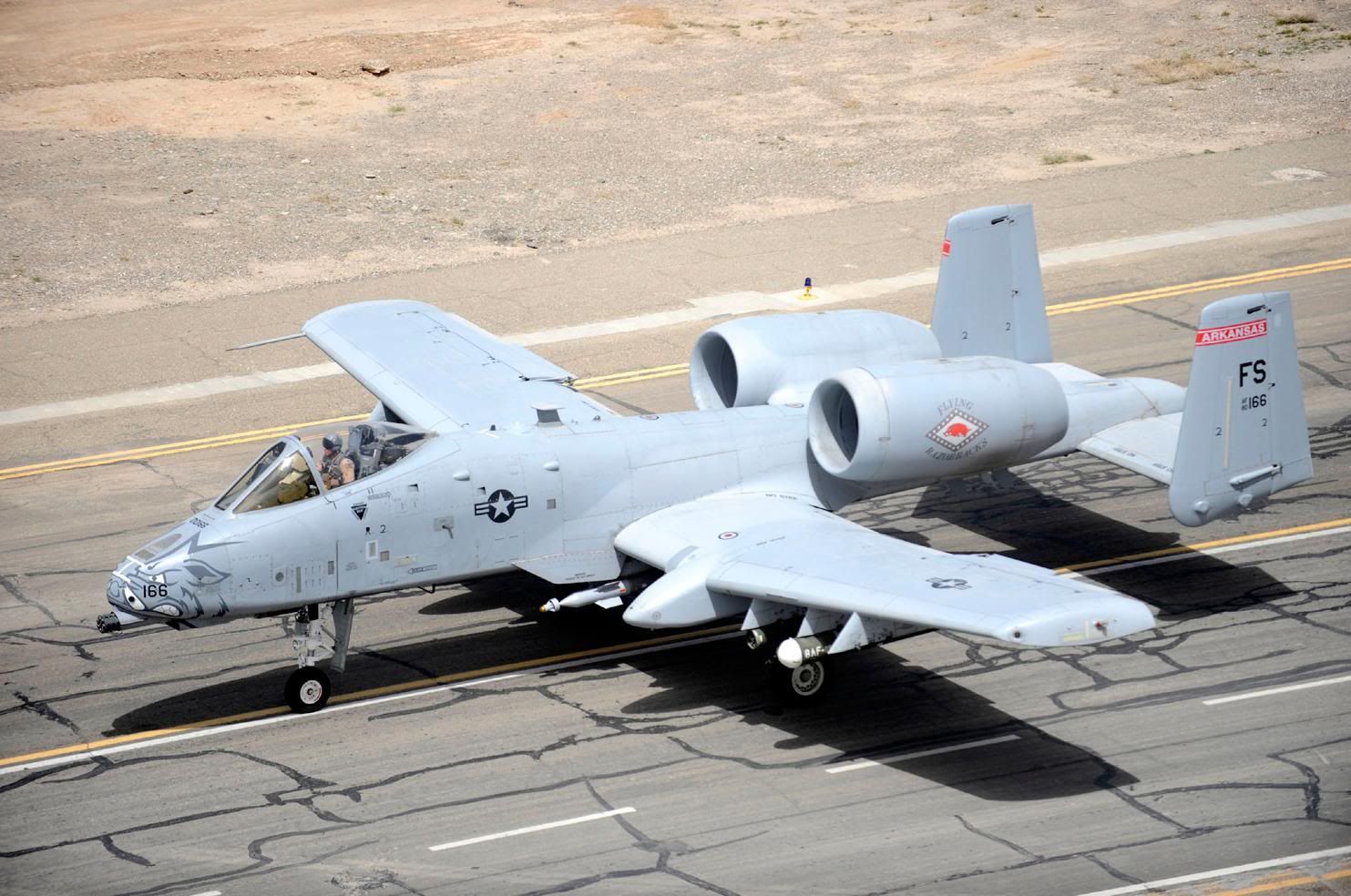
by Master Sgt. Ken Carr
TF34 Engine Regional Repair Center
5/13/2010 - SHAW AIR FORCE BASE, S.C. -- The last TF34 engine built at Shaw rolled onto a truck bound for Moody Air Force Base, Ga., May 11.
The movement marked the close of an era at Shaw.
The 20th Component Maintenance Squadron's Propulsion Flight at Shaw began working on the TF34-GE-100A engine that powers the A-10 Thunderbolt in 1992, following the deactivation of the 355th Fighter Squadron at Myrtle Beach AFB, S.C. In March of the same year, the fleet of A-10 aircraft assigned to Myrtle Beach was reassigned to the 21st Tactical Fighter Squadron, 363rd Tactical Fighter Wing at Shaw.
Years later, the A-10 aircraft left Shaw, but the 20th Propulsion Flight continued its mission of repairing the TF34 engine. Having endured several name changes and reorganizations throughout the years, the maintenance function ultimately became known as the TF34 Engine Regional Repair Center, or ERRC.
Throughout the last 18 years, many challenges were met, and the men and women of the ERRC produced more than 654 serviceable engines in support of Pope AFB, N.C., Spangdahlem Air Base, Germany, and Eglin AFB, Fla. The A-10 aircraft assigned to Pope was eventually reassigned to the 23rd Fighter Wing at Moody AFB, Ga.
Most recently, during Moody's deployment to Afghanistan, the 74th and 75th Fighter Squadrons received 14 engines built by the ERRC, enabling their sustained mission success in support of Operation Enduring Freedom.
According to the Global Security website, the 2005 base realignment and closure agenda to realign Shaw called for relocating base-level TF34 engine intermediate maintenance to Moody, establishing a Centralized Intermediate Repair Facility, or CIRF.
The Department of Defense also recommended realigning Shaw AFB by relocating base-level TF34 engine intermediate maintenance to Moody AFB to combine with other TF34 engine maintenance agencies to form the CIRF at Bradley ANG base.
In the end, establishing aTF34 engine maintenance CIRF at Bradley compliments the A-10 fleet realignment.
Ultimately, the CIRF consolidation at Bradley ANG base will centralize TF34 engine maintenance for ANG-owned A-10 aircraft from Barnes, Selfridge, and Martin State ANG bases.
Additionally, the CIRF will include support for all active-duty A-10 aircraft assigned to Spangdahlem AB Germany.
Following close behind the last engine shipment are 29 TF34 engine mechanics, who are also making the move. Once there, they will continue the long legacy of top quality TF34 turbo-fan engine maintenance they established here.
Source
Note: Related pictures will be uploaded soon.
Wednesday, May 19, 2010


Tuesday, May 18, 2010
188th Fighter Wing burns midnight oil in late night homecoming; more than 200 Airmen return from Kandahar deployment
by Capt. Heath Allen
Arkansas National Guard Public Affairs
5/18/2010 - FORT SMITH, Ark. -- While their minds were focused on the mission, their hearts were longing for home.
More than 200 members of the Arkansas Air National Guard's 188th Fighter Wing returned to home station Monday following an Aerospace Expeditionary Force (AEF) deployment to Kandahar Airfield in Afghanistan.
A World Airlines McDonnell Douglas DC-10 packed full of Guardsmen touched down at Fort Smith Regional Airport at 11:55 p.m. May 17, 2010.
More than 50 members of the 188th left Jan. 8, 2010, and spent the entire four-month AEF rotation in Kandahar. An additional 225 Guardsmen joined them in early March for the 188th's official two-month portion of the rotation. The remaining personnel, approximately 50, and the 188th's deployed A-10C Thunderbolt II "Warthogs" will return later this week.
The AEF mission was the 188th's first combat deployment as a unit with A-10s since it received its first Warthog April 14, 2007. The 188th shared the four-month AEF rotation with the 175th Wing, an A-10 Air National Guard unit based in Baltimore, Md. While in theater the 188th was attached to the 451st Expeditionary Wing at Kandahar Airfield.
"We're certainly glad to have our Airmen back home safe," said Col. Tom Anderson, 188th Fighter Wing commander. "It was an important mission and the 188th made key contributions to the effort. The 188th has a rich history of performing well under pressure and this deployment was no different. Everyone put in a lot of hard work to ensure each mission was successful."
The A-10 mission in southern Afghanistan is to fly close-air support in response to ground troops who may be in contact with the enemy, or to escort convoys in particularly hostile areas. When not supporting ground troops, A-10s patrol designated sectors and provide aerial reconnaissance on locations of interest to ground commanders.
While in Kandahar, the 188th consistently flew 12 to 16 sorties per day with each flying mission averaging two to five hours.
"We had 12 aircraft that we were responsible for and our A-10s were airborne 24/7," said Capt. Jim Garvey, 188th maintenance officer. "Our job was to ensure that we met a flying mission every day to support troops on the ground. The pilots did that with great zeal and determination. The maintenance group worked hard to ensure that we did not miss a single mission in the entire 60 days we were there."
While the deployed 188th members maintained and repaired A-10s, flew countless sorties, conducted numerous inspections and marched to the cadence of a 24-hour operations tempo, the families were not without myriad contributions in their Guardsman's absence.
And on Monday, the Guardsmen and their respective families reciprocated their thanks for a job well done.
"I'm so glad to be home and to see my family," Garvey said. "We have such a proud, supportive community and this reception is a reflection of that."
Despite the near midnight arrival, more than 1,000 family members and friends of the deployed Airman gathered at the 188th to welcome them home.
It was an emotional moment as the deployed members were reunited with their families at the 188th's Consolidated Maintenance Facility. Tearful embraces were greeted with fervor as families huddled in group hugs, collectively clinging to the moment.
"I'm very proud of each and every member of the 188th for all of their dedication," Anderson said. "I'm also very thankful for all of their wonderful families and the sacrifices they made while their loved ones were deployed."
Before this mission, the 188th's last AEF rotation transpired in 2005 when the unit deployed 267 Airmen and 10 F-16s to Balad Air Base, Iraq, in support of Operation Iraqi Freedom.
For more information on the 188th Fighter Wing please visit www.188fw.ang.af.mil.
You can also find us on Facebook: http://www.facebook.com/pages/Fort-Smith-Ark/188th-Fighter-Wing-Arkansas-Air-National-Guard/113971391965165?ref=mf

Maj. Brian Ahlert, right, reunites with his son and wife, Ashley, May 17, 2010. Ahlert was one of more than 200 members of the Arkansas Air National Guard's 188th Fighter Wing that returned to home station Monday following an Aerospace Expeditionary Force (AEF) deployment to Kandahar Airfield in Afghanistan. (U.S. Air Force photo by Capt. Heath Allen) Hi-res
Source
See also (updated May 19, 2010):
188th Fighter Wing Arrives Home
Kate Luck, Reporter
4:50 AM CDT, May 18, 2010
5NEWS / KFSM-TV
It was a late night but a happy one for the members of the 188th Fighter Wing. They returned around midnight Monday night from a two and a half month deployment to Afghanistan.
The airmen were originally scheduled to arrive around 6 in the afternoon. It was nearly midnight when their plane finally landed in Fort Smith. Despite the late hour, hundreds of friends and family were there to welcome their loved ones home.
Every face had a smile as the airmen of the 188th stepped off the bus and back into their family's lives. Everyone knew they had just completed an important mission.
"To fight the bad guys," said one boy who was welcoming his father, Master Sgt. Nathan Stanfill, home.
The cheering crowd could be heard as soon as the plane was spotted. The airmen say their homecoming was more than they could imagine.
"It was great. I can't explain it. The best feeling there is," said Master Sgt. Stanfill.
"I kinda had an idea that it would be something like this, but you never really get ready for it," said Sgt. Travis Black.
"It's a day or moment you wait for from the moment you leave. Knowing the folks at home are there to support us. Over the course of the 60 plus days, they sent us care packages and letters. As we got those, we couldn't wait to see them in person. So counting down the days is really what we did," said Captain Jim Garvey.
The Stanfill family didn't know until Sunday if their husband and father would be among those returning.
"The past weekend we were on pins and needles not knowing if he was going to be able to come back. When we got the word at ten p.m. last night, it was like a million Christmases. We knew we were going to have him back home and that's what we have been living for the past two and a half months," said Kasey Stanfill.
Captain Jim Garvey says the 188th is something the whole community can stand behind.
"It goes without saying the 188th did the River Valley proud and represented our people with great pride and determination over there in the desert," he said.
Source
Latest related news:
188th Airmen to Return from Afghanistan
Arkansas National Guard Public Affairs
5/18/2010 - FORT SMITH, Ark. -- While their minds were focused on the mission, their hearts were longing for home.
More than 200 members of the Arkansas Air National Guard's 188th Fighter Wing returned to home station Monday following an Aerospace Expeditionary Force (AEF) deployment to Kandahar Airfield in Afghanistan.
A World Airlines McDonnell Douglas DC-10 packed full of Guardsmen touched down at Fort Smith Regional Airport at 11:55 p.m. May 17, 2010.
More than 50 members of the 188th left Jan. 8, 2010, and spent the entire four-month AEF rotation in Kandahar. An additional 225 Guardsmen joined them in early March for the 188th's official two-month portion of the rotation. The remaining personnel, approximately 50, and the 188th's deployed A-10C Thunderbolt II "Warthogs" will return later this week.
The AEF mission was the 188th's first combat deployment as a unit with A-10s since it received its first Warthog April 14, 2007. The 188th shared the four-month AEF rotation with the 175th Wing, an A-10 Air National Guard unit based in Baltimore, Md. While in theater the 188th was attached to the 451st Expeditionary Wing at Kandahar Airfield.
"We're certainly glad to have our Airmen back home safe," said Col. Tom Anderson, 188th Fighter Wing commander. "It was an important mission and the 188th made key contributions to the effort. The 188th has a rich history of performing well under pressure and this deployment was no different. Everyone put in a lot of hard work to ensure each mission was successful."
The A-10 mission in southern Afghanistan is to fly close-air support in response to ground troops who may be in contact with the enemy, or to escort convoys in particularly hostile areas. When not supporting ground troops, A-10s patrol designated sectors and provide aerial reconnaissance on locations of interest to ground commanders.
While in Kandahar, the 188th consistently flew 12 to 16 sorties per day with each flying mission averaging two to five hours.
"We had 12 aircraft that we were responsible for and our A-10s were airborne 24/7," said Capt. Jim Garvey, 188th maintenance officer. "Our job was to ensure that we met a flying mission every day to support troops on the ground. The pilots did that with great zeal and determination. The maintenance group worked hard to ensure that we did not miss a single mission in the entire 60 days we were there."
While the deployed 188th members maintained and repaired A-10s, flew countless sorties, conducted numerous inspections and marched to the cadence of a 24-hour operations tempo, the families were not without myriad contributions in their Guardsman's absence.
And on Monday, the Guardsmen and their respective families reciprocated their thanks for a job well done.
"I'm so glad to be home and to see my family," Garvey said. "We have such a proud, supportive community and this reception is a reflection of that."
Despite the near midnight arrival, more than 1,000 family members and friends of the deployed Airman gathered at the 188th to welcome them home.
It was an emotional moment as the deployed members were reunited with their families at the 188th's Consolidated Maintenance Facility. Tearful embraces were greeted with fervor as families huddled in group hugs, collectively clinging to the moment.
"I'm very proud of each and every member of the 188th for all of their dedication," Anderson said. "I'm also very thankful for all of their wonderful families and the sacrifices they made while their loved ones were deployed."
Before this mission, the 188th's last AEF rotation transpired in 2005 when the unit deployed 267 Airmen and 10 F-16s to Balad Air Base, Iraq, in support of Operation Iraqi Freedom.
For more information on the 188th Fighter Wing please visit www.188fw.ang.af.mil.
You can also find us on Facebook: http://www.facebook.com/pages/Fort-Smith-Ark/188th-Fighter-Wing-Arkansas-Air-National-Guard/113971391965165?ref=mf

Maj. Brian Ahlert, right, reunites with his son and wife, Ashley, May 17, 2010. Ahlert was one of more than 200 members of the Arkansas Air National Guard's 188th Fighter Wing that returned to home station Monday following an Aerospace Expeditionary Force (AEF) deployment to Kandahar Airfield in Afghanistan. (U.S. Air Force photo by Capt. Heath Allen) Hi-res
Source
See also (updated May 19, 2010):
188th Fighter Wing Arrives Home
Kate Luck, Reporter
4:50 AM CDT, May 18, 2010
5NEWS / KFSM-TV
It was a late night but a happy one for the members of the 188th Fighter Wing. They returned around midnight Monday night from a two and a half month deployment to Afghanistan.
The airmen were originally scheduled to arrive around 6 in the afternoon. It was nearly midnight when their plane finally landed in Fort Smith. Despite the late hour, hundreds of friends and family were there to welcome their loved ones home.
Every face had a smile as the airmen of the 188th stepped off the bus and back into their family's lives. Everyone knew they had just completed an important mission.
"To fight the bad guys," said one boy who was welcoming his father, Master Sgt. Nathan Stanfill, home.
The cheering crowd could be heard as soon as the plane was spotted. The airmen say their homecoming was more than they could imagine.
"It was great. I can't explain it. The best feeling there is," said Master Sgt. Stanfill.
"I kinda had an idea that it would be something like this, but you never really get ready for it," said Sgt. Travis Black.
"It's a day or moment you wait for from the moment you leave. Knowing the folks at home are there to support us. Over the course of the 60 plus days, they sent us care packages and letters. As we got those, we couldn't wait to see them in person. So counting down the days is really what we did," said Captain Jim Garvey.
The Stanfill family didn't know until Sunday if their husband and father would be among those returning.
"The past weekend we were on pins and needles not knowing if he was going to be able to come back. When we got the word at ten p.m. last night, it was like a million Christmases. We knew we were going to have him back home and that's what we have been living for the past two and a half months," said Kasey Stanfill.
Captain Jim Garvey says the 188th is something the whole community can stand behind.
"It goes without saying the 188th did the River Valley proud and represented our people with great pride and determination over there in the desert," he said.
Source
Latest related news:
188th Airmen to Return from Afghanistan
Monday, May 17, 2010
Further feedback from MetaVR, Inc.
Today, from W. Garth Smith, MetaVR, Inc., I got the following e-mail:
Hello James,
thanks for your feedback on the http://warthognews.blogspot.com site. we updated the textures to reflect the bulldog logo. please see attached image. we redid our video as well of an A-10 support mission. we think that the model is substantially improved. thank you for your feedback
regards
garth
Watch the video
Hello James,
thanks for your feedback on the http://warthognews.blogspot.com site. we updated the textures to reflect the bulldog logo. please see attached image. we redid our video as well of an A-10 support mission. we think that the model is substantially improved. thank you for your feedback
regards
garth
Watch the video
Defining our Legacy
Extracted from the "Sandy Hog Gazette", official newspaper of the 111th Fighter Wing (Pennsylvania Air National Guard), Willow Grove ARS (May 2010 public online PDF issue, section Commander's Corner):
Lt. Col. Timothy "Wedge" O'Toole
111th Operations Support Flight Commander
Legacies are a unique phenomenon in that they emerge only after an organization ceases to exist. You can repair an organization's reputation since it's still in existence, but you can't repair a legacy once the entity is gone. Legacies are made
great by success over time but can be ruined in an instant. I know this first hand having been a member of a squadron that crashed an F/A-18 on the unit's final flight, ruining an amazing reputation and cementing a legacy. In addition to destroying a jet and seriously injuring a pilot, all of the squadron's successes, victories and achievements were instantly dashed by a single event caused by a lapse of judgment, focus and professionalism. I can't describe the frustration and disappointment of those of us who put so much effort into an organization to see it end in failure.
I recently flew my final flight in the A-10 and was struck by the attention to detail and pride displayed by our maintainers, crew chiefs, operations personnel and fellow flight crews. What struck me was that our Airmen are as sharp and focused today as they were on my first flight in the A-10 over six years ago. The jets are in great shape and are as reliable as ever. The fact that we're even able to conduct flight operations so late in the BRAC process is testament to this unit's professionalism, focus and tenacity. I have full confidence in our ability to maintain this high level of professionalism through the end of flight ops here at Willow Grove, but want to stress the importance of maintaining our focus on safety and doing things right. Now is not the time to cut corners. We must maintain our high standards and diligence to the task at hand until the last jet departs and our flying mission is complete.
When the 111th Fighter Wing ceases flying operations, it will have been an active flying unit from 1924 — 2010. I would like to point out that it's not the dates that will define our legacy but instead it's the dash between them. The dash not only represents the countless deployments, sorties, maintenance man hours, and sacrifices our Airmen have made for over 86 years, but also the conduct and professionalism maintained throughout this difficult changing of missions. If there was ever a unit with an excuse to lose focus and throw in the towel, it would be a BRAC'd unit, losing its aircraft with no definitive follow on mission. But that is not the 111th's nature and therefore will not it be our legacy as a Fighter Wing. Be proud of that fact!
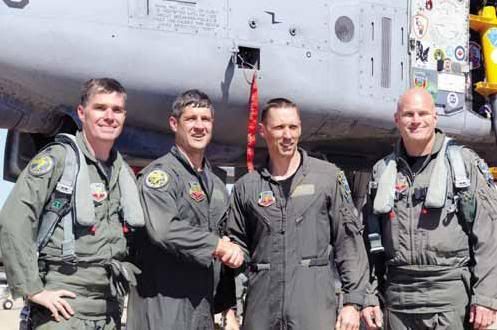
Note: Associated to this Commander's Corner is the following picture:

From left to right: Lt. Col. Nic Szoke, Lt. Col Daryl Newhart, Lt. Col. Tim O'Toole, and Lt. Col. Mike Shenk, all pilots from the 103rd Fighter Squadron, pose for a photo opportunity next to the A-10 II Thunderbolt II during Colonels Newhart's
and O'Toole's final "fini" flight ceremony that took place on base April 10, 2010. (Photo by Tech. Sgt. Alvin Farrow)
Source
Note: This very interesting picture was never released as JPG file on 111th's FW public website's photo section. Visible is a huge lot of patches or emblems on the aircraft's ladder door. Anybody who can/will provide me a close-up shot of this ladder door?
Lt. Col. Timothy "Wedge" O'Toole
111th Operations Support Flight Commander
Legacies are a unique phenomenon in that they emerge only after an organization ceases to exist. You can repair an organization's reputation since it's still in existence, but you can't repair a legacy once the entity is gone. Legacies are made
great by success over time but can be ruined in an instant. I know this first hand having been a member of a squadron that crashed an F/A-18 on the unit's final flight, ruining an amazing reputation and cementing a legacy. In addition to destroying a jet and seriously injuring a pilot, all of the squadron's successes, victories and achievements were instantly dashed by a single event caused by a lapse of judgment, focus and professionalism. I can't describe the frustration and disappointment of those of us who put so much effort into an organization to see it end in failure.
I recently flew my final flight in the A-10 and was struck by the attention to detail and pride displayed by our maintainers, crew chiefs, operations personnel and fellow flight crews. What struck me was that our Airmen are as sharp and focused today as they were on my first flight in the A-10 over six years ago. The jets are in great shape and are as reliable as ever. The fact that we're even able to conduct flight operations so late in the BRAC process is testament to this unit's professionalism, focus and tenacity. I have full confidence in our ability to maintain this high level of professionalism through the end of flight ops here at Willow Grove, but want to stress the importance of maintaining our focus on safety and doing things right. Now is not the time to cut corners. We must maintain our high standards and diligence to the task at hand until the last jet departs and our flying mission is complete.
When the 111th Fighter Wing ceases flying operations, it will have been an active flying unit from 1924 — 2010. I would like to point out that it's not the dates that will define our legacy but instead it's the dash between them. The dash not only represents the countless deployments, sorties, maintenance man hours, and sacrifices our Airmen have made for over 86 years, but also the conduct and professionalism maintained throughout this difficult changing of missions. If there was ever a unit with an excuse to lose focus and throw in the towel, it would be a BRAC'd unit, losing its aircraft with no definitive follow on mission. But that is not the 111th's nature and therefore will not it be our legacy as a Fighter Wing. Be proud of that fact!
Note: Associated to this Commander's Corner is the following picture:
From left to right: Lt. Col. Nic Szoke, Lt. Col Daryl Newhart, Lt. Col. Tim O'Toole, and Lt. Col. Mike Shenk, all pilots from the 103rd Fighter Squadron, pose for a photo opportunity next to the A-10 II Thunderbolt II during Colonels Newhart's
and O'Toole's final "fini" flight ceremony that took place on base April 10, 2010. (Photo by Tech. Sgt. Alvin Farrow)
Source
Note: This very interesting picture was never released as JPG file on 111th's FW public website's photo section. Visible is a huge lot of patches or emblems on the aircraft's ladder door. Anybody who can/will provide me a close-up shot of this ladder door?
81st Expeditionary Fighter Squadron left Spang for Afghanistan
As mentioned on the Dutch Scramble Message Board, A-10Cs from the 81st Fighter Squadron, 52nd Fighter Wing (USAFE), Spangdahlem AB, Germany, "have gone East!"
And as expected by me for months, elements from the 81st FS with twelve A-10Cs are finally on an Operation Enduring Freedom (OEF) combat deployment to the 451st Air Expeditionary Wing at Kandahar Airfield, Afghanistan.
As mentioned on the German Flugzeugforum - see topic Flugbetrieb in Spangdahlem (ETAD) 2010 - twelve A-10Cs departed Spang already on Thursday, May 6, 2010.
Possibly (and at least usual in the past), their stopovers en route Afghanistan were at Souda Bay, Crete, and at Al Udeid AB, Qatar.
During their AEF (Air Expeditionary Force) rotation (time frame still unknown to me, but four months are usual), the 81st EFS will replace an Air National Guard "Rainbow Team", consisting of personnel and 12 A-10Cs from the 104th Fighter Squadron, 175th Wing (Maryland ANG), and from the 184th Fighter Squadron, 188th Fighter Wing (Arkansas ANG).
For their current OEF combat deployment, the 81st FS finally spinned-up during exercise Red Flag 10-03 at Nellis AFB, Nevada.
And as expected by me for months, elements from the 81st FS with twelve A-10Cs are finally on an Operation Enduring Freedom (OEF) combat deployment to the 451st Air Expeditionary Wing at Kandahar Airfield, Afghanistan.
As mentioned on the German Flugzeugforum - see topic Flugbetrieb in Spangdahlem (ETAD) 2010 - twelve A-10Cs departed Spang already on Thursday, May 6, 2010.
Possibly (and at least usual in the past), their stopovers en route Afghanistan were at Souda Bay, Crete, and at Al Udeid AB, Qatar.
During their AEF (Air Expeditionary Force) rotation (time frame still unknown to me, but four months are usual), the 81st EFS will replace an Air National Guard "Rainbow Team", consisting of personnel and 12 A-10Cs from the 104th Fighter Squadron, 175th Wing (Maryland ANG), and from the 184th Fighter Squadron, 188th Fighter Wing (Arkansas ANG).
For their current OEF combat deployment, the 81st FS finally spinned-up during exercise Red Flag 10-03 at Nellis AFB, Nevada.
Saturday, May 15, 2010
188th Airmen to Return from Afghanistan
Staff Writer
5NEWS / KFSM-TV
3:59 PM CDT, May 14, 2010
200 airmen with the Arkansas Air National Guard's 188th Fighter Wing are coming home. On Monday, the troops are scheduled to return from a deployment to Kandahar Airfield in Afghanistan.
They have been there between two and four months as part of the 188th's Aerospace Expeditionary Forces rotation, according to a release from the Arkansas National Guard.
The airmen and their families will reunite with their families at the base on Leigh Avenue in Fort Smith that evening around 6 p.m.
Another set of 50 airmen and the 188th's deployed A-10Cs are set to return from Kandahar later next week. Officials say this was the first AEF deployment for the 188th as a unit since receiving the A-10 Thunderbolt II "Warthogs" in April 2007.
Source
Please note: The returning "Hogs" are not only from the 188th. On their way back home to CONUS from Kandahar Airfield, Afghanistan, after an Operation Enduring Freedom (OEF) combat deployment are twelve A-10Cs, deployed with an Air National Guard "Rainbow Team". They will make a stopover at Lajes Field, Azores.
Known serial numbers: 78-0640, 78-0682, 78-0702, 78-0719, 78-0720, 79-0082, 79-0165 (all from the 104th FS, 175th Wing, Maryland ANG); 78-0613, 78-0659, 79-0129, 80-0166 (all from the 184th FS, 188th FW, Arkansas ANG)
As mentioned on the Dutch Scramble Message Board by René (username Dutchmil), on May 15, 2010, they should arrive at Lajes next Wednesday, May 19, 2010.
Question: Anybody who got confirmed info about the awaited A-10C replacement unit? If really deployed, they must be already at Kandahar Airfield to relieve the ANG "Rainbow Team" in place.
5NEWS / KFSM-TV
3:59 PM CDT, May 14, 2010
200 airmen with the Arkansas Air National Guard's 188th Fighter Wing are coming home. On Monday, the troops are scheduled to return from a deployment to Kandahar Airfield in Afghanistan.
They have been there between two and four months as part of the 188th's Aerospace Expeditionary Forces rotation, according to a release from the Arkansas National Guard.
The airmen and their families will reunite with their families at the base on Leigh Avenue in Fort Smith that evening around 6 p.m.
Another set of 50 airmen and the 188th's deployed A-10Cs are set to return from Kandahar later next week. Officials say this was the first AEF deployment for the 188th as a unit since receiving the A-10 Thunderbolt II "Warthogs" in April 2007.
Source
Please note: The returning "Hogs" are not only from the 188th. On their way back home to CONUS from Kandahar Airfield, Afghanistan, after an Operation Enduring Freedom (OEF) combat deployment are twelve A-10Cs, deployed with an Air National Guard "Rainbow Team". They will make a stopover at Lajes Field, Azores.
Known serial numbers: 78-0640, 78-0682, 78-0702, 78-0719, 78-0720, 79-0082, 79-0165 (all from the 104th FS, 175th Wing, Maryland ANG); 78-0613, 78-0659, 79-0129, 80-0166 (all from the 184th FS, 188th FW, Arkansas ANG)
As mentioned on the Dutch Scramble Message Board by René (username Dutchmil), on May 15, 2010, they should arrive at Lajes next Wednesday, May 19, 2010.
Question: Anybody who got confirmed info about the awaited A-10C replacement unit? If really deployed, they must be already at Kandahar Airfield to relieve the ANG "Rainbow Team" in place.
Air Force Reserve gains people, moves planes
5/14/2010 - ROBINS AIR FORCE BASE, Ga -- Air Force Reserve Command will gain more people and move aircraft as part of a proposed force structure realignment announced by the Air Force May 11.
The fiscal 2011 realignment will affect some 1,300 positions in the command with increases in security forces, civil engineering and RED HORSE manpower.
"Additional security forces, Prime BEEF and RED HORSE manpower are critical to supporting the combatant commanders as well as the Air Force reservists, their families and their employers," said Brig. Gen. Robert E. Bailey, director of installations and mission support at Headquarters AFRC.
In addition to manpower changes, the announcement addressed the transfer of C-130H2 transport aircraft from Air Force Reserve units to Little Rock AFB, Ark. Ten Reserve and eight Air National Guard transport aircraft will support a C-130H2 Formal Training Unit.
The following AFRC unit locations are part of the Air Force realignment, and the numbers are subject to change in order to meet Air Force requirements:
[Please note: From this news article, I only extracted the info related to A-10 units]
[...] Barksdale AFB, La. - The 917th Wing will decrease by 20 air reserve technician and 20 drill positions because it is reducing its A-10 force by three aircraft this year. The wing will gain 28 ART positions and 70 drill positions to support the activation of a new B-52 flying squadron. Thirteen more drill positions will fulfill new security forces manpower requirements. Another six ART positions and 75 drill positions will bolster manpower requirements for the 307th RED HORSE Squadron. [...]
[...] Davis-Monthan AFB, Ariz. - The Air Force Reserve A-10 associate unit will increase 102 ART positions and 313 drill positions in support of its total force integration mission. The 943rd Rescue Group will gain two AGR positions and 54 drill positions to establish a new security forces squadron. [...]
[...] Whiteman AFB, Mo. - The 442nd Fighter Wing will gain 25 drill and one AGR position to support security forces and civil engineer manpower requirements. The wing's 303rd Fighter Squadron will decrease two ART and two drill authorizations because it is reducing its A-10 force by three aircraft this year. [...]
Source
The fiscal 2011 realignment will affect some 1,300 positions in the command with increases in security forces, civil engineering and RED HORSE manpower.
"Additional security forces, Prime BEEF and RED HORSE manpower are critical to supporting the combatant commanders as well as the Air Force reservists, their families and their employers," said Brig. Gen. Robert E. Bailey, director of installations and mission support at Headquarters AFRC.
In addition to manpower changes, the announcement addressed the transfer of C-130H2 transport aircraft from Air Force Reserve units to Little Rock AFB, Ark. Ten Reserve and eight Air National Guard transport aircraft will support a C-130H2 Formal Training Unit.
The following AFRC unit locations are part of the Air Force realignment, and the numbers are subject to change in order to meet Air Force requirements:
[Please note: From this news article, I only extracted the info related to A-10 units]
[...] Barksdale AFB, La. - The 917th Wing will decrease by 20 air reserve technician and 20 drill positions because it is reducing its A-10 force by three aircraft this year. The wing will gain 28 ART positions and 70 drill positions to support the activation of a new B-52 flying squadron. Thirteen more drill positions will fulfill new security forces manpower requirements. Another six ART positions and 75 drill positions will bolster manpower requirements for the 307th RED HORSE Squadron. [...]
[...] Davis-Monthan AFB, Ariz. - The Air Force Reserve A-10 associate unit will increase 102 ART positions and 313 drill positions in support of its total force integration mission. The 943rd Rescue Group will gain two AGR positions and 54 drill positions to establish a new security forces squadron. [...]
[...] Whiteman AFB, Mo. - The 442nd Fighter Wing will gain 25 drill and one AGR position to support security forces and civil engineer manpower requirements. The wing's 303rd Fighter Squadron will decrease two ART and two drill authorizations because it is reducing its A-10 force by three aircraft this year. [...]
Source
Friday, May 14, 2010
Former Fairchild Industries chief Edward G. Uhl died Sunday at age 92
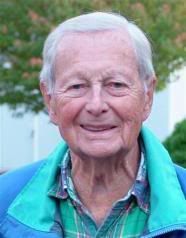
An October 31, 2005, handout photo provided by George A. Hatcher Jr. shows Edward G. Uhl, who helped invent the bazooka during World War II and later led the aerospace company Fairchild Industries Inc. Stepson George Hatcher said Thursday, May 13, 2010, that Uhl died Sunday, May 9, 2010, in Oxford, Md., of complications from a stroke he suffered three years earlier. He was 92. (AP Photo/via George A. Hatcher Jr) Full size
Related Associated Press news:
Bazooka co-inventor, aviation exec Edward Uhl dies
(AP) – 1 day ago
OXFORD, Md. — Edward Uhl, who helped invent the bazooka during World War II and later led the aerospace company Fairchild Industries Inc., has died. He was 92.
Stepson George Hatcher said Thursday that Uhl died Sunday in Oxford of complications from a stroke he suffered three years earlier.
In 1942, as an Army first lieutenant with an engineering degree, Uhl helped develop a shoulder-fired rocket launcher nicknamed the bazooka because it resembled a tube-shaped musical instrument.
Uhl joined Fairchild as president in 1961. He oversaw its transformation from a military aircraft manufacturer to an aerospace giant before retiring as chairman in 1985.
Fairchild's products included the A-10 Thunderbolt II, an airplane nicknamed the warthog that was used against Iraqi tanks in the first Gulf War.
Source
Other related news articles:
Former Fairchild chief was 'always pushing the technology forward'
By Don Aines
The Herald-Mail
May 12, 2010
OXFORD, MD. — From the early 1960s into the 1980s, Edward G. Uhl was well-known locally as president and later chairman of the board of Fairchild Industries in Hagerstown, but he also was co-inventor of one of the most recognizable pieces of military hardware ever carried into battle by American GIs — the bazooka.
Uhl, who helped revitalize Fairchild and make it a Fortune 500 company by the time of his retirement, died Sunday in Oxford, Md. He was 92.
"He was one of the ones always pushing the technology forward," taking projects off the drawing board and turning them into reality, said his stepson, George Hatcher of Easton, Md.
After Uhl graduated from Lehigh University in 1940 with a degree in engineering physics, Uhl's career began with the development of the relatively simple bazooka, a shoulder-fired anti-tank weapon, and ended near the time when Fairchild was producing the last of its tank-busting A-10 Thunderbolt II ground-attack aircraft. The A-10 became known by its unofficial nickname, "Warthog," during the first Persian Gulf War.
Uhl came to Hagerstown in 1961 when he was named president of Fairchild. He became chairman of the aerospace company in 1976, according to his obituary. Hatcher said Uhl retired in 1985.
When he resigned his military commission at the end of World War II, Uhl was employed by the Glenn L. Martin Co. for several years before becoming vice president of Technical Administration for Ryan Aeronautical Co.
Hatcher said his stepfather did not talk much about the new technologies he helped to develop, but did occasionally bring up the subject of the bazooka.
"When that was invented, the major problem for the U.S. was it hadn't kept its army and military up to snuff," Hatcher said. The U.S. Army lacked anti-tank weapons capable of defeating the heavily armed and armored Panzers of the Wehrmacht.
In 1942, Uhl began working with Lt. Col. Leslie A. Skinner to develop a weapon to deliver a rocket-propelled, shaped charge that was capable of penetrating armor, according to "A History of Innovation: U.S. Army Adaptation in War and Peace," by Jon T. Hoffman. Hatcher confirmed the story from the book that said Uhl fashioned the launcher for the rocket from a length of pipe found in a pile of scrap at a workshop.
"That's the answer! Put the tube on a soldier's shoulder with the rocket inside and away it goes," Uhl was quoted as saying in a 2007 article in the Maryland Cracker Barrel.
"I think they flipped a coin to see who got to fire it the first time" and Uhl won the toss, Hatcher said.
The weapon was demonstrated for Army brass, including Brig. Gen. Gladeon M. Barnes, head of the Ordnance Department's Research and Development Section, according to "A History of Innovation." The test was a success, and Barnes dubbed the weapon the bazooka for its resemblance to a fanciful musical instrument used by radio comedian Bob Burns, according to the book.
During Uhl's career with Fairchild, the company competed successfully for more government contracts, acquired ailing Republic Aviation in 1965 and branched out into space technology, according to the Cracker Barrel article.
The Pegasus and ATS-6 communications satellite programs were developed by Fairchild, Hatcher said. During those years, Uhl worked closely with Werner Von Braun, one of the pioneers of rocket technology, Hatcher said.
Hatcher said his stepfather was as proud of his family as anything he accomplished in the worlds of science and business, but he was a man whose work pushed new technologies forward.
"Everything he did was on the cutting edge of what was going on," Hatcher said.
While Fairchild grew and diversified under Uhl's management, he was chairman when the company received what was, at the time, the highest fine ever imposed in a Maryland pollution case. According to published reports, Fairchild was fined $100,000 in April 1983 after being convicted in a Washington County Circuit Court bench trial of five criminal counts relating to the illegal dumping in 1981 of wastewater containing toxic amounts of chemicals, including hexavalent chromium.
Source
Please note: More related news articles will be posted soon.
Thursday, May 13, 2010
Arkansas Hawgs reflect on deployment
by Senior Airman Nancy Hooks
451st Air Expeditionary Wing Public Affairs
5/13/2010 - Kandahar Airfield, Afghanistan -- When members of the 175th Fighter Wing, Baltimore, Md., and the 188th Fighter Wing, Fort Smith, Ark., Air National Guard units brought the A-10 Thunderbolt II to Kandahar Airfield, Afghanistan, January 13, 2010, they brought top quality, professional close-air support for ground troops. They used their presence and firepower to bring down the enemy, when needed. These guard units are comprised of support personnel, maintainers, aircrew flight equipment personnel, intelligence personnel, and medical personnel.
Please note: Not all of the ten pictures associated to this photo essay are realy new. At first, let me post at least some of the latest shots (further uploads will be follow):

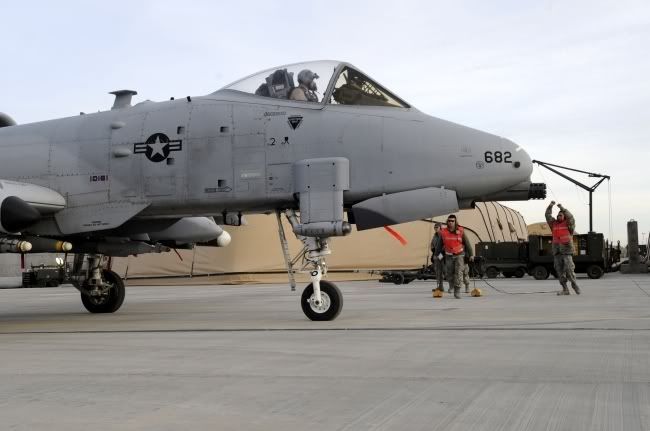
Members from the 451st Expeditionary Aircraft Maintenance Squadron prepare the A-10 Thunderbolt II for take-off Feb. 10. The A-10 has superior maneuverability at low speeds and altitude, due to large wing area, high wing aspect ratio, and large ailerons. (U.S. Air Force photo by Senior Airman Nancy Hooks) Hi-res
Note: The aircraft is A-10C 78-0682 from the 104th Fighter Squadron. Visible combat loadout: SUU-25 Flare Dispenser on station 2, LAU-131 Rocket Pod on station 3, GBU-12 on station 4, Mk 82 on station 7, GBU-38 JDAM on station 8.

Members from the 451st Expeditionary Aircraft Maintenance Squadron reload the A-10 Thunderbolt II 30mm GAU-8/A Avenger Gatling gun here Feb. 11, 2010. This is the A-10s primary built-in weapon which can hold up to 1,350 rounds of 30 mm ammunition. (U.S. Air Force photo by Senior Airman Nancy Hooks) Hi-res
Note: The aircraft is A-10C 79-0082 from the 104th Fighter Squadron

An Air Force A-10 Thunderbolt II pilot prepares to take-off on the active runway here March 22. The A-10 is more commonly known by its nickname "Warthog" or simply "Hog". The A-10 was designed for close air support (CAS) for ground forces by attacking tanks, armored vehicles, and other ground targets with a limited air interdiction capability. (U.S. Air Force photo by Senior Airman Nancy Hooks) Hi-res
Note: The aircraft is 80-0166 from the 184th Fighter Squadron.
Source
By first viewing all of these shots, I thought the following picture was already involved. But in fact, this shot (extracted from PDF) is unique:
Source

An A-10C Thunderbolt II "Warthog" prepares to take off at Kandahar Airfield, Afghanistan, March 22, 2010. The 188th Fighter Wing, based in Fort Smith, Arkansas, deployed more than 250 Airmen to Kandahar to share a four-month Aerospace Expeditionary rotation with the 175th Fighter Wing, an A-10 Air National Guard
unit based in Baltimore, Maryland. Approximately 50 members of the 188th deployed to Kandahar January 4, 2010. More than 200 Airmen from the 188th departed Fort Smith March 8, 2010, to join unit members already in Kandahar. The 188th is slated to return home from its AEF rotation in May 2010. (U.S. Air Force photo by Senior Airman
Nancy Hooks / 451st Expeditionary Wing Public Affairs) Full size
Source
Note: The aircraft is A-10C 80-0166 from the 184th Fighter Squadron, 188th Fighter Wing (Arkansas Air National Guard), Fort Smith Regional Airport. Visible combat loadout: SUU-25 flare dispenser on station 2, LAU-131 rocket pod on station 3, GBU-12 Paveway II on station 5.
I extracted the following stand-allone picture from "The Flying Razorback" (official 188th Fighter Wing newspaper), May 2010 public online PDF issue, just found by trying Google yesterday:
An A-10C Thunderbolt II "Warthog" prepares to take off at Kandahar Airfield, Afghanistan, March 22, 2010. The 188th Fighter Wing, based in Fort Smith, Arkansas, deployed more than 250 Airmen to Kandahar to share a four-month Aerospace Expeditionary rotation with the 175th Fighter Wing, an A-10 Air National Guard
unit based in Baltimore, Maryland. Approximately 50 members of the 188th deployed to Kandahar January 4, 2010. More than 200 Airmen from the 188th departed Fort Smith March 8, 2010, to join unit members already in Kandahar. The 188th is slated to return home from its AEF rotation in May 2010. (U.S. Air Force photo by Senior Airman
Nancy Hooks / 451st Expeditionary Wing Public Affairs) Full size
Source
Note: The aircraft is A-10C 80-0166 from the 184th Fighter Squadron, 188th Fighter Wing (Arkansas Air National Guard), Fort Smith Regional Airport. Visible combat loadout: SUU-25 flare dispenser on station 2, LAU-131 rocket pod on station 3, GBU-12 Paveway II on station 5.

Airmen from the 104th Expeditionary Fighter Squadron, Air National Guard, Baltimore, Md., and 188th Wing, Fort Smith, Ark., will work and maintain the A-10 Thunderbolt II for the next 120 days. (U.S. Air Force photo by Senior Airman Nancy Hooks) Hi-res

Tech. Sgt. Shawn Thorne and Tech. Sgt. Lew Smith, 451st Expeditionary Maintenance Squadron, onducts a phase inspection of an A-10 Thunderbolt II here February 24, 2010. (U.S. Air Force photo by Senior Airman Nancy Hooks) Hi-res
451st Air Expeditionary Wing Public Affairs
5/13/2010 - Kandahar Airfield, Afghanistan -- When members of the 175th Fighter Wing, Baltimore, Md., and the 188th Fighter Wing, Fort Smith, Ark., Air National Guard units brought the A-10 Thunderbolt II to Kandahar Airfield, Afghanistan, January 13, 2010, they brought top quality, professional close-air support for ground troops. They used their presence and firepower to bring down the enemy, when needed. These guard units are comprised of support personnel, maintainers, aircrew flight equipment personnel, intelligence personnel, and medical personnel.
Please note: Not all of the ten pictures associated to this photo essay are realy new. At first, let me post at least some of the latest shots (further uploads will be follow):
Members from the 451st Expeditionary Aircraft Maintenance Squadron prepare the A-10 Thunderbolt II for take-off Feb. 10. The A-10 has superior maneuverability at low speeds and altitude, due to large wing area, high wing aspect ratio, and large ailerons. (U.S. Air Force photo by Senior Airman Nancy Hooks) Hi-res
Note: The aircraft is A-10C 78-0682 from the 104th Fighter Squadron. Visible combat loadout: SUU-25 Flare Dispenser on station 2, LAU-131 Rocket Pod on station 3, GBU-12 on station 4, Mk 82 on station 7, GBU-38 JDAM on station 8.

Members from the 451st Expeditionary Aircraft Maintenance Squadron reload the A-10 Thunderbolt II 30mm GAU-8/A Avenger Gatling gun here Feb. 11, 2010. This is the A-10s primary built-in weapon which can hold up to 1,350 rounds of 30 mm ammunition. (U.S. Air Force photo by Senior Airman Nancy Hooks) Hi-res
Note: The aircraft is A-10C 79-0082 from the 104th Fighter Squadron
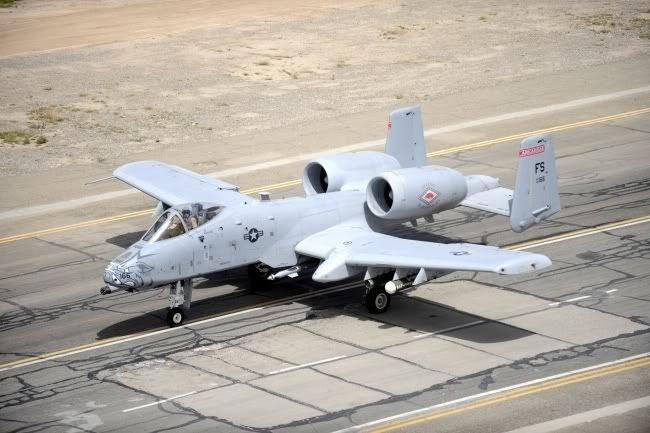
An Air Force A-10 Thunderbolt II pilot prepares to take-off on the active runway here March 22. The A-10 is more commonly known by its nickname "Warthog" or simply "Hog". The A-10 was designed for close air support (CAS) for ground forces by attacking tanks, armored vehicles, and other ground targets with a limited air interdiction capability. (U.S. Air Force photo by Senior Airman Nancy Hooks) Hi-res
Note: The aircraft is 80-0166 from the 184th Fighter Squadron.
Source
By first viewing all of these shots, I thought the following picture was already involved. But in fact, this shot (extracted from PDF) is unique:
Source
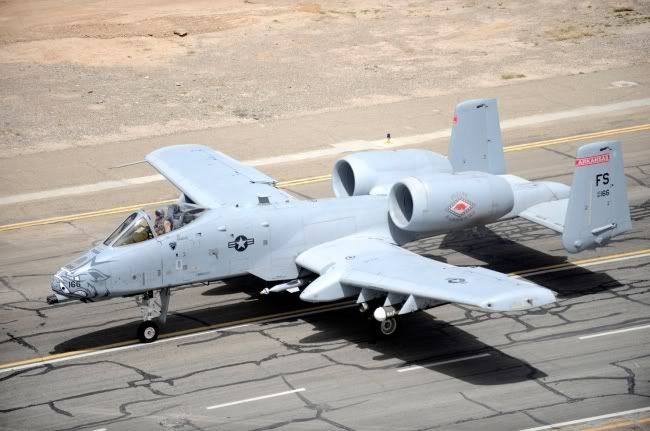
An A-10C Thunderbolt II "Warthog" prepares to take off at Kandahar Airfield, Afghanistan, March 22, 2010. The 188th Fighter Wing, based in Fort Smith, Arkansas, deployed more than 250 Airmen to Kandahar to share a four-month Aerospace Expeditionary rotation with the 175th Fighter Wing, an A-10 Air National Guard
unit based in Baltimore, Maryland. Approximately 50 members of the 188th deployed to Kandahar January 4, 2010. More than 200 Airmen from the 188th departed Fort Smith March 8, 2010, to join unit members already in Kandahar. The 188th is slated to return home from its AEF rotation in May 2010. (U.S. Air Force photo by Senior Airman
Nancy Hooks / 451st Expeditionary Wing Public Affairs) Full size
Source
Note: The aircraft is A-10C 80-0166 from the 184th Fighter Squadron, 188th Fighter Wing (Arkansas Air National Guard), Fort Smith Regional Airport. Visible combat loadout: SUU-25 flare dispenser on station 2, LAU-131 rocket pod on station 3, GBU-12 Paveway II on station 5.
I extracted the following stand-allone picture from "The Flying Razorback" (official 188th Fighter Wing newspaper), May 2010 public online PDF issue, just found by trying Google yesterday:
An A-10C Thunderbolt II "Warthog" prepares to take off at Kandahar Airfield, Afghanistan, March 22, 2010. The 188th Fighter Wing, based in Fort Smith, Arkansas, deployed more than 250 Airmen to Kandahar to share a four-month Aerospace Expeditionary rotation with the 175th Fighter Wing, an A-10 Air National Guard
unit based in Baltimore, Maryland. Approximately 50 members of the 188th deployed to Kandahar January 4, 2010. More than 200 Airmen from the 188th departed Fort Smith March 8, 2010, to join unit members already in Kandahar. The 188th is slated to return home from its AEF rotation in May 2010. (U.S. Air Force photo by Senior Airman
Nancy Hooks / 451st Expeditionary Wing Public Affairs) Full size
Source
Note: The aircraft is A-10C 80-0166 from the 184th Fighter Squadron, 188th Fighter Wing (Arkansas Air National Guard), Fort Smith Regional Airport. Visible combat loadout: SUU-25 flare dispenser on station 2, LAU-131 rocket pod on station 3, GBU-12 Paveway II on station 5.
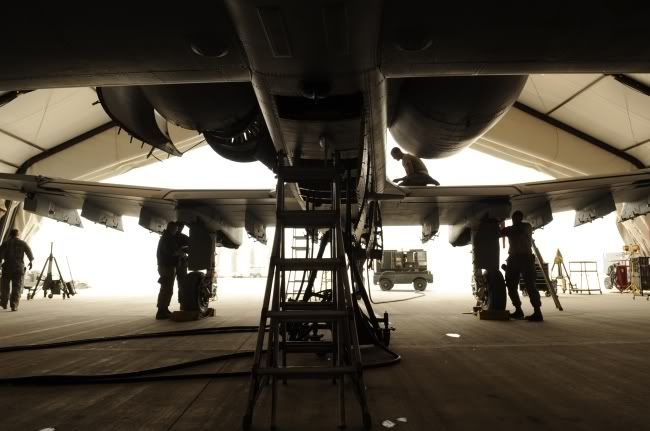
Airmen from the 104th Expeditionary Fighter Squadron, Air National Guard, Baltimore, Md., and 188th Wing, Fort Smith, Ark., will work and maintain the A-10 Thunderbolt II for the next 120 days. (U.S. Air Force photo by Senior Airman Nancy Hooks) Hi-res
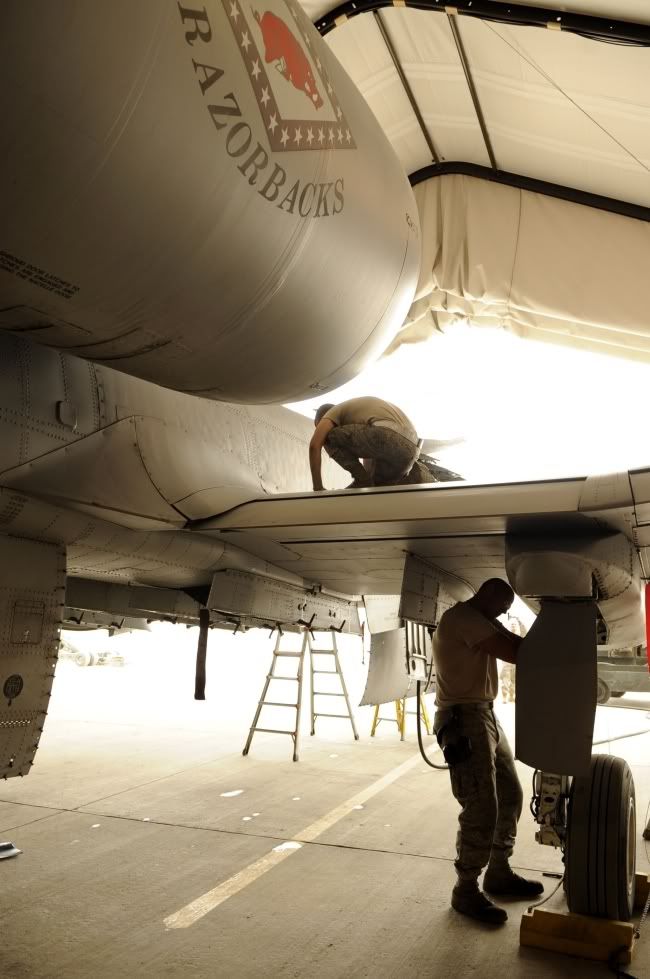
Tech. Sgt. Shawn Thorne and Tech. Sgt. Lew Smith, 451st Expeditionary Maintenance Squadron, onducts a phase inspection of an A-10 Thunderbolt II here February 24, 2010. (U.S. Air Force photo by Senior Airman Nancy Hooks) Hi-res
Behind the Scenes: The Making of an A-10C Pilot "First Refueling"
by Capt. Stacie N. Shafran
355th Fighter Wing Public Affairs
Posted 5/12/2010 Updated 5/13/2010
5/12/2010 - DAVIS-MONTHAN AIR FORCE BASE, Ariz. -- (Editor's note: Curious about what it takes to become an A-10 pilot? Follow along as this series showcases 1st Lt. Daniel Griffin's journey to becoming a fully qualified A-10C attack pilot.)
In the days leading up to his first airborne refueling mission, 1st Lt. Dan Griffin said he felt excited ... yet a little nervous.
A month after flying the A-10C for his first time, the lieutenant, a student in the 358th Fighter Squadron's A-10C Pilot Initial Qualification Course, was about to accomplish an aviation feat.
During the afternoon of April 27, at 18,000 feet above Southern Arizona's desert landscape, he needed to connect the topside of his A-10C's nose to a KC-135 via a boom and receptacle system and take on 2,000 pounds of gas in a matter of moments.
Sound like a challenge?
From talking more with Capt. Jason Bartels, 358th Fighter Squadron instructor pilot and Lieutenant Griffin's assigned IP, I learned just how intense this task can be.
He explained that refueling is equivalent to driving down the road, next to another car, with both windows rolled down. The person in the passing lane is staring at that (other) car without looking down the highway and maintaining his lane -- and then passing objects between the two cars while traveling down the road at 70 mph.
Refueling is essential to the A-10's wartime mission. It is a force enabler, which allows the "mighty Hog" to stay aloft in an over-watch position almost indefinitely, protecting U.S. and Coalition servicemembers.
Upon graduation, the pilots will be ready to support the wartime mission, which can require multiple refuelings over the course of an eight-hour mission.
Prior to this flight, Lieutenant Griffin practiced in a simulator, attended academic sessions, studied pictures showing what refueling should look like and learned all he could from the experienced pilots in his squadron.
He mentioned to me that he was most nervous about not being able to connect with the tanker and encountering trouble flying smoothly up to the connection point from the astern position.
Given what he was about to go do for the first time, I thought it seemed like a reasonable concern.
It also seemed like a great story to cover for this series. Curious to see how he'd perform and eager to learn more about the Air Force's refueling mission, Airman First Class Kristiana McDonough, a broadcaster, Airman Jerilyn Quintanilla, a photographer, and I flew aboard the KC-135 that day.
For several hours, we positioned ourselves in the rear of the tanker next to the boom operator, Staff Sgt. Ben Tressler, and peered outside the small window as students and instructor pilots flew up to the boom.
While approaching the boom, the students used visual references to position their aircraft and they also received guidance from both Sergeant Tressler and their instructor pilot via radio.
It certainly looked intimidating, but also thrilling at the same time.
When it was Lieutenant Griffin's turn, I put the headset on so I could listen to the whole process.
He checked in with Sergeant Tressler when he was 50 feet away from the boom and again when he was under the boom.
Up until this point, all of our interviews occurred in his squadron. For a brief moment, as I watched him, I felt like I had a better understanding and appreciation of his "office " and mission.
I've picked up enough about his body language to know when he's focused on something. I saw it April 16 as he prepared to take off for his first graded instrument check ride.
As I watched him fly, several feet away from me, his focus was evident. I could also hear it. His breaths were quick and heavy, so to speak, - a contrast to how relaxed the more seasoned pilots sounded on the radio.
Again, given what he was doing, who could blame him for being a little nervous?
Then, with sudden confidence, he connected to the boom, held on for two minutes, took on the fuel and repeated it once more.
I heard Sergeant Tressler comment, "Perfect." I was a bit awestruck -- and very proud.
Lieutenant Griffin told me that when he was under the boom it was really exciting and that, when he finally connected, it was easier than he thought it would be; once the boom connects, it kind of holds on to the A-10 a little bit.
At the end of the flight, I asked Sergeant Tressler if he could tell that he'd been refueling pilots who had never done this before. A bit surprised to learn this, he said they did well and that the opportunity to work with the new guys doesn't happen that often. He also said he could relate to how the pilots must have felt - he was scared the first time he refueled another aircraft.
From my perspective at least, all parties involved definitely demonstrated precision and skill that afternoon.
Next up for Lieutenant Griffin? In a few days, he'll fly north to the Barry M. Goldwater Range to fire the A-10's 30 mm Gatling gun for the first time.
Most of us will only see the jets fly overhead, taxi down the runway or take off. This series, through stories, photographs and videos, will go behind-the-scenes into Lieutenant Griffin's life as he becomes one of the Air Force's next A-10C pilots. The photos and video from this mission, along with the rest of the series, can be found on www.dm.af.mil.
Source
Note: Related pictures will be uploaded soon.
355th Fighter Wing Public Affairs
Posted 5/12/2010 Updated 5/13/2010
5/12/2010 - DAVIS-MONTHAN AIR FORCE BASE, Ariz. -- (Editor's note: Curious about what it takes to become an A-10 pilot? Follow along as this series showcases 1st Lt. Daniel Griffin's journey to becoming a fully qualified A-10C attack pilot.)
In the days leading up to his first airborne refueling mission, 1st Lt. Dan Griffin said he felt excited ... yet a little nervous.
A month after flying the A-10C for his first time, the lieutenant, a student in the 358th Fighter Squadron's A-10C Pilot Initial Qualification Course, was about to accomplish an aviation feat.
During the afternoon of April 27, at 18,000 feet above Southern Arizona's desert landscape, he needed to connect the topside of his A-10C's nose to a KC-135 via a boom and receptacle system and take on 2,000 pounds of gas in a matter of moments.
Sound like a challenge?
From talking more with Capt. Jason Bartels, 358th Fighter Squadron instructor pilot and Lieutenant Griffin's assigned IP, I learned just how intense this task can be.
He explained that refueling is equivalent to driving down the road, next to another car, with both windows rolled down. The person in the passing lane is staring at that (other) car without looking down the highway and maintaining his lane -- and then passing objects between the two cars while traveling down the road at 70 mph.
Refueling is essential to the A-10's wartime mission. It is a force enabler, which allows the "mighty Hog" to stay aloft in an over-watch position almost indefinitely, protecting U.S. and Coalition servicemembers.
Upon graduation, the pilots will be ready to support the wartime mission, which can require multiple refuelings over the course of an eight-hour mission.
Prior to this flight, Lieutenant Griffin practiced in a simulator, attended academic sessions, studied pictures showing what refueling should look like and learned all he could from the experienced pilots in his squadron.
He mentioned to me that he was most nervous about not being able to connect with the tanker and encountering trouble flying smoothly up to the connection point from the astern position.
Given what he was about to go do for the first time, I thought it seemed like a reasonable concern.
It also seemed like a great story to cover for this series. Curious to see how he'd perform and eager to learn more about the Air Force's refueling mission, Airman First Class Kristiana McDonough, a broadcaster, Airman Jerilyn Quintanilla, a photographer, and I flew aboard the KC-135 that day.
For several hours, we positioned ourselves in the rear of the tanker next to the boom operator, Staff Sgt. Ben Tressler, and peered outside the small window as students and instructor pilots flew up to the boom.
While approaching the boom, the students used visual references to position their aircraft and they also received guidance from both Sergeant Tressler and their instructor pilot via radio.
It certainly looked intimidating, but also thrilling at the same time.
When it was Lieutenant Griffin's turn, I put the headset on so I could listen to the whole process.
He checked in with Sergeant Tressler when he was 50 feet away from the boom and again when he was under the boom.
Up until this point, all of our interviews occurred in his squadron. For a brief moment, as I watched him, I felt like I had a better understanding and appreciation of his "office " and mission.
I've picked up enough about his body language to know when he's focused on something. I saw it April 16 as he prepared to take off for his first graded instrument check ride.
As I watched him fly, several feet away from me, his focus was evident. I could also hear it. His breaths were quick and heavy, so to speak, - a contrast to how relaxed the more seasoned pilots sounded on the radio.
Again, given what he was doing, who could blame him for being a little nervous?
Then, with sudden confidence, he connected to the boom, held on for two minutes, took on the fuel and repeated it once more.
I heard Sergeant Tressler comment, "Perfect." I was a bit awestruck -- and very proud.
Lieutenant Griffin told me that when he was under the boom it was really exciting and that, when he finally connected, it was easier than he thought it would be; once the boom connects, it kind of holds on to the A-10 a little bit.
At the end of the flight, I asked Sergeant Tressler if he could tell that he'd been refueling pilots who had never done this before. A bit surprised to learn this, he said they did well and that the opportunity to work with the new guys doesn't happen that often. He also said he could relate to how the pilots must have felt - he was scared the first time he refueled another aircraft.
From my perspective at least, all parties involved definitely demonstrated precision and skill that afternoon.
Next up for Lieutenant Griffin? In a few days, he'll fly north to the Barry M. Goldwater Range to fire the A-10's 30 mm Gatling gun for the first time.
Most of us will only see the jets fly overhead, taxi down the runway or take off. This series, through stories, photographs and videos, will go behind-the-scenes into Lieutenant Griffin's life as he becomes one of the Air Force's next A-10C pilots. The photos and video from this mission, along with the rest of the series, can be found on www.dm.af.mil.
Source
Note: Related pictures will be uploaded soon.
Subscribe to:
Posts (Atom)


 Posts
Posts