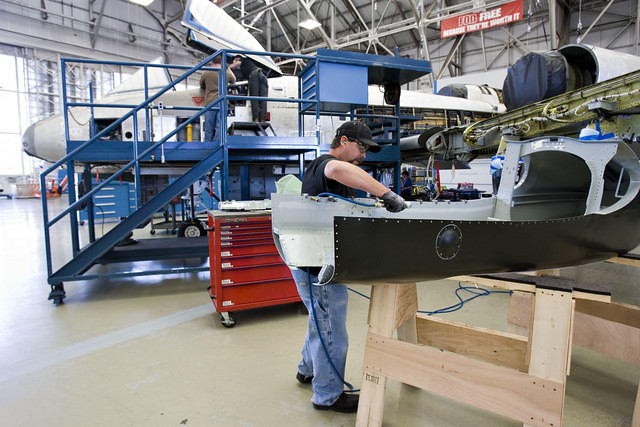
Civilian sheet metal mechanic Bronson Shaw works on parts for the Fairchild Republic A-10 Thunderbolt aircraft at Hill Air Force Base. (Photo by Mike Terry / Deseret News)
By ksl.com
June 16th, 2011 @ 9:49pm
HILL AIR FORCE BASE — Hill Field was barely a year old when the Army Air Corps began recruiting a civilian workforce for the first time early in 1941.
Soon, 92-year-old Utahn Ray Allred, who was tired of working seven days a week just to earn $60 a month at a dairy, responded to a newspaper ad at Hill. He walked out of his interview with the Army filled with hopes of weekends off, sick pay and enough money to buy that used Model T he had his eye on. On June 16, 1941, he became part of the first class of civilian mechanics training to work on airplanes at Hill's maintenance depot.
Ray Allred, 92, was among the first group of civilian workers to be employed at Hill Field. He started at age 20, six months before the attack on Pearl Harbor. (Mike Terry, Deseret News)
Thursday marks the 70th anniversary of that first group's entrance into mechanics learner class. When Allred entered class, there wasn't even a plane to work on yet, so he said the civilian workers used their sheet metal fabricating skills to make workbenches for Hangar 1 — the first aircraft hangar built on the new base. "There were only two hangars there when I started."
Allred, 92, is now both the first and one of the last. "I'm the only one left. The last one I know of died two years ago," he said of that first group of civilian workers, though KSL has learned of two others so far.
The activity level at Hill would change dramatically after the Japanese invasion of Pearl Harbor six months later. Hill added 5,000 civilians to that first group of 100 by the next July and hit an all-time peak of 15,780 civilians on base in May 1943, according to the base historian's office.
The mechanics worked on the B-17, B-24, B-26, P-40, P-47 and A-20. Allred's job was considered so important to the war effort that his induction into the military was deferred until 1944, when he spent a year in the Air Corps hoping to fly the planes he had worked on. But a surplus of air crews at the end of World War II the next year made it doubtful he could train as a pilot, so he went back to his job at the depot.
The Army and Air Force became separate branches of the military in 1947, and Hill Field became Hill Air Force Base in 1948. Allred and Hill's other mechanics dismantled World War II planes for storage, but soon started putting them back into service for the Korean conflict.
Hangar 1 still has a dominant presence on base.
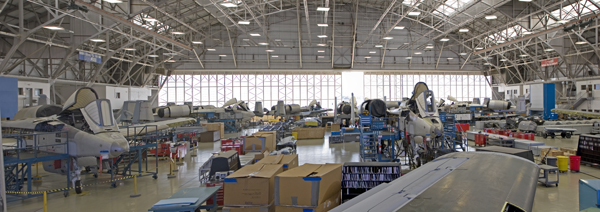
"We still do repairs and modify aircraft there," said Andy Flowers, Hill's director of personnel. Instead of tail-dragging planes with propellers and piston engines, the hangar sports six A-10 tank-killer jets, known affectionately as "Warthogs," that are undergoing extensive rehabilitation work. F-16s, C-130s and other military aircraft sit on the ramp outside the hangar, waiting for their turn for a makeover.
The base today boasts 12,000 civilian employees, not including bank, restaurant and other civilians working on the base, that boost the number of workers not in uniform to 23,000. In uniform, Air Force personnel add another 5,400. Military and civilian personnel are routinely coming and going from deployments to Iraq and Afghanistan.
Flowers said Hill has an $840 million annual civilian payroll with an economic impact in the state totaling $4 billion. Some 800 vanpools roll each day onto the base with more people working on base than for any other employer in the state. There are enough long-distance commuters around the state that Hill is the largest employer in Sanpete County.
Hill's size has repeatedly made it a high-profile target when Congress has conducted budget-cutting base closure and realignment hearings. On the other hand, the scope of Hill's operations, which include the expansive Utah Test and Training Range in Utah's west desert, has made it an operation the military considers hard to replace.
Expansion within the base's gates continues with construction advancing on the $1.4 billion Falcon Hill research park, which will move civilian defense contractors closer to their military counterparts on base.
Getting away from the southern end of a northbound milk cow may have been the prime motivation for Allred when he started at Hill, but he has long since considered his work to be an important, patriotic part of the nation's defense efforts.
"Getting a shot-up aircraft in crates and getting it back into service was always rewarding," he said. "And Hill was always just a really good place to work."
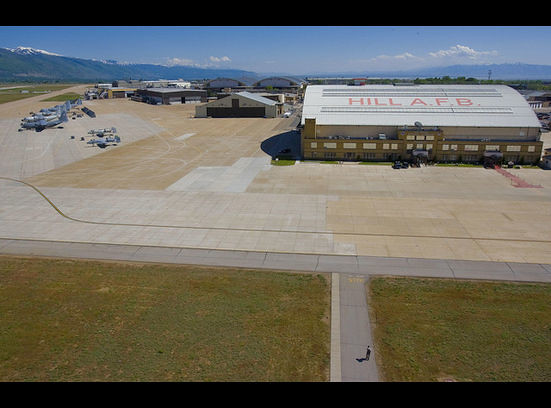
The historic Hangar 1 at Hill Air Force Base on June 14, 2011. Note the two A-10s outside the hangar.

Civilian employees work on A-10 aircraft maintenance at Hill Air Force Base on June 14, 2011.
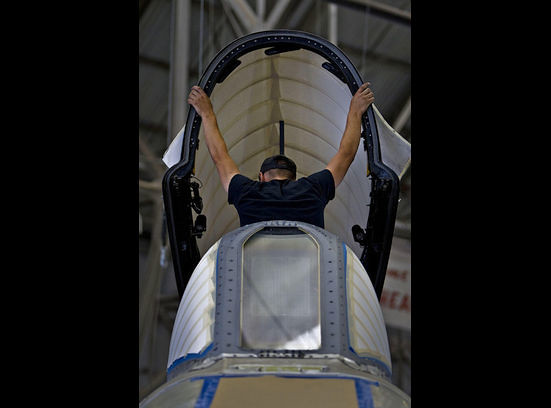
Civilian employees work on A-10 aircraft maintenance at Hill Air Force Base on June 14, 2011.
Source





 Posts
Posts


