Showing posts with label 74th Expeditionary Fighter Squadron. Show all posts

Friday, November 4, 2011

Very special A-10C close-up stopover shot taken at Lajes

By Joachim Jacob, Warthog News Editor

Let me present you this unique A-10C close-up stopover shot taken at Lajes Field, Azores, October 9, 2011, by Warthog News contributor João Toste from Portugal:


According to João, pictured in the foreground is A-10C 78-0600 from the 74th Fighter Squadron. Unfortunately, the "Hog" behind isn't identified by serial number. (Photo by João Toste) Full size

Please note: This shot should be a must have for any future A-10 history books!

Sunday, October 30, 2011

Last two returning 23rd Fighter Group A-10Cs caught at Lajes

By Joachim Jacob, Warthog News Editor

According to Warthog News contributor André Inacio from Portugal, the last two 23rd Fighter Group A-10Cs on their way back home from Afghanistan arrived at Lajes Field, Azores, for stopover on October 29, 2011. They touched down for stopover as Trend45 flight about 14:55pm (local time). The escorting tanker didn't land at Lajes and returned to Moron or another base. André had the opportunity to take the following pictures:


A-10C 81-0947 from the 74th Fighter Squadron. (Photo by André Inacio) Full size


A-10C 81-0990 from the 74th Fighter Squadron. (Photo by André Inacio) Full size

Friday, October 14, 2011

A-10 pilots return from deployment

Released by 23rd Wing Public Affairs


10/13/2011 - An A-10C Thunderbolt II operated by U.S. Air Force Lt. Col. James Clark, 74th Fighter Squadron commander, makes its way to a stopping point Oct. 11, 2011, at Moody Air Force Base, Ga. Clark flew the A-10 in support of U.S. and coalition ground forces during a six-month deployment at Kandahar Air Field, Afghanistan. (U.S. Air Force photo by Staff Sgt. Jamal D. Sutter) Hi-res

Note: Pictured is A-10C 78-0674, marked "74FS" as the 74th Fighter Squadron's boss bird.


10/13/2011 - U.S. Air Force Lt. Col. James Clark, 74th Fighter Squadron commander, parks his aircraft after redeployment Oct. 11, 2011, at Moody Air Force Base, Ga. Clark and the four other A-10 pilots were part of a six-month deployment to Kandahar Air Field, Afghanistan. (U.S. Air Force photo by Staff Sgt. Jamal D. Sutter) Hi-res

Note: OEF mission markings just below the windshield.


10/13/2011 - U.S. Air Force Maj. Craig Morash, 74th Fighter Squadron A-10 pilot, is greeted home by his daughter, Adeline, after returning from a deployment Oct. 11, 2011, at Moody Air Force Base, Ga. Morash was part of a six-month deployment to Kandahar Air Field, Afghanistan, where he supported Operation Enduring Freedom. (U.S. Air Force photo by Staff Sgt. Jamal D. Sutter) Hi-res

Note: OEF mission markings just below the windshield.


10/13/2011 - U.S. Air Force Maj. Craig Morash, 74th Fighter Squadron A-10 pilot, shares a kiss with his wife, Jennifer, after returning home from a deployment Oct. 11, 2011, at Moody Air Force Base, Ga. Morash was part of a six-month deployment to Kandahar Air Field, Afghanistan, where he supported Operation Enduring Freedom. (U.S. Air Force photo by Staff Sgt. Jamal D. Sutter) Hi-res


10/13/2011 - Family and friends of 74th Fighter Squadron Airmen greet A-10C Thunderbolt II pilots as they return from deployment Oct. 11, 2011, at Moody Air Force Base, Ga. The pilots flew the A-10s during a six-month deployment to Kandahar Air Field, Afghanistan, where they supported U.S. and coalition ground forces. (U.S. Air Force photo by Staff Sgt. Jamal D. Sutter) Hi-res


10/13/2011 - A double rainbow stretches over the Moody Air Force Base, Ga., flight line after five A-10C Thunderbolt II pilots from the 74th Fighter Squadron returned home from a deployment Oct. 11, 2011. The pilots supported Operation Enduring Freedom during a six-month deployment to Kandahar Air Field, Afghanistan. More than 300 maintenance Airmen returned home from the same deployment a week prior. (U.S. Air Force photo by Staff Sgt. Jamal D. Sutter) Hi-res

Source

Tuesday, October 11, 2011

23rd Fighter Group A-10Cs caught at Lajes on their way back home from Afghanistan (Part Three)

Later on Monday night, Warthog News contributor João Toste from Portugal e-mailed me the following two pictures, taken at Lajes Field, Azores:


This very impressive apron overview was taken on October 7, 2011. Pictured in the background are the five Moody A-10Cs which arrived at Lajes for stopover on Friday. From right: A-10C 80-0228, 74th Fighter Squadron; A-10C 80-0208, 75th Fighter Squadron; A-10C 79-0135, 74th Fighter Squadron; A-10C 78-0600, 74th Fighter Squadron; A-10C 79-0179, 74th Fighter Squadron. Visible in the foreground (also from right) are A-10C 79-0154, 47th Fighter Squadron, 917th Fighter Group (AFRC), Barksdale AFB; and A-10C 79-0109, 303rd Fighter Squadron, 442nd Fighter Wing (AFRC), Whiteman AFB. Both aircraft arrived at Lajes on Monday, September 26, 2011, with an A-10C package enroute Afghanistan, but these two are sill at Lajes. (Photo by João Toste) Full size


This shot was taken on October 9, 2011, during the departure of the 5 A-10Cs which arrived on October 7. Pictured in the foreground is A-10C 80-0208 from the 75th Fighter Squadron, followed by A-10C 79-0135 from 74th Fighter Squadron. (Photo by João Toste) Full size

See also:
23rd Fighter Group A-10Cs caught at Lajes on their way back home from Afghanistan (Part Two)
23rd Fighter Group A-10Cs caught at Lajes on their way back home from Afghanistan
Lajes stopover update: All A-10Cs identified by serial numbers now
Fresh deployed A-10Cs caught at Lajes

Monday, October 10, 2011

23rd Fighter Group A-10Cs caught at Lajes on their way back home from Afghanistan (Part Two)

Today, from Warthog News contributer André Inacio, Portugal, I got the following hot info:

The five A-10Cs of the returning 74th Expeditionary Fighter Squadron which arrived at Lajes Field, Azores, for stopover enroute Continental United States (CONUS) on Friday departed Sunday morning at 1012 (local time). On Sunday afternoon, about 1506 (local time), another flight of 5 A-10C arrived at Lajes as Trend31-35, supported by a KC-135 Stratotanker and a KC-10A Extender. Logged were:

A-10C 78-0674, 74th Fighter Squadron
A-10C 78-0688, 74th Fighter Squadron
A-10C 79-0172, 74th Fighter Squadron
A-10C 79-0138, 74th Fighter Squadron
A-10C 80-0144, 74th Fighter Squadron

KC-135 63-8004 (callsign Blue89)
KC-10A 87-0124 (callsign Blue98)

At Lajes Field, André had the opportunity to take the following shots:


A-10C 78-0674 from the 74th Fighter Squadron, marked 74FS as the squadron's boss bird. (Photo by André Inacio) Full size


A-10C 78-0688 from the 74th Fighter Squadron. (Photo by André Inacio) Full size


A-10C 79-0172 from the 74th Fighter Squadron. (Photo by André Inacio) Full size


A-10C 80-0144 from the 74th Fighter Squadron. (Photo by André Inacio) Full size


A-10C 79-0138 from the 74th Fighter Squadron. (Photo by André Inacio) Full size

See also:
23rd Fighter Group A-10Cs caught at Lajes on their way back home from Afghanistan

Sunday, October 9, 2011

23rd Fighter Group A-10Cs caught at Lajes on their way back home from Afghanistan

On Friday, five A-10Cs of the returning 74th Expeditionary Fighter Squadron arrived at Lajes Field, Azores, for stopover enroute Continental United States (CONUS). They touched down at 1557pm (local time) and were supported by a KC-10 Stratotanker:

A-10C 78-0600, 74th Fighter Squadron
A-10C 79-0135, 74th Fighter Squadron
A-10C 79-0179, 74th Fighter Squadron
A-10C 80-0208, 75th Fighter Squadron
A-10C 80-0228, 74th Fighter Squadron

Warthog News contributor André Inacio from Portugal had the opportunity to take the following arrival shots:


A-10C 80-0228 from the 74th Fighter Squadron. (Photo by André Inacio) Full size


A-10C 80-0208 from the 75th Fighter Squadron. (Photo by André Inacio) Full size


A-10C 79-0179 from the 74th Fighter Squadron. (Photo by André Inacio) Full size


A-10C 79-0135 from the 74th Fighter Squadron. (Photo by André Inacio) Full size


A-10C 78-0600 from the 74th Fighter Squadron. (Photo by André Inacio)

André, you did a great job to caught them!

Warthog News contributor João Toste from Portugal also had the opportunity to take pictures:

Full size


A-10C 78-0600 from the 74th Fighter Squadron. (Photo by João Toste)

Thursday, October 6, 2011

Moody Airmen return home

by Airman 1st Class Jarrod Grammel
23rd Wing Public Affairs

10/6/2011 - MOODY AIR FORCE BASE, Ga. -- Airmen stepped off a large airliner and onto the flightline at Moody as coworkers and base leadership welcomed them home from a six month deployment to Kandahar Airfield, Afghanistan.

The returning Airmen are from the 74th Fighter Squadron, 74th Aircraft Maintenance Unit, 23rd Component Maintenance Squadron, 23rd Equipment Maintenance Squadron and the 23rd Maintenance Operations Squadron who deployed in support of Operation Enduring Freedom.

"They fly, maintain, and build munitions for the A-10 Thunderbolt II aircraft," said Maj. Gregory Lowe, 23rd Aircraft Maintenance Squadron commander. "While deployed, the unit flew sorties supporting the United States and coalition ground forces."

After the returning Airmen got off the airliner, they boarded buses to be driven to a hanger where their family and friends anxiously awaited, keeping a close lookout for their loved ones.

"It was bittersweet to see him leave for this deployment," said Evelyn Jones, mother of Airman 1st Class Jason Jones. "It was his first deployment and we are so proud of him."

The Airmen attended one month of pre-deployment training then left for the six month deployment, and they still remember the feeling of leaving.

"We had never been to Kandahar Airfield, Afghanistan so there was some apprehension," said Senior Master Sgt. Marcus Ashby, 74th AMU A-10C Thunderbolt II productions superintendent. "We didn't know exactly what we were getting into."

While deployed, the units continued the mission and flew more A-10 sorties than ever before, said Ashby.

"It felt good being there and helping the greater good," said Airman Kenneth Barnes, 23rd EMS armament and weapon systems. "It was a harsh place and deployments are not fun. It seemed like we had to put up with a lot of stuff, but now that we are home, it was all worth it."

As the Airmen got off the busses they were greeted by a grateful crowd of friends and family members holding up "welcome home" signs and cheering them on.

"I'm so grateful that he is back home," said Jones. "A lot of things can happen over there. We are so proud and to see him wearing that uniform is wonderful."

For a nation at war, deployments are nothing new to Service members. As this group of Airmen return home to spend time with their family and friends another group of Airmen will be sent to continue the mission.


U.S. Air Force 1st Lt. Kevin Lukowiak, 74th Fighter Squadron, shakes hands with Col. Christopher Short, 23rd Wing vice commander, after returning home from deployment Oct. 6, 2011, at Moody Air Force Base, Ga. More than 300 Moody Airmen returned from a six-month deployment to Kandahar Air Field, Afghanistan, where they supported Operation Enduring Freedom. (U.S. Air Force photo by Staff Sgt. Jamal D. Sutter) Hi-res

Source


See also:

Moody troops return from Afghanistan
By Dave Miller
WALB-TV
Posted: Oct 06, 2011 3:19 PM
Updated: Oct 06, 2011 4:29 PM

Information from the USAF, Moody AFB

MOODY AIR FORCE BASE, Ga. - Over 200 members of the 23rd Maintenance Group and 23rd Fighter Group from Moody Air Force Base are returning home from a deployment to Kandahar Air Field, Afghanistan this week.

The Airmen maintained, equipped and flew the A-10C Thunderbolt II, providing the A-10's unparalleled air to ground capabilities in support of Soldiers, Sailors, Marines and Airmen in Afghanistan.

All their operations for the last six months were in support of Operation Enduring Freedom.

Moody is the home of the Air Force's legendary "Flying Tigers" and continues that tradition today with over 1300 Airmen deployed around the world supporting contingency operations.

Last year, 23rd Wing assets provided combat air support missions, as well as rescue, and medical evacuation support resulting in over 1,800 lives saved in Afghanistan.

Source

Monday, October 3, 2011

AFCENT command chief visits departing 74th EFS, AMU

By Senior Airman David Carbajal
451st Air Expeditionary Wing Public Affairs

9/28/2011 - KANDAHAR AIRFIELD, Afghanistan -- The Air Forces Central Command senior enlisted airman visited members of the 74th Expeditionary Fighter Squadron and Aircraft Maintenance Unit here Sept. 24 to applaud the unit for a successful deployment to Kandahar Airfield.

"On behalf of Lieutenant General (David) Goldfein and the thousands of service members on the ground, we thank you," said Command Chief Master Sgt. Richard Parsons, who previously oversaw the fighter squadron's operations as the command chief at the 23rd Wing at Moody Air Force Base, Ga. "I talk to 'ground guys' every day and they thank you for what you do."

The fighter squadron, deployed from Moody AFB, flew an area-of-responsibility record 16,000 hours supporting Operation Enduring Freedom during its tenure here. This feat would take the unit approximately three years to accumulate at home station, said Senior Master Sgt. Ken Francis, 74th Expeditionary Aircraft Maintenance Unit.

With only 18 A-10 Thunderbolt IIs, the fighter squadron aided "troops in contact" more than 500 times and flew more than 600 priority missions here. The unit dropped more than 220 joint direct attack munitions and fired more than 74,000 high explosive incendiary rounds during their 3,800 sorties.

"Those sorties have impact," said Parsons. "They allow ground forces the opportunity to return home safely."

On average, the fighter squadron has at least two A-10s flying to support operations throughout the country at any given moment.

The maintenance crews played a significant role in the fighter squadron supporting those troops on the ground, said Parsons.

"Over the last six months the AMU (Aircraft Maintenance Unit) and Maintenance Squadron teamed up to complete a record 35 phase inspection," said Francis. "The outstanding teamwork between the two squadron reduced aircraft downtime enabling the AMU to keep lethal iron in the air to support ground forces."

Parsons also attributes their expeditious maintenance time to what the unit members learned while stateside.

"They've been through inspections at home and used those skills to do great things out here," Parsons added. "I could not be prouder of these guys," said Parsons.

"It was great to see them and hear that even though the deployment was hard on the family, it was all worth it," the chief added.

Over the next several weeks, the fighter squadron and maintenance units will depart KAF and reintegrate with their families in Georgia.

The maintenance units have also enabled the fighter squadron to continue their success once they get home.

"The Airmen seem really excited to head home and they have a great base and community support system there to help them transition," the chief added.


Chief Master Sgt. Richard Parsons, AFCENT command chief, speaks to deployed Airmen at Kandahar Airfield, Afghanistan, Sept. 24, 2011. The Airmen are assigned to the 74th Expeditionary Aircraft Maintenance Squadron and the 74th Expeditionary Maintenance Squadron. (U.S. Air Force photo by Senior Airman Corey Hook)

Source

Sunday, October 2, 2011

CSAR executes high risk, dynamic ANA rescue

by Staff Sgt. John Wright
455th Air Expeditionary Wing Public Affairs

9/28/2011 - BAGRAM AIRFIELD, Afghanistan -- Rescuing injured coalition forces in Afghanistan is something the 83rd Expeditionary Rescue Squadron here is accustomed to doing, but flying over 12,000-foot mountains and refueling in air presented dynamic challenges during a mission Sept. 11, 2011.

Airmen from the 83 ERQS were pre-positioned at Forward Operating Base Ghazni to support casualty evacuation operations after an attack on coalition forces in the Wardak Province of Afghanistan, when a "REDCON" call came in that two wounded Afghan National Army personnel needed to be picked up. The location was high in the Kuh-e-Nilu Mountains. Due to the nature of the injuries and the time, distance and elevation factors, it was going to require some quick and efficient planning.

The 83 ERQS crews immediately made contact with a HC-130P/N aircraft out of Kandahar Airfield, Afghanistan, to establish an aerial refueling plan, while the pararescue Airmen and the flight engineer began stripping weight off the HH-60 Pave Hawks.

They took only the most basic rescue and medical equipment and decided to limit the number of Personnel on the aircraft.

Staff Sgt. Steven Prather, 83 ERQS flight engineer, was one of the Airmen responsible for figuring out the weight and balance plan for the "Pedros."

"Knowing we had to go that high, the big challenge was fuel load and fuel burn," the Moore, Okla., native said. "I had to run numbers to make sure we could get there. It wasn't a typical mission, but this is what we train for."

As the mission plan rapidly came together, the Pedros found out they were going to get substantial air support in the form of two A-10 Thunderbolt II aircraft and two Army AH-64 Apache helicopters. With heavy air support and an air refueling, Pedro 83 and Pedro 84 pushed out in less than 20 minutes.

The flight lead that day was Maj. Parkin Bryson, 83 ERQS HH-60 Pave Hawk pilot.

"The distance was so great that we had to refuel if we were going to make it," Bryson said. "Those guys made it happen. We could not have done this without them."

Bryson said aerial refueling in Afghanistan is not typical; it's a dicey affair requiring heightened concentration and skill.

"It's one of the more skill-intensive portions of what we do," the Durango, Colo., native said. "It's difficult because we were refueling at the upper edge of the refueling envelope. There is very little power. The HC-130 is basically at a stall margin, and we're going as fast as we can go. It was very sporty."

The tanker trails a hose and drogue refueling line behind and the helicopter pilot has to gently make contact with it using the pave hawk's refueling probe.

"These machines are designed for much lower altitudes," Bryson said. "It's difficult when you take them to the edge of the operational envelope. The controls become very loose."

The 83 ERQS pilots' training and dedication paid off as both helicopters successfully refueled were then able to fly over the mountain range.

Capt. Brian Carey, 83 ERQS combat rescue officer, was the pararescue team commander aboard Pedro 83. As the helicopters neared the pickup point, Carey and Tech. Sgt. Kristopher Burridge, 83 ERQS pararescue team leader, began finalizing their plans.

"We had been told it was a high-threat zone," Carey said. "It was a low-lying area in a bowl at 8,500 feet and a village all around it. There was heavy machine gun fire coming from the mountains to the east."

Bryson lead his helicopters on a couple of low passes over the area to determine the threat level as the PJs scanned their sectors.

"One of the things that's difficult about Afghanistan is that you never really know what the dynamic on the ground is," Bryson said. "When insurgents hear air power overhead, they will go to ground."

Burridge, who hails from Clearwater Beach, Fla., analyzed the situation.

"As we were coming in, I scanned the area for threats," he said. "I noticed the town was empty, which is a little unusual for that time of day; so, we had some concerns about that. My primary objective was making sure my team was safe."

Due to the overwhelming air support at their disposal, the Pedros decided to send their lead aircraft in (Pedro 83) as Pedro 84 provided security. However, landing that 8,500 feet required that Bryson perform a "roll-on landing" instead of a typical hover landing. A roll-on landing requires a pilot to skillfully land with forward momentum.

Carey and Burridge had eyes on the ANA patients as Bryson performed the landing.

"They were hunkered down on the northwest corner of a building since fire was coming from the east," Carey, a San Diego, Calif., native said. "They were packaged, ready to go and heading towards the aircraft."

Burridge and his commander were out of their tie-ins and off the aircraft in seconds as the helicopter rolled to a stop.

"Burridge and I stayed together until they came toward us," Carey said. "We then fanned out on both sides to provide security for them."

ANA personnel were carrying one patient on a litter and another piggyback style and quickly ran to the American forces waiting to airlift them to better medical care.

Burridge provided security as Carey helped load the patients into the pave hawk.

"We are moving as fast as we can to get off the ground," Carey said. "Let's land, get these guys and get out."

All told, they were on the ground less than three minutes.

"Once onboard, we started assessing and treating them," Burridge said. "We addressed the immediate life threats and from there started supportive care."

The 83 ERQS Airmen said seeing all the pieces of the mission come together was rewarding.

"We train for this type of mission a lot and to see it come together within a matter of a 10 to15 minutes and to go out and execute it was pretty awesome," Carey said. "We used assets from all over the theater. It couldn't have been more perfect."

Burridge echoed his team commander's words.

It's rewarding to be out there for there for the patients," Burridge said. "It's rewarding to train your guys and see them execute the mission. The more and more you do it and you see the faces of the people you pick up, it definitely brings it home that you are a big influence here. When I'm old and gray, I'll look back on these as some of the best days of my life."

Bryson said the mission emphasized something he see's quite often in Afghanistan.

"Lately, I've seen the Afghans really take an active part in the fighting," Bryson said. "Anything we can do to support them and take them back to the medical care they need ... it's a good thing for us to contribute to their cause."

Source

Please note: I decided to post this impressive news story on my blog because there were at least two "Hogs" mission-involved. They belonged to the 74th Expeditionary Fighter Squadron, 451st Air Expeditionary Wing, Kandahar Airfield, Afghanistan.

Monday, September 12, 2011

451st Air Expeditionary Wing added 16 new A-10C photos to their Facebook page

Released by 451st Air Expeditionary Wing Public Affairs


Capt. Richard Olson, 74th Expeditionary Fighter Squadron A-10 pilot, prepares to take flight at Kandahar Airfield, Afghanistan, Sept. 2, 2011. A-10s can go as fast as 420 miles per hour. (U.S. Air Force photo by Senior Airman Corey Hook)


Members of the 451st Expeditionary Maintenance Group perform a recovery on an A-10 Warthog at Kandahar Airfield, Afghanistan, Sept. 2, 2011. The 451st Expeditionary Maintenance Group consists of maintainers working in two expeditionary maintenance squadrons providing world-class flightline backshop, and munitions support for aircraft across eight different mission data series in the largest maintenance complex in the southwest area of responsibility.(U.S. Air Force photo by Senior Airman Corey Hook)


Members of the 451st Expeditionary Maintenance Group perform a recovery on an A-10 Warthog at Kandahar Airfield, Afghanistan, Sept. 2, 2011. The 451st Expeditionary Maintenance Group consists of maintainers working in two expeditionary maintenance squadrons providing world-class flightline backshop, and munitions support for aircraft across eight different mission data series in the largest maintenance complex in the southwest area of responsibility.(U.S. Air Force photo by Senior Airman Corey Hook)

Source

Please note: Most of these pictures are at least currently not available as hi-res versions on 451st AEW's public website. For some hi-res versions so far check: 451 AEW August Award winners

Saturday, September 10, 2011

451 AEW August Award winners

Released by 451st Air Expeditionary Wing Public Affairs


9/9/2011 - Compant Grade Officer of the Month – Capt. Richard Olson Currently with the 74th Expeditionary Fighter Squadron Home station - Moody AFB, GA Hometown - Cullman, AL How do you feel about receiving this honor? "Grateful to be recognized, however I'm just a small piece in the bigger puzzle. Many great people are doing a lot of hard work every day to make our mission here successful." Who helps you be the best you can be each day? "My wife and kids." What advice would you give to others to stay motivated and on task? "Do your best every day, striving to do better the next day. That is it. If everyone is giving their best, our mission will succeed and you will have no regrets about your time here."


9/9/2011 - NCO of the Month - Tech. Sgt. Christopher Ortega Currently with the 451st Expeditionary Maintenance Squadron How do you feel about receiving this honor? "I was truly surprised and very thankful for my supervision to feel that I was worthy of their recognition. I think there are so many people on this installation who are deserving of this award, and I'm just thankful that I was even mentioned alongside them." Who helps you be the best you can be each day? "I can speak volumes of the crew that I came here with and the leadership within my flight that has made all of this possible. Like most supervisors, I am at the mercy of the good graces of my guys, they're the real magic makers and deserve all the credit for bringing Kandahar Airfield the best Aircraft Fabrication support they possibly can. They never cease to amaze me on a daily basis." What advice would you give to others to stay motivated and on task? "I think it's important to be cognizant of what it is exactly we are here for and the job we have been asked to do. Everyone's purpose and responsibility here in the AOR far exceeds anything we can possibly imagine. There is a real mission here with real lives at stake and honestly with as many times as I've walked past the camp with flags at half mast, the little things that are bothering me that day, don't seem that important. It just puts things into perspective for me to just do my job the best I can and take care of my people the best way that I know how." In this photo: Tech. Sgt. Christopher Ortega, 451st Expeditionary Maintenance Squadron, works on a A-10 Warthog at Kandahar Airfield, Afghanistan, Aug. 26, 2011. Sergeant Ortega was named NCO in-charge of the month for the month of August. (U.S. Air Force photo by Senior Airman Corey Hook)

Monday, September 5, 2011

Wounded warriors visit 74th EFS, Thunderbolt II

by Senior Airman David Carbajal
451st Air Expeditionary Wing Public Affairs

9/5/2011 - KANDAHAR AIRFIELD, Afghanistan -- Approximately 15 wounded warriors visited the 74th Expeditionary Fighter Squadron here Aug. 29 to get a closer look at the attack aircraft that supports the ground troops throughout Afghanistan--the A-10 Thunderbolt II.

The wounded warriors are currently being treated at Kandahar's Role 3 for various injuries to include traumatic brain injury, shrapnel wounds and strained limbs.

"Positive attitude is an essential part of these Soldiers health and well-being," said Army Sgt. Maj. Ken Knowlton, Task Force Warhorse rear area operations center NCO in charge. "The opportunity to spend a little time interacting with the 'Warthog' pilots and seeing how they take the fight to the enemy rejuvenates that spirit."

Even though the A-10 is more than 30 years old, it is still respected by adversaries and friendly forces alike.

"It's quite simple: when they see it, they run," said Army Spc. Jeremy Kosman, who is deployed with the 14th Engineer Battalion, 22nd Engineer Clearing Company from Joint Base Lewis-McChord. Kosman is currently recovering from TBI and minor shrapnel wounds on his arm and leg but is expected to make a full recovery.

"Personally, it's my favorite plane," Kosman added. "These guys are fierce; when we're out there, they come in help us out."

Members of both services understand the value of the aircraft orientation.

"Knowing and understanding what we do helps give them piece of mind that we'll be there to support them when they're outside the wire," said Air Force Capt. Chris Palmer, 74 EFS pilot deployed from Moody Air Force Base Ga., and a Baltimore native. "And we get to put a face to their name, so it's mutually beneficial."

Pilots are tasked to fly four to eight hour sorties to provide close air support for task forces throughout the country. Prior to a combat sortie, most A-10s are armed with joint direct attack munitions and 30 mm high explosive incendiary rounds, which can be fired at up to 3,900 rounds per minute.

"The Air Force team gave an awesome tour, allowing us an opportunity to get up close and personal with one of my personal favorite aircraft," Army Spc. Daniel Baker, Charlie Company, 204th Brigade Support Battalion, 2nd Brigade Combat Team, 4th Infantry Division. "As a medic, it was great to see the wounded warriors I accompanied get excited. It lifted their spirits, even if for a few hours."

The fighter squadron will host another tour for the wounded warriors Sept. 12.

"It has been an eye-opening experience for me to work with these wounded warriors and I respect them so much more now," said Air Force Senior Airman Justin Peattie, Role 3 and the assisting coordinator for the tour. "I wanted to do this to give back to them."


KANDAHAR AIRFIELD, Afghanistan -- Air Force Capt. Chris Palmer, 74th Expeditionary Fighter Squadron pilot, shows a wounded warrior the 30 mm high explosive incendiary rounds during a tour of the A-10 Thunderbolt II Aug. 29, 2011. Approximately 15 wounded warriors visited the 74th EFS to get a closer look at the Wartog. (U.S. Air Force photo by Senior Airman David Carbajal) Hi-res

Source

Saturday, August 27, 2011

Maintenance teamwork keeps A-10s flying over Afghanistan


KANDAHAR AIRFIELD, Afghanistan -- Members of the 451st Expeditionary Maintenance Squadron perform the final steps of Phase 1 maintenance inspection on an A-10 Thunderbolt II here Aug. 25, 2011. During Phase 1, the maintainers remove most aircraft panels to visually inspect all major components to ensure they are working properly. (U.S. Air Force photo by Senior Airman David Carbajal) Hi-res

by Senior Airman David Carbajal
451st Air Expeditionary Wing Public Affairs

8/26/2011 - KANDAHAR AIRFIELD, Afghanistan -- If you cut something in half, usually it's not a good thing - like getting half a sandwich or half a paycheck. In this case, it's a demonstration of excellence.

With current mission requirements, members of the 451st Expeditionary Maintenance Squadron are tasked to perform phase maintenance inspections on the A-10 Thunderbolt IIs in half the time of stateside bases. In many cases, they surpass that goal and complete the inspections even faster.

During these maintenance inspections, commonly referred to as "Phase," the unit performs an inspection of all major components on the aircraft.

"We take nearly all the panels off the aircraft and inspect everything," said Staff Sgt. Richard Chase, 451st Expeditionary Maintenance Squadron inspection section journeyman.

Flying combat sorties comes at a steep price for the maintainers.

"As a general number, for every one flight hour, about six to 12 hours of maintenance must be done," said Staff Sgt. Brian Crofts, 451 EMXS quality assurance technician. "When we fly as much as we do here, a lot of maintenance has to be done to keep these A-10s in the air."

The maintenance team works around the clock with two 12-hour shifts, each day, seven days a week.

In a typical stateside location, Phase 1 maintenance is performed over a 10-day span, said Crofts, an Aiken, S.C., native. "Even though we're given five days to complete the same work, we'll have the aircraft out in three to four days."

To accomplish such a feat, the phase maintenance technicians don't work alone.

"We'll have maintainers from Fabrication, Fuels, Electrical and even the crew chiefs come out and help us," said Senior Master Sgt. Stephen Slaven, 451st Expeditionary Maintenance Squadron maintenance flight chief. "They form a very cohesive team," said Slaven, a Madison, Fla., native who is deployed from Ellsworth Air Force Base, S.D.

The unit that flies the Thunderbolts, the 74th Fighter Squadron, and several members of the 451 EMXS are deployed Moody Air Force Base, Ga. On average, the fighter squadron has at least two A-10s flying to support operations throughout the country at any given moment.

Every other Phase maintenance cycle or after 1,000 hours of flying time, the A-10s are treated to Phase 2 maintenance.

"The biggest difference between the two Phases is we go even more in depth in a Phase 2," said Chase, an Avondale, Ariz., native. In Phase 2, the maintenance personnel inspect the "white area," which is found inside the cockpit as well as the maintenance performed in Phase 1.

The timeframe for Phase 2 maintenance is also cut in half, allotting only six days for a typical 12-day task. The unit averages four to five days for Phase 2 maintenance.

Several steps must be accomplished before the aircraft can go back to the flightline.

"Before we re-attach the aircraft panels, we visually inspect everything again to ensure there is no FOD (foreign object debris), missing pieces or damaged components," said Crofts.

Even with the shrunken time requirements, the team still holds a 95 percent inspection passing average.

"I can't tell you how proud I am of my entire team ... the synergy that six flights created to get us to this point has been nothing short of amazing," said Capt. Jhames Illanez, 451 EMXS operations officer.

"In the end, it's all about doing the work that needs to be done to make sure these aircraft can support the warfighters in Afghanistan," said Slaven.

Source

Note: Pictured is A-10C 80-0272 from the 74th Fighter Squadron.

Tuesday, July 5, 2011

74th Expeditionary Fighter Squadron featured in Combat Aircraft Magazine, August 2011 issue

Updated July 6, 2011

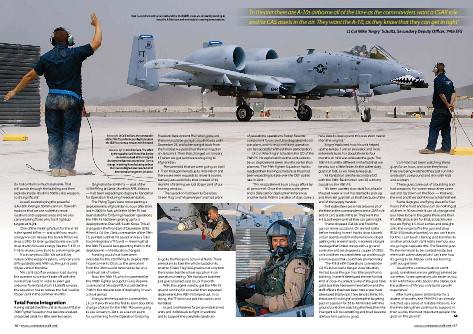
Today, from aviation photographer Neil Dunridge (United Kingdom) I got the following e-mail: Hi Joachim, In this month's Combat Aircraft magazine is an article on the 74th Fighter Squadron's deployment to Kandahar. I was there two days after the French Air Force Mirage 2000 crashed and includes details about the 74th FS response.


Related Magazine preview

FLYING TIGERS
When a French AF Mirage 2000D crashed in the Afghan desert in May, it was the A-10s of the 'Flying Tigers' that were among the first to respond. The squadron rolled into action in what rapidly developed from a close air support (CAS) mission to a combat search and rescue (CSAR) mission. Neil Dunridge visited the 74th Fighter Squadron on deployment for Operation 'Enduring Freedom'.


Update July 6, 2011:

Please enjoy this article preview, exclusively provided by Neil:


Comment from me: Neil, you did a great job again to document the modern "Hog" at war!

Please visit Neil's website

Friday, July 1, 2011

Flying Tigers snarl for 70 years


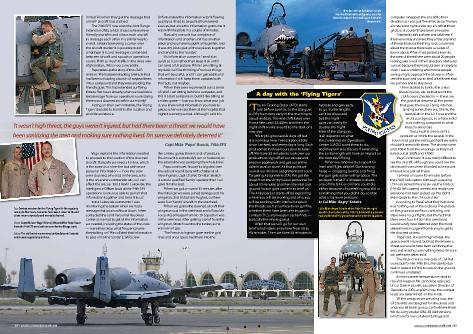
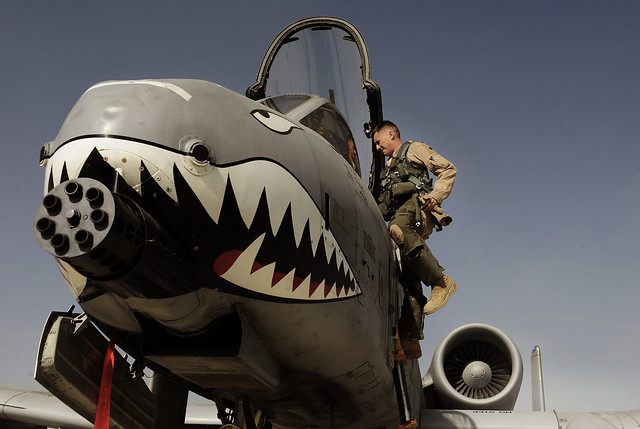
Maj. Loren Coulter exits an A-10C Thunderbolt II, Jan. 11, 2011, at Kandahar Airfield, Afghanistan.The tiger teeth painted on the aircraft is distinctive nose art only authorized to the Flying Tigers, a unit celebrating its 70th anniversary on July 4, 2011. (U.S. Air Force photo by Senior Airman Willard E. Grande II) Hi-res

by Tech Sgt. Emily F. Alley
451st AEW Public Affairs

7/1/2011 - KANDAHAR AIRFIELD, Afghanistan -- The 74th Expeditionary Fighter Squadron, which dates its history to a group of contracted prior-military pilots who flew against Japan in World War II, is scheduled to celebrate its 70th anniversary this July 4.

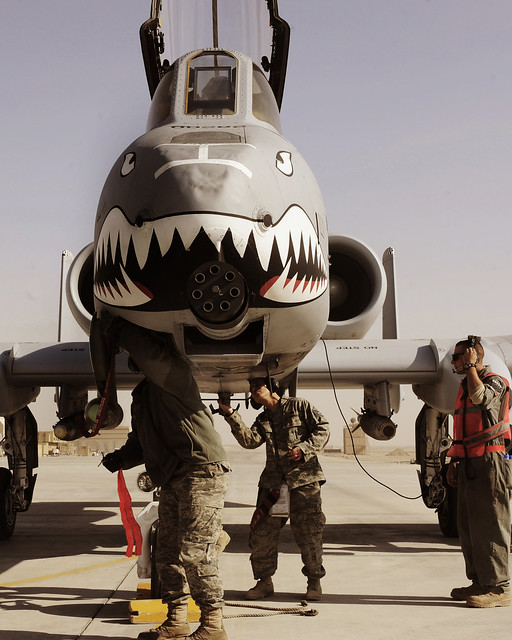
At Kandahar Airfield, current members reflected on how the work of previous crews helped to make the squadron innovative and iconic. It is the only group in the Air Force authorized to paint tiger shark teeth on the nose of each of its aircraft.

"You feel like you're walking into combat history," said Capt. Richard Olson, who has been a Flying Tiger pilot for about a year. "There are famous names, guys who shot down MiGs. This is their stuff, their history."

The hallway outside the offices of the 74th EFS at KAF is lined with photos and hand-written lists of crews and call signs. The squadron dates back to 1941, making it older than the Air Force itself. Even though the hallways of KAF only dates back to the few years the squadron has been flying out of Afghanistan, it's a historic list.

Olson was impressed to be working directly with Flying Tiger pilots such as 451 Air Expeditionary Wing commander Brig. Gen Paul T. Johnson, who was awarded the Air Force Cross for helping to save a crew of Airmen who had been shot down in 1991. Gen. Johnson also completed a landmark 3,000 flight hours during his final flight last month.

For many of the pilots, however, they remember the people they've worked with more than the missions.

"Most of them, their stories aren't about combat," said Olson, as he recalled a recent Flying Tiger reunion, which was attended by the few living members of the original World War II squadron.

They vividly retold the story of a donkey that wondered onto the runway and was almost hit by one of their aircraft, he said.

"It was a funny story about the guys, the people they worked with and they remembered it for 70 years," said Olson.

Those relationships, the camaraderie built between generations of pilots, fostered communication that allowed for innovation and helped make the A-10 an adaptable aircraft.

"They're big on passing lessons learned. They passed down everything they learned," said Maj. Craig Morash, a current Flying Tiger pilot. "We're trained and we spend time to understand the picture, the stress the people on the ground are under. Our mission is to get between the guy shooting and our guys on the ground."

Soldiers have visited 74 EFS meetings in the past to express their gratitude and tell stories of how the squadron helped them during attacks.

"The Army defaults every airplane to an A-10," said Staff Sgt. Angel Montes, a Joint Terminal Attack Controller who calls in air support for Soldiers, who have specifically requested the aircraft when they've needed air support.

The JTAC Airmen were impressed by the A-10s, who have an intuitive understanding how best to support ground patrols. They fly low, for example, and aptly select the weapon that fits each unique mission, said Airman 1st Class Justin Jackson, also a JTAC.

"It's over as soon as an A-10 shows up. Your day is made," said Montes. "They live up to their nose art. They're aggressive and they push to benefit the guys on the ground."


Crew chiefs install pins on an A-10C Thunderbolt II, Jan. 11, 2011, at Kandahar Airfield, Afghanistan. The tiger teeth painted on the aircraft is distinctive nose art only authorized to the Flying Tigers, a unit celebrating its 70th anniversary on July 4, 2011. (U.S. Air Force photo by Senior Airman Willard E. Grande II) Hi-res


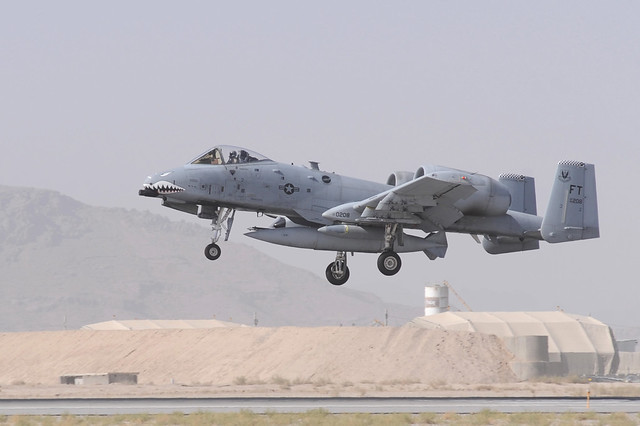
An A-10C Thunderbolt II pilot lands at Kandahar Airfield, Afghanistan Sept. 27, 2010. Throughout 2010, all the flying units under the 451st Air Expeditionary Wing collectively flew nearly 37,000 sorties, supporting more than 1,000 troops in contact on the ground, and saving close to 2,000 people on rescue missions in support of Operation Enduring Freedom. The 75th Expeditionary Fighter Squadron is deployed from Moody Air Force Base, Ga. (U.S. Air Force photo by Tech. Sgt. Chad Chisholm) Hi-res

Source

Tuesday, June 28, 2011

A-10C 81-0967 from the 74th Fighter Squadron caught at Al Udeid September 28, 2009

Yesterday, just before midnight, from photographer Keith Campbell (United Kingdom) I got the kind permission to post his following exclusive shots on my blog. Pictured is A-10C 81-0967 from the 74th Fighter Squadron during stop-over at Al Udeid AB, Qatar, on their way back home to CONUS after a 74th Expeditionary Fighter Squadron Operation Enduring Freedom combat deployment to Afghanistan. Special thanks to the photographer, because A-10 stop-over shots, taken at Al Udeid, are very rare.


A-10C 81-0967 (Photo by Keith Campbell) Full size


A-10C 81-0967 (Photo by Keith Campbell) Full size Note the absence of ladder door art and crew inscriptions.


A-10C 81-0967 (Photo by Keith Campbell) Full size

Please note: I've found Keith's shots by trying Google and Flickr. They were already posted on AirplanePictures, but with a water mark. And as Keith told me, 81-0967 was the one rebuilt after being hit by a missile over Kosovo.

For related Kosovo info please check:
http://www.thewarthogpen.com/fame_index.html
http://www.thewarthogpen.com/81_0967_files/81-0967.html (pictures)
http://www.irandefence.net/showthread.php?p=17190

Any other photographer around the world who likes to provide me some more A-10 Al Udeid stop-over shots?

Thursday, June 16, 2011

74th Expeditionary Fighter Squadron A-10Cs flying over Afghanistan

More air refueling shots, taken on May 8, 2011, and released by U.S. Air Force on Flickr:


An A-10 Thunderbolt II, assigned to the 74th Fighter Squadron, Moody Air Force Base, GA, returns to mission after receiving fuel from a KC-135 Stratotanker, 340th Expeditionary Air Refueling Squadron, over the skies of Afghanistan in support of Operation Enduring Freedom, May 8, 2011. (U.S. Air Force photo by Master Sgt. William Greer) Hi-res

Note: Pictured is A-10C 1990 from the 74th Fighter Squadron.


An A-10 Thunderbolt II, assigned to the 74th Fighter Squadron, Moody Air Force Base, GA, receives fuel from a KC-135 Stratotanker, 340th Expeditionary Air Refueling Squadron, over the skies of Afghanistan while supporting Operation Enduring Freedom, May 8, 2011. (U.S. Air Force photo by Master Sgt. William Greer) Hi-res


An A-10 Thunderbolt II, assigned to the 74th Fighter Squadron, Moody Air Force Base, GA, receives fuel from a KC-135 Stratotanker, 340th Expeditionary Air Refueling Squadron, over the skies of Afghanistan while supporting Operation Enduring Freedom, May 8, 2011. (U.S. Air Force photo by Master Sgt. William Greer) Hi-res


An A-10 Thunderbolt II, assigned to the 74th Fighter Squadron, Moody Air Force Base, GA, returns to mission after receiving fuel from a KC-135 Stratotanker, 340th Expeditionary Air Refueling Squadron, over the skies of Afghanistan in support of Operation Enduring Freedom, May 8, 2011. (U.S. Air Force photo by Master Sgt. William Greer) Hi-res

Note: Pictured is A-10C 0277 from the 74th Fighter Squadron.

Saturday, May 14, 2011

Safety office keeps maintainers cool

by Tech. Sgt. Emily F. Alley
451st Air Expeditionary Wing Public Affairs

5/14/2011 - KANDAHAR AIRFIELD, Afghanistan -- As it gets hotter in Afghanistan, it's more important to make sure people working outdoors are hydrated. The 451st AEW safety office handed out water to crew chiefs here May 13.

Since mid-March, the safety office has brought coolers to the flight line to make sure that maintainers are drinking water and keeping cool.

They try to make trips in the morning and after lunch, but also keep the coolers packed in case they are called out to investigate a mishap or bird strike, added Maj. Leo Nevell, flight safety chief.

Bringing water is a chance to get to know the aircraft maintainers and help them see the safety office cares about them and not just paperwork, said Master Sgt. Kelvin Samuel, weapons safety superintendent from the 451st AEW. When Airmen see the safety truck, they are glad to know the office is there to help.

"It brings people out, instead of hiding from us," said the major.

The flight line visit began at the A-10 Warthogs, which were further from tents and shade than other 451st AEW aircraft, Sergeant Samuel explained.

Crew chiefs, inspectors and other maintenance Airmen stood under the shade of the A-10s wings, the only shadowy area on the expanse of concrete. Samuel handed a cold water bottle, condensation beading over it, to an airman.

"There's no air conditioning," crew chief Airman 1st Class Matthew Bryant described his work area.
Hot water, sitting in the sun for an afternoon, isn't as refreshing, said Airman 1st Class Justin Painter, an A-10 inspector. He looks forward to seeing the safety truck, since he'll get cold water.

Samuel was inspired to suggest the program because he understands the maintainers' environment. He used to be a production supervisor for munitions maintenance.

After the program was suggested, Lt. Col. Richard Mills, 451st AEW chief of safety, found an ice machine. The members of the safety office said it is the only potable ice making machine on the airfield, as far as they know.

Each day, they prepare water bottles and pack them in ice to be ready to carry to the flight line because, for the rest of their deployment, the days will only get hotter.


Airman 1st Class Matthew Bryant drinks water from the 451st AEW safety office at Kandahar Airfield, Afghanistan on May 13. The flightline of the airfield has been getting hotter as summer progresses. Airman Bryant is a crew chief on the A-10 Warthog. (Photo by Senior Airman Willard Grande II) Hi-res

Source

Friday, May 13, 2011

Afghanistan-deployed 23rd Fighter Group A-10C now at SABCA Charleroi

Big surprise: On May 10, 2011, A-10C 79-0189 from the 23rd Fighter Group, 23rd Wing, Moody AFB, Georgia, arrived at the SABCA Charleroi plant, located right on the runway of Brussels South Charleroi Airport in Belgium. As mentioned on the well-recommended Dutch Scramble Messageboard, the aircraft landed at 13:45 local time and was comming from Naval Support Activity (NSA) Souda Bay, Crete.

First-known photo proofs were also posted on the Scramble Messageboard. And this evening, I got the photographer's kind permission to post both exclusive shots also on Warthog News:


A-10C 79-0189 landing at Charleroi. Note the brand-new 75th Fighter Squadron fin flash. (Photos by N.C.)

Please remember:

A-10C 79-0189 arrived at Lajes Field, Azores, for stopover on March 9, 2011, as part of the 74th Expeditionary Fighter Squadron, enroute to Kandahar Airfield, Afghanistan, in support of Operation Enduring Freedom. A nice arrival shot, already published exclusively on my blog, was taken by Warthog News contributor André Inácio from Portugal. See the following low-res version:


Sometime later, maybe on March 24, 2011, an official USAF photo of this aircraft (visible in the foreground at right) was taken at Kandahar's A-10C ramp and released on the 451st Air Expeditionary Wing's public website (U.S. Air Force photo by Senior Airman Willard E. Grande II). See the following low-res version:


Please note: In both pictures, A-10C 79-0189 wears the 74th Fighter Squadron's blue fin flash with the white lightning. But now, it is wearing the 75th Fighter Squadron's chequered fin flash... The reasons of this change and of the arrival at SABCA are both still unknown to me.

See also:
Charleroi/Brussels South - Gosselies - EBCI 10/05/2011

Important questions:
- What's the reason to ferry this aircraft from Afghanistan to the SABCA Charleroi plant?
- Why did the 74th Expeditionary Fighter Squadron at Kandahar Airfield this significant change of the aircraft's fin flashes (from 74th FS to 75th FS markings)?
- What's the cause of the black stain below on the right vertical stabilizer (visible on all of the pictures)?

I would be very grateful for any related insider info.

BTW: Employees of the SABCA Charleroi plant did a great job to upgrade 81st Fighter Squadron "Hogs" to the A-10C standard.

Please note: This post will be updated soon.