ACC Aerial Events Schedule (released by HQ ACC/A3TA, Aerial Events Branch), updated on 24th February, 2009:
March 14-15: Brownsville, TX; Air Show; A-10 East
March 21-22: Luke AFB, AZ; Open House; A-10 West
March 28: Riverside, CA; Air Show; A-10 West
March 28-29: MacDill AFB, FL; Open House; A-10 East
April 4-5: Tuscaloosa, AL; Air Show; A-10 East
April 11: Burnet, TX; Air Show; A-10 West
April 18-19: Beale AFB, CA; Open House; A-10 West
April 25-26: Vidalia, GA; A-10 East
May 2-3: Temple, TX; Air Show; A-10 West
May 9-10: Branson, MO; Air Show; A-10 East
May 15-17: Andrews AFB, MD; Joint Services Open House; A-10 East
May 16: Baltimore, MD; Preakness Horse; A-10 East
May 16-17: Chino, CA; Air Show; A-10 West
May 23-24: Columbia, MO; Air Show; A-10 West
May 23-24: Jones Beach, NY; Air Show; A-10 East
May 25: Columbia, MO; Parade; A-10 West
May 30-31: Rochester, NY; Air Show; A-10 East
May 30-31: Ellsworth AFB, SD; Open House; A-10 West
June 6: Whiteman AFB, MO; Open House; A-10 West
June 6-7: Indianapolis, IN; Air Show; A-10 East
June 13-14: Ocean City, MD; Air Show; A-10 East
June 20-21: Davenport, IA; Air Show; A-10 West
June 27-28: Baraboo, WI; Air Show; A-10 West
June 27-28: Fort Drum, NY; Air Show; A-10 East
Source
See also:
A-10 Thunderbolt II Demo Teams Schedule for 2009
To photographers:
Feel free to submit your private A-10 demo teams shots to the "Warthog News". I would be very grateful for any support.
Related links:
A-10 East Coast Demonstration Team
A-10 West Demonstration Team
Over the year, I will further update any related info, given either by Air Combat Command (ACC) or by Air Show Buzz
Tuesday, March 10, 2009


Moody welcomes home Tiger Sharks

Family, friends and loved ones await the arrival of members from the 75th Aircraft Maintenance Unit at Moody AFB, Georgia, on March 9th, 2009. Members from the 75th AMU have been deployed to Bagram AB, Afghanistan, for about six months in support of Operation Enduring Freedom. (U.S. Air Force photo by Airman Joshua Green) Hi-res

Col. Henry Santicola, 23rd Wing vice commander, shakes hands with deployed members from the 75th Aircraft Maintenance Squadron. (U.S. Air Force photo by Airman Joshua Green) Hi-res
Source
Moody celebrates the homecoming of 300
Posted: March 9, 2009 11:55 PM
Updated: March 10, 2009 12:47 AM
By Robin Jedlicka
WALB-TV
VALDOSTA, GA (WALB) - On Monday, Moody Air Force Base had one of its biggest homecomings in recent history.
After a long deployment, over three hundred airmen returned home to their families and friends. These airmen were from the 75th Fighter Squadron and the 75th Aircraft Maintenance Unit. They've spent the past six months at Bagram Air Base in Afghanistan.
Their mission was a first for Moody Air Force Base. New A-10 'C'-Model aircrafts were flown in combat zones. Their mission was extended by two months, making loved ones all the more eager to have them home.
Dana Breining's husband, Staff Sergeant Thomas Breining, was deployed when their son was only three months old. "It's been difficult," Dana said. "Family's far away, and we'll really appreciate having the extra hands. Plus, he's getting at that point where now where he's crawling and he's getting into things, and I don't want him to miss that. That's the fun time!"
The airmen were ecstatic at the success they achieved at Bagram. "We got a lot of great feedback from the guys on the ground who were our customers," said Lt. Col. Sam Milam, Commander of the 75th Fighter Squadron. "We flew a lot of sorties and we're glad to be back."
Their success brought a sense of pride to the entire 23rd Wing. Chief Paul Burgess said, "From the logistics people, from the support people, to the administrative people--all had to come together as a team to make this a successful combat deployment."
As happy as the airmen were to protect our nation's ground troops, there was no question that these courageous men and women were just as happy to be home.

Watch Video
Source
Monday, March 9, 2009
111th Fighter Wing supports JTAC training in Florida
By Joachim Jacob
The following first-hand info is extracted from the "Sandy Hog Gazette", 111th Fighter Wing newspaper, March 2009 public online PDF issue. At least on the moment, there are no related news articles and pictures on 111th FW's public website.

ON THE COVER: Staff Sgt. Joseph Galada III, 111th Aircraft Maintenance Squadron, conducts a pre-flight inspection on an A-10 Thunderbolt. (Photo by Master Sgt. Patrick Cashin)

Pictured in this photo essay is A-10C 81-0981 from the 103rd Fighter Squadron.
Source
The following first-hand info is extracted from the "Sandy Hog Gazette", 111th Fighter Wing newspaper, March 2009 public online PDF issue. At least on the moment, there are no related news articles and pictures on 111th FW's public website.
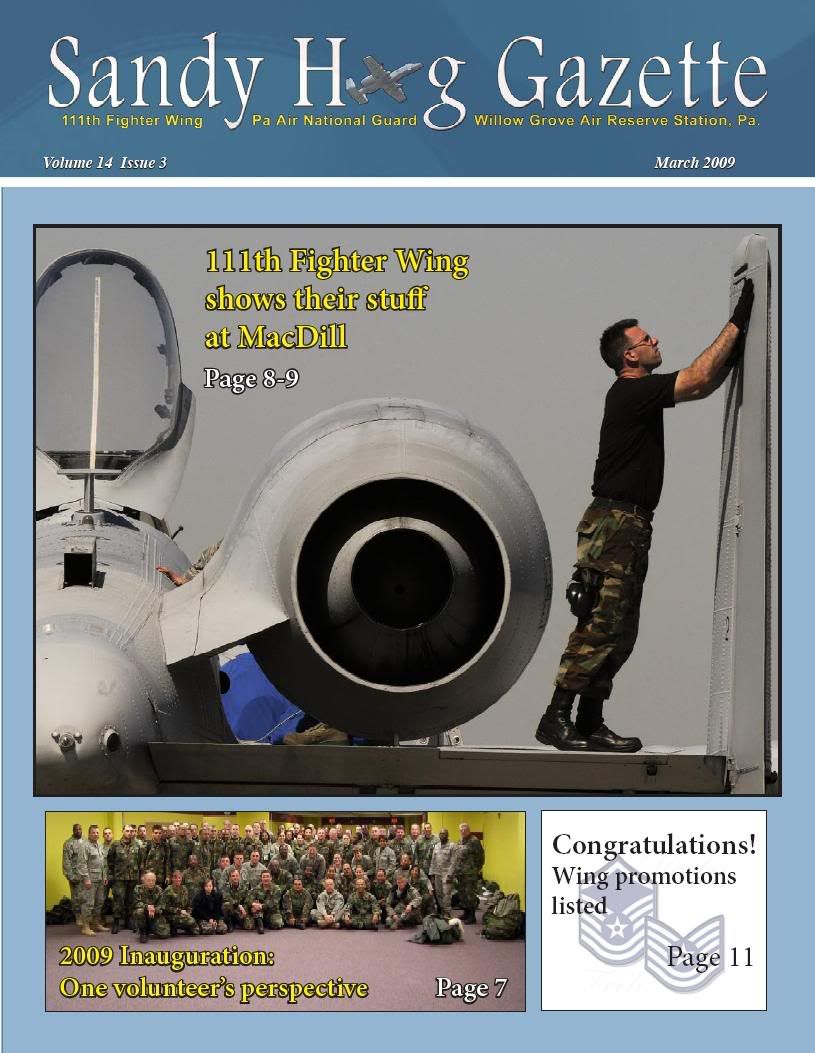
ON THE COVER: Staff Sgt. Joseph Galada III, 111th Aircraft Maintenance Squadron, conducts a pre-flight inspection on an A-10 Thunderbolt. (Photo by Master Sgt. Patrick Cashin)
Wing heads to Florida; kicks off training Pa. style
By Tech. Sgt. Jonathan E. White
111th Fighter Wing Public Affairs
MACDILL AIR FORCE BASE, Fla.— Approximately 160 guardsmen with the 111th Fighter Wing, Pa., Air National Guard, arrived here Feb. 17 to support the Joint Tactical-Air Controllers (JTACS) from Avon Park Air Force Range located in central Florida.
"The JTACs communicate, plan and facilitate the execution of close-air support for ground forces while working hand-andhand with the fighter aircraft in identifying ground targets," said Senior Master Sgt. John Felice, detachment noncommissioned officer in charge.
"This is the wing's third year in a row working with the JTACs here. The JTACs requested the wing's support in preparing other squadrons deploying to Afghanistan for this year's deployment," said Lt. Col. Timothy O' Toole, detachment project officer.
"All of the logistics basically started three months ago," said Colonel O' Toole.
"We are one of the most recently returned squadrons from Afghanistan. We had a very successful deployment."
The wing deployed to Afghanistan July 2008, and the JTACs requested the wing's assistance because of (the wing's) recent knowledge and experience gained in theater.
"The advantage we have is our massive experience. We are going to use our knowledge to train the JTACs," said Colonel O'Toole. Sharing knowledge through experience gained has been a common practice during this deployment.
Tech. Sgt. Michael Scully, 111th Maintenance Squadron electro-environmental technician, participated in last year's MacDill deployment.
"My supervisor, Master Sgt. Andy Jarosz, and I have been working since day one." said Sergeant Scully. "We've trained Koder and Jeffries and brought them up to spec from the C-130s to the A-10s.
It's very good having them, and they are definitely an asset to our shop."
In addition to training the JTACs, another goal was to bring people who normally do not get the opportunity to deploy on a regular basis, considering this could possibly be the unit’s last trip with the [news is not finished - J.J.]
Lt. Col. Ed Fink, a pilot from the 111th Fighter Wing, does a final pre-flight inspection before launching during A-10A Snowbird Support Exercise at MacDill AFB. (Photo By Tech. Sgt. Marie Harmon)

A-10s bomb, rattle ground at Avon Park bombing range
By Tech. Sgt. Elisabeth A. Matulewicz
111th Fighter Wing Public Affairs
A caravan of 111th FW personnel left the Tampa area on Feb. 23 headed for Avon Park Air Force Range, Fla. to experience an A-10 training mission. They drove interstate to local highway, past palm trees and cattle, covering over 100 miles.
Once they arrived, they scaled several metal staircases up to an observation tower. The A-10s roared in one by one dropping practice bombs called BDU-33s onto ground targets.
Several screaming passes later, the A-10s came in lower and fired their 30-mm GAU-8/A cannons. Each aircraft burst plumes of smoke before emitting a roar reminiscent of a loud zipper pull.
Sunny, blue skies set the backdrop for a perfect live firing for pilots and audience alike.
Watching the A-10s descend towards each target, take aim and rock the sky was breathtaking—especially for a brother-sister team with the 111th Maintenance Sq. munitions section.
"Seeing what we make being used here is interesting," said Senior Airman Aaron M. Thieroff.
On a typical day, Airman Thieroff and his team pack fuses and safe aiming devices into shells before loading them 40 to a trailer. The munitions are delivered to the armament section and loaded onto the aircraft. "I think it's awesome," Senior Airman Ashley B. Thieroff added.
For several first-timers (including myself), seeing the A-10s in action broke a few misconceptions. "I always wanted to see how they did it," said Tech. Sgt. Byron S. Lockett, 111th Logisitics Readiness Sq. "I thought they'd be over the target when they let the bombs go. But when they come in, they're several hundred yards away."
An added bonus was having Col. Paul W. Comtois, 111th FW Commander, there to talk us through what we saw. We were very lucky to have him explain everything from a pilot's point of view and educate everyone on the A-10.
The following pilots made up the 4-member team that flew that day: Lt. Col. Niclas Szoke, Lt. Col. Scott Hreso, Col. Jim Blaydon, and Lt. Col. Gary Beard.
Avon Park Air Force Range is located in Polk and Highland counties, Fla. and covers over 106,000 acres, of which 82,000 is open to the public for recreation.
Surprisingly, the range is home to a number of endangered species of birds and reptiles. According to Range Control Officer Chris Spears, Avon Park is the largest bombing range east of the Mississippi; Nellis's being the largest in the country.
A BDU-33 is dropped at a target from an A-10 from the 103rd Fighter Sqadron at Avon Park Air Force Range near Tampa, Florida, on February 23rd, 2009. Approximately 160 guardsmen from the 111th Fighter Wing trained at the Deployment Unit Complex (DUC) at Mac Dill AFB. (Photo by Master Sgt. Patrick Cashin)

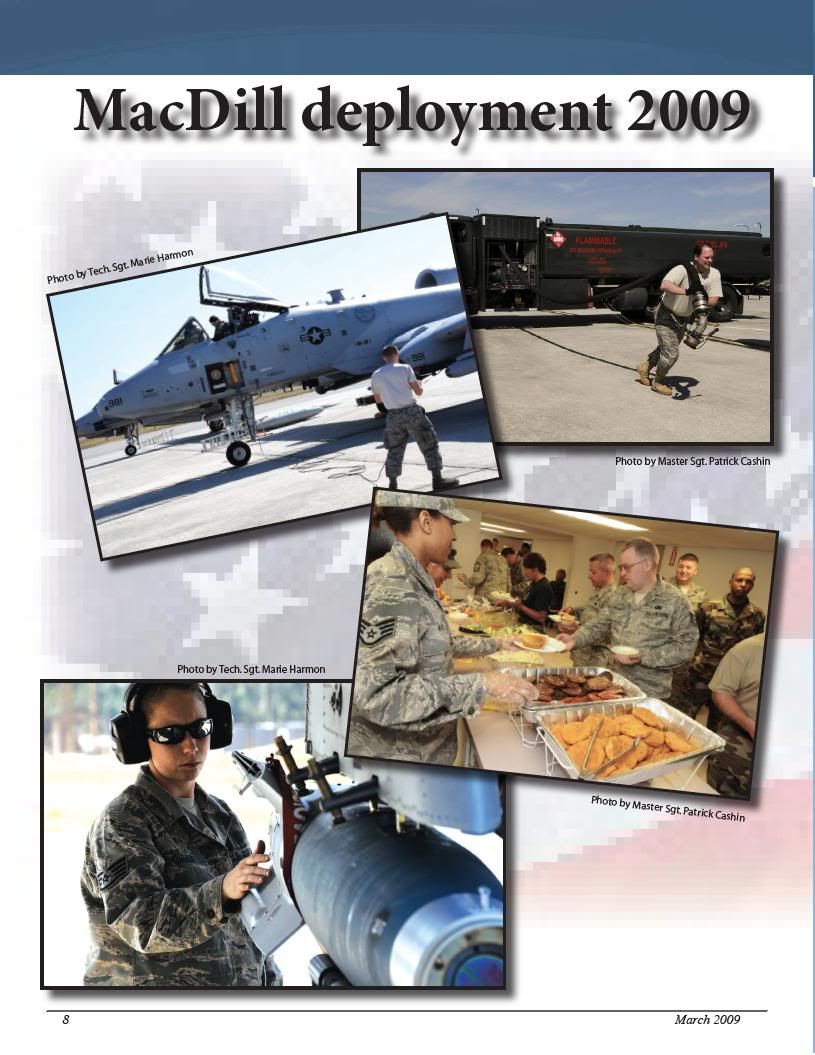
Pictured in this photo essay is A-10C 81-0981 from the 103rd Fighter Squadron.
Source
Saturday, March 7, 2009
Inspections of A-10 Thunderbolts continue
Air Force Times
By Bruce Rolfsen - Staff writer
Posted : Friday Mar 6, 2009 16:11:57 EST
The Air Force continues to inspect and repair the wings of A-10 Thunderbolts.
As of the end of February, 322 of the service’s 356 Warthogs had been inspected for wing cracks, according to the service. Of the checked jets, 214 returned to flying while 108 await or are undergoing repairs.
Another 34 jets had not been inspected but were allowed to continue flying because they were considered the least likely to have cracks.
“We remain on schedule to complete the fleet-wide inspections and initial repairs by June,” Lt. Col. Jim Marx, deputy commander of the 538th Aircraft Sustainment Group, Hill Air Force Base, Utah, told Air Force Times. Marx added that all A-10s deployed to Afghanistan have been repaired.
The groundings and inspections began Oct. 3 after inspections at Ogden Air Logistics Center, where A-10s go through depot-level repairs, uncovered unexpected cracks. The cracks were in wheel trunnions, sections not frequently checked. While A-10s were designed to last for 8,000 flying hours, many have passed the 10,000 hour mark.
Starting in late 2010, the Air Force hopes to replace the aging A-10 wings with new wings.
Source
Thursday, March 5, 2009
A-10 Pilot reaches 3,000 combat flight hours

Brig. Gen. Mike Holmes, 455th Air Expeditionary Wing commander congratulates Lt. Col. Sam "Spam" Milam, 75th Expeditionary Fighter Squadron commander, on February 28th, 2009, as he completed his 3,000 combat hours at Bagram AB, Afghanistan. This event occurred a week after the 75th EFS completed 10,000 combat flight hours. Colonel Milam is deployed from Moody AFB, Georgia. (U.S. Air Force photo by Senior Airman Erik Cardenas) Hi-res

Capt. Bob "Grim" Burdette, 75th EFS pilot, and Lt. Col. Sam "Spam" Milam, 75th EFS commander, complete a mission at Bagram AB, Afghanistan, on February 28th, 2009, that gave Colonel Milam more than 3,000 combat flight hours. "I am very happy, it was a lot of hard work and its a great thing. Many man hours go into each flight and its a great accomplishment." He also thanked the crew chiefs because without them, they would not be able to do their mission. Both pilots are deployed from Moody AFB, Georgia. (U.S. Air Force photo by Senior Airman Erik Cardenas) Hi-res
Source
Note: It should be 3,000 flight hours, not combat flight hours.
Related news:
A-10 unit reaches 10,000 hour milestone
Tuesday, March 3, 2009
74th EFS deploys to Bagram for Operation Enduring Freedom
by Joachim Jacob
Yesterday, on Moody's public website, a photo essay Moody Airmen deploy in support of Operation Enduring Freedom was released. This official USAF info confirms that the 75th Expeditionary Fighter Squadron will be eventual replaced by the 74th Expeditionary Fighter Squadron. And as anticipated, 23rd Wing and 23rd Fighter Group will only change personnel, but no aircraft.
The 75th EFS deployed as part of USAF's AEF 5/6 (Cycle 7) rotation (September - December 2008). The original aircraft package of probably 12 A-10Cs left Moody AFB, Georgia, on September 8th, 2008. After the A-10 groundings, at least four additional Moody A-10Cs were deployed to Bagram AB as replacements.
See: During the Phase I portion we deployed over 300 personnel, 300+ tons of cargo, four real-world A-10C Thunderbolt II aircrafts for Operation Enduring Freedom, and one real-world HH-60G Pave Hawk helicopter to support the Space Shuttle launch.
The 74th EFS should be deployed for the rest of USAF's ongoing AEF 7/8 (Cycle 7) rotation (January - April 2009).
Source

Members of the 23rd Aircraft Maintenance Squadron prepare to process through the mobility line at Moody AFB, Georgia, on February 26th, 2009. The 23rd AMXS is deploying to assist and support the 74th Fighter Squadron. (U.S. Air Force photo by Senior Airman Gina Chiaverotti)

Airmen from the 74th Aircraft Maintenance Unit board a McDonnell Douglas MD-11 for their departure to Bagram Air Base, Afghanistan, at Moody AFB, Georgia, on February 26th, 2009. About 300 Airmen from the 74th AMU deployed. (U.S. Air Force photo by Airman Joshua Green)

Staff Sgt. Joe Stanchak, 23rd Logistics Readiness Squadron, air transportation instructor, supervises augmentees as they load mobility bags onto a New Generation Small Loader before they are uploaded to a McDonnell Douglas MD-11 aircraft in support of a deployment at Moody AFB on February 26th, 2009. Members from the 23rd LRS provide crucial support during deployments and redeployments at Moody. (U.S. Air Force photo by Senior Airman Gina Chiaverotti)

MOODY AIR FORCE BASE, Ga. -- Staff Sgt. Ryan O'Neil, 23rd Aircraft Maintenance Squadron, weapons loader crew team chief, is interviewed by Matt Flumerfelt, a writer with the Valdosta Daily Times, before his deployment Feb. 26 here. Sergeant O'Neil has been a weapons loader primarily for the A-10 weapons system for nine years and this will be his first deployment from Moody. (U.S. Air Force photo by Senior Airman Javier Cruz Jr.)

MOODY AIR FORCE BASE, Ga. -- 1st Lt. Charles Merrell, 74th Aircraft Maintenance Unit, assistant officer in charge, speaks with a local news anchor about his thoughts on his upcoming deployment here Feb. 26. Lieutenant Merrell is one of approximately 300 Moody Airmen who is scheduled to Bagram Air Base, Afghanistan. (U.S. Air Force photo by Senior Airman Javier Cruz Jr.
See also:
A-10 unit reaches 10,000 hour milestone
Related U.S. news media coverage:
The Valdosta Daily Times
Published February 26, 2009 11:37 pm -
300 from Moody deployed
By Matt Flumerfelt
MOODY AIR FORCE BASE — Three hundred men and women from Moody Air Force Base deployed to Bagram Air Base in Afghanistan Thursday.
Most of those deploying are from the 23rd Maintenance Group, although airmen from the 23rd Fighter Group and 23rd Mission Support Group deployed also, said Lt. Chelsey Garrison, public information officer for Moody.
Airmen began processing around 11 a.m. Thursday. After a predeployment screening, they went through the Mobility Bank for last-minute equipment checks and to get their field kits, Garrison said. From the Mobility Bank, they went to the Deployment Center, where they were checked by medical, financial, and other services to ensure all their vaccinations, finances, and other arrangements were in order.
Garrison said 74th Fighter Squadron personnel will be providing air-to-ground support for troops. The Maintenance Group will be maintaining aircraft and loading ammunition, and the Mission Support Group will be doing logistics, which includes everything from loading planes and administrative functions to packing palettes and performing other support activities that enable missions to be carried out.
Once the airmen go through processing, Garrison said they are briefed on things like where they are going, what the conditions are there, what to expect, and perhaps given a pep talk by one of their commanding officers. From there, the airmen went to the base theater to await departure. Their plane was scheduled to complete loading around 7:10 p.m. with departure set for around 8 p.m.
This is the fourth deployment for Ryan Oneill, a weapons load crew team chief who said, "I feel good. I actually like deploying. Being a weapons loader, it's the only time I get to load live bombs. It's a little bit of job satisfaction to see the jets come back empty. You can only practice so long before you want to get in the game."
Oneill said he leads a crew that loads bombs on A-10 and F-15E Strike Eagle aircraft.
Bryan Taggart, also a weapons load crew team chief, said he and Oneill are golfing buddies.
"When it's time to go, it's time to go. That's what you signed up for," he said. "It'll be nice to see something different."
It's the first deployment for Charles Merrell, an officer in charge with the 74th Aircraft Maintenance Unit. Merrell said he was "ready to go, ready to get there, ready to do my job."
When asked if he had received any advice from those who had been deployed to Afghanistan before, he said, "Yeah, they say, 'Travel light. You won't need it.'"
For the most part, the airmen will be performing the same types of jobs they trained for at Moody, said Lt. Col. Lisa Spivey, who is assigned to Moody's public information office.
Capt. James Satchell said, "Moody's men and women are always ready to answer the nation's call. Of course, it's always difficult to leave their families. Our role is to make sure the base is always ready to deploy. Our job is to deploy often."
As far as where the troops are going or what they'll be doing, Satchell said, "They may be headed to various locations, so I can't say. When these airmen deploy, we miss their presence here. We appreciate the support of this community and ask you to keep our folks in your thoughts and prayers."
Bagram Air Base is located in the Parvan Province, southeast of the city of Charikar and north of Kabul, according to information found on the Internet.
Source
Local Tucson teen becomes February pilot for a day
by Airman 1st Class Jamie L. Coggan
355th Fighter Wing Public Affairs
3/2/2009 - DAVIS-MONTHAN AIR FORCE BASE, Ariz. -- Cassy Eubanks, an 18-year-old Tucsonan battling bone cancer, toured the base Feb. 20 as this month's participant in the Pilot for a Day Program.
The purpose of the program is to give local children with serious illnesses a day completely devoted them and their interest in aviation.
Cassy brought along her mother, Marcia, father, Shawn, and sisters, Brianna and Lauren. Her day started off meeting her host pilot, Capt. Jennifer "Tuzzi" Schoeck, an A-10 pilot with the 358th Fighter Squadron, along with Senior Airman Cobie McClain, 358th FS aviation resource manager.
Captain Schoeck took Cassy back to her squadron, where Cassy put on her new flight suit, complete with a personalized name tag and squadron patches. There, Cassy and her family checked out life support gear and looked through night-vision goggles.
After finishing up at the 358th, Captain Schoeck took Cassy and her family to the D-M Fire Protection Flight to meet the Airmen and see the fire trucks.
At the next stop, Cassy got to sit in the cockpit of a real A-10 jet on static display.
From there, the group visited the 79th Rescue Squadron's hangar, where Cassy and her family checked out an HC-130 rescue aircraft. Cassy got to tour the inside of the plane before heading to the 55th RQS, where she toured an HH-60 Pave Hawk helicopter.
During lunch Cassy said she really enjoyed being able to tour the aircraft. "I have been on commercial airplanes," she said, "but nothing like this real military aircraft. It's just amazing."
The group then headed to the 355th Operations Support Squadron. Cassy got to experience the A-10 flight simulator, a system that replicates flying an aircraft over a virtual map as realistically as possible. After her mock flight, their visit ended with a brief tour of the control tower. Then, Cassy and her family headed home.
"It was a fantastic and very emotional experience being able to make her day special," said Captain Schoeck. "She was really into aircraft maintenance, so to for her to be able to see three (different aircraft) was just amazing for her and for her family."
Source

Staff Sgt. Joshua Adams (right) of the 355th Aircraft Maintenance Squadron, shows Pilot For a Day Cassy Eubanks (second from right) along with her family A-10 78-0706 during their visit to Davis-Monthan AFB on February 21th, 2009. The Pilot For A Day program is designed to help children with disabilities or serious illnesses enjoy a day focused on them and their interest in aviation. (U.S. Air Force photo by Senior Airman Noah R. Johnson) Hi-res

Pilot For a Day Cassy Eubanks, 18 years old, flies an A-10 flight simulator during her visit to Davis-Monthan AFB on February 21th, 2009. The Pilot For A Day program is designed to help children with disabilities or serious illnesses enjoy a day focused on them and their interest in aviation. (U.S. Air Force photo by Senior Airman Noah R. Johnson) Hi-res
Monday, March 2, 2009
A-10 Afghanistan Combat Summary for February 2009
by Joachim Jacob
From the "Airpower Summaries", released on USAF's public main website, for February 2009 I extracted and edited all available info related to A-10 Thunderbolt II combat missions in Afghanistan (Operation Enduring Freedom). The mostly daily airpower summaries for OEF and OIF are provided by Combined Air and Space Operations Center (CAOC) officials at Al Udeid AB, Qatar. According to the sources, all of the listed missions were confirmed successful by on-scene joint terminal attack controllers (JTACs).
Feb. 1: An A-10 Thunderbolt II conducted a show of force, expending flares to stop enemy personnel from shooting at a coalition convoy. The enemy withdrew following the maneuver, allowing the supply convoy to safely continue on its mission. Over the Nangalam area, an A-10 flew a show of force to deter enemy action in the area where a coalition ground unit was conducting its mission. The A-10 provided aerial overwatch afterward.
Feb. 2: A-10 Thunderbolt IIs performed shows of force over Nangalam in order to deter an enemy group gathering for attack on a coalition patrol. The enemy personnel broke off after the aircraft passed overhead. A-10s and F-15E Strike Eagles along with coalition aircraft performed shows of force in several areas including Qarah Bagh, Ghazni and Musa Qala to prevent additional anti-Afghan forces actions.
Feb. 3: Near Nangalam, A-10 Thunderbolt IIs and F-15E Strike Eagles coordinated attacks with marking rockets and GBU-31s to target anti-Afghan forces firing heavy machine guns and rocket-propelled grenades. A Strike Eagle also flew a show of force to deter additional enemy activity. A-10s along with Navy F/A-18E Super Hornets and coalition aircraft flew shows of force over Monari, Ghazni and Tarin Kowt to discourage activity from enemy forces. Shows of force provide a level of non-lethal aerial engagement in support of coalition missions.
Feb. 4: No A-10 info
Feb. 5: An A-10 Thunderbolt II destroyed an anti-Afghan rocket position preparing to fire on a coalition base. The strike, employing a guided bomb unit-38, took place in the vicinity of Orgun. An A-10 executed a show of force to suppress enemy fire during an engagement between coalition troops and anti-Afghan gunmen. Enemy forces had unsuccessfully attempted to assault a coalition forward base in the Orgun region. A dismounted coalition patrol called in an A-10 to fly a show of force to deter enemy activity and provide aerial overwatch as they patrolled near Bagram. The patrol conducted operations to increase security in the region and provide humanitarian aid for local residents. An A-10 and an F-15E also flew shows of force near Kandahar and Ghazni respectively in order to prevent enemy attacks in those areas.
Feb. 6: A-10 Thunderbolt IIs targeted multiple anti-Afghan firing positions near Bagram using general purpose 500-pound bombs and 30mm cannon strafes. Enemy gunmen had opened fire on a coalition unit with intense automatic weapons and rocket propelled grenade fire when the jets engaged, destroying the enemy positions. Following the engagement an A-10 flew a show of force over the area to deter further enemy action. An A-10 also flew a show of force to deter enemy activity during a coalition ground operation near Monari.
Feb. 7: A Navy F/A-18E Super Hornet, an A-10 Thunderbolt II, and a coalition aircraft each performed a show of force to deter enemy actions near Lashkar Gah, Soltani, and Qalat. The aircraft also provided tactical reconnaissance for coalition ground forces in their respective areas.
Feb. 8: An A-10 Thunderbolt II executed pre-planned strikes with GBU-38s on enemy targets in the vicinity of Morghab, supporting coalition operations. A-10s flew shows of force in the vicinity of Ghazni and Moqor to deter enemy activity against coalition convoys transiting the areas. The convoys reached their destinations safely under aerial escort.
Feb. 9: An A-10 Thunderbolt II flew several shows of force near Sheykhabad during an extended enemy attack on a coalition convoy. The A-10 flew in as anti-Afghan forces, hiding in civilian settlements, opened fire on the convoy with automatic weapons, rocket-propelled grenades and wire-detonated improvised explosives at several points along the route. Each time, the aircraft's maneuvers caused the enemy to cease fire long enough for the convoy to safely withdraw and continue to its destination.
Feb. 10: No A-10 info
Feb. 11: Over Sheykhabad, an A-10 Thunderbolt II flew a show of force for a coalition convoy being shot at by enemy gunmen. Passing over the enemy's position while expending flares, the aircraft deterred the shooters and caused them to withdraw. The convoy was able to continue safely on under the A-10's protection. Another A-10 flew a similar mission in the area later in the day. An A-10 flew a show of force and expended flares to disrupt an enemy ambush on a coalition convoy following detonation of an IED along a highway near Gardez. The convoy was able to withdraw and continue on its mission following the maneuver.
Feb. 12: No A-10 info
Feb. 13: Not released
Feb. 14: Not released
Feb. 15: Near Jalalabad, an A-10 Thunderbolt II and F-15E performed shows of force to prevent enemy actions.
Feb. 16: Near Orgun, A-10 Thunderbolt IIs used their 30mm cannons and general purpose 500-pound bombs to destroy an enemy mortar position near Orgun. The strike was called in after the position began launching mortar rounds toward a coalition forward base. An A-10 flew a show of force over Gardez to prevent rocket attacks on a coalition forward base sited in the area. The attack caused suspicious individuals near the site of a previous rocket firing position to scatter. In Nangalam, another A-10 flew a show of force to discourage anti-Afghan force activity as coalition representatives met with local leaders. The aircraft remained overhead keeping watch and serving as a visible deterrent.
Feb. 17: An A-10 Thunderbolt II flew a show of force near Orgun, responding to a call from a unit that had been taking enemy small arms fire. The aircraft's appearance presented a deterrent to enemy personnel, who stopped shooting and withdrew.
Feb. 18: An A-10 Thunderbolt II performed a show of force near a coalition forward base in Ghazni to stop a potential enemy attack against a convoy nearby. The A-10 also provided air cover for the convoy along its supply route.
Feb. 19: An A-10 Thunderbolt II flew a show of force over Bagram to deter enemy action near a coalition observation post. Coalition troops manning the post called in the A-10s to increase local security when they observed individuals engaged in suspicious activity. The individuals left the area when the aircraft flew overhead. In the Asadabad area, an A-10 flew a show of force to prevent enemy activity. Coalition soldiers conducting a security operation requested the maneuver to increase presence and deter violence during the operation.
Feb. 20: A-10 Thunderbolt IIs destroyed a series of anti-Afghan fighting positions while providing close air support during an extended firefight on the ground. After a show of force and a warning shot with a smoke-marking round went unheeded, the jets engaged enemy positions with general purpose 500-pound munitions and 30mm Avenger cannon strafes. Coalition ground units reported all enemy fire had stopped after the strikes. A-10s and a coalition aircraft flew shows of force over Ghazni, Bagram, and Lashkar Gah as deterrence against enemy action while coalition units performed their missions. The aircraft served as an additional measure of security for coalition forces' ongoing security and reconstruction efforts.
Feb. 21: A-10 Thunderbolt IIs flew a show of force near a coalition forward base in the vicinity of Kandahar. The maneuver telegraphed the coalition's protective presence to the public and served as a deterrent to any enemy forces in the area. Additional A-10s performed a show of force near Ghazni as a dismounted coalition unit performed security and reconstruction operations there. The mission was carried out without interference after the aircraft established a visible presence.
Feb. 22: In the vicinity of Shurakian, many coalition aircraft provided air support for an ambushed coalition convoy after one vehicle was disabled by an improvised explosive device. Enemy forces took cover and pulled back from the immediate area when the aircraft arrived. An A-10 Thunderbolt II destroyed an additional IED using a GBU-38 as the convoy prepared to depart. An A-10 intervened after anti-Afghan forces in fortified positions near Nangalam engaged a coalition convoy with rocket-propelled grenade and assault-weapons fire. The A-10 used a GBU-38 and 30mm cannon strafes to destroy the enemy positions. Near Moqor, an A-10 flew a show of force and expended flares after a coalition convoy started taking enemy small-arms fire from a civilian settlement. The enemy's fire was suppressed long enough for the convoy to withdraw and complete the mission.
Feb. 23: A-10 Thunderbolt IIs provided air cover during an engagement at the request of a coalition convoy taking fire from anti-Afghan fighting positions outside Nangalam. The A-10s engaged, rolling in with 30mm cannon strafes to destroy the fortifications, freeing up the convoy to safely complete its mission.
Feb. 24: No A-10 info.
Feb. 25: A-10 Thunderbolt IIs and an F-15E performed a number of shows of force in Bagram and Kabul to disperse suspicious people gathering along the road or engaged in suspicious behavior along the routes of several coalition convoys. The convoys proceeded to their destinations without interference and without coalition forces needing to employ lethal force. In Ghazni, an A-10 flew a show of force near a coalition forward base when sentries detected suspicious activity near the base perimeter. The maneuver provided a deterrent against any further enemy action.
Feb. 26: A-10 Thunderbolt IIs flew shows of force near Nangalam and expended flares to deter attack as a coalition convoy approached a suspected enemy location. Enemy forces had already fired RPGs at the convoy prior to the arrival of the A-10s, but the convoy was able to successfully complete its mission. Near Bagram, A-10s performed a preemptive show of force to deter anti-Afghan action as a convoy leaving the area assumed travelling formation. The aircraft continued to fly above the convoy providing overwatch until it safely returned to base. A-10s executed a show of force and expended flares near Asadabad after receiving reports of potential enemy movement. A coalition unit requested the maneuver to preserve peace as they performed security and reconstruction operations in the area.
Feb. 27: Near Bari Kowt, an A-10 Thunderbolt II flew a show of force near a coalition observation post after ground forces starting receiving small arms fire. Enemy fire ceased upon the aircraft's arrival. Near Orgun, an A-10 conducted a show of force to put a stop to an enemy attack. The A-10 arrived shortly after coalition ground troops had taken rocket propelled grenade and automatic weapons fire. An A-10 carried out a show of force near Ghazni after a coalition unit spotted individuals acting suspiciously near a supply route through a civilian settlement. After ground observers determined it likely that the individuals were preparing to place an improvised explosive device, the aircraft carried out the maneuver to discourage the group.
Feb. 28: Near Orgun, F-15Es interdicted a group of enemy personnel who had crossed Afghanistan's mountainous border to attack friendly patrols. The jets hit the enemy group using GBU-38s and a strafing pass, ending their attempt to flee back across the border. A-10 Thunderbolt IIs provided additional shows of force in the area to discourage further enemy activity. An A-10 performed a show of force near Nangalam to disperse enemy forces firing heavy machine guns from a concealed location at a coalition ground unit. The maneuver succeeded in stopping the attack.
See also:
A-10 Afghanistan Combat Summary for January 2009
A-10 Afghanistan Combat Summary for December 2008
A-10 Afghanistan Combat Summary for November 2008
A-10 Afghanistan Combat Summary for October 2008
Saturday, February 28, 2009
354th FS hones CAS skills, capabilities at Green Flag East
by Staff Sgt. Jake Richmond
355th Fighter Wing Public Affairs

An A-10C from the 354th Fighter Squadron fires 30mm rounds from its GAU-8 cannon during moving-target strafe training at Green Flag East, a close-air support exercise in Louisiana. (U.S. Air Force photo by Staff Sgt. Jake Richmond) Hi-res
2/27/2009 - DAVIS-MONTHAN AIR FORCE BASE, Ariz. -- Members of the 354th Fighter Squadron returned today from their two-week participation in Green Flag East, a permanent-party exercise contingent at Barksdale AFB, La. The ongoing exercise is specifically designed to train flying units that perform air-to-ground combat.
The 354th FS attended GFE in preparation for their upcoming Air Expeditionary Force window.
"The training at Green Flag East relates directly to the missions CAS aircraft perform in Iraq and Afghanistan today," said Lt. Col. Michael Millen, 354th FS commander. "Green Flag is considered a must-do before an AEF spin-up, and it's been excellent training for the Bulldogs."
The purpose of the exercise is to train pilots together with Joint Terminal Attack Controllers and Army ground forces at the Joint Readiness Training Center at Fort Polk, La. And, thanks to unique agreements with three local governments and the existence of a one-of-a-kind simulated village, units can conduct that training in four separate urban environments.
Maj. Brendan O'Brien, the director of operations for Barksdale's 548th Combat Training Squadron, said pilots and ground troops use real people and vehicles in the cities of Oakdale, Leesville and Deridder, La., to mimic the process of accurately locating and tracking enemy and friendly forces - in an area with active roads and occupied buildings - all the way up to the moment when the target would be engaged with weapons.
The fourth location, aptly named "CAS Town," is located on military-owned land within restricted air space. There, contracted employees act like good guys and bad guys, and JTACs are tasked with identifying them correctly. Then, pilots have to avoid the simulated friendlies and other collateral damage, while the "enemies" are visibly firing simulated weapons at the aircraft. The village is also complete with strategically placed pyrotechnics, which ignite as soon as the imaginary munitions hit their target.
Even though no bombs are dropped and no bullets are fired, Colonel Millen said it still provides an immensely important and distinctive training arena for a difficult part of the CAS mission.
"Our focus here is almost entirely on urban CAS, and it's not easy," he said. "Cities are busy places, and trying to find and track the bad guys among thousands of non-combatants is difficult."
And it's not just the environment that presents the challenge. The GFE exercise planners, like Major O'Brien, constantly work to develop demanding training scenarios that reflect what warfighters are seeing downrange.
"Every time a unit comes in (to Green Flag), we pick the brains of the guys who recently came back from a deployment," Major O'Brien said. "Those guys have seen it up close and personal, and they help keep our training fresh and relevant."
Another part of the deployment training is getting pilots, JTACs and ground forces working comfortably in unison with new digital equipment being used in real combat zones - specifically, the new Tactical Air Control Party, Close Air Support System.
"This was the first time we've had a full unit of A-10Cs with digital capability working with JTACs and ground forces using TACP CASS," Colonel Millen said. "It's really perfect training to help our pilots get familiar with the kinds of combat situations they'll see on their deployments and help develop the tactics they'll be using."
Without TACP CASS, a pilot responding to a troops-in-contact, or TIC, would have to wait until he was in radio range of a JTAC to get much of the information necessary to conduct CAS. Using TACP CASS, JTACs can now digitally send crucial details to the cockpit before the pilot arrives at the engagement.
"A pilot can be en route to a TIC and have very good situational awareness on friendly and enemy positions and ground commanders' intent," said Capt. Andy Pitts, a former F-16 pilot who's now the operations officer in charge for GFE. "Before, pilots didn't really know the situation until they arrived."
Staff Sgt. Tyler Woodson, a JTAC assigned to the Georgia Air National Guard's 165th Air Support Operations Squadron, was also participating in GFE. He said "it's nice to give pilots a good picture of what's going on without having to say much -- and that has noticeable benefits in the fight."
"The technology really makes it easier," Sergeant Woodson said. "From the time the aircraft checks in with us to the time munitions hit the ground is a lot faster than before."
He said he and his fellow JTACs were making the most of their time to learn new and better ways to work with the air component of the CAS process, especially since they all have the same goal.
"There's nothing like the opportunity to go out and give guys on the ground the help they need," he added. "To know in your heart and mind that good guys are going home because you did your job right...that's why we do this."
Source

An A-10C from the 354th Fighter Squadron fires 30mm rounds from its GAU-8 cannon during moving-target strafe training at Green Flag East. (U.S. Air Force photo by Staff Sgt. Jake Richmond) Hi-res

An A-10C from the 354th Fighter Squadron approaches a target and prepares to fire 30mm rounds from its GAU-8 cannon during training at Green Flag East. (U.S. Air Force photo by Staff Sgt. Jake Richmond) Hi-res

Two Joint Terminal Attack Controllers coordinate a close-air support attack as an A-10C from the 354th Fighter Squadron, dropping flares, approaches to perform moving-target strafe training during Green Flag East, an exercise in Louisiana for flying units that perform air-to-ground combat. (U.S. Air Force photo by Staff Sgt. Jake Richmond) Hi-res

Rounds from an A-10's 30mm GAU-8 cannon impact the ground during moving-target strafe training, a part of the Air Force's Green Flag East exercise in Louisiana. Davis-Monthan's 354th Fighter Squadron participated in GFE for two weeks to enhance their close-air support tactics and capabilities. (U.S. Air Force photo by Staff Sgt. Jake Richmond) Hi-res
355th Fighter Wing Public Affairs
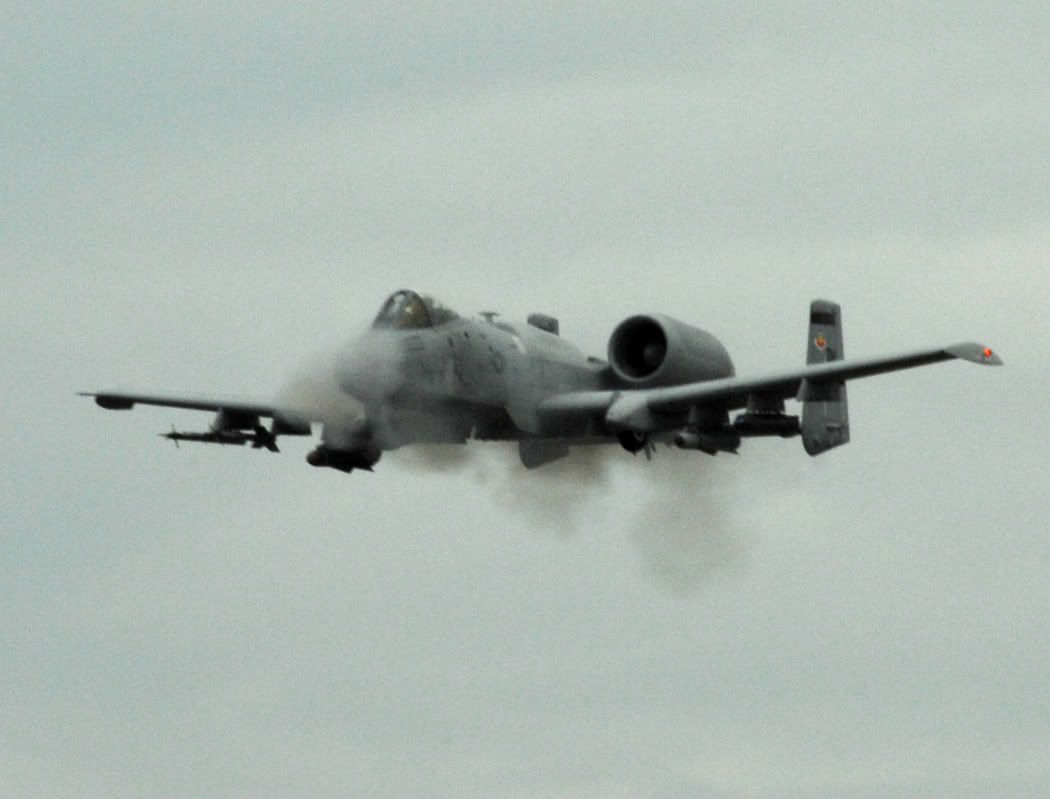
An A-10C from the 354th Fighter Squadron fires 30mm rounds from its GAU-8 cannon during moving-target strafe training at Green Flag East, a close-air support exercise in Louisiana. (U.S. Air Force photo by Staff Sgt. Jake Richmond) Hi-res
2/27/2009 - DAVIS-MONTHAN AIR FORCE BASE, Ariz. -- Members of the 354th Fighter Squadron returned today from their two-week participation in Green Flag East, a permanent-party exercise contingent at Barksdale AFB, La. The ongoing exercise is specifically designed to train flying units that perform air-to-ground combat.
The 354th FS attended GFE in preparation for their upcoming Air Expeditionary Force window.
"The training at Green Flag East relates directly to the missions CAS aircraft perform in Iraq and Afghanistan today," said Lt. Col. Michael Millen, 354th FS commander. "Green Flag is considered a must-do before an AEF spin-up, and it's been excellent training for the Bulldogs."
The purpose of the exercise is to train pilots together with Joint Terminal Attack Controllers and Army ground forces at the Joint Readiness Training Center at Fort Polk, La. And, thanks to unique agreements with three local governments and the existence of a one-of-a-kind simulated village, units can conduct that training in four separate urban environments.
Maj. Brendan O'Brien, the director of operations for Barksdale's 548th Combat Training Squadron, said pilots and ground troops use real people and vehicles in the cities of Oakdale, Leesville and Deridder, La., to mimic the process of accurately locating and tracking enemy and friendly forces - in an area with active roads and occupied buildings - all the way up to the moment when the target would be engaged with weapons.
The fourth location, aptly named "CAS Town," is located on military-owned land within restricted air space. There, contracted employees act like good guys and bad guys, and JTACs are tasked with identifying them correctly. Then, pilots have to avoid the simulated friendlies and other collateral damage, while the "enemies" are visibly firing simulated weapons at the aircraft. The village is also complete with strategically placed pyrotechnics, which ignite as soon as the imaginary munitions hit their target.
Even though no bombs are dropped and no bullets are fired, Colonel Millen said it still provides an immensely important and distinctive training arena for a difficult part of the CAS mission.
"Our focus here is almost entirely on urban CAS, and it's not easy," he said. "Cities are busy places, and trying to find and track the bad guys among thousands of non-combatants is difficult."
And it's not just the environment that presents the challenge. The GFE exercise planners, like Major O'Brien, constantly work to develop demanding training scenarios that reflect what warfighters are seeing downrange.
"Every time a unit comes in (to Green Flag), we pick the brains of the guys who recently came back from a deployment," Major O'Brien said. "Those guys have seen it up close and personal, and they help keep our training fresh and relevant."
Another part of the deployment training is getting pilots, JTACs and ground forces working comfortably in unison with new digital equipment being used in real combat zones - specifically, the new Tactical Air Control Party, Close Air Support System.
"This was the first time we've had a full unit of A-10Cs with digital capability working with JTACs and ground forces using TACP CASS," Colonel Millen said. "It's really perfect training to help our pilots get familiar with the kinds of combat situations they'll see on their deployments and help develop the tactics they'll be using."
Without TACP CASS, a pilot responding to a troops-in-contact, or TIC, would have to wait until he was in radio range of a JTAC to get much of the information necessary to conduct CAS. Using TACP CASS, JTACs can now digitally send crucial details to the cockpit before the pilot arrives at the engagement.
"A pilot can be en route to a TIC and have very good situational awareness on friendly and enemy positions and ground commanders' intent," said Capt. Andy Pitts, a former F-16 pilot who's now the operations officer in charge for GFE. "Before, pilots didn't really know the situation until they arrived."
Staff Sgt. Tyler Woodson, a JTAC assigned to the Georgia Air National Guard's 165th Air Support Operations Squadron, was also participating in GFE. He said "it's nice to give pilots a good picture of what's going on without having to say much -- and that has noticeable benefits in the fight."
"The technology really makes it easier," Sergeant Woodson said. "From the time the aircraft checks in with us to the time munitions hit the ground is a lot faster than before."
He said he and his fellow JTACs were making the most of their time to learn new and better ways to work with the air component of the CAS process, especially since they all have the same goal.
"There's nothing like the opportunity to go out and give guys on the ground the help they need," he added. "To know in your heart and mind that good guys are going home because you did your job right...that's why we do this."
Source
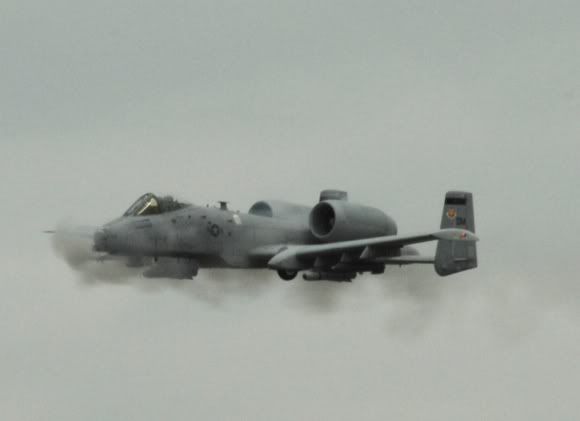
An A-10C from the 354th Fighter Squadron fires 30mm rounds from its GAU-8 cannon during moving-target strafe training at Green Flag East. (U.S. Air Force photo by Staff Sgt. Jake Richmond) Hi-res

An A-10C from the 354th Fighter Squadron approaches a target and prepares to fire 30mm rounds from its GAU-8 cannon during training at Green Flag East. (U.S. Air Force photo by Staff Sgt. Jake Richmond) Hi-res

Two Joint Terminal Attack Controllers coordinate a close-air support attack as an A-10C from the 354th Fighter Squadron, dropping flares, approaches to perform moving-target strafe training during Green Flag East, an exercise in Louisiana for flying units that perform air-to-ground combat. (U.S. Air Force photo by Staff Sgt. Jake Richmond) Hi-res

Rounds from an A-10's 30mm GAU-8 cannon impact the ground during moving-target strafe training, a part of the Air Force's Green Flag East exercise in Louisiana. Davis-Monthan's 354th Fighter Squadron participated in GFE for two weeks to enhance their close-air support tactics and capabilities. (U.S. Air Force photo by Staff Sgt. Jake Richmond) Hi-res
Subscribe to:
Posts (Atom)


 Posts


