Wednesday, April 8, 2009

Video: A-10 East Demo Team pilot explains the 'Hog' at air show


A-10 East Demo Team pilot Capt. Johnnie "Dusty" Green explains the 'Hog' at Tuscaloosa Air Show last weekend. (Video by Cory Pennington, released on Tuscaloosa News Blogs on April 6th, 2009) Source

Watch the video (Running time 03:12)


In my post Heritage Flight Conference 2009 photo report I stated:

The A-10C Thunderbolt II demo aircraft for the 2009 season are:

A-10 East Demonstration Team:
79-0213 and 79-0223, both from the 74th Fighter Squadron, 23rd Fighter Group, 23rd Wing, Moody AFB, Georgia. 79-0223 is the 23rd FG flagship. As a demo aircraft, 79-0213 is also special-marked '23 FG'.

A-10 West Demonstration Team:
78-0712 and 79-0209, both from the 357th Fighter Squadron, 355th Fighter Wing, Davis-Monthan AFB, Arizona. 78-0712 is the 355th FW flagship. As a demo aircraft, 79-0209 is also special-marked '355 FW'.

As usual, all four demo jets have chromed gun muzzles.


But surprisingly, the A-10 in this video is clearly 80-0194 (probably assigned to the 74th Fighter Squadron), and also marked '23 FG' and also with a chromed gun muzzle.

Question: How many A-10s are "styled" for the ongoing air show season?

Nellis A-10s catched


A-10 80-0234 from the 66th Weapons Squadron returns to Nellis AFB, Nevada, after a Weapons School training mission on April 6th, 2009. (Photo by Bruce Smith) Hi-res


A-10 79-0204 from the 66th Weapons Squadron heads out as part of a 4 ship for the Nellis ranges on a Weapons School trainig mission on April 1th, 2009. (Photo by Bruce Smith) Hi-res


A-10 80-0242 from the 422nd Test and Evaluation Squadron departs on runway 21L at Nellis AFB, Nevada, on the morning of January 16th, 2009. (Photo by Bruce Smith) Hi-res

Special thanks to Bruce Smith for sharing his exclusive Nellis A-10s shots and related knowledge on Warthog News as a contributor! Bruce is a well-known aviation photographer from Las Vegas, about 5 miles from Nellis. He also submitted this Nellis A-10s update:

The following are coded WA:
79-0204, 80-0185, 80-0200, 80-0229 (marked '66th WPS'), 80-0234, 81-0946, 81-0958. 81-0977 is/was assigned here but I haven't seen it in many months. 78-0701 has been here for several months now and flies with WAs, although it is unmarked.

The following are coded OT:
79-0171, 79-0199, 80-0242, 82-0658. 79-0169 is/was assigned here but I have not seen it in many months either.

It is possible 977 and 169 are getting new wings and will be back.

Tuesday, April 7, 2009

New mission, new plane, new friends


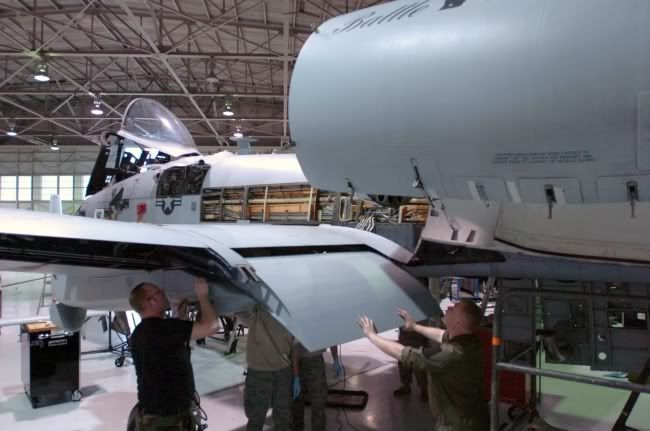
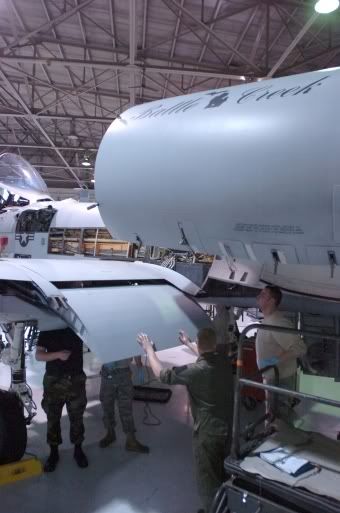
Maintenance technicians of the 175th Maintenance Group, 175th Wing, Maryland Air National Guard, and 127th Maintenance Group, 127th Wing, Michigan Air National Guard, install a wing flap on an A-10C Thunderbolt II at Warfield Air National Guard Base in Essex, Maryland, on April 3rd, 2009. Michigan Guardmembers in the maintenance field are transitioning from the F-16 Fighting Falcon to the A-10 through on-the-job training. (U.S. Army Photo by Staff Sgt. S. Patrick McCollum) Hi-res

By Staff Sgt. S. Patrick McCollum
National Guard Bureau

ESSEX, Md. (4/3/09) – The year was 1987 and it was a good time to be a fighter pilot.

The movie "Top Gun" had been released the year before and a newly pinned Air Force officer was beginning his career as a pilot in the top-of-the-line F-16 "Fighting Falcon" fighter.

"When I got into the service in '87, that was the go-to airplane," said Lt. Col. Douglas "Bubbles" Champagne, commander of the 107th Fighter Squadron of the Michigan Air National Guard.

The 107th is part of the 127th Wing at Selfridge Air National Guard Base near Detroit.

"They did just about everything," said Champagne. "And they still do."

While the F-16 can handle multiple missions, the 107th FS is also showing its ability to change with the times.

In 2005, the Base Realignment and Closure Commission (BRAC) mandated that the unit turn in its Falcons and take possession of the A-10 II Thunderbolts from the 110th Fighter Wing at Battle Creek, Mich.

This close-air-support aircraft aids troops in the field through its ability to "loiter" near battle areas and operate under a 1,000-foot ceiling, not to mention what its 30 mm Gatling gun can do to tanks, armored vehicles and other ground targets.

During this BRAC transition, Champagne and other unit members have become part of a small, close-knit community in the Air National Guard.

After pilot training at Davis-Monthan Air Force Base, Ariz., Champagne trained on the Thunderbolt with the 175th Fighter Squadron [175th Wing, 104th Fighter Squadron - edited by J.J.] here at Martin State Airport.

He said that with Air Guard units in just five states flying the aircraft – Idaho, Maryland, Arkansas, Pennsylvania and Michigan – it is almost impossible not to think of everyone as a team.

"You see the same guys all the time. You deploy with the same guys," said Champagne. "You all have a very common mindset."

That mindset is also apparent with some of the 127th Wing mechanics who also visited Martin State for the type of training they like best.

"It's all on-the-job training," said Senior Airman James Judd, a phase technician, who worked on F-16s for seven years and rebuilt his first car at age 15. "We've been to a couple different bases and learned from them – kind of shadow them – [to] see what they do."

Having worked on cars, tractors, snowmobiles and aircraft for most of their lives, these technicians were grateful for a training program that didn't require them to start from scratch.

"Honestly, that's the best way to learn," said Senior Airman Justin Smith, a Michigan phase technician, who worked aircraft recovery concerns during a tour in Balad, Iraq. "'Here's what you need to do. Here's the book on how to do it – do it."

Although it was an ancillary benefit to fixing aircraft, the training also gave them the opportunity to get to know their counterparts in other states.

On "Salsa Friday" in Maryland, the crew worked in a relaxed atmosphere with salsa music from a local radio station blasting in the background while they worked.

Knowing your fellow Guardmembers is useful, especially when you may have to borrow a few for deployment in an Air Expeditionary Force (AEF) cycle.

"Now when we go do an AEF, we're going to be grouped with [these] three other units," said Master Sgt. Adam Strine, a phase shift leader with the 175th Maintenance Squadron. "It's nice to know the guys that are coming with you are guys that have worked with you … that you’ve trained."

While some are new to the workings of the Thunderbolt, also known as the Warthog, not everyone in the unit is completely new to the aircraft.

Capt. Jeremy "Frogger" Stoner, a former member of the 110th FW, deployed to Afghanistan as an A-10 pilot and saw its benefits firsthand.

"It was designed to do what the guys in Afghanistan need right now," said Stoner. "They need a plane that can get down below the weather and into the mountain valleys, [that] can stay for a while to support them with longer fuel capabilities than some of the other fighters, and slow enough and quiet enough that they can loiter and not give themselves away."

While there, Stoner's unit helped rebuild the A-10 program at Bagram Air Base.

"A-10s hadn't been there for a while," Stoner said. "We got an empty building, where we had to build our own operations desk. We had to build our own life support area for all of our gear."

After a lot of hard work by Citizen-Airmen, some of whom had experience in carpentry and electricity, the flight operations shop was ready to go.

Stoner flew close-air missions in support of many operations, some for which he was thanked personally.

"Special-ops teams or smaller groups that needed our assistance actually went out of their way to drive from wherever they were on their day off and sit down with us and say, 'You guys really helped us out,' or 'You guys saved our lives,'" Stoner said.

"Everything that a Guardsman sacrifices is more than compensated for when that one guy says "thanks for being there for me today,'" Champagne added.

Source

On April 6th, this news article was distributed by DVIDS, titled New Mission, New Plane, New Friends – Michigan Air Guard A-10 Unit Learning From Maryland, together with two additional pictures:


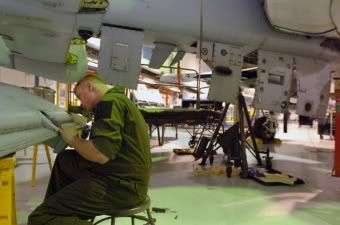
Senior Airman James Judd, a phase technician with the 127th Maintenance Group, 127th Wing, Michigan Air National Guard, fixes a wing flap for an A-10C Thunderbolt II at Warfield Air National Guard Base in Essex, Maryland, on April 3rd, 2009. (U.S. Army Photo by Staff Sgt. S. Patrick McCollum) Hi-res


Maintenance technicians of the 175th Maintenance Group, 175th Wing, Maryland Air National Guard, and 127th Maintenance Group, 127th Wing, Michigan Air National Guard, install a wing flap on an A-10C Thunderbolt II at Warfield Air National Guard Base in Essex, Maryland, on April 3rd, 2009. (U.S. Army Photo by Staff Sgt. S. Patrick McCollum) Hi-res

On April 7th, this news article was also released as New mission, new plane, new friends – Michigan Air Guard A-10 unit learning from Maryland on 127th Fighter Wing's public website.

Please note: By a Public Affairs error, in the original photo captions the 127th Maintenance Group is misinterpreted as 107th Maintenance Group, probably related to the 127th Wing's 107th Fighter Squadron's designation.

Please also note: At least on their left engine nacelle, the photographed A-10C still wears the legendary "Battle Creek" inscription from their former owner - the 172nd Fighter Squadron, 110th Fighter Wing, Michigan ANG, Battle Creek Air National Guard Base. Due to BRAC 2005, the 110th is on their way to transitioning to the C-21.

Monday, April 6, 2009

A-10s bomb, rattle ground at Avon Park bombing range

by Tech. Sgt. Elisabeth A. Matulewicz
111th Fighter Wing

4/5/2009 - WILLOW GROVE AIR RESERVE STATION, Pa. -- A caravan of 111th FW personnel left the Tampa area on Feb. 23 headed for Avon Park Air Force Range, Fla. to experience an A-10 training mission. They drove interstate to local highway, past palm trees and cattle, covering over 100 miles. Once they arrived, they scaled several metal staircases up to an observation tower. The A-10s roared in one by one dropping practice bombs called BDU-33s onto ground targets.

The airmen were part of approximately 160 guardsmen from the 111th Fighter Wing, Pa., Air National Guard, who deployed for training to Mac Dill Air Force Base, Fla. from Feb. 17-27.

Several screaming passes later, the A-10s came in lower and fired their 30-mm GAU-8/A cannons. Each aircraft burst plumes of smoke before emitting a roar reminiscent of a loud zipper pull. Sunny, blue skies set the backdrop for a perfect live firing for pilots and audience alike.

Watching the A-10s descend towards each target, take aim and rock the sky was breathtaking--especially for a brother-sister team with the 111th Maintenance Sq. Munitions section.

"Seeing what we make being used here is interesting," said Senior Airman Aaron M. Thieroff. On a typical day, Airman Thieroff and his team pack fuses and safe aiming devices into shells before loading them 40 to a trailer. The munitions are delivered to the armament section and loaded onto the aircraft. "I think it's awesome," Senior Airman Ashley B. Thieroff added.

For several first-timers (including myself), seeing the A-10s in action broke a few misconceptions.

"I always wanted to see how they did it," said Tech. Sgt. Byron S. Lockett, 111th Logistics Readiness Sq. "I thought they'd be over the target when they let the bombs go. But when they come in, they're several hundred yards away."

An added bonus was having Col. Paul W. Comtois, 111th FW Commander, there to talk us through what we saw. We were very lucky to have him explain everything from a pilot's point of view and educate everyone on the A-10.

The following pilots made up the 4-member team that flew that day: Lt. Col. Niclas Szoke, Lt. Col. Scott Hreso, Col. Jim Blaydon, and Lt. Col. Gary Beard.

Avon Park Air Force Range is located in Polk and Highland counties, Fla. and covers over 106,000 acres, of which 82,000 is open to the public for recreation. Surprisingly, the range is home to a number of endangered species of birds and reptiles. According to Range Control Officer Chris Spears, Avon Park is the largest bombing range east of the Mississippi; Nellis being the largest in the country.


An A-10 from the 103rd Fighter Squadron drop BDU-33s and other munitions on targets on February 23rd, 2009, at Avon Park Air Force Range, Florida. (Photo by Master Sgt. Patrick Cashin) Hi-res

Source

Please note: I can't understand that 111th Fighter Wing Public Affairs released this info on their public website so late. But I will not withhold my readers from this old info.

PECO's "Operation Military Pride" campaign donates items to 111th FW


Representatives from PECO delivered donated goods collected during an "Operation Military Pride" campaign in November 2008 to Willow Grove Air Reserve Station on December 11th, 2008. Based in Philadelphia, PECO is an electric and natural gas utility subsidiary of Exelon Corporation. Hi-res

by Technical Sgt. Elisabeth A. Matulewicz
111th Fighter Wing

4/5/2009 - WILLOW GROVE AIR RESERVE STATION, Pa. -- Representatives from PECO delivered donated goods collected during an "Operation Military Pride" campaign in November to Willow Grove Air Reserve Station Dec. 11. Items for deploying members included: food, snacks, powdered beverages, toiletries, phone cards and leisure items such as puzzles, game books and stationary. After the items were unloaded, they had the opportunity to learn about the A-10 during a base tour.

Operation Military Pride was sponsored by PECO's C&M Bucksmont Region. Based in Philadelphia, PECO is an electric and natural gas utility subsidiary of Exelon Corporation.

Source

Please note: I can't understand that 111th Fighter Wing Public Affairs released this info on their public website so late. But I will not withhold my readers from this old info.

Kirtland provides Airmen, location for 'Terminator Salvation'


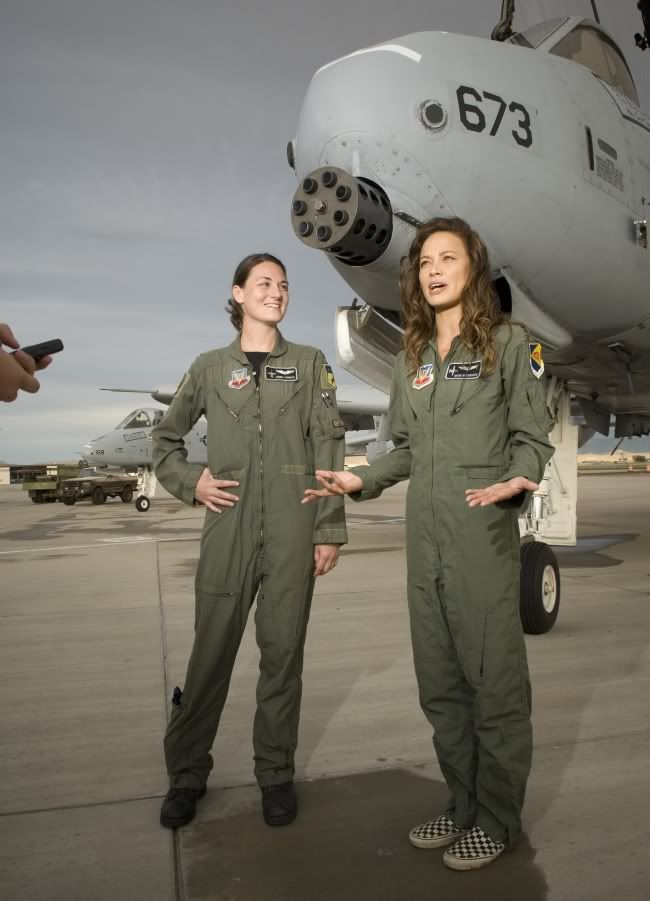
Capt. Jennie Schoeck (left) and actress Moon Bloodgood meet in front of A-10 78-0673 for an interview with the news media during the production of "Terminator Salvation" at Kirtland AFB, New Mexico. Captain Schoeck is assigned to the 358th Fighter Squadron at Davis-Monthan AFB, Arizona, and was the A-10 advisor for the production. Moon Bloodgood portrays a lead resistance pilot in the movie. (U.S. Air Force photo by Lance Cheung) Hi-res

by Staff Sgt. Matthew Bates
Defense Media Activity-San Antonio

4/6/2009 - KIRTLAND AIR FORCE BASE, N.M. (AFNS) -- Airmen here recently supported a different kind of war, one against futuristic machines out for world domination.

The Airmen performed as extras on the set of "Terminator Salvation," which filmed several scenes in a hangar on the base's flightline. The movie is the latest in the popular man-versus-machine franchise and stars Christian Bale and is directed by McG.

"It's really cool," said Airman 1st Class Andrew Saunders, a member of the 377th Logistics Readiness Squadron, who plays a "resistance" soldier. "The set, the vehicles, the stars ... it's a lot of fun."

And, as Airman Saunders found out, making movies is a lot of work, too.

"It's amazing," he said. "It takes so much to prepare for a 30-second clip ... hours and hours of work for just one scene."

Still, the Airmen didn't only sign on to support the "resistance." Some were brought on as advisors to the stars, teaching them how to act and think like military people.

One of these Airmen was Capt. Jenny Schroeck, an A-10 Thunderbolt II pilot instructor with the 358th Fighter Squadron at Davis-Monthan AFB, Ariz., Captain Schroek worked alongside the movie's lead actress, Moon Bloodgood, who plays an A-10 pilot in the movie.

"I just showed her how to act and talk when inside the cockpit," Captain Schroeck said. "And she shadowed me around for a while and just observed what I did and how I did it."

It was "training" Ms. Bloodgood was happy to get.

"Of course it helps," she said. "As an actor, anytime you can observe someone performing the roles you're about to play, it's a tremendous benefit. It makes it look like you know what you're doing and adds a touch of credibility and realism to the movie."

But it wasn't only the stars who benefited from the base's support. Those involved in the movie's production also found working with the Air Force a positive experience.

"The eye-opening thing for me was just how mutually beneficial the relationship between the Air Force and the production staff was," said James Middleton, an associate producer with the movie. "The base has been very supportive, flexible and done what they could to meet our needs."

"Terminator Salvation" is the latest in a number of recent films to highlight Air Force people and equipment. Others include "Transformers," "Eagle Eye" and "Iron Man."


Capt. Jennie Schoeck shows the cockpit of an A-10 Thunderbolt II to actress Moon Bloodgood. (U.S. Air Force photo by Lance Cheung) Hi-res

Source (Video included)

Friday, April 3, 2009

The future of the 111th Fighter Wing

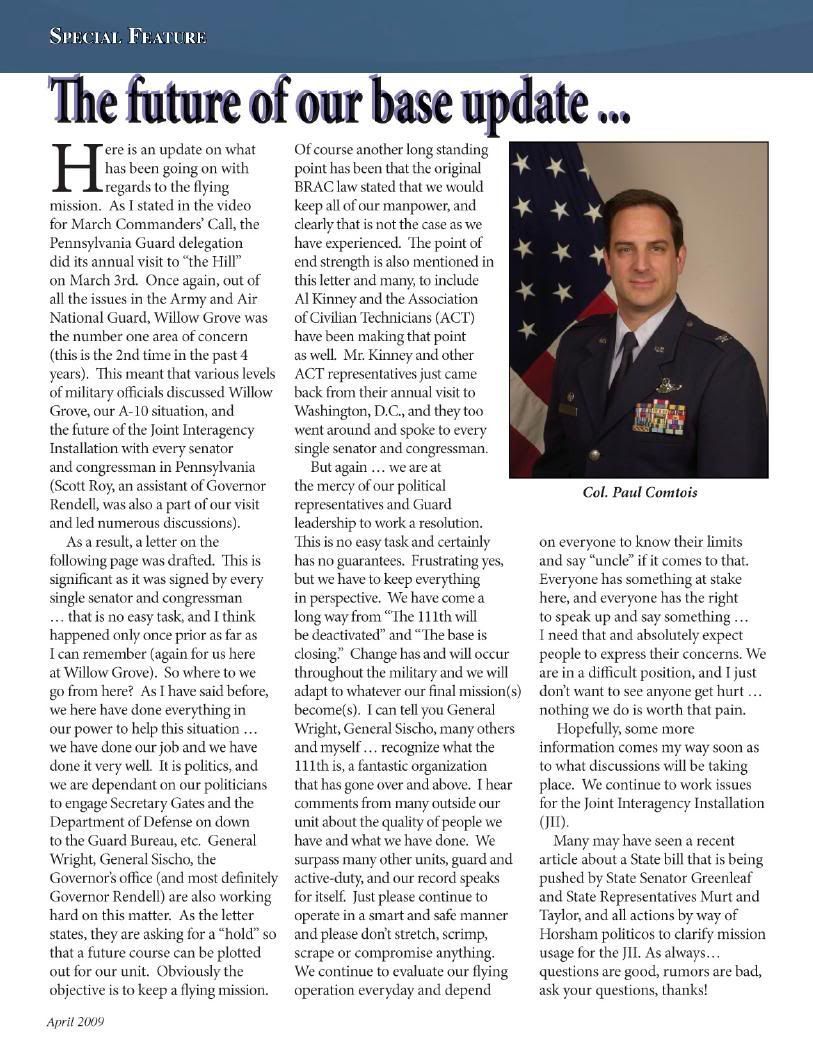
The following first-hand info is extracted from the 111th Fighter Wing's base newspaper "Sandy Hog Gazette", April 2009 public online PDF issue.

Click to enlarge

Commander's message by Col. Paul W. Comtois, 111th Fighter Wing Commander:

The future of our base update ...

Here is an update on what has been going on with regards to the flying mission. As I stated in the video for March Commander's Call, the Pennsylvania Guard delegation did its annual visit to "the Hill" on March 3rd. Once again, out of all the issues in the Army and Air National Guard, Willow Grove was the number one area of concern (this is the 2nd time in the past 4 years). This meant that various levels of military officials discussed Willow Grove, our A-10 situation, and the future of the Joint Interagency Installation with every senator and congressman in Pennsylvania (Scott Roy, an assistant of Governor Rendell, was also part of our visit and led numerous discussions).

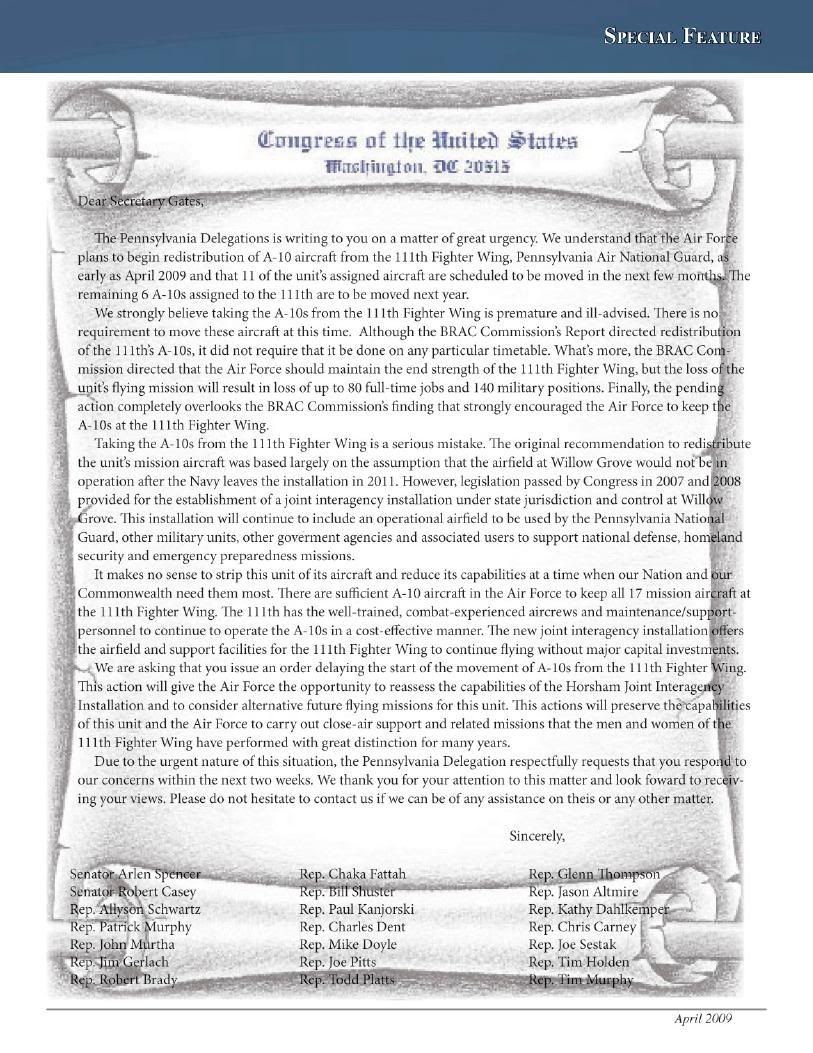
As a result, a letter on the following page was drafted. This is significant as it was signed by every single senator and congressman. ... that is no easy task, and I think happened only once prior as far as I can remember (again for us here at Willow Grove). So where to we go from here? As I have said before, we here have done everything in our power to help this situation ... we have done our job and we have done it very well. It is politics, and we are dependant on our politicians to engage Secretary Gates and the Department of Defense on down to the Guard Bureau, etc. General Wright, General Sischo, the Governor's office (and most definitely Governor Rendell) are also working hard on this matter. As the letter states, they are asking for a "hold" so that a future course can be plotted out for our unit. Obviously the objective is to keep a flying mission.

Of course another long standing point has been that the original BRAC law stated that we would keep all of our manpower, and clearly that is not the case as we have experienced. The point of end strength is also mentioned in this letter and many, to include Al Kinney and the Association of Civilian Technicians (ACT) have been making that point as well. Mr. Kinney and other ACT representatives just came back from their annual visit to Washington, D.C., and they too went around and spoke to every single senator and congressman.

But again ... we are at the mercy of our political representatives and Guard leadership to work a resolution. This is no easy task and certainly has no guarantees. Frustrating yes, but we have to keep everything in perspective. We have come a long way from "The 111th will be deactivated" and "The base is closing." Change has and will occur throughout the military and we will adapt to whatever our final mission(s) become(s). I can tell you General Wright, General Sischo, many others and myself ... recognize what the 111th is, a fantastic organization that has gone over and above. I hear comments from many outside our unit about the quality of people we have and what we have done. We surpass many other units, guard and active-duty, and our record speaks for itself. Just please continue to operate in a smart and safe manner and please don't stretch, scrimp, scrape or compromise anything. We continue to evaluate our flying operation everyday and depend on everyone to know their limits and say "uncle" if it comes to that. Everyone has something at stake here, and everyone has the right to speak up and say something ... I need that and absolutely expect people to express their concerns. We are in a difficult position, and I just don't want to see anyone get hurt ... nothing we do is worth that pain.

Hopefully, some more information comes my way soon as to what discussions will be taking place. We continue to work issues for the Joint Interagency Installation (JII).

Many may have seen a recent article about a State bill that is being pushed by State Senator Greenleaf and State Represantives Murt and Taylor, and all actions by way of Horsham politicos to clarify mission usage for the JII. As always... questions are good, rumors are bad, ask your questions, thanks!

Click to enlarge

The letter

Congress of the United States
Washington, DC 20515

Dear Secretary Gates,

The Pennsylvania Delegations is writing to you on a matter of great urgency. We understand that the Air Force plans to begin redistribution of A-10 aircraft from the 111th Fighter Wing, Pennsylvania Air National Guard, as early as April 2009 and that 11 of the unit's assigned aircraft are scheduled to be moved in the next few months. The remaining 6 A-10s assigned to the 111th are to be moved next year.

We strongly believe taking the A-10s from the 111th Fighter Wing is premature and ill-advised. There is no requirement to move these aircraft at this time. Although the BRAC Commission's Report directed redistribution of the 111th's A-10s, it did not require that it be done on any particular timetable. What's more, the BRAC Commission directed that the Air Force should maintain the end strenght of the 111th Fighter Wing, but the loss of the unit's flying mission will result in loss of up to 80 full-time jobs and 140 military positions. Finally, the pending action completely overlooks the BRAC Commission's finding that strongly encouraged the Air Force to keep the A-10s at the 111th Fighter Wing.

Taking the A-10s from the 111th Fighter Wing is a serious mistake. The original recommendation to redistribute the unit's mission aircraft was based largely on the assumption that the airfield at Willow Grove would not be in operation after the Navy leaves the installation in 2011. However, legislation passed by Congress in 2007 and 2008 provided for the establishment of a joint interagency installation under state jurisdiction and control at Willow Grove. This installation will continue to include an operational airfield to be used by the Pennsylvania National Guard, other military units, other goverment agencies and associated users to support national defense, homeland security and emergency preparedness missions.

It makes no sense to strip this unit of its aircraft and reduce its capabilities at a time when our Nation and our Commonwealth need them most. There are sufficient A-10 aircraft in the Air Force to keep all 17 mission aircraft at the 111th Fighter Wing. The 111th has the well-trained, combat-experienced aircrews and maintenance/support-personnel to continue to operate the A-10s in a cost-effective manner. The new joint interagency installation offers the airfield and support facilities for the 111th Fighter Wing to continue flying without major capital investments.

We are asking that you issue an order delaying the start of the movement of A-10s from the 111th Fighter Wing. This action will give the Air Force the opportunity to reassess the capabilities of the Horsham Joint Interagency Installation and to consider alternative future flying missions for this unit. This actions will preserve the capabilities of this unit and the Air Force to carry out close-air support and related missions that the men and women of the 111th Fighter Wing have performed with great distinction for many years.

Due to the urgent nature of this situation, the Pennsylvania Delegation respectfully requests that you respond to our concerns within the next two weeks. We thank you for your attention to this matter and look foward to receiving your views. Please do not hesitate to contact us if we can be of any assistance on theis or any other matter.

Sincerely,

Senator Arlen Spencer
Senator Robert Casey
Rep. Allyson Schwartz
Rep. Patrick Murphy
Rep. John Murtha
Rep. Jim Gerlach
Rep. Robert Brady
Rep. Chaka Fattah
Rep. Bill Shuster
Rep. Paul Kanjorski
Rep. Charles Dent
Rep. Mike Doyle
Rep. Joe Pitts
Rep. Todd Platts
Rep. Glenn Thompson
Rep. Jason Altmire
Rep. Kathy Dahlkemper
Rep. Chris Carney
Rep. Joe Sestak
Rep. Tim Holden
Rep. Tim Murphy

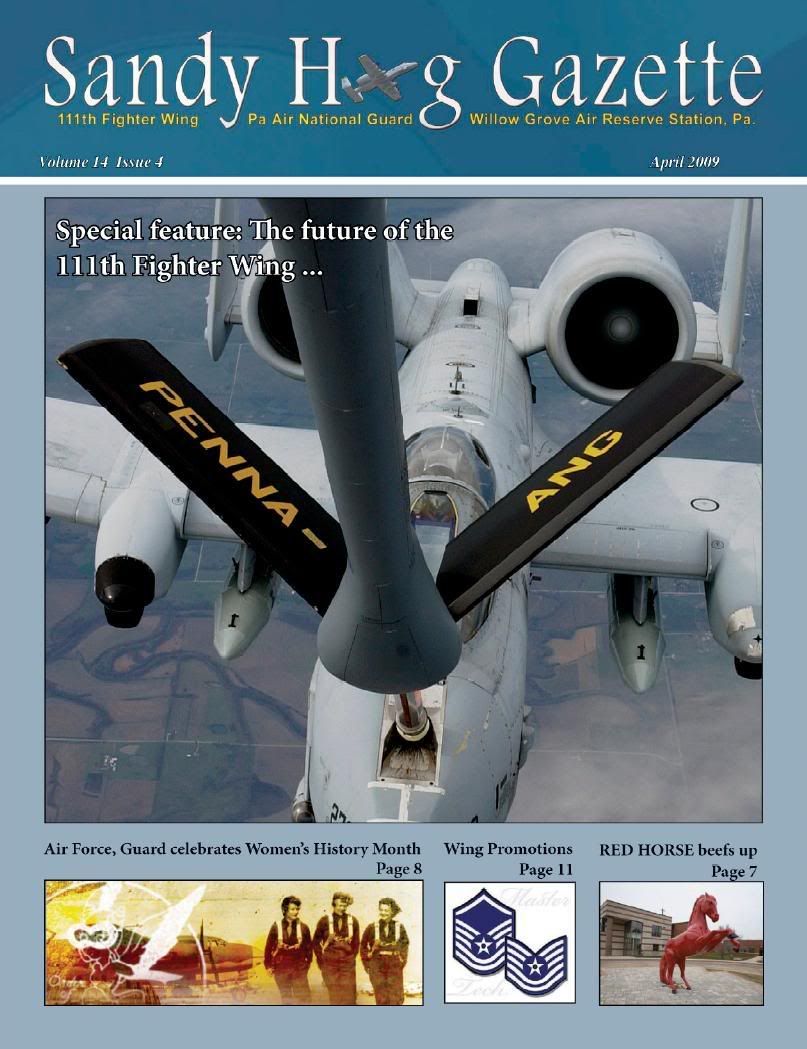
Click to enlarge

Cover photo: A KC-135 Stratotanker performs an in-air refueling mission on an A-10 Thunderbolt II from the Willow Grove Joint Reserve Base. (Photo by Master Sgt. Patrick Cashin)

Source

A-10s over Spangdahlem AB - An actual photo essay

On March 31st and April 1st, 2009, a group of German aircraft spotters traveled to Spangdahlem AB, Germany, to catch some aircraft movements (including A-10s from the 81st Fighter Squadron, F-16Cs and other aircraft). Spotted on March 31st were A-10s 81-0966, 81-0978, 81-0983 and 81-0988. Spotted on April 1st were at least A-10s 81-0952, 81-0980 and 82-0646. From three photographers I got the permission to post their A-10 shots on my blog.


A-10 81-0966 on March 31st, 2009. A civilian airliner is crossing the blue sky just behind. (Photo by Philipp Jakob Schumacher)


A-10 81-0966 on March 31st, 2009. (Photo by Philipp Jakob Schumacher)


A-10 81-0966 on March 31st, 2009. (Photo by Philipp Jakob Schumacher)


A-10 81-0966 on March 31st, 2009. (Photo by Philipp Jakob Schumacher)


A-10 81-0962 on April 1st, 2009. (Photo by Philipp Jakob Schumacher) Full size


A-10 81-0966 on March 31st, 2009. (Photo by Oliver Jonischkeit) Full size


A-10 81-0966 on March 31st, 2009. (Photo by Oliver Jonischkeit) Full size


A-10 on March 31st, 2009. (Photo by Oliver Jonischkeit) Full size


A-10, probably 81-0962, on April 1st, 2009. (Photo by Oliver Jonischkeit) Full size


A-10 on April 1st, 2009. (Photo by Oliver Jonischkeit) Full size


A-10 on April 1st, 2009. (Photo by Oliver Jonischkeit) Full size


A-10 81-0952 on April 1st, 2009. (Photo by Matthias Bienentreu) Full size


A-10 81-0980 on April 1st, 2009. (Photo by Matthias Bienentreu) Full size


A-10 82-0646 on April 1st, 2009. (Photo by Matthias Bienentreu) Full size

For some more related shots please check:
Fighter Town ETAD on sunny days 31.3. - 1.4.09

Wednesday, April 1, 2009

Osan Airmen train to Fight and Win Tonight!


Weapons loaders unload munitions from A-10 79-0211 from the 25th Fighter Squadron after landing at Osan AB, Republic of Korea, during Operational Readiness Exercise Beverly Bulldog 09-02 on March 31st, 2009. The pre-scheduled exercise is designed to help the 51st Fighter Wing prepare for their Operational Readiness Inspection in April. (U.S. Air Force photo by Staff Sgt. Brian Ferguson) Hi-res


Airmen from the 25th Aircraft Maintenance Unit pull the wheel chocks on an A-10 Thunderbolt II at Osan AB, Republic of Korea, during Operations Readiness Exercise Beverly Bulldog 09-02 on March 31st, 2009. (U.S. Air Force photo by Staff Sgt. Brian Ferguson) Hi-res

Source

A-10 Afghanistan Combat Summary for March 2009

by Joachim Jacob

From the "Airpower Summaries", released on USAF's public main website, for March 2009 I extracted and edited all available info related to A-10 Thunderbolt II combat missions in Afghanistan (Operation Enduring Freedom). The mostly daily airpower summaries for OEF and OIF are provided by Combined Air and Space Operations Center (CAOC) officials at Al Udeid AB, Qatar. According to the sources, all of the listed missions were confirmed successful by on-scene joint terminal attack controllers (JTACs).


Mar. 1: A-10 Thunderbolt IIs responded to a ground engagement between anti-Afghan forces and coalition troops, employing 500-pound general purpose bombs and cannon strafes to attack enemy positions. The jets also used marking rounds to clearly identify the positions and confirm target identity with coalition ground observers before releasing their weapons. Near Orgun, A-10s struck an enemy firing site with 500-pound general purpose bombs, halting an enemy mortar attack against a coalition forward base. An Air Force MQ-9 Reaper unmanned aircraft targeted additional enemy personnel in the area using a Hellfire missile strike. Enemy indirect fire teams had threatened not just the base but also the surrounding settlement with their scattered mortar fire until they were stopped by the strikes. An A-10 and an F-15E conducted shows of force to deter enemy action during rebuilding efforts in the Ghazni and Gardez regions respectively. Coalition convoys successfully delivered humanitarian aid, medical care and reconstruction materials to these areas.

Mar. 2: A-10 Thunderbolt IIs dropped general purpose 500-pound bombs, striking a large group of anti-Afghan fighters amassed for an attack on a coalition forward base near Asmar. The strike repelled the attack, inflicting heavy casualties on the enemy force. Near Sheykhabad, an A-10 flew a show of force to stop an enemy sniper attack against a coalition convoy. The attack ceased after the maneuver and the convoy preceded on to complete its mission. An A-10 flew shows of force to establish presence near Nangalam as coalition representatives met with tribal leaders and soldiers provided medical treatment for local residents. The humanitarian operation was completed without interference from enemy forces.

Mar. 3: No A-10 info

Mar. 4: Near Asadabad, A-10 Thunderbolt IIs hit a group of enemy fighting positions with 30mm cannon strafing passes, stopping an anti-Afghan ground attack against a coalition outpost. The outpost requested the air strike after enemy personnel fired on them with assault weapons and rocket-propelled grenade fire. A-10s rolled in near a coalition forward base in Jalalabad, using general purpose 500 pound bombs and 30mm cannon strafes to hit enemy positions during a ground attack. The attack was repelled with enemy forces taking heavy losses in the process. In the vicinity of Mata Khan, an A-10 flew a show of force, expending flares, to aid a coalition convoy in breaking away from an enemy ambush. The convoy was able to withdraw and returned to base with the aircraft flying overwatch.

Mar. 5: An A-10 flew a show of force near a dismounted coalition patrol performing a mission near Asadabad to discourage enemy attack. The ground force commander called for the show of force since the unit had taken enemy small arms fire in that area earlier in the day. Over a highway near Sheykhabad, an A-10 flew a show of force to disperse people engaged in suspicious activity in the path of an approaching coalition convoy. The group dispersed following the maneuver. A-10s flew shows of force near a coalition forward base in Ghazni to establish an aerial security presence to prevent a potential enemy attack. Coalition security and reconstruction operations from the base continued without interference.

Mar. 6: In the vicinity of Asadabad, an A-10 Thunderbolt II flew a show of force to suppress enemy fire as a Coalition and Afghan National Army ground force assaulted an enemy compound. The jet remained on scene to provide aerial reconnaissance for the ground commander. In Bagram, an A-10 flew a show of force when enemy forces began firing toward security personnel with automatic weapons. Anti-Afghan forces broke off their attack and withdrew when the aircraft arrived. An A-10 performed several shows of force supporting coalition positions during its patrol in the Garmser region. The positions requested shows of force to deter anti-Afghan forces attempting to conduct IED, mortar and direct attacks against friendly units.

Mar. 7: A-10 Thunderbolt IIs targeted enemy snipers during a battle between anti-Afghan forces and coalition soldiers in a valley outside Bagram. After marking the snipers' positions with smoke, the A-10s rolled in, using 30mm Avenger cannons to hit each enemy fighting position. After eliminating the sniper threat, the A-10s reengaged and strafed an enemy command position. Following the engagement, the aircraft flew a show of force over a base in order to deter enemy small-arms fire from outside the base perimeter. Near Asadabad, A-10s aided coalition ground forces during a nighttime firefight by providing illumination flares and marking enemy positions with smoke. Due to the close proximity of positions in the engagement, the A-10s withheld weapons strikes but provided aerial overwatch and spotted targets until the fight ended.

Mar. 8: An A-10 Thunderbolt II executed a show of force and expended a number of flares over anti-Afghan forces concealed in a residential block, helping a friendly supply convoy withdraw from the enemy's attack. Enemy fire ceased when the aircraft arrived.

Mar. 9: Not released

Mar. 10: In the vicinity of Malek Din, an A-10 Thunderbolt II preemptively flew a show of force in the route of a coalition convoy, expending flares. The maneuver was intended to discourage enemy action while the convoy passed a point where enemy forces historically set up ambushes.

Mar. 11: No A-10 info

Mar. 12: No A-10 info

Mar. 13: A-10 Thunderbolt IIs and F-15E Strike Eagles used a mix of guided and general-purpose munitions to strike enemy indirect fire positions that were taking shots at a coalition forward base near Worzhanah Kalay. Enemy forces had been periodically firing at the base with rockets and mortars. An A-10 flew several shows of force and expended flares to stop enemy attacks while providing overwatch to coalition convoys transiting roads through Shurakian and Sangin. The aircraft quickly executed the maneuvers after convoy vehicles started taking automatic weapons and RPG fire.

Mar. 14: A-10 Thunderbolt IIs used 30 mm Avenger cannon strafes and guided bomb unit-38s to target a concentrated force of anti-Afghan fighters after they initiated an attack on a coalition patrol near Musa Qala. The A-10s then stayed on station providing strafes and bomb drops as the enemy attempted to press their offensive. One A-10's precision GBU-38 strike hit enemy forces just a few hundred meters from the coalition position. Multiple enemy rocket-propelled grenade, rifle and machine gun teams were killed in the engagement. Navy F/A-18F Super Hornets arrived at the end of the fight to provide air cover as a coalition medical helicopter arrived to retrieve casualties. Another battle took place near a coalition forward base in Bagram, with several flights of Air Force F-15E Strike Eagles and B-1B Lancers arriving to assist ground forces. During the fight, the aircraft employed shows of force, numerous strafing attacks, and a number of both guided and general-purpose munitions to hit anti-Afghan personnel massed in the open and in fighting positions along the mountainsides. A-10s also marked ground targets with smoke in order to coordinate strikes and help orient friendly air and ground forces. The enemy suffered severe losses during their unsuccessful attack. Near Nangalam, a group of enemy gunmen readying for an attack on a coalition unit was detected by an Army unmanned aerial vehicle. The gunmen were holding position, apparently waiting for nearby F-15Es and A-10 fighters flying overwatch to leave. When the aircraft pulled back to a hold position out of visual range, the gunmen began firing and attempted an assault. The aircraft returned, dropping GBU-38s on the enemy positions, and quickly ended the fight.

Mar. 15: A-10 Thunderbolt IIs used GBU-38s and 30mm cannon fire to destroy enemy fighting positions in caves near Bagram. The strikes took place after enemy forces opened fire on a coalition forward base with assault weapons and rocket-propelled grenade launchers.

Mar. 16: No A-10 info

Mar. 17: No A-10 info

Mar. 18: An A-10 Thunderbolt II dropped guided bomb unit-38s on an anti-Afghan mortar team in the vicinity of Orgun. The strike occurred in response to enemy mortar attack against coalition ground forces. The A-10 also preformed a show of force to deter enemy fire on a coalition convoy. An A-10 performed a show of force in response to enemy fire against a forward base. The maneuver ended the attack and caused enemy personnel to retreat.

Mar. 19: A-10 Thunderbolt IIs and F-15E Strike Eagles targeted anti-Afghan forces in the Asadabad region with a mix of guided-bomb units and general- purpose bombs. The strikes destroyed multiple fortified enemy-fighting positions and hit rocket-propelled grenade and machine-gun teams. The engagement was part of a lengthy battle between coalition and anti-Afghan forces continuing throughout the day.

Mar. 20: Coalition aircraft, Strike Eagles, and an A-10 Thunderbolt II performed shows of force in the Ghazni, Bagram, Shurakian and Tarin Kowt areas to deter the threat of enemy aggression on coalition ground forces and convoys.

Mar. 21: F-15E Strike Eagles and A-10 Thunderbolt IIs intervened near Nangalam after anti-Afghan forces launched an attack against a coalition forward base. The jets used strafes and guided bomb unit-31s and -38s to knock out enemy indirect fire and automatic-weapons positions on mountain ridges overlooking the base. The strikes, combined with fire from coalition ground units and from troops at the forward base, put a halt to the enemy attack. In the vicinity of Jalalabad, an A-10 flew a show of force near a coalition border checkpoint after enemy forces fired mortars towards the outpost. The maneuver prevented additional enemy activity or fire against the base.

Mar. 22: In the Nangalam area, A-10 Thunderbolt IIs hit several enemy rocket-propelled grenade positions during a firefight between coalition forces and anti-Afghan gunmen. The jets hit specific buildings where the enemy fighting positions were located, using smaller GBU-38 precision weapons to prevent excess damage to surrounding structures. Near Monari, A-10s performed shows of force over a coalition forward base to deter suspected enemy activity in the area and preserve peace. The additional security provided by the aircraft helped foster a safer environment for both coalition personnel and local residents.

Mar. 23: No A-10 info

Mar. 24: In the vicinity of Worzhanah Kalay, A-10 Thunderbolt IIs used smoke to mark enemy positions before teaming up to take them out with a GBU-38 and general purpose 500-pound bombs. The aircraft worked in teams to positively identify enemy fighters before employing munitions, ensuring weapons landed precisely on target.

Mar. 25: A Navy F/A-18C Hornet and an A-10 Thunderbolt II executed shows of force near Garmser and Tigari respectively as deterrent to enemy attack on friendly convoys. The aircraft provided a strong additional level of security to prevent interference with delivery of humanitarian and reconstruction supplies to Afghan residents.

Mar. 26: An A-10 Thunderbolt II and F-15E flew additional shows of force over Garmser and Bagram in order to deter enemy activity in those areas.

Mar. 27: A-10 Thunderbolt IIs and F-15Es flew shows of force and provided aerial overwatch in multiple areas to deter enemy aggression against coalition ground forces and convoys.

Mar. 28: In the Gardez area, an A-10 Thunderbolt II flew a show of force, expending a number of flares, to deter an enemy force attack while providing overwatch for a coalition medical evacuation by helicopter. Enemy forces had detonated an improvised explosive device against an Afghan National Army unit.

Mar. 29: An A-10 Thunderbolt II and a Navy Super Hornet provided shows of force to coalition units as deterrent to enemy activity as those units travelled through the Bagram and Tarin Kowt areas. A coalition aircraft also conducted a show of force in the Garmser area after ground forces spotted enemy personnel moving nearby. The effect of each show of force was that anti-Afghan forces were unable to act while reconstruction and security operations were carried out.

Mar. 30: A-10 Thunderbolt IIs and an MQ-1 Predator engaged anti-Afghan forces near Nurestan using rockets and strafing fire from the A-10s, and a Hellfire missile from the unmanned aircraft system. The strike took place during a firefight on the ground in which anti-Afghan gunmen hit a coalition patrol with assault weapons, rocket-propelled grenades and mortars. The strikes allowed the friendly unit to withdraw and inflicted casualties on the anti-Afghan attackers.

Mar. 31: In Afghanistan, a large, two-day battle between coalition forces and anti-Afghan forces concluded after extensive airpower and ground force engagement, resulting in heavy losses to enemy personnel. Dozens of aircraft from the Navy and Air Force, Royal Air Force and other coalition partners employed guided bomb units, cannon strafes and rocket fire against enemy fighting positions, buildings and personnel concentrations while providing continuous aircover to friendly ground units. Initial reports estimated more than 30 enemy personnel were killed in the fight, which began as an improvised explosive attack followed up with mortar and automatic weapons fire.

In Ghazni and Bagram, A-10s performed shows of force and expended flares to stop indirect fire attacks against coalition forward bases. Enemy forces concealed in populated civilian areas had fired mortars from civilian buildings, prompting the aircraft to use shows of force instead of bombs. The maneuvers successfully ended the enemy attacks.

See also:
A-10 Afghanistan Combat Summary for February 2009
A-10 Afghanistan Combat Summary for January 2009
A-10 Afghanistan Combat Summary for December 2008
A-10 Afghanistan Combat Summary for November 2008
A-10 Afghanistan Combat Summary for October 2008